
19th Hole
This position paper is one of Arnold Palmer’s most important contributions to the future of golf

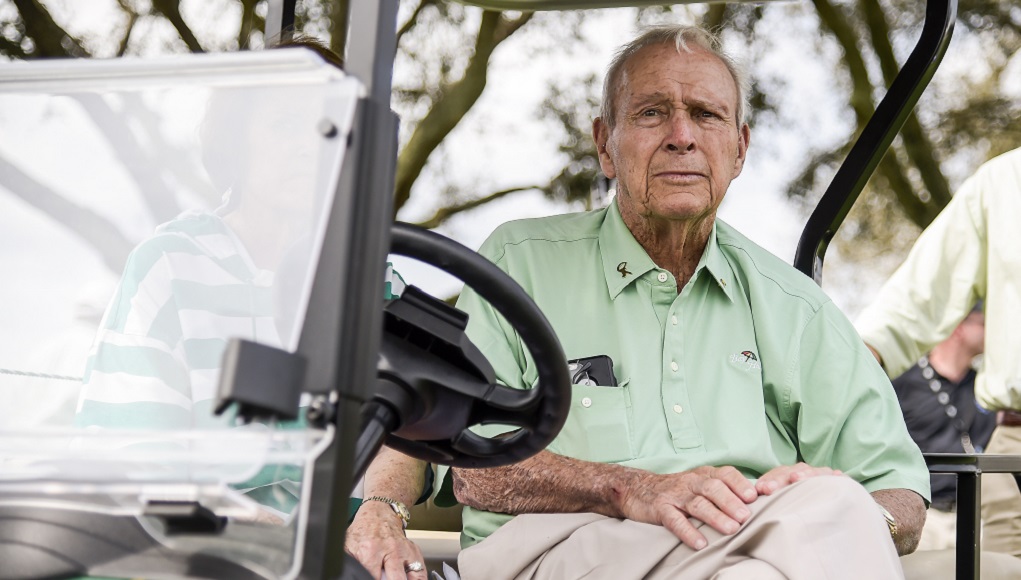
There are no shortage of excellent remembrances of Arnold Palmer on this the first anniversary of his passing. Viewing Palmer’s life and legacy through the lens of equipment, there’s enough to fill a multi-volume work.
However, an episode in 2000 and 2001, Palmer’s endorsement of the non-conforming Callaway ERC II for recreational play (and the ensuing furor), is too often swept under the rug. The King’s acknowledgment of realities the USGA and others resist remains as important today as it was 17 years ago.
In discussing whether the ERC II, with its taboo COR numbers, should be played by non-competitive golfers, Palmer pointed out the elephant in the USGA Handicap room
“For many, many years’ golfers have been establishing handicaps based upon scores achieved in recreational rounds of golf where the Rules of Golf have not been strictly followed.”
He also looks declining participation in the face. And although Palmer stopped short of calling for bifurcation, this blistering passage from a position paper he wrote for the Golf Channel remains spot on and is worth quoting at length.
“It has been said that I have played more rounds of golf with mid to high handicap golfers than any golf professional in history. I suspect this is true. Over the years I have played in thousands of pro-ams, competed in the Bay Hill Shoot Out with amateurs of all skill levels two or three times a week for many years, and have played in countless outings with my corporate sponsors, such as Pennzoil, Cooper Tire, and Verizon, and their customers.
“From this exposure to so many golfers of all skill levels over such a long period of time, it is to me an incontestable fact that there are two quite different games of golf being played in the United States and, for that matter, throughout the world. In this regard it is important to note that research shows only 14% of U.S. golfers shoot 85 or below, 44% shoot between 85 and 100, and 42% shoot over 100!
“Among most amateur golfers, particularly those who shoot 90 or above, it is common practice to avoid stringent enforcement of the rules in the interest of making the game more enjoyable to play. Mulligans, ‘hit `til you’re happy’, ‘gimme’ putts, preferred lies, and ignoring the stroke-and-distance rule are common everyday practices at municipal courses and, indeed, at most country clubs everywhere.
“I view the use of the ERC II in recreational play as no different than any of these other infractions of the rules that are routinely accepted in recreational play. Indeed, it seems to me that it is less objectionable inasmuch as it simply gives a player a chance to drive the ball farther and doesn’t necessarily guarantee a lower score on the hole. The player still must get the ball to the green and into the hole. On the other hand, mulligans and gimmes are, by their very nature, stroke savers.
“It is useful and important to remind ourselves of the genesis of the concern that the golf ball is traveling too far. Professional golfers were reaching such prodigious lengths that there was a growing concern that many historically great tournament golf courses could become obsolete. This is a legitimate concern, but its relevance to the use of a non-conforming driver by any golfer is remote at best. First of all, if there is any problem with extra distance off the tee, it relates to professional golfers only. Secondly, the lengths which these professional players are hitting the ball is not confined to the driver, but applies to all other clubs in the bags as well.
“And, finally, there are other reasons for this increased length beyond technological improvements in clubs. Principal among these are the technology of the golf ball and the superb physical condition of today’s professional golfers and today’s courses. The bottom line on this is that there are very, very few, if any, amateur players who pose any serious threat to the obsolescence of any golf course anywhere.”
The USGA, on the other hand, argues that any round where a player is keeping score is “competitive.” It follows, then, that they expect the Rules of Golf are followed to the letter of the law in all posted scores. This is insane. Palmer’s position was one of sense in the face of ivory tower lunacy. It remains so.
Palmer never faltered from his initial endorsement of the ERC II for recreational use. In wrapping up the position paper, Palmer wrote.
“ I approve of the ERC II for recreational/leisure play. I do not do this for money or for any reason other than my lifelong interest and love of the game. At a time when the game is not growing, when there are more former golfers than active golfers, it seems clear to me that everyone who loves the game and wants to see it grow must support reasonable efforts to make the game more enjoyable, more fun.”
Again, Palmer was right on the mark then. He based his opinion on a both a bounty of first-hand experience and respect for the game. Non-conforming drivers didn’t catch on, but the soundness of his argument means the King continues to speak to us as we debate imposed limits, the distance of the golf ball, participation, the Rules of Golf, etc, after his passing.
The full text is well worth a read as you remember Mr. Palmer today. And if you’d like a refresher on the ERC II issue, this CNN Money article from 2001 outlines things nicely.


Rory McIlroy made it two wins in as many years at Augusta National, seeing off the challengers on a dramatic Sunday to slip on the green jacket once again. The victory earned Rory a whopping payday of $4.5 million, with Scottie Scheffler his closest challenger earning $2.43 million for his sole runner-up finish.
With a total prize purse of $22.5 million up for grabs, here’s a look at how much each player won at the 2026 Masters tournament.
For players that did not make the cut, they still earned $25k for their efforts at the year’s opening major.
- 1: Rory McIlroy, $4.5 million
- 2: Scottie Scheffler, $2.43 million
- T3: Tyrrell Hatton, $1.08 million
- T3: Russell Henley, $1.08 million
- T3: Justin Rose, $1.08 million
- T3: Cameron Young, $1.08 million
- T7: Collin Morikawa, $725,625
- T7: Sam Burns, $725,625
- T9: Xander Schauffele, $630,00
- T9: Max Homa, $630,00
- 11: Jake Knapp, $562,500
- T12: Jordan Spieth, $427,500
- T12: Brooks Koepka, $427,500
- T12: Hideki Matsuyama, $427,500
- T12: Patrick Reed, $427,500
- T12: Patrick Cantlay, $427,500
- T12: Jason Day, $427,500
- T18: Viktor Hovland, $315,000
- T18: Maverick McNealy, $315,000
- T18: Matt Fitzpatrick, $315,000
- T21: Keegan Bradley, $252,000
- T21: Ludvig Aberg, $252,000
- T21: Wyndham Clark, $252,000
- T24: Matt McCarty, $182,083
- T24: Adam Scott, $182,083
- T24: Sam Stevens, $182,083
- T24: Chris Gotterup, $182,083
- T24: Michael Brennan, $182,083
- T24: Brian Campbell, $182,083
- T30: Alex Noren, $146,250
- T30: Harris English, $146,250
- T30: Shane Lowry, $146,250
- T33: Gary Woodland, $121,500
- T33: Dustin Johnson, $121,500
- T33: Brian Harman, $121,500
- T33: Tommy Fleetwood, $121,500
- T33: Ben Griffin, $121,500
- T38: Jon Rahm, $105,750
- T38: Ryan Gerard, $101,250
- T38: Haotong Li, $96,750
- T41: Justin Thomas, $92,250
- T41: Sepp Straka, $87,750
- T41: Jacob Bridgeman, $83,250
- T41: Kristoffer Reitan, $78,750
- T41: Nick Taylor, $74,250
- 46: Sungjae Im, $69,750
- 47: Si Woo Kim, $65,250
- 48: Aaron Rai, $61,650
- T49: Corey Conners, $57,600
- T49: Marco Penge, $57,600
- 51: Kurt Kitayama, $55,250
- 52: Sergio Garcia, $54,000
- 53: Rasmus Hojgaard, $52,650
- 54: Charl Schwartzel, $51,300

While Sunday was a dramatic day at the Masters, many golf fans were left feeling frustrated by the CBS final round coverage.
There were plenty of moments that golf fans took to social media to air their frustrations on Sunday over, including a lack of shots being shown throughout the day, being behind the live action, confusion over the approach shots of the final group on 18, and providing an angle for the winning putt where the cup couldn’t be seen.
Here’s a look at some of the criticisms that were directed at the CBS coverage throughout the day on X:


This has been a brutal broadcast for CBS. When the folks from Augusta sit down with them this year, you can bet they’ll talk about this 15 seconds where we have no idea where Rory’s ball went, and Dottie moans. #TheMasters pic.twitter.com/ak3mkpIN7V
— Ryan (@PossiblyRy) April 12, 2026
It’s rare criticism coming in for CBS, who are usually heavily praised for their Masters coverage each year.

Tommy Fleetwood goes in search for the first major victory of his career again this week, with the Englishman proving to be a popular pick at Augusta National.
Fleetwood’s best showing at Augusta came back in 2024 where he finished T3, and while speaking at his pre-tournament press conference, the 35-year-old emphasized the importance of his 9-wood in his pursuit of the green jacket.
Speaking on Tuesday to media, Fleetwood said:
“It’s a great 9-wood golf course. I think it’s always been — I can’t remember when I first put like a 9-wood in or a high lofted club, but it’s a perfect like 9-wood golf course. I’ve had that in the bag for a few years.”
The Englishman continued, revealing that his strategy for the week won’t just be to hit driver off the tee as much as possible:
“Yeah, it’s funny really because I know Augusta is probably associated with being fairly forgiving off the tee in a way, so you think you can whale around driver a little bit. But I don’t necessarily think that’s always the play for me. I think there’s holes that set up really well where I can draw it with the mini driver if I’m feeling less comfortable with the driver and things like that.”
That strategy he believes will make his TaylorMade Qi10 9-wood extra critical this week in Georgia:
“The biggest thing is the 9-wood for me. If I can put myself in position on the par-5s or the 4th long par-3, like it — for me, I can’t really hit that high 4-iron, so 9-wood helps me a lot.”

Tommy Fleetwood WITB 2026

RBC Heritage Tour Report: More minis, course-specific setups, Spider & GTS launches

Justin Rose WITB 2026 (April): Full WITB breakdown with new McLaren irons

Best fairway woods of 2026: The most versatile fairway woods + the most forgiving fairway woods

What’s the story behind Webb Simpson’s custom-stamped irons?

Cadillac Championship Tour Report: Spieth’s sizable changes, McLaren Golf launches, and more

The 24 players who can win the Masters

Rory McIlroy’s winning WITB: 2026 Masters

Kristoffer Reitan’s winning WITB: 2026 Truist Championship

J.J. Spaun’s winning WITB: 2026 Valero Texas Open

Cameron Young’s winning WITB: 2026 Cadillac Championship


Alex Fitzpatrick WITB 2026 (May)
Driver: Ping G440 LST (9 degrees) Shaft: Fujikura Ventus Black 6 X 3-wood: TaylorMade Qi4D (15 degrees) Shaft: Fujikura Ventus...

Kristoffer Reitan’s winning WITB: 2026 Truist Championship
Driver: Ping G440 Max (9 degrees) Shaft: Mitsubishi Tensei 1K White 60 TX 3-wood: Ping G440 Max (15 degrees) Shaft:...


WITB Time Machine: Rory McIlroy’s winning WITB, 2021 Truist Championship
Rory McIlroy’s victory at the 2021 Wells Fargo Championship 2021 (now the Truist Championship) marked a significant return to form,...


Collin Morikawa WITB 2026 (May)
Driver: TaylorMade Qi4D LS (8 degrees) Shaft: Mitsubishi Diamana D+ Limited 60 TX 3-wood: TaylorMade SIM Tour (14 degrees) Shaft:...
-
 Equipment2 weeks ago
Justin Rose WITB 2026 (April): Full WITB breakdown with new McLaren irons
-
 Equipment1 week ago
What’s the story behind Webb Simpson’s custom-stamped irons?
-
 Equipment2 weeks ago
Cadillac Championship Tour Report: Spieth’s sizable changes, McLaren Golf launches, and more
-
Whats in the Bag3 days ago
Kristoffer Reitan’s winning WITB: 2026 Truist Championship
-
 Whats in the Bag1 week ago
Cameron Young’s winning WITB: 2026 Cadillac Championship
-

 Whats in the Bag3 weeks ago
Nelly Korda WITB 2026 (April)
-

 Equipment2 weeks ago
Justin Rose on the switch to McLaren Golf, learnings from previous equipment moves
-

 Tour Photo Galleries2 weeks ago
Photos from the 2026 Cadillac Championship

