
Instruction
A Biomechanical Look at David Leadbetter’s “A Swing”

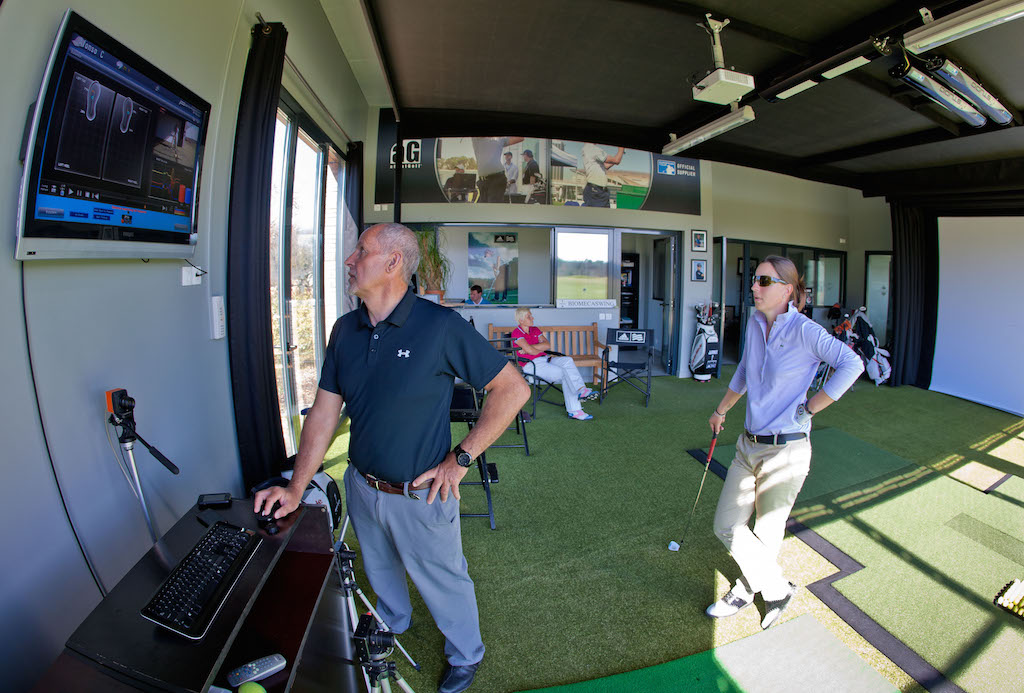
The seed for what would blossom into the A Swing was planted back in 1998, while I was visiting David Leadbetter at his academy headquarters in Florida. As time went by, our discussions about the A Swing deepened, which, as a biomechanist specializing in sports, excited me tremendously.
While about 10 years in the making, the A Swing has now made its debut to the world. I feel proud to have helped David realize his dream of developing a swing that maximizes energy efficiency, employs a minimum of body movement, is easier and simpler to repeat and is far less stressful on the body than conventional golf swings. In a manner that I hope all will understand, I’d like to present and explain a few of the A Swing’s key biomechanical facts and principals and offer some of the reasons why the swing works as well as it does.
First, the A Swing (which stands for the Alternative Swing) isn’t based on flat, two-dimensional Euclidean geometry. The golf swing unfolds in the same three-dimensional space we all live and act in every day, so one needs to think about the golf swing and frame it within the voluminous space of the real world as well.
With this in mind, we can compare the biomechanical efficiency and overall efficacy of the A Swing to a helicopter’s blade revolving around the fixed axis of its stable hub. A helicopter can, like a gyroscope, nimbly and precisely tilt and shift the plane of its orientation while flying in space without disturbing the constant rotation of its blade — just as a golfers tilt their bodies while swinging their arms and club around the hub of their spines. This is why the helicopter metaphor is a very good one for the A Swing, whose set-up posture, alignment, grip and flat-arm swing/steeply set shaft backswing motion has been designed to swing in sync with the body’s stable hub-like pivoting action, which we will shortly discuss. Our research reveals that golfers can repeat their A Swings with less of a need to make last-moment arms and hands compensations before impact than when executing conventional swings.
The Traditional Backswing vs. The A Swing Backswing
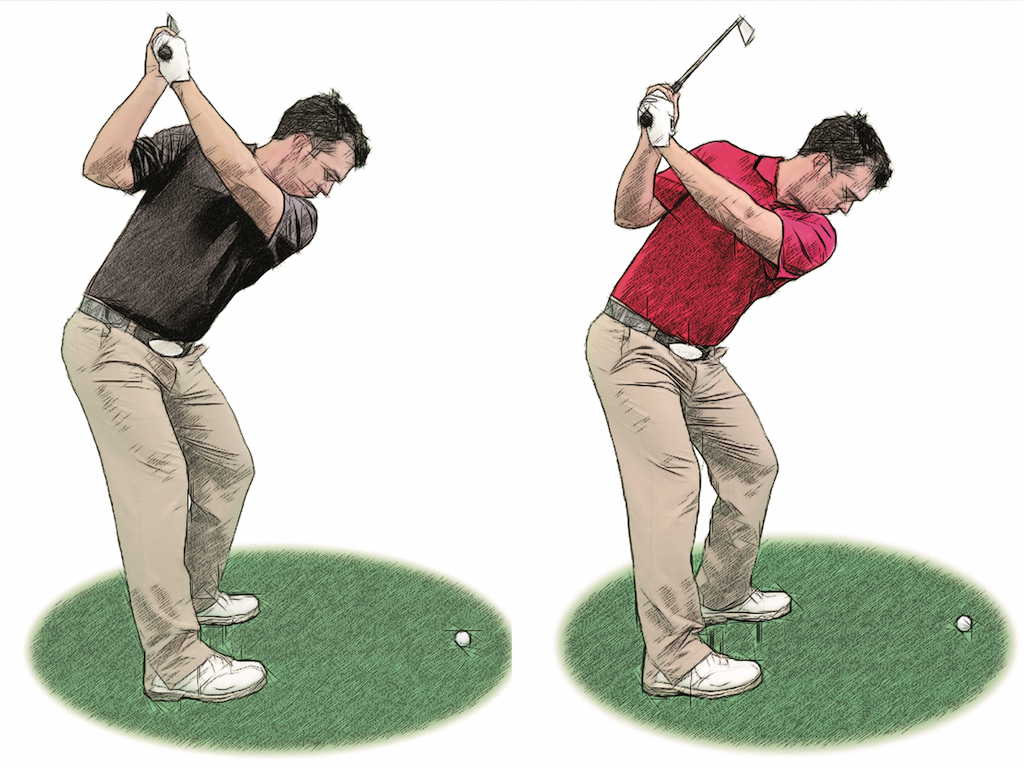
Photo Credit: The A Swing by David Leadbetter. St Martins Press, 2015
The A Swing is unique among contemporary swing philosophies in that it values and considers the biology part of biomechanics as much as it does the mechanical side. In this context I want to discuss with you the importance the A Swing places on the use and control of the body’s deep core muscles of the entire torso, from the abdomen up through the chest. Anatomically known as the abdominal-thoracic hydro pneumatic caisson, this organic structure of bone, muscle, organs and other tissue establishes a composite beam, or girder-like structure, around which the several kinematic muscular chains of the golf swing revolve.
In more layman’s terms, it is this core “unit” which in tying into the muscles of the golfer’s shoulders, pelvis, hips and legs both transmits and stabilizes the golfer’s motion throughout the swing. The correct and sustained engagement of the body’s core is an inviolable principal of the A Swing, and when golfers fully engage and sustain the contraction of their core muscles throughout the entire swing, they reap the benefits of a tremendously stable and repeatable swing that produces power and accuracy on a consistent basis.
Our research also shows that 30 percent less energy is needed in the A Swing to complete the backswing pivot or coil than in conventional swings and that the golfer’s center of gravity shifts 15 percent less during the swing than in conventional swings. The first finding allows for a greater establishment of potential power during the backswing, while the second allows golfers to more easily transition into their downswing while maintaining complete balance. Taken together, they result in a more efficient energy and controlled build up and application of power applied through the downswing and release into the ball. Please keep in mind, however, that the percentages quoted in this article and in the book refer to A Swings made in a fully efficient manner according to our model, and that any incremental movement in the direction of these percentages and improved will result in better shots and long-term better swing for golfers. Furthermore, we obtained these findings by working with a group of golfers of different handicap levels who had previously trained by working with The A Swing book’s “Seven-Minute Practice Plan.”
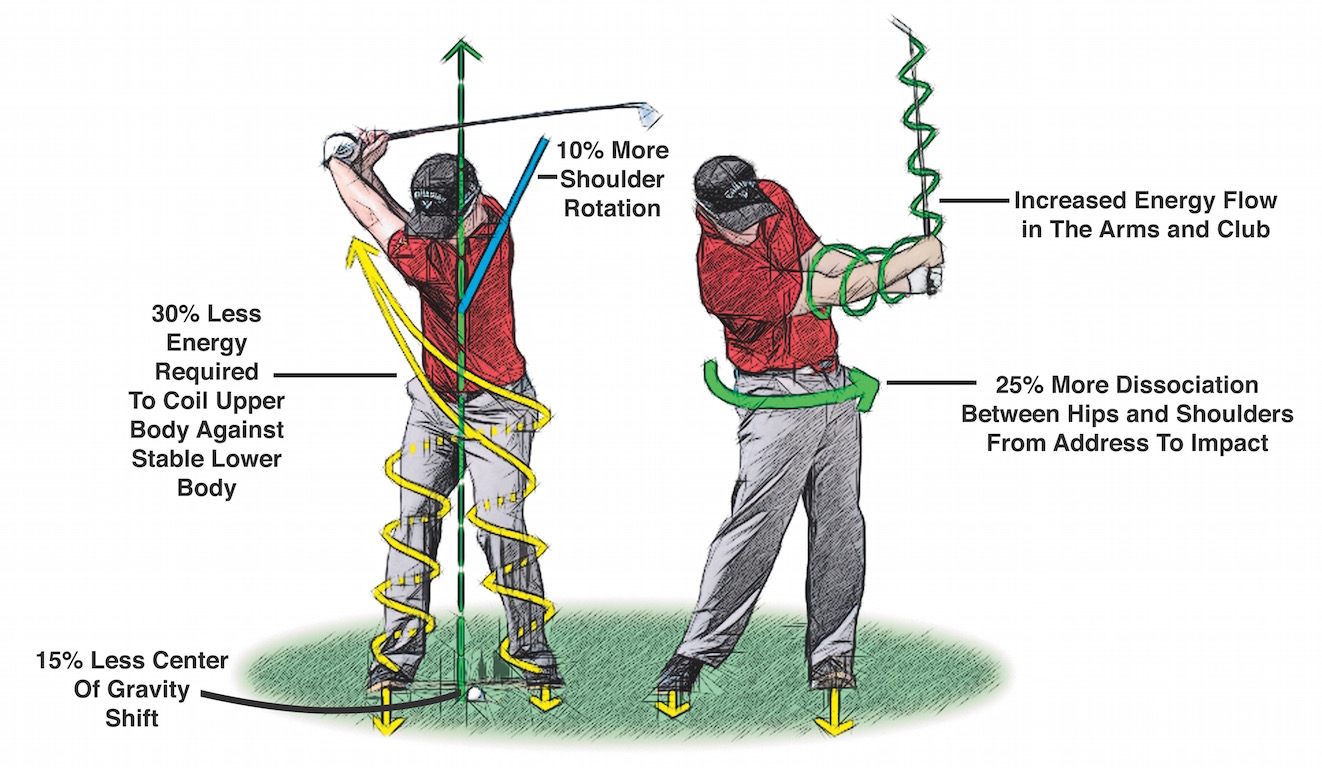
Photo Credit: The A Swing by David Leadbetter. St Martins Press, 2015
With that said, it’s important to know that the key to the A Swing, and, indeed the impetus behind David’s commitment to developing it lies in its simpler and more efficient backswing. In testing the A Swing’s backswing, we found that the hands travel 20 percent less in distance, while the club itself travels 15 percent farther than in a traditional backswing.
Now the reason an A Swinger’s hands travel a shorter distance to the top of the backswing is because they stay inside of the arc of the club head’s backswing motion all the way to the completion of the backswing itself. In a conventional backswing, the club head actually swings back inside of the hands at some point in the motion, and this change of direction, so to speak, increases the distance that the hands travel as well. We can compare the hands’ path of an A Swing’s backswing to driving a car directly from Chicago to New York City. If we extend the analogy to a conventional backswing, we would find this car driving first to Miami Beach before turning around and heading north to NYC.
So let me ask you a question, and believe me, you don’t have to be Albert Einstein to answer it correctly. Which route consumes more gasoline and, therefore, expends more energy during their respective road trips? Obviously it’s the Chicago-Miami Beach-New York City route! The same scientific concept of conservation of energy applies to the A Swing’s compact, “short” and direct backswing. The time and energy saved when the hands move on the most direct path to the top of the swing both allows the golfer to more leisurely transition their swings into the downswing, and provides them, again, with more energy that they can apply into the club, and, ultimately into the ball.
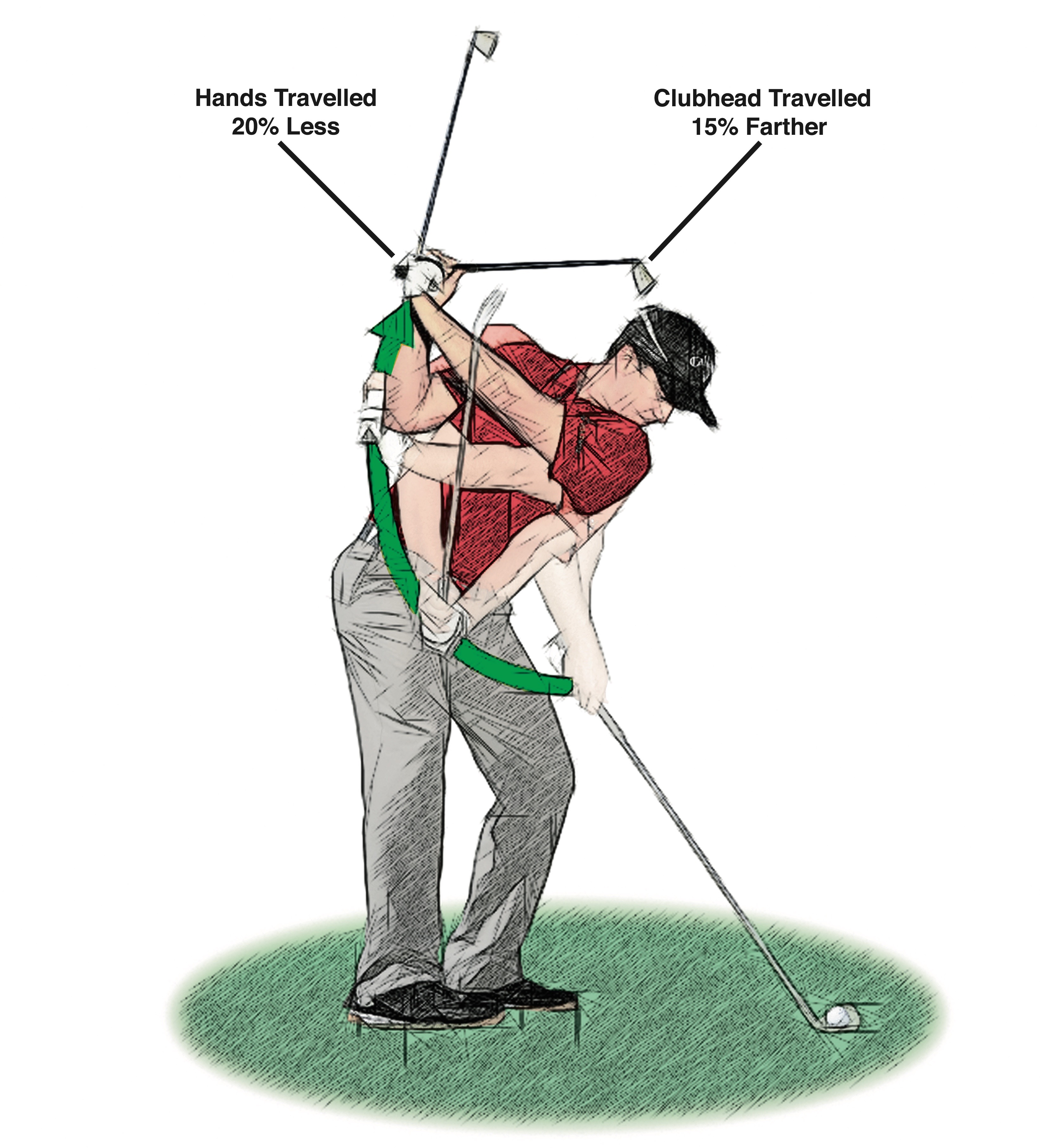
Photo Credit: The A Swing by David Leadbetter. St Martins Press, 2015
Now the golf club itself travels up to 15 percent farther in the A’s versus a conventional backswing because of the efficiency of the swing’s pivoting or coiling motion and also because of its extremely flexible “Prayer Grip.” The grip, which features a slightly strong left hand and weak right-hand placement on the club, yields maximum wrist motion and bend but almost no rotational motion during the backswing. David, who designed this grip specifically for the A Swing, really understands that the human wrist joints are extremely mobile, even “fluid,” and are not machine-like and rigid like clamps. Again, the A Swing is backswing oriented, but only for the sake of its capacity to create a powerful and easy-to-repeat downswing.
From a biomechanical point of view, the A Swing’s backswing and downswing create far better synchronization between the body’s rotation and the movement of the arms and club than do a conventional swing’s. In fact, a key “episode” in this coordinated and synchronized “story” of the swing in motion takes place during the transition from its backswing to its downswing. Here is where the initially steeply set shaft flattens planes into its shallower downswing counterpart, which produces a kind of whiplash effect that turbo-charges the shaft with an infusion of living energy. Now I’m aware that this isn’t the most mechanical description of a downswing’s transition that you may have ever encountered, but, remember, this is BIO-mechanics that we’re discussing here!
Let me conclude this article by talking about the two synergistically linked ideas: the applications of “ground forces” in the swing and the role and importance of the body’s center of gravity (COG). These two elements combine in the A Swing to create its powerful, stable and consistent pivot motion, which David describes in the book as “the life blood” of the swing. Since the mid-1990s I have focused on studying and understanding the essential elements of the closed kinematic chain as they are expressed and executed by golfers and other athletes. This intricately involves the way ground forces work and interact with the throwing (and swinging) and posture forces of the athletic actions in which they take place.
To begin with, golfers need to use the ground correctly in order to execute the essentially circular motion that defines a pivot as a pivot and creates the swing’s vital centripetal force.
I’ll turn to another car analogy, and this time ask you to imagine one riding in a straight line on an ice rink. Now when the driver of the car attempts to steer this vehicle into a turn, what will happen? Because of the insufficient friction between the tires and the ice, the car will skid off in the same straight direction on which it was driving. Correspondingly, the feet in the A Swing really need to grip the earth to provide what’s called the “centripetal requirement” that allows the body to move in a circular pivoting motion. To this end, The A Swing book teaches with great detail a pivot action that first transfers the golfer’s weight into the right heel by the completion of the backswing (and its concurrent and diagonal distribution of the weight that’s placed on the left toe), then how it moves in a symmetrical fashion into the left heel by the completion of the full swing.
Now the A Swing’s pivoting action, again initiated and sustained throughout the swing by the body’s core, must rotate around the body’s Center of Gravity (situated approximately just above the body’s naval) and it does so by taking advantage of the stability the ground forces provides. Finally, it is the circularly generated centripetal force of the pivoting action of the feet and body synchronized around the body’s Center of Gravity with the swinging motion of the arms and club that produces the A Swing’s power, accuracy and consistency.
In conclusion, then, let me say that it is the entire gestalt of this wonderfully synchronized, unified and biomechanically efficient “system” that represents the A Swing’s greatest achievement. It is a golf swing that offers a tremendous opportunity for improvement to golfers serious about working on their swings and games.
For more information about the A Swing, visit www.leadbetterAswing.com



The LPGA Tour is kicking off its 2026 season this week at Lake Nona Golf and Country Club in Orlando, and the pros are dealing with something most Florida golfers rarely face: freezing temperatures.
“It’s colder here than in the UK at the minute, which is a first,” said England’s Charley Hull during Wednesday’s media day at the Hilton Grand Vacations Tournament of Champions.
Even Lydia Ko, who lives at Lake Nona, seemed surprised by the cold snap. “We’re pretty much getting to below zero in celsius here, which maybe in other parts of the country they would be thankful, but when you’re in Florida it is a little bit of a surprise,” she said.
If the world’s best players are adjusting their games for cold weather, recreational golfers should, too. Here’s how to play smart when the mercury drops.
Understand What Cold Does to Your Game
Before you change anything, you need to know what you’re fighting against. Cold air is denser than warm air, which means your ball won’t fly as far. Period.
Hull noticed this immediately during practice rounds at Lake Nona. She mentioned hitting a gap wedge into the 18th hole during a previous win but needing a 4-iron during Tuesday’s practice round. That’s a difference of four or five clubs for the same shot.
Action item: Expect to lose 5-10 yards on every club in your bag when temperatures dip below 50 degrees. Plan accordingly and don’t be stubborn about club selection.
Layer Up Without Restricting Your Swing
Hull admitted she wore three pairs of pants during practice. While that might be extreme for most of us, staying warm is critical to playing well in cold conditions.
Your muscles need warmth to function properly. When you’re cold, your body tightens up and your swing gets shorter and faster. Neither of those things help you hit good golf shots.
Action item: Wear multiple thin layers instead of one bulky jacket. Look for golf-specific cold weather gear that stretches with your swing. Keep hand warmers in your pockets between shots. And don’t forget a good hat because you lose significant body heat through your head.
Take More Club Than You Think You Need
This is where ego gets in the way of good scores. When it’s cold, the ball doesn’t compress as well off the clubface. Combined with denser air, you’re looking at serious distance loss.
The pros at Lake Nona are dealing with a course that measures 6,642 yards but plays much longer this week. If they’re adjusting, you should too.
Action item: Take at least one extra club on every approach shot. In temperatures below 40 degrees, consider taking two extra clubs. It’s better to fly the ball to the back of the green than to come up short in a bunker.
Adjust Your Expectations on the Greens
Cold weather affects putting in ways most golfers don’t consider. The ball is harder and doesn’t roll as smoothly. Your hands are cold, making it harder to feel the putter. And if there’s any moisture on the greens, they’ll be slower than normal.
Ko mentioned that she still sometimes reads the greens wrong at Lake Nona despite being a member for years. Cold weather makes that challenge even tougher.
Action item: Hit putts more firmly than usual. The ball needs extra speed to hold its line on cold greens. Take a few extra practice strokes to get a feel for the speed before you putt.
Embrace the Mental Challenge
Hull said something interesting about cold weather golf: “I like the mental toughness of it.”
That’s the right attitude. Everyone on the course is dealing with the same conditions. The player who stays patient and doesn’t get frustrated by the extra difficulty will come out ahead.
Action item: Lower your expectations by a few strokes. If you normally shoot 85, accept that 90 might be a good score in 40-degree weather. Focus on solid contact and smart decisions rather than perfect shots.
Warm Up Longer and Smarter
This might be the most important tip of all. Cold muscles are tight muscles, and tight muscles get injured easily.
World No. 1 Jeeno Thitikul revealed she’s been protecting a wrist injury that bothered her late last season. Cold weather makes those kinds of injuries more likely if you don’t prepare properly.
Action item: Spend at least 20 minutes warming up before your round. Start with stretching, then hit easy wedge shots before working up to your driver. Keep moving between shots on the course to maintain body heat and flexibility.
The pros at Lake Nona this week will adapt and compete at the highest level despite the cold. You can do the same at your local course by following these tips and keeping a positive attitude.
PGA Professional Brendon Elliott is an award-winning coach and golf writer. You can check out his writing work and learn more about him by visiting BEAGOLFER.golf and OneMoreRollGolf.com. Also, check out “Playing Through” now on R.org, RG.org’s partner site, each Monday.
Editor’s note: Brendon shares his nearly 30 years of experience in the game with GolfWRX readers through his ongoing tip series. He looks forward to providing valuable insights and advice to help golfers improve their game. Stay tuned for more tips!

Brooks Koepka is back on the PGA Tour, and whether you love him or hate him, the guy knows how to win when it matters. After his LIV Golf stint, the five-time major champion returns this week at the Farmers Insurance Open.
What makes Koepka fascinating? He doesn’t fit the mold. His swing isn’t textbook. He doesn’t obsess over mechanics. Yet he’s won three PGA Championships and two U.S. Opens, regularly making it look easier than guys with prettier swings.
So, what can average golfers learn from someone who treats the game so differently? Quite a bit.
Stop Overthinking Every Shot
Koepka describes his approach as “reactionary” rather than mechanical. While most tour pros grind over swing thoughts, Brooks sees the target and hits it. No mental checklist.
This might be the most valuable lesson for weekend golfers who’ve watched too many YouTube swing videos.
How to actually do this:
On the range, hit five balls where you stare at the target for three seconds prior to addressing the ball. Don’t think about grip or stance. Just burn that target into your brain. You’ll be shocked at how pure you hit it when your brain focuses on where the ball is going instead of how you’re swinging.
Next time you play, give yourself a rule: Once you pull the club, you’ve got 15 seconds to hit. Koepka is one of the fastest players on tour because he doesn’t give his brain time to sabotage him.
If you feel tension in your hands at address, you’re trying to control too much. Koepka’s grip pressure is famously light. Loosen up until the club almost feels like it might slip, then add just enough pressure to hold on. That’s your swing thought: soft hands, see the target.
This approach works better under pressure. When you’re standing over that shot with water left and OB right, the last thing you need is a mental checklist. See it, feel it, hit it.
Play to Your Strengths (Even If They’re Not Pretty)
Koepka uses a strong grip that wouldn’t pass muster in some teaching circles. But he’s built his game around what works for him, elite driving distance and recovery skills. He doesn’t try to be someone he’s not.
Here’s how to build your game like Brooks:
Look at your last five rounds and figure out where you’re actually gaining strokes. Bombing it off the tee, but can’t hit greens? Lean into it. Play courses where distance matters more than precision. On tight holes, grip down on your 3-wood instead of trying to thread a driver through a keyhole you’ll miss seven times out of ten.
Koepka knows he can scramble, so he’s not afraid to miss greens. If you’re deadly from 50 to 75 yards, start leaving yourself those distances on the par 5’s instead of going for them in two every time.
Know when to take your medicine. Koepka in the trees at the PGA? He’s punching out to 100 yards, not trying to bend a 6-iron around three oaks. You’re in the rough with a flyer lie and water short? Hit your 8-iron to the middle and move on. That’s not playing scared, that’s playing smart.
Save Your Best for When It Counts
Here’s a wild stat: Koepka’s putting average in majors is often more than a full stroke better per round than in regular events. He elevates when pressure is highest.
How does an amateur tap into that gear? It’s not about trying harder, it’s about caring differently.
Here’s what actually works:
Decide which rounds matter to you. Club championship? Member-guest? That annual trip with college buddies? Circle those dates and treat them differently. Koepka doesn’t care much about regular tour events, but majors? That’s when he locks in.
Two weeks before your big round, change your practice. Stop beating balls mindlessly. Play nine holes in which every shot has consequences. Miss the fairway? Hit from the rough on the next hole too. Three-putt? Twenty push-ups. Koepka’s practice intensity ramps up before majors because he’s rehearsing pressure, not just swings.
Develop a between-shot routine that resets your brain. Koepka is famous for his blank expression after bad shots. Try this: After any shot, take three deep breaths while walking, then find something specific to notice, a tree, a cloud, someone’s shirt. That’s your reset button. By the time you reach your ball, the last shot is gone.
The Bottom Line
Brooks Koepka’s return reminds us there’s no single path to success in golf. His “substance over style” approach proves that results matter more than looking good.
You don’t need a perfect swing; you need a reliable one that holds up under pressure. You don’t need to hit every shot in the book; you need the shots you can count on. And you don’t need to play great every time; you need to play great when it matters.
Welcome back, Brooks. Thanks for the reminder that golf is ultimately about getting the ball in the hole, not winning style points.
PGA Professional Brendon Elliott is an award-winning coach and golf writer. You can check out his writing work and learn more about him by visiting BEAGOLFER.golf and OneMoreRollGolf.com. Also, check out “Playing Through” now on R.org, RG.org’s partner site, each Monday.
Editor’s note: Brendon shares his nearly 30 years of experience in the game with GolfWRX readers through his ongoing tip series. He looks forward to providing valuable insights and advice to help golfers improve their game. Stay tuned for more tips!

Blades Brown made a big impression last week in the California desert, and not just because he’s only 18. He put up numbers that would catch any weekend golfer’s attention. Most of us won’t hit 317-yard drives or find 86% of our greens in regulation, but there’s a lot to learn from how Brown managed his game at The American Express.
Here are three practical lessons from his performance that you can use on your own course this weekend.
Step 1: Give Priority to Accuracy Over Distance Off The Tee
Brown’s driving stats are impressive. He averaged almost 318 yards off the tee, ranking 12th in the field. More importantly, he hit 76.79% of his fairways, tying for fourth place in the tournament.
Think about that ratio for a second. Brown could have swung harder, chased more distance and tried to overpower the course. Instead, he played smart golf and kept his ball in play.
Your Action Item: Next time you’re on the tee box, ask yourself a simple question before pulling the driver. Do you need maximum distance here, or do you need to be in the fairway? If there’s trouble lurking or the hole doesn’t demand every yard you can muster, take something off your swing. Grip down an inch. Make a three-quarter swing. Do whatever it takes to find the short grass. Brown’s approach illustrates that fairways lead to greens, and greens lead to birdies. He made 22 of them last week, along with an eagle.
The math is simple. When you’re hitting three out of every four fairways like Brown did, you’re giving yourself legitimate looks at the green with your approach shots. That’s when scoring happens.
Step 2: Commit To Hitting More Greens
This is where Brown really separated himself. He hit 62 of 72 greens in regulation, an 86.11% clip that tied for first in the entire field. Read that again. An 18-year-old kid tied for the lead in one of the most important ball-striking statistics in professional golf.
How did he do it? By keeping his ball in the fairway (see Step 1) and giving himself clean looks with mid-irons and wedges.
Your Action Item: Start tracking your greens in regulation. You don’t need a fancy app or a statistics degree. Just mark down whether you hit the green in the regulation number of strokes. Par 3s in one shot. Par 4s in two shots. Par 5s in three shots.
Once you know your baseline, set a goal to improve it by 10%. If you’re currently hitting five greens per round, aim for six. The beauty of this approach is that it forces you to think strategically about club selection and shot shape. Brown’s strokes gained approach number was positive (0.179), meaning he was better than the field average. You don’t need to be perfect. You just need to be on the dance floor more often.
When you hit more greens, you eliminate the need for heroic short game shots. Brown only had to scramble 10 times all week, and he got up and down 70% of the time. That’s solid, but the real story is that he rarely put himself in scrambling situations to begin with.
Step 3: Minimize Mistakes And Stay Patient
Here’s the stat that jumps off the page: Brown made only three bogeys all week. Three. In four rounds of professional golf against the best players in the world.
He also made just one double bogey. That kind of clean card doesn’t happen by accident. It happens when you play within yourself, avoid the big miss and trust that pars are never bad scores.
Your Action Item: Before your next round, decide that you’re going to play boring golf. No hero shots over water. No driver on tight holes just because you can. No aggressive pins when there’s a safe side of the green.
Brown’s performance shows us that consistency beats flash every single time. He didn’t lead the field in any single strokes gained category, but he was solid across the board. That’s how you post numbers and cash checks.
Give these three steps a try. Your scorecard will thank you.
PGA Professional Brendon Elliott is an award-winning coach and golf writer. You can check out his writing work and learn more about him by visiting BEAGOLFER.golf and OneMoreRollGolf.com. Also, check out “The Starter” now on R.org, RG.org’s partner site, each Monday.
Editor’s note: Brendon shares his nearly 30 years of experience in the game with GolfWRX readers through his ongoing tip series. He looks forward to providing valuable insights and advice to help golfers improve their game. Stay tuned for more tips!

RBC Heritage Tour Report: More minis, course-specific setups, Spider & GTS launches

Justin Rose WITB 2026 (April): Full WITB breakdown with new McLaren irons

Best fairway woods of 2026: The most versatile fairway woods + the most forgiving fairway woods

What’s the story behind Webb Simpson’s custom-stamped irons?

Cadillac Championship Tour Report: Spieth’s sizable changes, McLaren Golf launches, and more

The 24 players who can win the Masters

Rory McIlroy’s winning WITB: 2026 Masters

Kristoffer Reitan’s winning WITB: 2026 Truist Championship

J.J. Spaun’s winning WITB: 2026 Valero Texas Open

Cameron Young’s winning WITB: 2026 Cadillac Championship


Alex Fitzpatrick WITB 2026 (May)
Driver: Ping G440 LST (9 degrees) Shaft: Fujikura Ventus Black 6 X 3-wood: TaylorMade Qi4D (15 degrees) Shaft: Fujikura Ventus...

Kristoffer Reitan’s winning WITB: 2026 Truist Championship
Driver: Ping G440 Max (9 degrees) Shaft: Mitsubishi Tensei 1K White 60 TX 3-wood: Ping G440 Max (15 degrees) Shaft:...


WITB Time Machine: Rory McIlroy’s winning WITB, 2021 Truist Championship
Rory McIlroy’s victory at the 2021 Wells Fargo Championship 2021 (now the Truist Championship) marked a significant return to form,...


Collin Morikawa WITB 2026 (May)
Driver: TaylorMade Qi4D LS (8 degrees) Shaft: Mitsubishi Diamana D+ Limited 60 TX 3-wood: TaylorMade SIM Tour (14 degrees) Shaft:...
-
 Equipment2 weeks ago
Justin Rose WITB 2026 (April): Full WITB breakdown with new McLaren irons
-
 Equipment1 week ago
What’s the story behind Webb Simpson’s custom-stamped irons?
-
 Equipment2 weeks ago
Cadillac Championship Tour Report: Spieth’s sizable changes, McLaren Golf launches, and more
-
Whats in the Bag4 days ago
Kristoffer Reitan’s winning WITB: 2026 Truist Championship
-
 Whats in the Bag2 weeks ago
Cameron Young’s winning WITB: 2026 Cadillac Championship
-

 Whats in the Bag3 weeks ago
Nelly Korda WITB 2026 (April)
-

 Equipment2 weeks ago
Justin Rose on the switch to McLaren Golf, learnings from previous equipment moves
-

 Tour Photo Galleries2 weeks ago
Photos from the 2026 Cadillac Championship


RBImGuy
Feb 14, 2020 at 2:18 am
Lydia Ko lost her game with Leadbetters A-Swing.
Good Job Rivet with bio mechanics……………………………
Alan Long
May 8, 2017 at 9:32 pm
There is no such thing as a revolutionary swing.
There is no such thing as a perfect swing.
There is no such thing as a text book swing.
There is no such thing as a conventional swing.
There is no such thing as the “right” swing.
No two swings in the world are alike.
A golf coach should never teach you to swing like he does.
A good golf coach will give pupils the tools to discover their own unique swings.
frank
Jul 5, 2016 at 7:53 am
I tried the A swing at the range an it is a easy swing to use. If you are a athlete there should be no problem using it.
Took it to the couse. My distance was about the same but I hit 13 of 14 firways very accurate.
If you look at some of the pga players in slo mo they use a very similar style like brook koepa and nick price.
All I can say dont knock it unless you try it. Many golfer get stuck by taking the club back to far inside this will fix any floors an it is a very efficent swing
leadbetter great job DAVE.
Rick
Feb 20, 2016 at 11:59 am
The A Swing appears to be the ‘Craig Stadler Swing’. It’s very similar to the swings of bigger barrel chested golfers who can’t rotate as much as the flat-bellied pros. On the takeaway the A Swing clubhead stays a little more outside the hands, but overall it’s very similar. Check out Stadler’s DTL swing below:
https://m.youtube.com/watch?v=45mYS7QRv4s
Stadler had great success with this swing. It works.
Tom
Dec 24, 2015 at 3:24 pm
I can’t find anywhere where it states, or ia discussed, what is the position of the left wrist at impact. Is it still cupped like it is in the rest of the swing, or does it flatten out just before contact? I would think there would be a tendency to hit the ball thin with a cupped left wrist
Robert Pine
Feb 4, 2016 at 5:16 am
impact potion is exactly the same as a conventional swing..it is the release that is different..instead of rolling the arms you use like a “skipping a stone on water” motion while on continuing on plane
Robert Pine
Feb 4, 2016 at 5:27 am
sorry I meant “impact position”
Steve Wozeniak PGA
Sep 27, 2015 at 11:20 am
I would have loved to be a fly on the wall when Lydia told these “teachers” to take a hike…….she tried this for a month, missed cuts, and hit it like a dog!!!!!! Of course she did, she was just used, horribly I might add to sell some trash. And if someone that says they understand physics and bio-mechanics signs off on this, they have no clue how to apply their craft to the golf swing……
http://www.stevewozeniak.com
Ted Edwards
Nov 2, 2015 at 7:24 pm
Totally agree with you Steve.
Robert Pine
Feb 4, 2016 at 5:24 am
I believe Lydia Ko is still using it..she is still with Leadbetter and is still #1..how many #1 pro golfers do you mentor steve?
Jimmy
Sep 23, 2015 at 9:00 pm
Im a 10 handicap and love the result of this swing pattern. Tried lots of different patterns. This works and has value. Interesting the positive and pro comments mostly coming from those who have actually tried it and experienced the ideas. What a concept!
Carol Greco-Cardinale
Jul 17, 2015 at 3:44 pm
Thank you Mr. Leadbetter. I recently lost sight in my left eye. It has been difficult keeping my eye on the ball with the traditional back swing. For some reason it is much easier with the A swing. I also am better able to hit a draw since it is easier going from in to out instead of over the top. Hugs and kisses to you for being so innovative and creative.
Captain Caveman
Jun 29, 2015 at 11:31 am
Please help me swing like a caveman.
Hudson
Jun 10, 2015 at 1:50 pm
I found a very interesting video explaining the PROS/things to avoid implementing this method.
https://www.youtube.com/watch?v=Q6akWVwovRQ
Mike
Jun 6, 2015 at 12:26 pm
Can you please explain the cupped left wrist and open club face at the top of the swing? I’ve swung exactly like this but worked hard to get rid of it.
Barryw710
Jun 5, 2015 at 4:45 pm
Whats with all the haters ? If you dont like it dont do it. Personally i have been into the A swing for 3 weeks. I am hitting the ball way better and way more consistently than ever before. At least 1 club extra distance but the quality of the strike is something that is difficult to explain. Golf is a total blast and cant wait to get on the course as often as possible. Handicap is down 1.2 strokes and i have only lost 1 golf ball in past three rounds. That to me is an indication of something positive. No more high right slices off the tee that just destroy your soul. Not even a hint of a shank.Thank you David Leadbetter.
Robert Pine
Feb 4, 2016 at 5:11 am
I have been using it myself..it is easy to understand and have also picked up more distance with this swing
Ball
Jun 5, 2015 at 1:08 pm
This stuff should be taught for FREE, if it works so naturally. Why are they even charging for it?
Jang Hyung-sun
Jun 4, 2015 at 8:25 pm
I no like this ugly reverse pivot yuck. Looks like stack n tilt! This major shank!
Desmond
Jun 4, 2015 at 7:31 pm
We’ll see how Lydia Ko does with the A Swing … From the the stories one hears, Leds has a lot of enemies …. they’re called former students.
Scott
Jun 4, 2015 at 3:08 pm
No point to my response other than this is hardly new.
My wife was taught most of this stuff 20 years ago. After her lessons, her swing has morphed into the EXACT poster child for this method. Maybe Leadbetter copied it from her on one of our southern trips? She hits that ball OK for not playing very often. Other than her right hand becoming too strong, which needs occasional adjustment, her swing seems to be repeatable year after year. Might be worth a try for some people.
She is not very good, but she has fun playing about 10 times a summer.
ald
Jun 4, 2015 at 11:41 am
You are aware that David’s teaching methods have been termed “lead poisoning” on the PGA Tour for about 20 years. A well respected European tour pro with multiple wins world wide once told me “he’s ruined WAY more swings than he’s helped including mine”….just sayin’
KK
Jun 4, 2015 at 9:17 am
Decreased effort and increased repeatability, accuracy and efficiency are goals of a lot of golfers. However, some just want to bomb it longer down the fairway. *Raises hand*
Paul Glazier
Jun 4, 2015 at 8:37 am
“…and during the development of the A Swing completed a full biomechanical study and evaluation.”
Is this published anywhere? If not, is it possible to obtain a copy of the report?
Frosty
Jun 4, 2015 at 2:32 pm
Ha. I think you just read about as much publishing as this “study” received.
Desmond
Jun 4, 2015 at 8:03 am
I generally have an open mind about swinging a golf club. Over the last 20 years, I’ve had instruction with at least 4 types of systems/methods. I am now taking instruction that involves a biomechanics approach.
Having said that, when the author says “conventional golf swing”, I’d like to know what he means. Does he means “Ledbetter’s conventional swing” versus Ledbetter’s A Swing?” I hope so because there is no conventional golf swing unless it’s the one Leds has taught for 20 years, or how Pros were swinging in the ’80’s — head moves back, no extension of back leg, arms off chest, clubhead pointed at target, swinging in a barrel, etc.
Got away from that about 5 years ago…
dapadre
Jun 4, 2015 at 5:59 am
I dont know if this is so revolutionary. To me the key move when is midway the hands go up and the shaft points almost down. This move makes the club feel very light vs the laid of position. Another advantage is that the club butt will WANT to come down straight more pointing to the target, which is very key for those coming over the top. Actually this SECRET has been adopted by Jack Nicklaus, Calvin Peete and Straham.
To me its about finding YOUR swing. There are elements that you must maintain, but at the end, its the impact position that counts the most.
JT
Jun 3, 2015 at 8:53 pm
The A Swing seemed to work pretty well for Ben An a few weeks ago when he won the BMW PGA Championship by 7.
“David has helped me understand my own swing. His A Swing approach has really improved my ball striking and consistency. My game is getting better and better and winning the BMW PGA Championship just proves it. The A Swing technique is simple and the best part is, apart from at the very beginning, I don’t have to see him that often to maintain it. When I do see him, if my game is a little off, it is an easy process to get back on track. He has made me my own best teacher, which is important as I travel the work playing golf.” – Ben An
Bog us
Jun 3, 2015 at 9:25 pm
Yeah? So he won one tournament. This is the exactly same sort of thing that the Stack & Tilt guys said when they won one. Where are they now, eh?
Robert Pine
Feb 4, 2016 at 5:34 am
lydia ko is still number one
stephenf
Jun 4, 2015 at 3:52 am
You do know what anecdotal evidence is and what its level of significance is, right?
What a lot of people don’t seem to understand about the guys who are good enough to play for a living is that some of them do a lot what they do because of what they were taught, and some of them in spite of what they were taught.
Ball
Jun 5, 2015 at 1:06 pm
So what’s the point of being taught, or teaching at all, then? Eejit
stephenf
Jun 6, 2015 at 1:01 am
Eejit your own feckin’ self. That some people are taught well and are helped by it, and that others are taught at least partly in error and are not helped by it but become good anyway through systems of compensation, athletic skill, an accumulation of good elements that tend to overwhelm the bad, etc…these facts do not negate for one second the idea that good teaching of true things about the swing is worthwhile (as in, “what’s the point of teaching at all?”). In fact, it only emphasizes the worthwhileness of good teaching. It also emphasizes the need for an objective standard as to what good technique is, since the fact that a player swings a club reasonably well may not be a result of the quality of his instruction, and neither is the fact that a player is having trouble at the moment an indication that he’s on the wrong path or working on the wrong things (cf. Faldo in his first two years working with Leadbetter). Eejit.
Paul
Jun 3, 2015 at 7:27 pm
Thanks for your article.
In looking at the comments above, it is interesting to see all the doubters, and how critical they are. What is the point?
If they had taken the time to try this method as it is set out, and practice it for a reasonable amount of time their comments I am sure would not be so derogatory.
A lot of the angst seems to be directed at David Leadbetter himself, as opposed to the A Swing.
I am a low handicap golfer. I play often, and consistently, and was happy with my game.
I also (unlike some others it seems) have an open mind.
I bought the book. Changed to everything as set out in the book and practised daily for 2 weeks before taking it to the course.
I shot the easiest 73 I’ve ever had.
My game is now the straightest it has ever been, length is about the same, but the percentage of pure shots is now amazing. It is so easy.
So, to all you doubters, and everyone else whose game isn’t perfect, look at it with an open mind and you may be pleasantly surprised.
JT
Jun 3, 2015 at 8:39 pm
Exactly .. nothing like a bunch of know it alls that haven’t tried it. I’m generally indifferent to Leadbetter, but I like Paul have an open mind.
If you watch his 1 hour intro video from the North Coast Golf show on youtube, he is says that he didn’t invent each of the component parts. It’s a culmination of what he has learned from others combined with his teaching.
For those that say it’s no different than conventional teaching … please point me to a well known instructor says that at half way back he wants the club to match the spine plane or to be across the line at the top?
I’m not sure that I’m going to employ every piece of this methodology, but one thing I can say from watching myself on video … a the OTT move that haunts 90% of golfers does not compute with this backswing.
Desmond
Jun 5, 2015 at 4:33 am
Let’s see the video. Feel ain’t real.
JOHN
Oct 30, 2015 at 9:49 am
i totally agree paul , i did the same, read the book twice, practiced the moves , instantly saw the improvement , i started the Aswing 5 months ago ive come down from 15 hcp to an 8 and shot 77 last start , & our coarse slope rating is 137 , gone from high 80 s now into the high 70 s . My advice is if anyone`s golf swing is not consistent give it a go ,or keep giving your mates your cash LOL
erick
Jun 3, 2015 at 6:04 pm
nothing spectacular to say aside from.. womp womp..do not pass go do not collect 200 dollars. disappointed that leadbetter is still trying to encourage.. “golfers” to his teachings… which minimal follow among the best in the world.. he teaches “flipper” style golf. the best in the world dont do so and have far fewer books and videos..everything leadbetter comes out with reminds me of watching a golf channel commercial with ALL THE BEST SWING TIPS IN THE WORLD. square to square, hank haney, and the other one who doesnt like confusing conflicting instruction.. its all just another way to get over on those who dont have the natural ability to receive direction and have to work extra hard…. not saying one is better than the other just saying they.. and leadbetter are taking advantage of those who want to enjoy the game better, who dont have the ability or understanding to be recreationally successful at golf
Marc
Jun 3, 2015 at 5:40 pm
Nothing revolutionary or new here at all. More annoying is how the “A-swing” compares and contrasts the “conventional swing” as if all the swings performed in a conventional matter are all the same. I think it’s clear that they are not. In addition, I’m willing to bet many “conventional” swings have the exact same sequences described as an A-swing anyways.
All he’s done here is describe the golf swing in his own words and slapped a name on it trying to create a brand. Pretty lame IMO.
Roger the codger
Jun 3, 2015 at 5:39 pm
Have any of the commenters tried this swing? Doubt it. I’m 75yo 10 index with typical
flexibility issues of golfers my age. After careful study and practice of the “A” swing method
I am hitting at least one club longer thru the bag with a surprising level of accuracy. Finding
clubface center consistently easier. It takes a little work and commitment like any swing
change, but don’t knock it if you haven’t tried it.
JT
Jun 3, 2015 at 8:40 pm
Amen to that.
Dale Doback
Jun 4, 2015 at 2:25 pm
I have tried the swing, in fact a year an a half ago my swing looked identical to the A swing and I am currently overhauling my swing and here is why. I think I always swung the club into the A swing backswing position because it is easy to repeat and bio mechanically follows how the body wants to move but the A swing and mine have one major flaw and that is the club is so far across the line that it takes tremendous amount of timing to loop it back to the plane. If the body rotates to early from the top the club will not flatten enough and you are stuck from a steep position and can only pull left and have to release early to shallow. If you slide laterally to long the club flattens to much and you get stuck behind with an open face. While the A swing is an easier back swing to learn the downswing is harder to time because of sequencing. Like Furyk and Ryan Moore it can be down but it’s not for most people.
Frosty
Jun 4, 2015 at 2:39 pm
Well said. I wondered, as all the hype I have seen concerns the back-swing, followed by a few sentences about how the swing magically falls into the slot on the way down. You don’t hit the ball with a back-swing.
Dale Doback
Jun 5, 2015 at 1:27 pm
Don’t get me wrong I don’t think this is a bad way to swing the club. So far I have read and watched every piece of A Swing material I can find so as to limit blind ignorant commenting. I wouldn’t call this swing type hype because there are lots of elite champions that were across the line and the closest look a like to the A Swing that comes to mind is Bobby Jones. What Ive found since my backswing is similar is that it is a really easy back swing to learn with minimal forearm rotation but the BIG KEY to this swing is TIMING what Leadbetter refers to as the VPlane or shaft shallowing. I think most people will agree that the steeper you are at the top of the backswing the more the shaft has to shallow to get back to impact plane on the downswing. What Leadbetters logic is that if you go to max on shaft steepness in the backswing it will force golfers to shallow because they have nowhere else to go with the club and a players natural athletic ability will takeover but there is an element of timing. I am intrigued by the A Swing because i have spent a year and a half trying to overhaul the backswing but i can do the A Swing back swing in 5 minutes so it may be more productive to spend the time on working on the downswing motion. Just my 2 cents worth.
BustyMagoo
Jun 3, 2015 at 5:26 pm
Isn’t he Michelle Wie’s coach? I’m surprised her overbearing dad would allow such a thing if that is indeed the reputation Leadbetter has on the pro tour.
DC3
Jun 3, 2015 at 4:08 pm
Furthermore, if the joints of the human body are ‘fluid’ as you say, why would they be connected to a system of rigid/fixed pieces known as the kinematic chain?
I understand your attempt to wow and impress with technical jargon, but, gestalt? GeSTAHP.
DC3
Jun 3, 2015 at 4:02 pm
While some of the points you make are indeed valid, there exists no counterpoint to the argument(s) you use in support of Mr. Leadbetter’s theory. You may paint a very convoluted picture, but the deceit is plain to see.
cb
Jun 3, 2015 at 2:19 pm
I read the book and wouldn’t use the term “revolutionary” to describe it but it is a good compilation and explanation of a way to swing the club. in golf all that matters is the club at impact and there are hundreds of different ways to get the club to the ball. this is merely one way that some golfers have found to be personally easier. Also, to all those who say this is not a powerful swing, go watch rory mcilroy swing the club and you will notice he does a lot of the same things that leadbetter advocates in the book. obviously rory is not someone who has trouble hitting the ball long.
Ian
Jun 3, 2015 at 12:49 pm
That backswing looks a lot like Ryan Moore to me.
Shwing
Jun 3, 2015 at 12:20 pm
Besides – not being able to stand in position to use the ground forces is the main problem for most bad golfers because they’re not athletic nor fit enough in their legs to start.
Bobtrumpet
Jun 3, 2015 at 12:19 pm
“The A Swing is unique among contemporary swing philosophies in that it values and considers the biology part of biomechanics as much as it does the mechanical side.”
Unique? Not hardly. Don Trahan’s Peak Performance swing has had substantial input from a number of docs and engineers during development, and he’s been teaching it for more than 20 years. It still appears more body friendly, and in-line with physiology, than the “A” Swing (and conventional teaching at least back to the the “X-Factor”).
Ted Edwards
Nov 2, 2015 at 7:20 pm
When I saw video of Leadbetter demonstrating the A swing, I was immediately reminded of the backswing position that Don Trahan teaches in his Peak Performance videos (which I have). So I completely agree. In my view Leadbetter stole this idea from Trahan.
Shwing
Jun 3, 2015 at 12:18 pm
A short-lived, short-term swing fix for the young body. Not to be swung in your old age. Won’t be able to twist and stay compact like that when your arms won’t even let you flip it behind your head like that as you get older. But they don’t care. They’ll have a swing for you to use when you’re older, so they can sell you more DVDs!
martin
Jun 3, 2015 at 11:36 am
looks like someone was reading the Stack and Tilt swing
redneckrooster
Jun 3, 2015 at 12:17 pm
I agree stack and tilt . Jim Furyk swing modified slightly.
Tom
Jun 3, 2015 at 10:28 am
Lost after the 3 rd sentence as a teaching pro this type of analysis of a golf swing will screw up more than it will cure.
99 percent of golfers dont have the capacity or time to go down this road.
Jimmeh
Jun 3, 2015 at 1:52 pm
I read the whole article and as a low-level playing pro and teaching pro, I agree. I know Leadbetter is a house name in the teaching circuit, or was, apparently, but who needs to know about specific vertebrae moving through certain positions? What happened to teaching with the ball-flight?
M.
Jun 3, 2015 at 8:37 am
David designed the ‘prayer grip’, lol… I think there are a handful of people who deserve recognition for some of the concepts explained here without the marketing machine of Leadbetter making them his!
TR1PTIK
Jun 3, 2015 at 10:21 am
No kidding. I was gripping the club like that long before I ever heard about the A swing.
Bob Jones
Jun 3, 2015 at 1:10 pm
I adopted this grip to stop hooking due to my right hand overpowering my left through impact. The left hand in this position acts as a buttress that the right hand cannot move. Also, I saw a good number of players using this kind of grip at the U.S. Women’s Open in 2003.
other paul
Jun 3, 2015 at 2:02 pm
Anti hook grip. I use it as well. And I thought I made it up ????
George Jefferson
Jun 4, 2015 at 2:34 pm
Ben Hogan appeared to have a much stronger left hand grip paired with an extremely weak right hand grip. I’m not saying Hogans left hand grip was strong but he had one of the weakest right hand grips I’ve ever seen and his palms do not face each other when they are on the club. Sounds kind of like Leadbetters prayer grip.
M.
Jun 4, 2015 at 6:25 pm
…and the cupped left wrist at the top… think Leadbetter has gone back to the roots of the game with the greatest ball strikers and is now claiming ‘a new swing’…. disgraceful really!
dekker
Jun 8, 2015 at 11:04 am
Hogan’s left hand was weak , no more than 1.5 knuckles, compared to Ledbetter’s 3 knuckle A grip.
Gary Gutful
Jun 3, 2015 at 7:25 am
Not sold on this…
brendon
Jun 3, 2015 at 11:10 am
Me either. Especially flimsy is the argument that this would be a more powerful swing.
I interviewed Dr. Sasho Mackenzie, works on biomechanics of golf, and he says high hands with flexible arms and wrists are much more powerful
http://youtu.be/2cj1gTfKeTs