
Equipment
13 Revealing Photos from the 2016 WGC-Dell Match Play

GolfWRX was live this week from the 2016 WGC-Dell Match Play at Austin Country Club in Austin, Texas. If you missed any of the photos form this week, make sure to browse the galleries below:
The bracket-style format of the WGC-Dell Match Play is reminiscent of the NCAA March Madness tournament, which is currently being played — the only difference being that most people understand how the format of March Madness works. If you want to read up on the rules for the Dell Match Play, check them out here.
My job isn’t to explain formatting groups and teams, however, it’s to reveal photos. So please, allow me do my job. As such, we begin Revealing Photos: Confusing Match Play Bracket Style Events.
All squared up

All you need to learn to putt well is two parallel alignment rods, 10 golf tees, and a putter with squares on it. See, golf is easy.

Don’t be such a square. Just try it.

I promise, it won’t be like trying to fit a square peg into a round hole.

I’ll see you on the practice green. Be there or be square.
How do you know you’re at a WORLD Golf Championship?

Yardage signs are also in metric.
Adam Scott settles (maybe) on a driver

It’s been a long road for Adam Scott and his driver. He’s gone from a Titleist 915D5 — a driver basically made specifically for him — to a D3, then to a D2. We may have a winner, since he won the Honda Classic and the WGC-Cadillac Championship back-to-back after making the switch to a D2, the most forgiving driver of the bunch.
Scott Piercy’s WITB is heavier than most

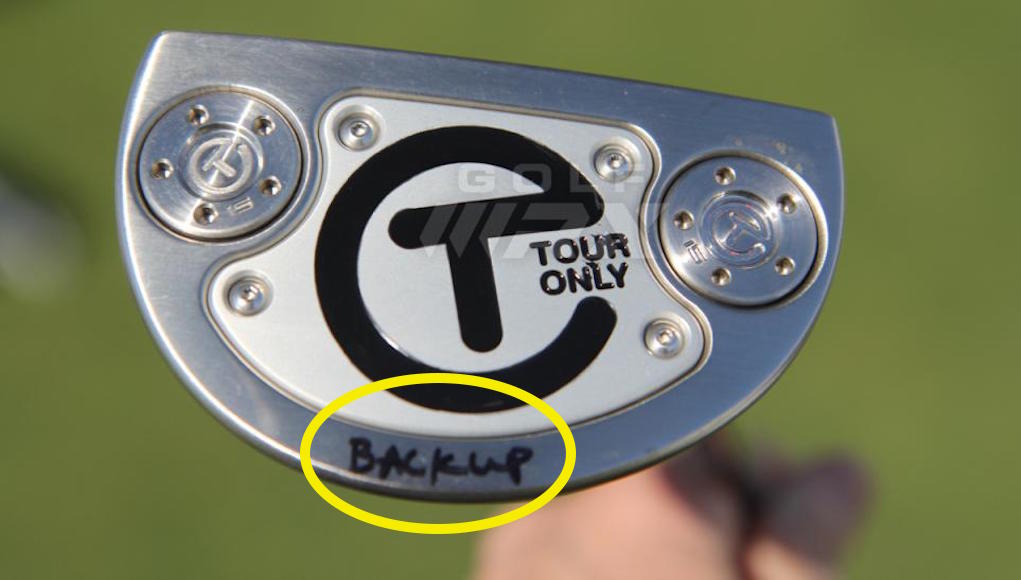
I won’t declare him the lead tape king as to offend Phil Mickelson, but he certainly uses a hefty amount of the stuff. Also, he has this Scotty Cameron Tour Only putter as his “backup.” How do I know it’s his backup? Well…

Check out Piercy’s full WITB from this week here.
Kevin Kisner’s “In-N-Out” Great Big Bertha

A fair share of Callaway Tour staffers have two weights in their Great Big Bertha drivers, opposed to the one sliding weight that’s offered in the stock versions. And according to this forum member, Tour reps have a code name for the additional-weight setups.


I’ll never be able to look at a Great Big Bertha driver again without getting hungry.
Rory puts a Nike Vapor Fly Pro 2-iron in the bag

He said he carries it “about 260 yards,” and generates more ball speed with it than some PGA Tour players do with their driver. Don’t ever change, Rory.
“Taking dead aim”

Of course, this sculpture quotes one of the most influential, storied and respected golf instructors ever, Harvey Penick, who also authored the Little Red Book. If you haven’t read it, drop everything and pick up a copy now.
Penick started his career in the golf world as a caddie at the age of 8 at none other than Austin Country Club. He later became the head professional at the club, and taught there for the rest of his life. His spirit stands strong on the premises.

Above is a life-size statue of Penick standing behind Tom Kite, one of his former students, who is now in the World Golf Hall of Fame (2004). Penick was also inducted into the hall-of-fame in 2002, seven years after his death.
And “taking dead aim” is no joke at Austin CC.

Where do you even aim?

Sorry, Harvey. I’m going with the “hit-and-hope” approach instead.
G-mac’s… uh… extension cord?
 My best guess is that this is one of the brown extension cords taped together and being used as a training aid.

Maybe he’s working on his extension?
Wanna see a rumor start?

Bubba Watson is talking to Tour Reps from PXG in the photo above. Boom. Rumor started.
Hey, Michael. I have mac-n-cheese in the microwave…

Fork or spoon?
Jordan Spieth: Master of the greens and mac & cheese. #ThisIsSportsCenterhttps://t.co/nHmRivSYp0
— SportsCenter (@SportsCenter) March 16, 2016
Instant classic.
P. Reed’s lob wedge saga ends

Patrick Reed has been struggling to find a lob wedge. The last few weeks, he’s been spotted testing Bettinardi, Callaway and Titleist wedges. It appears the Titleist Vokey Prototype T-Grind has won out… for now.
Last week, I joked that Reed might be a WRX member due to his frequent equipment changes. But maybe I was right. Check out what’s in his bag this week.

A PXG 3-iron with a UST Mamiya ProForce V2 100X hybrid shaft.
What’s your forum name, P-Reed?
Shouts to Sweden

David Lingmerth’s putter pays homage to Sweden’s national Men’s Hockey team, also known as Tre Kronor, or “three crowns” in Swedish.

His putter also shows off a new logo from Ping, which we’ve also spotted on Bubba Watson’s putter. Keep a look out for what that’s all about.
Why is Edel’s new putter called “The Brick”?

Oh, nevermind.


In a golf world where players are looking to eke out every yard possible, usually by lengthening their drivers to add clubhead speed, there’s one player at the PGA Championship who’s going in the opposite direction. In fact, for Rickie Fowler, his goal off the tee is not about gaining extra distance or yards north to south, but rather about shrinking the misses from east to west.
Ahead of the PGA Championship and the week prior at the Truist Championship. Fowler mentioned to Cobra Tour Rep Ben Schomin that the driver didn’t quite swing feel the same as everything in the bag. As a result, and with Schomin’s suggestion to try and sync everything up with the big stick, Fowler decided to test out a shorter length shaft.
“He’s been at 45 (inches), and he’d been at 45 for a few weeks, 44 1/8 (inches) is really is where he is been living really for the most part, for the last couple of years, and is where he is been comfortable,” Schomin told GolfWRX. “It just felt like it was a little long and loose on him.”
Interestingly, Fowler ranks 40th in Driving Accuracy this year on the PGA Tour. It’s his most accurate season with the driver since the start of the decade. But sometimes for players, feel is more important than statistics.
“It was really more of a trying to get the swing to feel the fluidness from club to club to club to try to get it to feel the same,” Schomin added. “And so we took it down to 43 and a quarter, and it was a touch of a ball speed loss, just based on that overall club head speed. But honestly, he squared it up probably a little better. The right miss wasn’t nearly as far. So really, overall down-range dispersion tightened up a fair amount, and he felt confident in swinging it.”
The change in length had Fowler’s caddie, Ricky Romano, beaming at how well he had driven during Tuesday’s practice round at Aronimink. So much so, he was asking Schomin not to suggest changes anymore.
Fowler’s shaft-shortening is one of a few driver adjustments he’s made this season, and to Schomin’s credit, it’s thanks to the fact that he and the rest of the Cobra team had Fowler fit very well into three of the four heads in the Cobra OPTM lineup.
“He had three distinct drivers and the biggest decision was trying to decide which worked best at that time,” Schomin told GolfWRX previously. “He’s played the majority of the season with OPTM X, but has also played a couple of tournaments with OPTM LS. His overall driving stats have been good.”
At the RBC Heritage earlier this spring, Fowler switched drivers, changing from his Cobra OPTM X and into the Tour, low-loft Max K model that Gary Woodland used to win just a few weeks prior.
Now for the PGA Championship, Fowler’s back in the X head, but still using the UST Mamiya LIN-Q PowerCore White 6TX shaft, just a little bit shorter.
“Will he stay there? I’m not sure,” Schomin added. “Could we end up say at like 43 and 7.5 (of an inch). If it’s giving him the same feel of consistency through the bag, then I think we might end up just a touch longer. But if he likes where he is at, he’s confident where he is at, that’s really all that matters.”
If there’s more testing, though, just don’t tell his caddie.

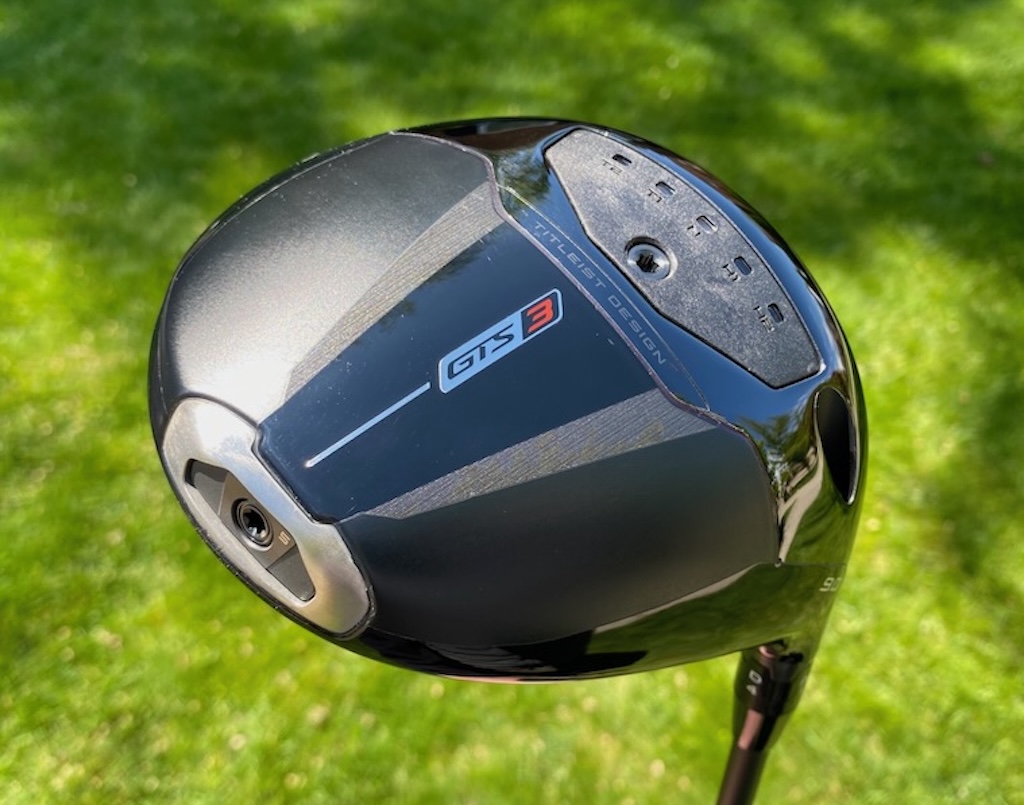
What you need to know: As is customary for the Fairhaven-based company, Titleist officially announced today that its GTS drivers are headed to retail, following a successful tour release. The GTS2, GTS3, and GTS4 drivers will be available in golf shops June 11.
Since debuting at the Texas Children’s Houston Open, the new GTS lineup has quickly gained traction on the PGA Tour, with more than 50 players already making the switch to a GTS2, GTS3, or GTS4 driver. Among them are Justin Thomas and Jordan Spieth.

Justin Thomas’ Titleist GTS2 driver (Greg Moore, GolfWRX)
According to Titleist, the GTS series builds upon the performance foundation established by the GT Series, while introducing several major technological advancements, including a new Split Mass Frame construction, refined aerodynamics, and an updated Speed Sync face design.

2026 Titleist GTS drivers: What’s new, key technology
Split Mass Frame and thermoform body
At the center of the new GTS lineup is a redesigned internal structure: the Split Mass Frame. This technology works with a full-thermoform body made from Titleist’s Proprietary Matrix Polymer (PMP), a lightweight composite that enables engineers to reposition mass more efficiently throughout the head. Compared to the previous GT generation, GTS drivers feature nearly double the PMP material, increasing from 13 grams to 26 grams, while maintaining the sound and feel preferred by better players.
The weight savings from the thermoform construction allowed Titleist engineers to strategically separate mass placement inside the head. Specifically, more weight is pushed rearward to improve stability and forgiveness, while additional mass is positioned low and forward to optimize speed, launch, and spin.
In short, golfers are able to maintain ball speed and consistency across both centered and off-center strikes.

Faster aerodynamics
Titleist also refined the aerodynamic shaping of the GTS heads to help players generate more clubhead speed.
The tails of the new GTS2 and GTS3 heads have been raised compared to previous models, helping airflow stay attached to the crown and sole longer during the swing. According to Titleist, the improved airflow reduces drag and increases speed without affecting launch conditions or center of gravity placement.
Typically, aerodynamic gains can compromise forgiveness or launch characteristics, but the weight savings from the Split Mass Frame allowed engineers to preserve preferred CG locations.

New Speed Sync face
The new Speed Sync Face design is engineered to improve ball speed retention across a larger portion of the face. A reinforced perimeter structure helps maximize face deflection and COR on centered strikes, while the upper portion of the support ring is opened up to increase speed on high-face impacts, a common strike location for many golfers. The face also features a variable thickness design to preserve speed and performance across a wider impact area.
Expanded adjustability
Each GTS model includes a dual-weighting system to fine-tune launch, spin, and shot shape more precisely than previous generations. GTS2 uses interchangeable forward and aft weights, while GTS3 and GTS4 combine a rear weight with an adjustable forward track weight system.
Tour-inspired face graphics
The new lineup features redesigned high-contrast face graphics to improve alignment and framing at address, according to Titleist. Sharp visual lines are designed to make it easier to center the golf ball and to perceive loft more easily at setup.

Additional model details
GTS2

- The GTS2 is the most forgiving model, designed for golfers seeking maximum stability and consistent speed across the face.
- It produces high launch with mid spin and features a larger, confidence-inspiring profile behind the ball.
- Standard weighting includes an 11-gram forward weight and a 5-gram rear weight, with additional fitting configurations available.
GTS3

- The GTS3 is aimed at players who want more control over launch, spin, and shot shaping.
- Compared to GTS2, the GTS3 offers lower launch and spin while featuring a more compact profile and deeper face design preferred by many stronger players.
- The head features an adjustable forward-track weight system to further fine-tune center of gravity placement.
GTS4

- The lowest-spinning option in the lineup, GTS4 is built for golfers looking to reduce excessive spin and maximize total distance.
- Unlike previous “4” models from Titleist, the new GTS4 features a full 460cc profile that improves forgiveness and stability while retaining its low-spin DNA.
- Like GTS3, it includes a forward track weighting system for precise fitting adjustments.

What Titleist says
“When we talk about driver design, it’s never about the one feature or benefit — it’s about all of them,” said Stephanie Luttrell, Titleist’s Senior Director of Metalwood R&D. “Ball speed, forgiveness, spin stability, adjustability, exceptional sound and feel… these are all attributes that golfers care about. It’s our job to design a lineup that elevates performance across the board without sacrificing in key areas, and we feel we’ve done that with GTS.”
“We know that forward CGs drive speed with great launch and spin characteristics, but you need to be able to do that with an inertial stability that still preserves ball speed, launch and spin consistency on off-center hits,” Luttrell said. “We’ve never before been able to hit these CG positions and inertia properties at the same time, and we’re achieving that because of GTS’ construction.”
Club Junkie’s take
I feel like every time there is a new Titleist wood release, I figure they can’t outdo their previous driver. And every year, I am wrong and impressed with the performance. The GTS fits right into that narrative again, as I didn’t know where Titleist could go from GT, but they pushed the limits again, and my fitting proved the smart people there found ways to improve.
My past four Titleist drivers have been a 2 series as my swing typically requires a little height, spin, and forgiveness so I figured I would just get a new GTS2 and be on my way. During the fitting, I was impressed by the new GTS construction, its added PMP material, and the advanced adjustability on each model. My fitter, Joey, got to work putting together a GTS2 and we started there. The launch and spin were great, and the consistency on misses was very tight. My average ball speed with the GTS went up a little bit as the new Speed Sync face creates more speed away from the center.
Joey then built up a GTS3 in 11 degrees, but I figured this wouldn’t have the stability I needed for tight dispersion on my miss hits. That thought was quickly erased after a few shots, and I really liked the more center start line and reduced draw on the misses I was seeing. We tried a few different settings and shafts to dial in the details in order to get the best fit. Having a forward and rear weight in the head allowed Joey to set up the GTS3 with a heavier rear weight to keep the launch and spin up, while the Sure Fit hosel set flat created a more center start line for me. My misses were not nearly as far left, and I was really impressed with the consistency on the spin and launch when I didn’t hit it in the center.
Titleist again created a wood line in GTS that delivers improvements over previous drivers while keeping the traditional look and feel you expect. More adjustability, better off-center speed, and 3 drivers that are playable over a wider range of players should make these extremely successful in fittings.
Pricing, specs, availability
GTS2 lofts: 8, 9, 10, 11 degrees (RH/LH)
GTS3 lofts: 8, 9, 10, 11 degrees (RH/LH)
GTS4 lofts: 8, 9, 10 (RH/LH)
Featured shafts
- Project X Titan Black
- Mitsubishi Tensei 1K White
- Mitsubishi Tensei 1K Blue
- Mitsubishi Tensei 1K Red
Premium shafts
- Graphite Design Tour AD DI
- Graphite Design Tour AD VF
- Graphite Design Tour AD FI
Available for fittings and pre-sale now.
In golf shops worldwide beginning June 11.
Price: $699 (standard), $899 (premium)


Titleist has today introduced its new GTS2 and GTS3 fairways.
Lower and deeper center of gravity (CG) positions, new adjustable heel-toe weights and advanced clubface innovations drive total performance in the two tour-proven models.
- Tour-inspired polished clubfaces: To help players see more of the clubface at address.
GTS2 Fairway


The new GTS2 fairway is designed with a shallower face and a larger profile than GTS3, ideal for players with more sweeping deliveries with their fairway metals.


GTS2’s new face height, inspired by tour feedback, was designed shallower than the prior generation GT2 model and more in line with the GT1 fairway. Each loft in GTS2 leverages a shallower profile except for the 13.5-degree, which maintains a slightly taller face.

With its new dual-weighting system, the ‘2’ model now has heel-toe CG adjustability.
Lofts: 13.5, 15.0, 16.5, 18.0, 21.0
Dual-weight system: 11-gram weight in heel, 5-gram weight in toe (standard)
GTS3 Fairway


The new GTS3 fairway is designed with a deeper face and a more compact profile, ideal for players who hit down on the golf ball more with their fairway metals.

New to the GTS3 family is a 21-degree offering, giving players two distinct profiles in Titleist’s 7-wood loft.


RBC Heritage Tour Report: More minis, course-specific setups, Spider & GTS launches

Justin Rose WITB 2026 (April): Full WITB breakdown with new McLaren irons

Best fairway woods of 2026: The most versatile fairway woods + the most forgiving fairway woods

What’s the story behind Webb Simpson’s custom-stamped irons?

Cadillac Championship Tour Report: Spieth’s sizable changes, McLaren Golf launches, and more

The 24 players who can win the Masters

Rory McIlroy’s winning WITB: 2026 Masters

Kristoffer Reitan’s winning WITB: 2026 Truist Championship

J.J. Spaun’s winning WITB: 2026 Valero Texas Open

Cameron Young’s winning WITB: 2026 Cadillac Championship


Alex Fitzpatrick WITB 2026 (May)
Driver: Ping G440 LST (9 degrees) Shaft: Fujikura Ventus Black 6 X 3-wood: TaylorMade Qi4D (15 degrees) Shaft: Fujikura Ventus...

Kristoffer Reitan’s winning WITB: 2026 Truist Championship
Driver: Ping G440 Max (9 degrees) Shaft: Mitsubishi Tensei 1K White 60 TX 3-wood: Ping G440 Max (15 degrees) Shaft:...


WITB Time Machine: Rory McIlroy’s winning WITB, 2021 Truist Championship
Rory McIlroy’s victory at the 2021 Wells Fargo Championship 2021 (now the Truist Championship) marked a significant return to form,...


Collin Morikawa WITB 2026 (May)
Driver: TaylorMade Qi4D LS (8 degrees) Shaft: Mitsubishi Diamana D+ Limited 60 TX 3-wood: TaylorMade SIM Tour (14 degrees) Shaft:...
-
 Equipment2 weeks ago
Justin Rose WITB 2026 (April): Full WITB breakdown with new McLaren irons
-
 Equipment1 week ago
What’s the story behind Webb Simpson’s custom-stamped irons?
-
 Equipment2 weeks ago
Cadillac Championship Tour Report: Spieth’s sizable changes, McLaren Golf launches, and more
-
Whats in the Bag4 days ago
Kristoffer Reitan’s winning WITB: 2026 Truist Championship
-
 Whats in the Bag2 weeks ago
Cameron Young’s winning WITB: 2026 Cadillac Championship
-

 Whats in the Bag3 weeks ago
Nelly Korda WITB 2026 (April)
-

 Equipment2 weeks ago
Justin Rose on the switch to McLaren Golf, learnings from previous equipment moves
-

 Tour Photo Galleries2 weeks ago
Photos from the 2026 Cadillac Championship


Phil
Mar 26, 2016 at 10:09 am
This is, by far, my favorite bit you guys do! Love the revealing photos from each tournament and the commentary. Great stuff!
richard
Mar 27, 2016 at 8:26 am
I love it as well. Andrew… the “how to start a rumor?” – love that. LOLOLOL
Taco John
Mar 26, 2016 at 12:16 am
AUstin Country Club has been in 3 different locations. The original AUstin country club moved to Riverside in 1950 and then moved to where it is now in 1984 the course that Crenshaw and Kite learned from Harvey was the riverside course. Riverside is now owned by Austin Community College.
Red McCombs
Mar 25, 2016 at 12:30 pm
Harvey Penick worked at the Original Austin Country Club which is now Riverside Golf Course which is a Press Maxwell Design. That is where Tom Kite and Ben Crenshaw learned to play. Austin Country Club moved across town in the 1980s and this course was designed by Pete Dye. It is the not the same course with the all of Penick history but the same club.
Kirk
Mar 25, 2016 at 5:50 pm
Hi Red. The original ACC is now part of Hancock Park GC.
I was a student of Mr. Penick 1967-71.
RG
Mar 25, 2016 at 10:59 pm
So don’t be such a smarty pants Red.