
19th Hole
A hacker plays the big ones: Pt. 4


“A Hacker Plays The Big Ones” is a short story authored by Steven R. Roberts. The short story, written two months following the trip, tells the tale of Roberts and his friend, Bob Blackman’s, golf odyssey around Scotland in the 1970s where the two played four of most historic courses in the game: St. Andrews, Carnoustie, Muirfield and Gleneagles.
We have broken the short story into a four-parter and here is the final part.
The final day of competition was at Muirfield Golf Club near Scotland’s southern border. It’s officially known as the “Company of Honorable Gentlemen from Edinburg”, and it was the only private club we attempted to play. We arrived to find only one car in the parking lot.
“Could you direct us to the Pro Shop?” I asked the club secretary.
“Muirfield da noot hoov a pru ship,” (or a pro for that matter), he said. “Ya kin buy bells un tees if ya moost.” There you have the Scottish disdain for things commercial. There were no souvenir shirts, hats, gloves or bag tags for sale at Muirfield. One imagines any money prize awarded at the Open Championship to be held in 1980 will be slipped under the winner’s door in a plain white envelope.
Standing in front of the clubhouse, you can see across the rugged links course to the sea. Some 40 miles north across the Firth of Forth lies yesterday’s winner, St. Andrews, and another 40 miles north across the Tay River is the rugged Carnoustie.
Just a word about the course. Bob and I decided it would be tough on a calm day, but the gales blow off the sea without relief. Muirfield members say if there was a day without wind, they wouldn’t know what to lean against.
The rough is knee-high everywhere you look except for the thin strips of the fairways. Some players think there may be whole families living in the tall grass. Nicklaus used his driver only four times per round in winning in 1966. But as tough as the course was tee to green, the greens were tougher. On the third hole, my caddie, another of the weathered veteran survivors of the sea breezes, spent some time telling me exactly how my uphill 30-footer broke. I steadied myself over the ball and took a stroke which traveled to the crest of the break and stopped. As I took a step forward, the ball turned, slowly rolling back down the hill coming to rest at my feet. My caddie turned to look out at the sea. He didn’t bother to read my putts again for the rest of the round.
Moving on, the 17th hole, a 530-yard par 5, was going to provide an appropriate climactic stage for the finishing moments of the scheduled 1980 Open. Bob’s caddie advised that in some wind conditions the par five is reachable in two. On my second shot, I swung a three wood with both feet off the ground and was able to reach the front of the green. Bob got lucky and put his second shot within 100 feet from the pin. He two-putted for a birdie. I won’t bore you with the details, but I managed to sink a two-footer for my six.
Finishing off the round with two pars, we took some comfort in the fact that Gary Player took a double bogie six on the final hole to win the Open Championship in 1958.
We packed up our wet gear and said goodbye to four days of soaking in the adventure of Scottish golf. On the drive home that afternoon and evening, Bob and I played the “if only” game, a favorite of all golfers. This technique allowed us to imagine away five or six shots a round. Looking back over the four rounds, each course had the devil buried inside its character. Carnoustie was a weathered Scottish seaman’s face; Gleneagles was a soft, classy lassie with curves in the right places; St. Andrews was the ceremonial lord of the manor with understated British strength and style; and Muirfield was a wicked woman with her fringed skirt flapping in the breeze – aggravating because you suspect she’s easy for some but not for you.
We also distributed the prizes on the drive home. Bob beat me two rounds, and we tied for two, so he won ten pounds and six golf balls. He had six birdies during the week compared to my four, so Bandit Bob won another 40 pence. Luckily, he didn’t have any eagles or holes in one.
I was driving when we passed the Nottingham Forest exit about halfway home. I slowed down to let a sheriff’s car pass me in hot pursuit. I supposed he was looking for Robin Hood. The sheriff would be well advised, I thought, to check out the sandy-haired hood sitting in the dark, chuckling quietly in the passenger seat of my car.
I was also smiling. If Bob doesn’t play again for a week, he is going to have a real surprise. Before we loaded up at Muirfield, I found a city of termites under the woodwork in the hotel. I’d spent half the night collecting the squiggly little termite biters, and I was able to poke the putter shaft through the bag and slide it down the shaft, finally securing the bag to the shaft midway with tape. In a week Bob will find only a clubhead, grip and a pile of sawdust after the little beasties have a go at that tasty shaft.
But alas, Bob and I have had a week of living out a dream. We have walked the same fairways and greens that have been walked for centuries of golfers, from the founding fathers of the game to the stars of recent years. No other sport provides its fans such an opportunity to so closely assimilate the physical challenges of its major championships. The average amateur baseball player is not permitted to walk to the pitcher’s mound in Yankee Stadium and pitch three innings, and the weekend football nut cannot play running back at Heinz Field stadium facing the Pittsburgh Steelers. But we stood on the same spot on the 17th fairway at St. Andrews and faced the same wind off the Forth of Firth that has humbled the greats of the game for centuries. All the more is the hacker’s thrill if he somehow carries his ball over the trap and keeps it from bouncing over the green onto the road.
So, that’s my story from a week in the middle of October 1979. Having read this only slightly-exaggerated report on our trip, you are exempt from listening to my telling of the story in the event we run into each other at a cocktail party somewhere down the road. But if after a few drinks the conversation turns again to lifelong dreams, my answer will be the same. There are many more courses out there to be concurred. But, do me a favor. Bob is still raw over the mysterious pulverizing of his wooden shaft. If he’s around, just don’t say anything about another trip.
Author’s note: This story was originally written two months after the trip. I sent a copy to my former teammate at college and attached is a reproduction of his response. He finished second to Tom Watson at Muirfield in 1980. I should have been on the bag and helped him read those tricky greens


Rory McIlroy made it two wins in as many years at Augusta National, seeing off the challengers on a dramatic Sunday to slip on the green jacket once again. The victory earned Rory a whopping payday of $4.5 million, with Scottie Scheffler his closest challenger earning $2.43 million for his sole runner-up finish.
With a total prize purse of $22.5 million up for grabs, here’s a look at how much each player won at the 2026 Masters tournament.
For players that did not make the cut, they still earned $25k for their efforts at the year’s opening major.
- 1: Rory McIlroy, $4.5 million
- 2: Scottie Scheffler, $2.43 million
- T3: Tyrrell Hatton, $1.08 million
- T3: Russell Henley, $1.08 million
- T3: Justin Rose, $1.08 million
- T3: Cameron Young, $1.08 million
- T7: Collin Morikawa, $725,625
- T7: Sam Burns, $725,625
- T9: Xander Schauffele, $630,00
- T9: Max Homa, $630,00
- 11: Jake Knapp, $562,500
- T12: Jordan Spieth, $427,500
- T12: Brooks Koepka, $427,500
- T12: Hideki Matsuyama, $427,500
- T12: Patrick Reed, $427,500
- T12: Patrick Cantlay, $427,500
- T12: Jason Day, $427,500
- T18: Viktor Hovland, $315,000
- T18: Maverick McNealy, $315,000
- T18: Matt Fitzpatrick, $315,000
- T21: Keegan Bradley, $252,000
- T21: Ludvig Aberg, $252,000
- T21: Wyndham Clark, $252,000
- T24: Matt McCarty, $182,083
- T24: Adam Scott, $182,083
- T24: Sam Stevens, $182,083
- T24: Chris Gotterup, $182,083
- T24: Michael Brennan, $182,083
- T24: Brian Campbell, $182,083
- T30: Alex Noren, $146,250
- T30: Harris English, $146,250
- T30: Shane Lowry, $146,250
- T33: Gary Woodland, $121,500
- T33: Dustin Johnson, $121,500
- T33: Brian Harman, $121,500
- T33: Tommy Fleetwood, $121,500
- T33: Ben Griffin, $121,500
- T38: Jon Rahm, $105,750
- T38: Ryan Gerard, $101,250
- T38: Haotong Li, $96,750
- T41: Justin Thomas, $92,250
- T41: Sepp Straka, $87,750
- T41: Jacob Bridgeman, $83,250
- T41: Kristoffer Reitan, $78,750
- T41: Nick Taylor, $74,250
- 46: Sungjae Im, $69,750
- 47: Si Woo Kim, $65,250
- 48: Aaron Rai, $61,650
- T49: Corey Conners, $57,600
- T49: Marco Penge, $57,600
- 51: Kurt Kitayama, $55,250
- 52: Sergio Garcia, $54,000
- 53: Rasmus Hojgaard, $52,650
- 54: Charl Schwartzel, $51,300

While Sunday was a dramatic day at the Masters, many golf fans were left feeling frustrated by the CBS final round coverage.
There were plenty of moments that golf fans took to social media to air their frustrations on Sunday over, including a lack of shots being shown throughout the day, being behind the live action, confusion over the approach shots of the final group on 18, and providing an angle for the winning putt where the cup couldn’t be seen.
Here’s a look at some of the criticisms that were directed at the CBS coverage throughout the day on X:


This has been a brutal broadcast for CBS. When the folks from Augusta sit down with them this year, you can bet they’ll talk about this 15 seconds where we have no idea where Rory’s ball went, and Dottie moans. #TheMasters pic.twitter.com/ak3mkpIN7V
— Ryan (@PossiblyRy) April 12, 2026
It’s rare criticism coming in for CBS, who are usually heavily praised for their Masters coverage each year.

Tommy Fleetwood goes in search for the first major victory of his career again this week, with the Englishman proving to be a popular pick at Augusta National.
Fleetwood’s best showing at Augusta came back in 2024 where he finished T3, and while speaking at his pre-tournament press conference, the 35-year-old emphasized the importance of his 9-wood in his pursuit of the green jacket.
Speaking on Tuesday to media, Fleetwood said:
“It’s a great 9-wood golf course. I think it’s always been — I can’t remember when I first put like a 9-wood in or a high lofted club, but it’s a perfect like 9-wood golf course. I’ve had that in the bag for a few years.”
The Englishman continued, revealing that his strategy for the week won’t just be to hit driver off the tee as much as possible:
“Yeah, it’s funny really because I know Augusta is probably associated with being fairly forgiving off the tee in a way, so you think you can whale around driver a little bit. But I don’t necessarily think that’s always the play for me. I think there’s holes that set up really well where I can draw it with the mini driver if I’m feeling less comfortable with the driver and things like that.”
That strategy he believes will make his TaylorMade Qi10 9-wood extra critical this week in Georgia:
“The biggest thing is the 9-wood for me. If I can put myself in position on the par-5s or the 4th long par-3, like it — for me, I can’t really hit that high 4-iron, so 9-wood helps me a lot.”

Tommy Fleetwood WITB 2026

RBC Heritage Tour Report: More minis, course-specific setups, Spider & GTS launches

Justin Rose WITB 2026 (April): Full WITB breakdown with new McLaren irons

Best fairway woods of 2026: The most versatile fairway woods + the most forgiving fairway woods

What’s the story behind Webb Simpson’s custom-stamped irons?

Cadillac Championship Tour Report: Spieth’s sizable changes, McLaren Golf launches, and more

The 24 players who can win the Masters

Rory McIlroy’s winning WITB: 2026 Masters

Kristoffer Reitan’s winning WITB: 2026 Truist Championship

J.J. Spaun’s winning WITB: 2026 Valero Texas Open

Cameron Young’s winning WITB: 2026 Cadillac Championship


Alex Fitzpatrick WITB 2026 (May)
Driver: Ping G440 LST (9 degrees) Shaft: Fujikura Ventus Black 6 X 3-wood: TaylorMade Qi4D (15 degrees) Shaft: Fujikura Ventus...

Kristoffer Reitan’s winning WITB: 2026 Truist Championship
Driver: Ping G440 Max (9 degrees) Shaft: Mitsubishi Tensei 1K White 60 TX 3-wood: Ping G440 Max (15 degrees) Shaft:...


WITB Time Machine: Rory McIlroy’s winning WITB, 2021 Truist Championship
Rory McIlroy’s victory at the 2021 Wells Fargo Championship 2021 (now the Truist Championship) marked a significant return to form,...


Collin Morikawa WITB 2026 (May)
Driver: TaylorMade Qi4D LS (8 degrees) Shaft: Mitsubishi Diamana D+ Limited 60 TX 3-wood: TaylorMade SIM Tour (14 degrees) Shaft:...
-
 Equipment2 weeks ago
Justin Rose WITB 2026 (April): Full WITB breakdown with new McLaren irons
-
 Equipment1 week ago
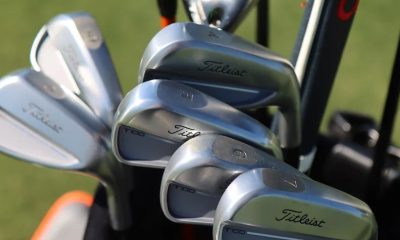
What’s the story behind Webb Simpson’s custom-stamped irons?
-
 Equipment2 weeks ago
Cadillac Championship Tour Report: Spieth’s sizable changes, McLaren Golf launches, and more
-
Whats in the Bag3 days ago
Kristoffer Reitan’s winning WITB: 2026 Truist Championship
-
 Whats in the Bag1 week ago
Cameron Young’s winning WITB: 2026 Cadillac Championship
-

 Whats in the Bag3 weeks ago
Nelly Korda WITB 2026 (April)
-

 Equipment2 weeks ago
Justin Rose on the switch to McLaren Golf, learnings from previous equipment moves
-

 Tour Photo Galleries2 weeks ago
Photos from the 2026 Cadillac Championship

