
Equipment
The story of Nickent Golf: From breakthroughs to bust

The golf equipment business is full of companies that have come and gone.
For some, it was quick—“Mac Burrows,” anyone?—and for others, it was a slow decline with some of the best examples being Ram and Founders Club (Remembering golf’s forgotten big brands).
But when it comes to “what could have been” in the golf industry, to me there is one company that stands out above the rest in the modern equipment business: Nickent.
From the very beginning
Our story begins with Nickent playing the part of an entry-level custom “clone” brand—but this era didn’t last long.
Although it’s difficult to put an exact date to it, Nickent quickly changed its tune and started creating its own original designs. That’s when things really started to take off for the company. The first line was under the Genex Cross name, and then soon after the 3DX was launched, which included the famous Genex Ironwood—one of the finest hybrids of all time.
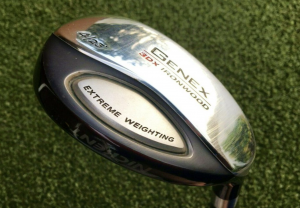
As much as Adams gets well-earned credit for pioneering the modern hybrid to the mainstream market, Nickent was right there around the same time—and its designs appealed to both better players and higher handicaps alike.
Overall, the clubs weren’t flashy, but they worked, and beyond the designs, they also found a sweet spot in retail at a price point just below where the big OEMs played, while still offering great performance. I can distinctly remember working golf retails when Nickent was at its peak and for those players who wanted new clubs, Nickent was a go-to brand that offered hundreds of dollars in savings compared to the major players.
So how did they do it at a lower price point?
Behind the Nickent design curtain
The keys to any club’s performance starts with a great design ( shocking right?), and Nickent had a little secret weapon up its sleeve—John Hoeflich. I realize this name is unknown to many people, but John is an industry veteran and was the person behind the second most famous iron of all time: the Tommy Armour 845 (with number one being the Ping Eye2). John was also the designer behind another extremely popular iron, the TaylorMade RAC LT.

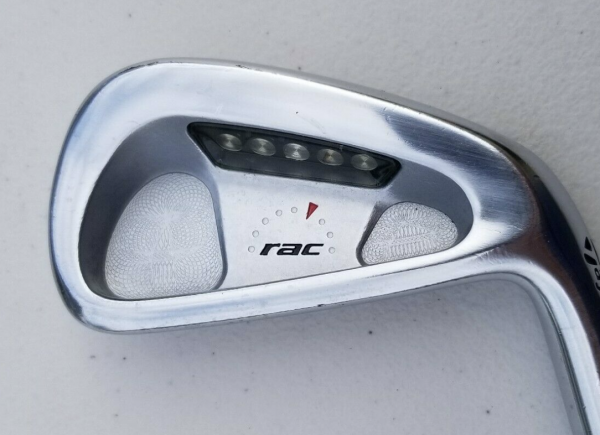
John was brought aboard by Michael Lee, the founder, and owner of Nickent. The smaller team allowed them to be nimble in the market and also kept the cost low, which was passed down to the consumer. They had a small tour presence which helped to create buzz; Jim Furyk was among the early adopters, but beyond that, it was print media and word of mouth through retail channels that helped Nickent quickly grow.
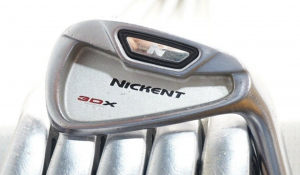
The most noted irons produced by Nickent were the forged 3DX Pros, and what set them apart on the retail level, beyond their looks and price, was the stock shaft offering—the Nippon NS Pro 1180. Most “players irons” at the time still came stock with heavier shafts designed to lower ball flight but the lightweight Nippon offered a stable yet easier to hit option players loved—and that lead to sales!
Nickent innovations
Nickent wasn’t afraid to innovate the industry and try new things—it’s one of the benefits the smaller company had.
“The exciting thing about Nickent is that we dont have to be afraid to try anything and the chain of command is very short! Our creativity isn’t stifled by big corporate business blockades, we are not risk aversive, we dont have to protect 30% market share, so we can do whatever the heck we want as long it is a quality product and people like it.”
– John Hoeflich (2005 Golf Channel interview)
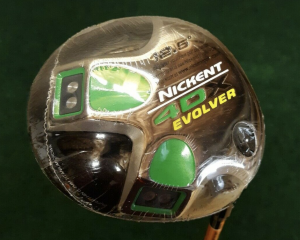
They had hybrids that utilized multi-material construction along with forged irons with vibration dampening cavity inserts (3DX and 4DX pro irons), but the two biggest innovations they brought to the mainstream market before their demise still have design relevance today—the ARC blades and the 4DX Evolver driver

ARC Blades
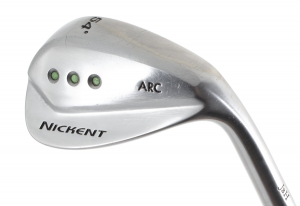
ARC stood for “Active Rebound Core,” and the ARC blades could be credited as one of the first modern true hollow “players” irons. There was even a point when Bubba Watson played an ARC lob wedge.
4DX Evolver driver
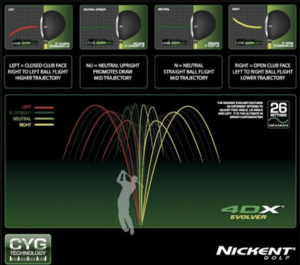
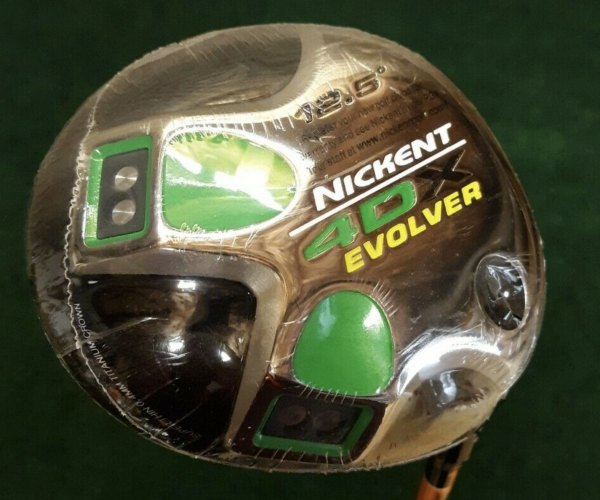
The 4DX Evolver was the first 460cc adjustable hosel driver and came with two interchangeable shafts when you bought it.
The driver even led to a small lawsuit with TaylorMade when Nickent ran an aggressive print ad claiming the 4DX was the “Number 1 driver on tour.” The ad featured an asterisk noting it was the Number 1 driver model at a Nationwide Tour event but it created enough heat at the time TaylorMade decided to step in—from memory the lawsuit never really went anywhere.
*for some reason, this is the kind of stuff is seared into my memory
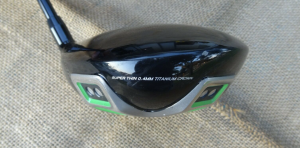
The 4DX’s construction was impressive beyond just the adjustability and touted 0.4mm thick crown—a number that is still impressive by today’s standards.
But even with all the technological breakthroughs and growing tour staff, it wasn’t long before Nickent’s eventual demise.
So what really ended it?
As a smaller company, Nickent’s death was attributed to a number of culminating events, with the biggest being something it had no control over—the 2008 financial crash. That market decline was the final nail in the coffin.
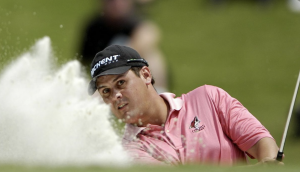
Leading up to 2008, Nickent was growing fast, and ownership was ready to take the company to the next level and make it “one of the big guys.” It made a substantial investment on the PGA Tour into staff players—including former U.S. Am Champ Jeff Quinney along with Tim Petrovic—as well as investing in a state-of-the-art tour trailer.
To accomplish all of this Nickent took on debt, both for marketing and inventory to cover the expected sales growth numbers. Unfortunately, the rising costs were too much of a burden for the smaller company and its single financial backer, and when club sales dried up in 2008 and the industry slowed down over the next few years, it was too much all at once. In May of 2009, Nickent went into receivership, and that was that—the beginning of a steep decline for Nickent.
The brand was eventually bought and turned into a house brand for Golf Galaxy, but it only lasted a few more years before being shelved entirely.




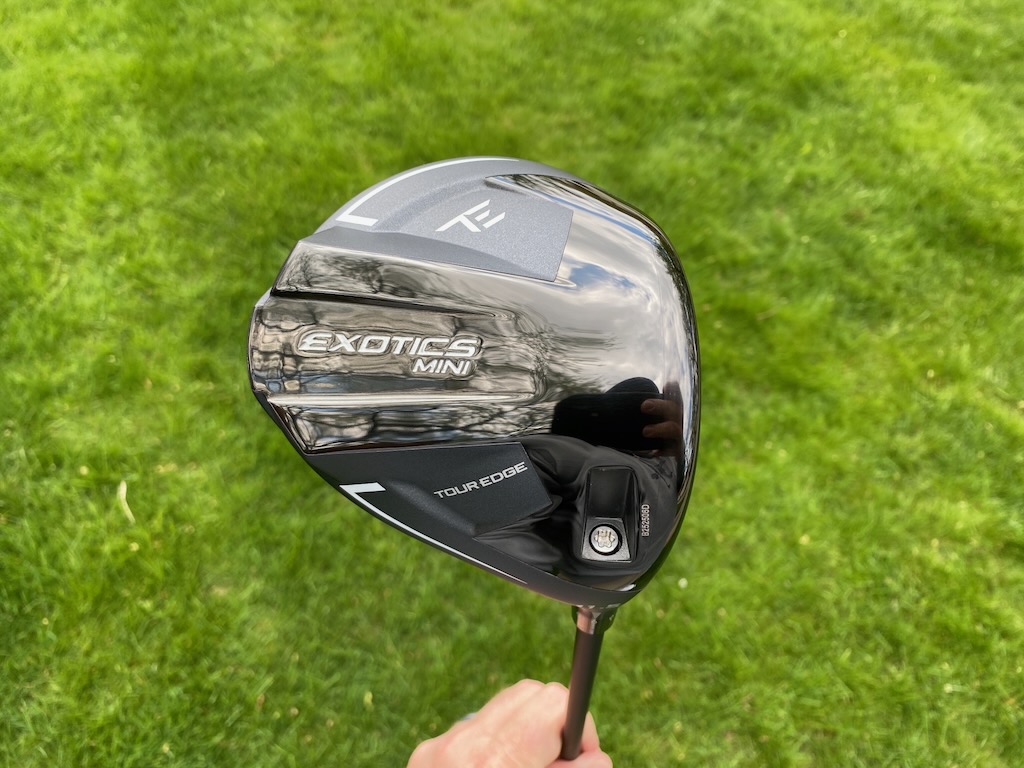
Tour Edge Golf has today introduced the all-new Exotics mini driver, engineered to deliver a powerful combination of speed, control, and versatility in the long game.
The Exotics Mini combines a titanium face with a stainless-steel body in design to balance ball speed with stability and control, creating a versatile option at the top end of the bag.

At the core of the design is Tour Edge’s proprietary Combo Brazing technology, a high-precision thermal bonding process that seamlessly fuses a titanium cup face to a stainless-steel body into a single, continuous structure. By eliminating energy loss found in traditional multi-piece constructions, Combo Brazing is designed to deliver faster face response, more efficient energy transfer, and a uniquely powerful yet controlled feel.

The multi-material construction also allows mass to be positioned lower and deeper in the head in a bid to increase stability, while the thin titanium face is engineered to maintain ball speed across a wider impact area.

“While the initial goal was to enhance control and versatility in the long game, Combo Brazing ultimately drove measurable gains in ball speed and distance within the mini driver category. In robot testing, we’ve documented higher ball speeds, higher launch, reduced spin, and increased carry and total distance compared to leading models.” – Vice President of R&D Matt Neeley

In addition to distance performance, the Exotics mini emphasizes forgiveness through a heavier stainless-steel body that shifts mass toward the perimeter. This configuration increases MOI relative to traditional all-titanium mini drivers, helping preserve ball speed and directional stability on off-center strikes. Paired with Pyramid Face Technology from the Exotics metalwood line, the design is intended to support consistent speed across the face.

To further enhance MOI, a lightweight carbon fiber crown frees additional mass that is strategically repositioned low and deep in the head in design to improve stability and promote optimal launch with controlled spin.

“We designed the Mini to be about five millimeters shallower than other mini drivers on the market. That change improves playability off the deck. From a clean fairway lie, it can function as a strong 3-wood alternative while still providing control off the tee.” – Tour Edge CEO David Glod
An adjustable hosel system allows for loft and lie tuning to dial in trajectory and shot shape, while a fixed 13-gram rear weight helps stabilize the head through impact to improve dispersion consistency. The Exotics Mini Driver is available in 11.5 and 13.5-degree lofts in right-handed models.

Pricing & Availability
The Exotics Mini Driver is available for pre-order beginning today for $399.99 USD at touredge.com, and will be available for purchase at retail outlets worldwide on May 22, 2026.

In our forums, our members have been pitting a Srixon ZXi combo against a TaylorMade P7CB/770 combo. WRXer ‘edutch22’ is on the hunt for a new set of irons and kicks off the thread saying:
“Looking at picking up a new set of irons and think I’ve narrowed it down to Srixon ZXi combo or Taylormade P7CB/770 combo. I am currently a 5 cap and allbeit I feel irons are my weakness. My miss is a little to the toe side. I am decently steep at 4-5 down. Always thought I am high spin but recently on trackman my 7 was spinning at 5800 roughly.
My question or looking for thoughts on which one would benefit me more from a forgiveness standpoint? Or is there another iron is should be looking at entirely? I only get to play about once or twice a week, if I am not playing a 2-3 day event. Thanks in advance.”
And our members have been sharing their thoughts and suggestions in response.
Here are a few posts from the thread, but make sure to check out the entire discussion and have your say at the link below.
- manima1: “You just can’t go wrong with Srixon ZXi7.”
- MattM97: “You have to hit them to know, the V-Sole on the Srixon can be make or break for many.”
- dmeeksDC: “P7CB is more forgiving for me than ZXi7 because my main miss is low middle and the P7CB still flies and spins great on that miss. These are both really nice irons but I like the P7CB more than the Zxi7 and the P770 (or P790) more than the Zxi5. The Srixons are larger so if that gives you confidence that is the way to go. I don’t feel like I get any benefit from the V-sole and the P7CBs live up to their high Maltby forgiveness rating so the TaylorMades have been great for me.”
Entire Thread: “Srixon ZXi combo or TaylorMade P7CB/770 combo? – GolfWRXers discuss”

At GolfWRX, we are a community of like-minded individuals who all experience and express our enjoyment of the game in many ways.
It’s that sense of community that drives day-to-day interactions in the forums on topics that range from best driver to what marker you use to mark your ball. It even allows us to share another thing we all love – buying and selling equipment.
Currently, in our GolfWRX buy/sell/trade (BST) forum, @pianoman0123 has a 2024 Wilson Staff CB/Blade combo up for grabs.

From the listing: “2024 Wilson Staff CB/Blade Combo. 4-8 irons are CB’s and the 9,PW are Blades. 5-PW have Project X 6.0 Shafts and the 4 Iron has a Steelfiber CW110 Stiff Shaft. Standard Length, Lie and Lofts. These are in very good condition the shafts just don’t work for me. Like new Lamkin Grips on the 5-PW and a stock Golf Pride on the 4 Iron. $525 OBO.”
To check out the full listing in our BST forum, head through the link. If you are curious about the rules to participate in the BST Forum, you can learn more here: GolfWRX BST Rules

RBC Heritage Tour Report: More minis, course-specific setups, Spider & GTS launches

Justin Rose WITB 2026 (April): Full WITB breakdown with new McLaren irons

Best fairway woods of 2026: The most versatile fairway woods + the most forgiving fairway woods

What’s the story behind Webb Simpson’s custom-stamped irons?

Cadillac Championship Tour Report: Spieth’s sizable changes, McLaren Golf launches, and more

The 24 players who can win the Masters

Rory McIlroy’s winning WITB: 2026 Masters

Kristoffer Reitan’s winning WITB: 2026 Truist Championship

J.J. Spaun’s winning WITB: 2026 Valero Texas Open

Cameron Young’s winning WITB: 2026 Cadillac Championship


Alex Fitzpatrick WITB 2026 (May)
Driver: Ping G440 LST (9 degrees) Shaft: Fujikura Ventus Black 6 X 3-wood: TaylorMade Qi4D (15 degrees) Shaft: Fujikura Ventus...

Kristoffer Reitan’s winning WITB: 2026 Truist Championship
Driver: Ping G440 Max (9 degrees) Shaft: Mitsubishi Tensei 1K White 60 TX 3-wood: Ping G440 Max (15 degrees) Shaft:...


WITB Time Machine: Rory McIlroy’s winning WITB, 2021 Truist Championship
Rory McIlroy’s victory at the 2021 Wells Fargo Championship 2021 (now the Truist Championship) marked a significant return to form,...


Collin Morikawa WITB 2026 (May)
Driver: TaylorMade Qi4D LS (8 degrees) Shaft: Mitsubishi Diamana D+ Limited 60 TX 3-wood: TaylorMade SIM Tour (14 degrees) Shaft:...
-
 Equipment2 weeks ago
Justin Rose WITB 2026 (April): Full WITB breakdown with new McLaren irons
-
 Equipment1 week ago
What’s the story behind Webb Simpson’s custom-stamped irons?
-
 Equipment2 weeks ago
Cadillac Championship Tour Report: Spieth’s sizable changes, McLaren Golf launches, and more
-
Whats in the Bag3 days ago
Kristoffer Reitan’s winning WITB: 2026 Truist Championship
-
 Whats in the Bag1 week ago
Cameron Young’s winning WITB: 2026 Cadillac Championship
-

 Whats in the Bag3 weeks ago
Nelly Korda WITB 2026 (April)
-

 Equipment2 weeks ago
Justin Rose on the switch to McLaren Golf, learnings from previous equipment moves
-

 Tour Photo Galleries2 weeks ago
Photos from the 2026 Cadillac Championship


Holmer
Aug 29, 2022 at 3:09 am
I just added a 4DX 3 “Iron wood” to the bag. It was passed around the guys for a few weeks before it was handed to me. My first thought was this is not for me. I don’t care all that much about branding, but the 20 degree loft it says it has is only a single degree stronger than the Speedzone 4 hybrid I bought last year. But I guess because it’s lighter and of course has a slightly longer shaft, it actually fit the gap between the 4 hybrid and my Cobra 4 wood which I have set to 16 degrees as far is distance is concerned. The club has found a home in my bag.
From the very first swing I was taken with it. That first shot was from the fairway, uphill 30 feet or so to a green that was wider than it was deep and 195 yards away. And while it ran off the back onto the first cut a few inches it barely missed landing in the hole. When you get that with your first swing, you know you have a winner in your hands.
Pingback: Morning 9: Whataberger! | Is the Spieth half empty or half full? | Winning WITB – GolfWRX
Chris
Feb 14, 2021 at 9:35 am
Good article. Still in my bag today complete set of 4dx irons,hybrids and 4dx Evolver driver. Left handed so options were limited back then. Still love them.
NevadaBobs
Feb 14, 2021 at 12:15 am
The GH+ irons (X14) were as good as the real deal. These irons also helped golfers realize graphite shafts could be good for more than seniors, they were available with the UST Proforce “Laker Shafts” in regular and stiff. I also remember them having great customer service, I think her name was Chablis. She was rad, hope she sees this post.
ChipNRun
Feb 13, 2021 at 10:35 pm
The Nickent hybrids were industry leaders. The drivers and irons, however, were mainly niche fads which didn’t get wide traction.
Looking back at golf club manufacturing, the number of OEMs has gone down and up and down since the 1970s. The following figures come from company counts available in Ralph Maltby’s 1995 4th ed. of “Golf club Design, Fitting, Assembly and Repair.
* Early 1970s: 14 main OEMs (this was about the time Karsten/Ping was gaining traction, and people with aerospace backgrounds were getting into club design)
* Late 1980s: 31 OEMs active in the USA market.
In the mid-1990s a shakeout comes, as several brands such as MacGregor and Hogan and TopFlite are sold, and sold again. Others go out of business. Big holding companies are not as patient with quirky golf divisions as are golf insiders and loyalists.
In the 2008 Recession, several brands finally crash. Hogan, MacGregor and Nickent among them. Hogan goes to Callaway for the Edge brand, then gets bought out and resurrected circa 2015 by a Texas group. MacGregor and Nickent become house brands before finally fading out. Adams gets bought by TaylorMade, and then fades away. Another shakeout… (Callaway still owns TopFlite.)
Charles Hamilton
Feb 13, 2021 at 10:14 pm
Sheesh, give the guy a break! Brief it may be, but the article is a great read. I can only imagine the vitriol unleashed on the writer if he had written a comprehensive wall to wall article. Then the complaints would have been that it was too long, boring, this ‘n that, and that ‘n this about a late great has been golf company that did not make it. I had a Nick hybrid that served me well till I got ahold of Taylormade’s offerings. Great write up Ryan, keep ’em coming!
Jim
Feb 13, 2021 at 10:07 pm
I had two of the evolver drivers because I put in bids on E-Bay and won them both…both were new still plastic wrapped and both cost less then $100..and still in golf shops.(when E-bay had deals) I sold one and played the other till one of the back weights came off during a round somewhere. Loved the green color and head cover and it played as good as anything at the time…
ChipNRun
Feb 13, 2021 at 7:36 pm
The Nickent hybrids were industry leaders. The drivers and irons, however, were mainly niche fads which didn’t get wide traction.
Looking back at golf club manufacturing, the number of OEMs has gone down and up and down since the 1970s. The following figures come from company counts available in Ralph Maltby’s 1995 4th ed. of “Golf club Design, Fitting, Assembly and Repair.
* Early 1970s: 14 main OEMs (this was about the time Karsten/Ping was gaining traction, and people with aerospace backgrounds were getting into club design)
* Late 1980s: 31 OEMs active in the USA market.
In the mid-1990s a shakeout comes, as several brands such as MacGregor and Hogan and TopFlite are sold, and sold again. Others go out of business. Big holding companies are not as patient with quirky golf divisions as are golf insiders and loyalists.
In the 2008 Recession, several brands finally crash. Hogan, MacGregor and Nickent among them. Hogan goes to Callaway for the Edge brand, then gets bought out and resurrected circa 2015 by a Texas group. MacGregor and Nickent become house brands before finally fading out. Adams gets bought by TaylorMade, and then fades away. (Callaway still owns TopFlite.)
A. Commoner
Feb 13, 2021 at 5:09 pm
A nice, interesting read. (Also sad.) Would welcome more like it.
flagolf
Feb 13, 2021 at 4:27 pm
You forgot the part when nickent was offering sales associates at off course retailers HUGE spiffs to sell their products. At one point a set of 3dx irons, woods and a pipe putter put almost $200 in the sales associates pocket.
Don
Feb 13, 2021 at 4:03 pm
I owned 2 of the ironwoods and the arc wedges. They were the best clubs in my bag at the time. Consistent and always got me out of trouble.
Too bad. Was a decent company at the time.
Bern
Feb 13, 2021 at 3:59 pm
So this is a really cool company to do a little profile on but was there any consideration put into doing a full comprehensive story on them opposed to just reminiscing? Exact dates, responses/quotes from former owners and employees, revenue #s etc…would have been really cool to see on Nickent and many other club companies that came and went. Lynx, Adams, Tommy Armour, Liquid Metal, Sonartec, Hogan, etc. Are all companies that long time club ho’s know and love and would love to read the “behind the scenes” rise and fall.
I have no idea if your job with WRX is to write such detailed and “investigative” type of stories but would certainly read them if you went that route.
Mike
Feb 14, 2021 at 9:27 am
Get a life! Better yet, go research this yourself if you’re that interested, there’s thing called the “internet”. This article told me just enough of what I wanted to know.
matt
Feb 14, 2021 at 9:43 am
Relax pal. The guy was respectful, just giving content feedback, you don’t have to agree. If this isn’t the place to do that I’m not sure where he should.
ben
Feb 13, 2021 at 1:43 pm
Thanks for this very teachful article. Hopefully more To come on the golf industry history!
Greg B.
Feb 13, 2021 at 11:29 am
The Genex 3DX ironwoods were pretty revolutionary at the time. Like many, I struggled hitting anything longer than a 5-iron consistently, and when I heard the initial buzz about them I went to my favorite golf shop the check them out. The owner had only a few demo clubs because he could not keep them in stock. I bought first a 3-iron replacement, which arrived in a couple of weeks, then a 4. They weren’t as easy to hit as some that came later, but were well-made and worked. It’s a shame that 2008 took them down along with a few other brands like MacGregor.