
Equipment
TaylorMade R1 V2 TP driver to hit the market


We’ve detailed the different TaylorMade R1 heads previously (as far back as March in this article and much earlier in the forums). Now, some four months later, TaylorMade is officially releasing the TaylorMade R1 V2 TP driver, a.k.a. the “tour-only R1,” to the general public.
The driver, which is available for pre-order now, has an expected in-stock date of July 17th and costs $599, $200 more than the retail version of the R1 cost when it was released in January.

So, what’s different about this version of the driver, which “tunes to any loft, any look, and any flight?”
As you might have guessed, it’s smaller. We originally noted that TaylorMade had produced a smaller-headed version of the R1 for tour use in March. As we said then, “the R1 Version 2 is 440 cubic centimeters, 20 CCs smaller than the retail version.”
A key benefit of the smaller head is its decreased weight, which allows the use of heavier tour spec shaft, which better players usually prefer. To this point, the stock shaft for the V2 is the 65 g Aldila RIP Phenom, rather than the 55 g model, which is standard in the original R1.
The 440 CC club head, of course, maintains the same proportions as the v1, as well as the same tunability. The configuration of the sole of the club, however, is slightly different and more compact, as evidenced by our early shots of the V2’s sole.

Is this R1 V2 TP is the “same” in every way to the ones being played by Dustin Johnson and Sergio Garcia? As to that, we’ll leave Pandora’s Box closed for the time being.
(For a full recap of the R1’s technology and features, see our Editor Review of the TaylorMade R1, here.)
Click here to read what members are saying about the R1 V2 in the forums.



Equipment
Putters that never made it: Check out some of the best tour builds that didn’t make the cut

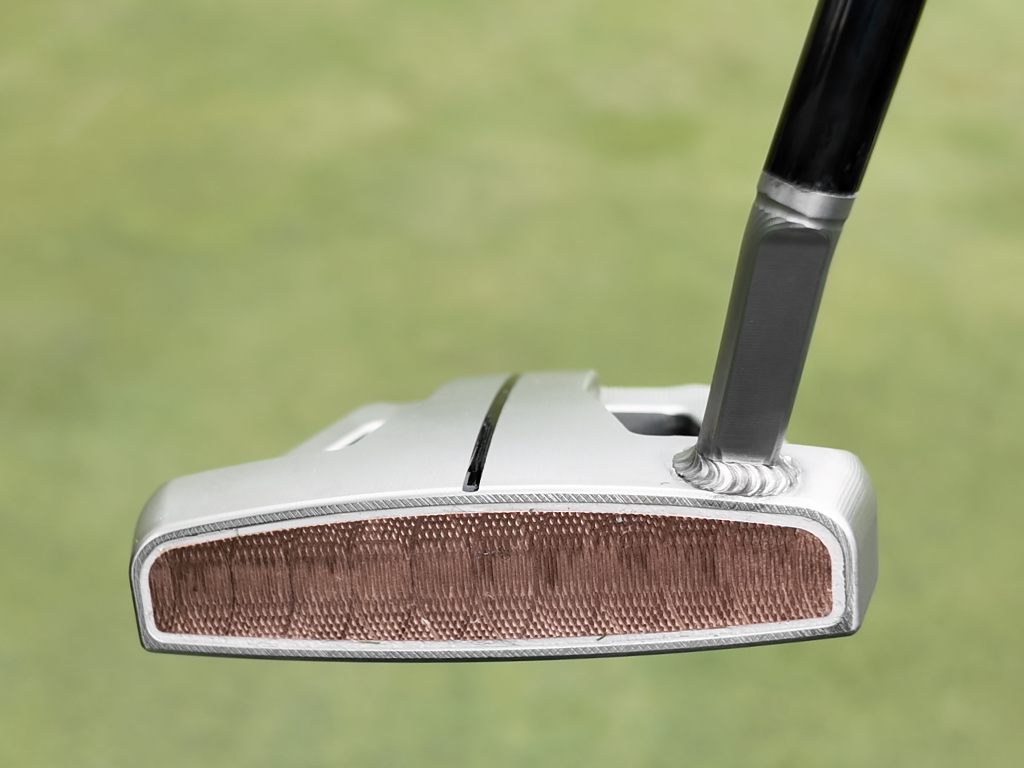
Arguably, the best perk of being a professional golfer on the PGA Tour is the ability to request or even just be handed pretty much any club you could think of. It happens more often than you think, usually with putters around the practice green from one event to the next. Come Wednesday, the Tour bags lining the edge of the putting surface become resting places for fallen flatsticks that never made the cut.
So let’s take a look at some of the best we’ve seen out on Tour this year that never made it to the competition. (You may notice none of Hideki Matsuyama’s custom Scotty Cameron putters made this list. There are too many.)
Let’s start with this custom Damascus Milled Odyssey Rossie made for Ryo Hisatsune. Featuring a single line and the short-slant hossel, we’ve seen plenty of Number 7 and jailbird heads featuring the Damascus Milled insert, but this is the first and only one we’ve spotted in a Rossie. Hisatsune primarily putts with an Odyssey Black Series iX #9, but we have seen him recently with a TaylorMade TP Collection SOTO, so there could be potential that the Damascus Milled Rossie could end up in the bag.

Everyone wants to be Cameron Young right now. We’ve had Justin Thomas and Tom Hoge both game the Scotty Cameron 9.5R prototype. Well, for the PGA Championship, Brooks Koepka nearly joined that list after requesting the same style of putter, with the full-length alignment line. But the Scotty Cameron reps took the request a step further and made one specially for Koepka with a Teryllium insert, similar to one in his previous Newport 2 gamers. The reason why this one didn’t go into play, though? Because it was too heavy.

Harry Hall was the third-best putter on Tour last year, so when Bettinardi made him a custom proto, you know it was going to be good. The custom BB28 blade features VDF face milling, a custom-welded single-bend shaft, and the owner’s initials – HH – on the sole of the putter. Hall, who usually games an Odyssey O-Works #7 W, has dabbled with a TaylorMade Spider Tour X already this year. Maybe there’s a chance this Bettinardi might make his bag.

Honestly, this one doesn’t need a description. It’s Kieth Mitchell’s custom Scotty Cameron Napa. One Scotty Cameron face stamp, two Scotty Dogs, two Scotty Cameron 7-Point Crowns and one Circle T. That is all. Oh, except for the Cashmere Cameron headcover.

Finally, and just for fun, how about we pour one out for this TaylorMade Spider Tour X made for Scottie Scheffler in its new torched finish. It’s unlikely we’ll see a putter change anytime soon from the best golfer in the world. In fact, he hit just two putts with it on the Harbour Town practice before going back to his trusty gamer.


Driver: Titleist GT3 (9 degrees) Buy here.
Shaft: Aldila Rogue Silver 130 M.S.I. 70 TX


3-wood: TaylorMade Qi35 (15 degrees)
Shaft: Fujikura Ventus Blue 7 X

7-wood: TaylorMade Qi35 (21 degrees)
Shaft: Fujikura Ventus Blue 8 X

Irons: Grindworks PR-202 (4), Grindworks PR-101A (5-PW)
Shafts: True Temper Dynamic Gold Tour Issue X100


Wedges: Cleveland RTX6 Tour Rack (52-10 Mid), Titleist Vokey Design SM10 (56-08M), SM11 (60-04T)
Shafts: True Temper Dynamic Gold Tour Issue S400


Putter: Scotty Cameron Tour Rat 1.5 Tour Prototype


Ball: Titleist Pro V1x
Grips: Golf Pride MCC


In our forums, our members have been discussing their favorite major winning irons used by Tiger Woods. WRXer ‘golferdude54’ kicks off the thread saying:
“Mizuno MP 14/29. Titleist 681T. Nike Forged Blades. TaylorMade P7TW.
Among these irons that helped Tiger win 15 majors, which is your favorite in terms of looks?”
And our members have been naming their favorites and why in response.
Here are a couple of posts from the thread, but make sure to check out the entire discussion and have your say at the link below.
- SwingBlade: “I prefer the early blades he played and the more recent TM TW’s especially because after Tiger had his major behavioral setbacks, part of Nikes support payback was making Tiger play a Nike putter and cease using his beloved uniquely customized Scotty putter.”
- ProjectX: “This (Nike Forged Blades) and there’s not even a close second.”
Entire Thread: “Which of Tiger’s major winning irons are your favorite? – GolfWRXers discuss”

Justin Rose WITB 2026 (April): Full WITB breakdown with new McLaren irons

RBC Heritage Tour Report: More minis, course-specific setups, Spider & GTS launches

What’s the story behind Webb Simpson’s custom-stamped irons?

Cadillac Championship Tour Report: Spieth’s sizable changes, McLaren Golf launches, and more

Kristoffer Reitan’s winning WITB: 2026 Truist Championship

Cameron Young’s winning WITB: 2026 Cadillac Championship

Aaron Rai’s winning WITB: 2026 PGA Championship

Nelly Korda WITB 2026 (April)

Justin Rose on the switch to McLaren Golf, learnings from previous equipment moves

Photos from the 2026 PGA Championship


Patrick Reed WITB 2026 (May)
Driver: Titleist GT3 (9 degrees) Buy here. Shaft: Aldila Rogue Silver 130 M.S.I. 70 TX 3-wood: TaylorMade Qi35 (15 degrees)...

Aaron Rai’s winning WITB: 2026 PGA Championship
Driver: TaylorMade M6 (9 degrees) Shaft: Aldilda Synergy Blue 70 TX 3-wood: TaylorMade Qi10 (15 degrees) Shaft: Fujikura Ventus Blue...


Michael Block WITB 2026 (May)
Driver: TaylorMade Qi4D (9 degrees) Shaft: Fujikura Ventus Black VeloCore+ 5 X 3-wood: TaylorMade Qi4D (15 degrees @14.25) Shaft: Mitsubishi...


Bryson DeChambeau WITB 2026 (May)
Driver: Krank Formula Fire Pro (6 degrees) Shaft: Project X Prototype 3-wood: Krank Formula Fire (10 degrees) Shaft: LA Golf BAD...
-
 Whats in the Bag3 weeks ago
Kristoffer Reitan’s winning WITB: 2026 Truist Championship
-
Whats in the Bag2 weeks ago
Aaron Rai’s winning WITB: 2026 PGA Championship
-
 Tour Photo Galleries3 weeks ago
Photos from the 2026 PGA Championship
-
 Equipment2 weeks ago
GolfWRX Launch Report: 2026 Titleist GTS drivers
-

 Equipment2 weeks ago
PGA Championship Tour Report: Fitzpatrick, Koepka among big-name putter switches for Aronimink
-

 News2 weeks ago
WITB Time Machine: Phil Mickelson’s winning WITB, 2021 PGA Championship
-

 Equipment2 weeks ago
Which of Tiger’s major winning irons are your favorite? – GolfWRXers discuss
-

 Equipment2 weeks ago
Lead Tape Report: Adjusting the swingweight of the Wanamaker Trophy


Benny46
Oct 8, 2013 at 7:24 pm
Can anyone tell me why I keep seeing 2 different serial number fonts on the V2 heads? I’ve had my hands on 4 different V2 heads and 3 outta the 4 were a light font while the other a more pronounced. Any answered would be interesting.
Ron
Jul 21, 2013 at 4:46 pm
Iagree
Greg
Jul 15, 2013 at 3:27 pm
Can someone please tell me how to “preorder” one of these secret clubs?
Rob
Jul 11, 2013 at 1:01 am
Why does a lighter head allow for the use of heavier shafts. I would of expected the reverse
Jim
Jul 10, 2013 at 6:04 pm
I don’t think you guys get it. A g25 head is a a G25 head, the pros play the same head as consumers that cost $350. They get fit for a shaft and loft that fits their swing.
I was not calling the V2 a clone, the one that has been selling in stores is a clone of what tour pros are playing, as in its a cheaper club. I recently heard not a single player on tour plays the retail head of the R1, obviously something is wrong there.
Boo
Jul 10, 2013 at 11:34 pm
Agreed! We have the right to play what we choose, or we can go to a manufacturer that will offer us what we want, not some watered down retail head different from tour heads!
John
Jul 13, 2013 at 7:54 am
This is my exact argument. Every other company but taylormade has retail versions of there drivers in play. The whole problem with taylormade is them acting like every pro on tour plays his “r1” that is completely different from the one they sell. Yes, nike has several drivers too, but players still play retail versions, not a single retail r1 is in play. But taylormade is sure as hell going to try and advertise that the pros play the r1. Doesn’t matter if the retail r1 is better for the average golfer, it’s still straight up BS marketing by taylormade.
Don
Jul 10, 2013 at 4:36 pm
Any chance that a V2 RBZ Stage 2 Tour Driver will become available? Do like the smaller heads that were available with some of the old TP Models.
John
Jul 10, 2013 at 1:44 pm
I don’t get it anymore…why do people want the exact same driver tour pros use? I keep hearing Dustin Johnson’s name and driver being thrown around…if anyone on the site were given his EXACT driver it would undoubtedly hurt their game…the only differences in their club fitting is that the loft, face angle and cog is permanent…go get fit and if you want it to be permanently fixed, pay to have the head hot-melted but expect to pay a premium…enough whining about not getting a superbly fit, premium club for a retail price, it’s not gonna happen. Everything available to tour players is available to us (with the exception of prototype shafts) if you know where to look and are willing to pay for it, tour players don’t have to pay because they’ve EARNED access to these services.
Sean
Jul 9, 2013 at 11:54 pm
I wonder how much of a difference it would make for the average golfer?
Brian
Jul 10, 2013 at 9:13 am
I think the biggest difference it will make for amatuers will be in their credit card statements
Boo
Jul 10, 2013 at 11:38 pm
The tour heads are not for the “average” golfer! That would be the retail head.
Devin
Jul 9, 2013 at 6:25 pm
No taylormade clubs in my bag, and not at all a taylormade fan either, but I will be giving this head a serious look. With the combination of the adjustability like the original r1, with a smaller, lower spinning profile, I look forward to giving this a shot to get in the bag.
cw
Jul 9, 2013 at 5:18 pm
Yup,the trolls probably couldnt hit the ball with the tour equipment :o)
bravesgolf
Jul 9, 2013 at 4:00 pm
If you don’t like TMAG, just don’t buy their stuff. I won’t buy this driver because it’s the tour version and I’m a club golfer but If people want to buy it, good for them. TMAG make good golf clubs as do all OEM’s out there. It’s all about personal preference and what works for your game. The last time I checked, it’s a free world and people can buy whatever they like. It’s getting old that people rag on TMAG all the time. If you don’t have something nice to say, don’t say anything at all.
Honmagolfan
Jul 9, 2013 at 5:13 pm
Agreed!
Boo
Jul 10, 2013 at 11:36 pm
Seriously???
Curt
Jul 9, 2013 at 9:53 am
Good move TM!!!
Be sure to keep offering the exact heads used by the pro’s or we will go elsewhere, as we have of late. Also, please up your game on shaft options!!!! You know its all about being properly “fit”, so please give us as a huge selection so we can get the shaft that fits our swing.
Thanks for cutting the bullsh__ TM!!!!
Andy (2)
Jul 9, 2013 at 8:53 am
Amazing how when a golf ball manufacturer makes balls for different levels of players / club speeds then they are applauded. However TM make drivers for real people and they get slated by trolls for not selling pro clubs to amateur golfers.
When they do offer the pro clubs then the trolls are back saying they are too expensive / still not the version the Tour Pro’s are playing / testing.
Just a shame the Trolls can’t think of anything nice to say. I don’t even understand why they read a thread with TaylorMade in the title as they are already angry !
John
Jul 9, 2013 at 7:24 am
Or go with callaway or another company that already listened to there customer, don’t over charge and give them the heads they want with good shafts in the first place, not after everyone preaches how $h!tty of company taylormade.
Jim
Jul 9, 2013 at 2:51 am
Guess how much the G25 that Hunter, Bubba, etc. play… $350. This is lame, once again Taylormade. This comes months after all your loyal faithfuls that believe your marketing buy your clone clubs that only appear to look like what the pros play, real weak!
Andy
Jul 9, 2013 at 7:11 am
Jim… I’ve actually hit this V2 and it is not a clone / marketing ploy. They actually do make a different head that is lower spinning for tour level players. I think this news is absolutely spectacular. This is them basically bringing TP back into play. These clubs don’t cost any more for them to make besides getting a premium shaft, so why should we have to pay $1,000 on eBay to get a tour performance club. I think it’s a huge win for them to make this option available for $600. If I can get the shaft I want for that price, I’ll be standing in line.
P.S… show me where you can get exactly what Bubba and Hunter are playing (shaft & all) for $350.
Gfunk
Jul 9, 2013 at 5:03 pm
Show were it says that you can get any shaft the pros are using for $600. It appears that you get a relatively cheap aldila rip phenom shaft. Again, it’s TM being TM.