
Opinion & Analysis
Statistics that make a great Ryder Cup player and the 2014 U.S. Team standings


With the Ryder Cup upon us this year, I want to look at the status of the U.S. team from a statistical perspective throughout the season leading up to the event. The U.S. team will have Tom Watson as its captain with four of the 12 members being appointed by Watson. The other eight players will make the team based on points earned.
With that said, what makes for a good Ryder Cup player? This was one of the first things I examined as best as I could since most statistical data prior to 2004 is limited. In the end, I found that there were two player attributes that work very well in the Ryder Cup: a great short game from less than 20 yards around green and good putting.
Look at many of the great all-time Ryder Cup players and they tend to have this common trait: Nick Faldo, Seve Ballesteros, Ian Poulter, Luke Donald, Jose Maria Olazabal, Billy Casper, Larry Nelson, Bernhard Langer and Arnold Palmer. I don’t think anything changes the momentum in a Ryder Cup match than a player who can get his team out of trouble and save crucial pars when the other team thinks it has the hole won.
Great iron play is a player attribute that is a bit less common than a great short game, but there have been plenty of great Ryder Cupper known for their precise iron play. Think of golfers like Colin Montgomerie, Sergio Garcia, Lanny Wadkins and Lee Trevino. They were all great iron players, but they weren’t nearly as good at the other parts of the game.
What makes a good fourball pairing?
Fourball is often referred to as “best ball.” This is where the best score between two players on one team is matched against the best score between two players on the other team. All of the data concludes that the best fourball players make a lot of birdies. This is why Jim Furyk has struggled in the fourball pairings; he typically ranks low on the PGA Tour in birdie percentage.
I feel the best way to pair a fourball team is to look at the players who make a high percentage of birdies, and to pair them up based on their performance on par-3’s, par-4’s and par-5’s. For instance, if both players make a lot of birdies but only play the par-4’s well, they are likely to have difficulty winning the par-3’s and par-5’s. With that said, a captain should value par-4 play the most because there are nearly 2.5 times more par-4’s on the course than the par-3’s or par-5’s.
One of my all-time favorite pairings was J.B. Holmes and Boo Weekley in 2008. Weekley is one of the premier drivers on Tour and would tee off first. He was routinely blasting it 20 yards past Lee Westwood and still finding the fairway. When Weekley would find the fairway, that allowed Holmes to have a free rip at the ball and often times he would hit it 380 yards. If he was playable, he increased his odds of winning the hole outright. If it wasn’t, the steady ball striking of Weekley would still mean that the team had a good chance to win or tie the hole. After the front nine you could see Westwood was visibly frustrated playing the pair.
What make a good foursome pairing?

Foursome play is often referred to as “alternate shot.” Unlike the fourball play, the better players tend to be better at avoiding bogies than making birdies. Historical trends also show that the better foursome format players tend to be very good short game players around the green. Mistakes are going to be made in the foursome format and it helps to have players who can counter those mistakes and end up avoiding bogies.
It is vital for the captain to pair players based on their strengths and weaknesses as well. For instance, a poor pairing would be something like Phil Mickelson and Zach Johnson. Johnson does not play well from the rough and Mickelson struggles to find the fairway. That’s why Johnson and Jason Dufner worked so well at Medinah. Dufner was one of the most effective drivers of the ball in the world at the time, and hit a lot of fairways. That played right into one of Johnson’s strengths of hitting shots from the fairway. And that year Dufner was one of the premier iron players from longer than 150 yards and had a great year with his short game.
Versatility, youth and experience
One of the key components to fielding a team is that the captain should favor player versatility and youth over experience. A captain should look for players who can be effective in both the fourball and foursome formats. If a player struggles badly in the Friday morning foursome matches, the captain may need to sit that player until the Sunday individual matches. And that will require the captain to find a replacement for that player in the Saturday foursome matches. The more versatile the roster is, the more options the captain has and the more the captain can hide the players who are playing poorly.
This leads us to the players who continually make the Ryder Cup based on their experience instead of their performance. We see this every Ryder Cup from the U.S. team. The captain ends up picking a player who usually has a poor Ryder Cup record, but has ample experience. In my opinion, that thinking is tragically flawed because it tells us that the player has experience at underperforming at the Ryder Cup. There are always players who never get that chance at the Ryder Cup, and we are left wondering how they would have performed if they were given the opportunity. But here we have certain players who have been given the opportunity to play in the Ryder Cup and we know that they will perform poorly.
Often times it is not the player’s fault. For instance, Davis Love III caught a lot of flak for making Jim Furyk a captain’s pick. Furyk played brilliantly in all of 2012 and actually played quite well at the Ryder Cup. His playing partner, Brandt Snedeker, played poorly and cost him a match with what was thought of as Europe’s best team in Rory McIlroy and Graeme McDowell. And Furyk was within a small fraction of halving his match with Sergio Garcia. The issue with Furyk is that he is not a versatile player. He is only good for the foursome format and given his age, Love had to limit the matches he could play in order to keep him fresh. So if Furyk came out on fire, the captain can’t use him in the rest of the matches in fear of burning him out.
Here’s a look at the top-12 U.S. players in Ryder Cup points so far (accurate as of 9/10/14), as well as a breakdown of their strengths and potential best pairings.
1. Phil Mickelson

Mickelson’s getting up there in age, but he has developed a game that is more versatile for Ryder Cup play. He is usually best suited for fourball, but with his vast improvement in his putting since working with Dave Stockton he has made himself a much better Foursome player if he is paired with a player who can hit difficult shots out of the rough like Keegan Bradley or Bubba Watson. However, Watson is a weak putter and short game player and would not likely make a good foursome player.
So there are some limitations on what Phil can do given his age and style of play, but he is likely more effective of a Ryder Cup player than any other time in his career. Mickelson’s issues always come down to his driver, but he has actually struck the ball well off the tee so far this year.
2. Jason Dufner
If Dufner regains his 2012 form where he was an elite driver, iron player and short game artist, he is nearly ideal as a Ryder Cup player because he can play in either format with just about any type of player and make their job quite easy. Dufner’s iron play dropped off quite a bit in 2013 and then picked up before the PGA Championship. He’s never been a great putter, but if the rest of his game is like it was in 2012 then Watson should be able to work around it.
3. Dustin Johnson
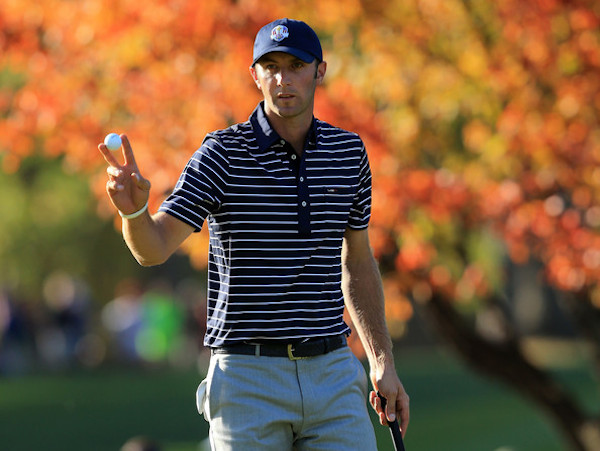
For a bomber, Johnson is quite versatile because he has shown the ability to perform well in numerous parts of the game. For example, he ranked 12th in short game play in 2013. Johnson is still best suited for fourball given his ability to make birdies, and he performs extremely well on the par-3’s and par-5’s. He is one of those players that could get hot early on and Captain Watson could ride out for the rest of the tournament.
4. Ryan Moore
Moore is ranked 4th because of the start to his 2013-2014 season, as his 2013 season was not overly impressive. He tends to make more birdies than bogeys, and driving is typically the strength of his game. I think he is best suited for the fourball format with a golfer that can really bomb it off the tee and plays the par-3’s well (i.e. Dustin Johnson). I would have Moore tee off first and get his drive out there. If he executes, then let the bomber get a free rip at the ball. I am remain skeptical, however, that Moore can continue this pace and earn a spot on the U.S. team.
5. Harris English

English is only in his 2nd season on Tour so I have limited data on his game. He ranked 17th in Birdie Percentage in 2013, and was very good on the par-4’s and par-5’s. He is also a great putter (14th in Putts Gained in 2013) and a good driver of the ball. His iron play and short game will have to improve this year in order to consider him for the foursome format. For now, he is clearly a favorite for the fourball format and I would probably try to pair him with a strong par-3 and par-4 player (i.e. Dustin Johnson, Jason Dufner, Phil Mickelson, etc).
6. Webb Simpson
Simpson had two very different years in terms of ballstriking in 2012 and 2013. In 2012, he was arguably the best iron player in the world, particularly from the fairway, but he struggled mightily off the tee. In 2013 he drove it fairly well (67th in Driving Effectiveness), but regressed into an above average iron player. He only ranked 77th on iron shots from the fairway.
Meanwhile, his putting and short game remained quite steady, being very good in both areas of the game. He is excellent at the par-3’s, par-4’s and par-5’s and is better at making birdies than bogeys, but ranks well in both categories. This makes for a versatile player, but he is better suited for fourball. I liked his pairing with Bubba Watson in the fourball in 2012, but not in the foursome format. It’s really going to depend on what style of play shows up for Simpson in 2014.
In 2012, the simulations favored Simpson playing with Jason Dufner in the foursome format. If the Ryder Cup was held in 2013, Brandt Snedeker would have been the most favorable partner for Simpson in the foursome format.
7. Jimmy Walker
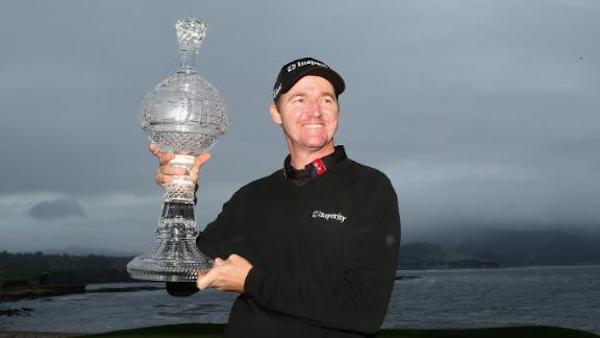
Walker has been putting extremely well in the 2013-2014 season, which has led to his current ranking in Ryder Cup points. He hits it very long, but he was a mediocre driver of the ball last year (155th in Driving Effectiveness). He was also mediocre on iron shots from the fairway (124th), but excellent from the rough (16th). Walker ranked 26th in both Birdie Percentage and Bogey Avoidance and played the par-4’s and par-5’s very well. This leads me to believe at this moment he is not very versatile as a Ryder Cup player and is mostly suited for the fourball format.
I would pair Walker with a player that can play the par-3’s well like Dustin Johnson or Webb Simpson. If I had to put him in the foursome format, I would look for a long, but effective driver of the ball: someone who can hit it long so that it can make up for Walker’s weak iron play. And a player that has a good enough short game to clean up any of Walker’s misses. Dustin Johnson appears to be an ideal partner in this format.
8. Chris Kirk
Kirk has the makings of a breakout star if he makes the Ryder Cup. Just take a look at these rankings in key metrics in 2013:
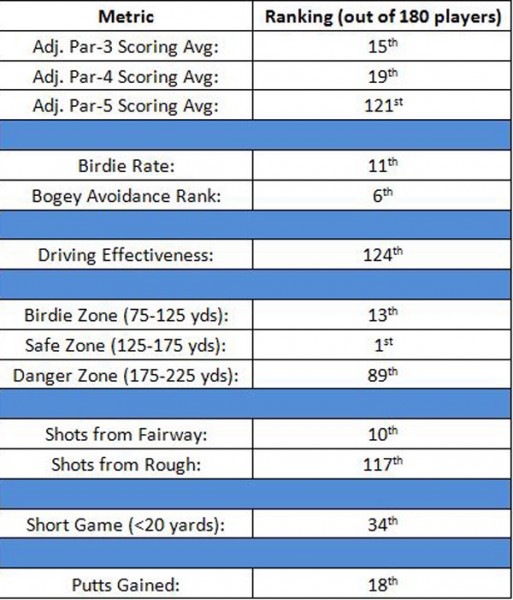
Kirk would be best suited for fourball given his ability on the par-3’s and par-4’s, as well as his ability to make a lot of birdies. He would just need to be paired with a great par-5 player like Bubba Watson, Phil Mickelson, Tiger Woods or Keegan Bradley.
Kirk could fit into the foursome format if he is paired with the right player. He will need a partner who drives it effectively while keeping the ball in the fairway. That will play right into Kirk’s strength of hitting iron shots from the fairway. And the longer and more accurate the golfer, the better it works for Kirk since he is so good from inside 175 yards. My simulations show that Kirk would work nicely with Keegan Bradley, Jordan Speith, Webb Simpson and Kevin Streelman.
9. Jim Furyk
Keep him out of the fourball format and you’re pretty much fine. I would also pair him with an accurate driver of the ball as hitting out of the rough is not one of Furyk’s specialties, as well as a golfer who hits it well from 175-or-more yards given Furyk’s lack of distance off the tee. Zach Johnson would be a nice pairing. The same goes for Jordan Spieth and Steve Stricker.
10. Jason Bohn

Bohn is a longshot to make the team, and is on this list based on his play at the Shriners Hospital For Children Open and OHL Classic at Mayakoba. He also turns 41 years old in April.
His strength has always been his iron play from inside 175 yards, particularly from the fairway. He did rank 35th in Birdie Percentage last year, but ranked 119th in Bogey Avoidance. I think he’s best suited for the fourball format with a partner who makes a lot of birdies, but also does a great job of avoiding bogeys and plays the par-5’s very well. The numbers would favor Bohn being paired with Tiger, Stricker or Keegan Bradley in the fourball format.
In the foursome format, he would probably only work well with Bubba Watson because of Watson’s length and overall effectiveness off the tee. Bohn is an unlikely Ryder Cup candidate, but stranger things have happened.
11. Gary Woodland
Woodland seems to finally be getting his game to click. He’s a power player and was struggling to play towards that strength. However, he is likely relegated towards the fourball format because he is one of the worst short game players on Tour. And despite his power, he has never been a great player on the Par-5’s.
Woodland ranked 27th in Birdie Percentage and 92nd in Bogey Avoidance in 2013. So, he would best off with a high-birdie-rate player who can avoid bogeys and play the par-4’s and par-5’s well in the fourball format. Webb Simpson could be an excellent fit for him. If he were to play in the foursome format, it would be best to stick him with an excellent iron player — particularly from the rough — who can putt well to make up for Woodland’s struggles from around the green. Jordan Spieth, Phil Mickelson and Brandt Snedeker top the list as the most suitable teammate for Woodland in the foursome format.
12. Brian Stuard

Stuard recorded three top-6 finishes in a row and also had a T15 at the Shriners, which has earned him his top-12 ranking thus far. Stuard is 31 years old and not a long hitter, but he drives it effectively off the tee (68th in 2013) and putts pretty decently (79th in Putts Gained in 2013). He’s a very steady, Jim Furyk-type of player who ranked 23rd in Bogey Avoidance and 138th in Birdie Percentage. This means that if he were to make the Ryder Cup, he would fit more into the foursome format and should avoid the fourball format at all costs.
Stuard would be best paired with a good iron player, particularly from the fairway to take advantage of his accurate driving and to avoid his need to scramble (Stuard was 131st in Short Game play in 2013). It would also help to have a partner who can find the fairway off the tee in order to help him with his below average iron play. Therefore, he would fit best with Furyk, Spieth, Tiger or Snedeker at this point in time.
Look for an update, Part 2 of this series, after the 2014 Masters!


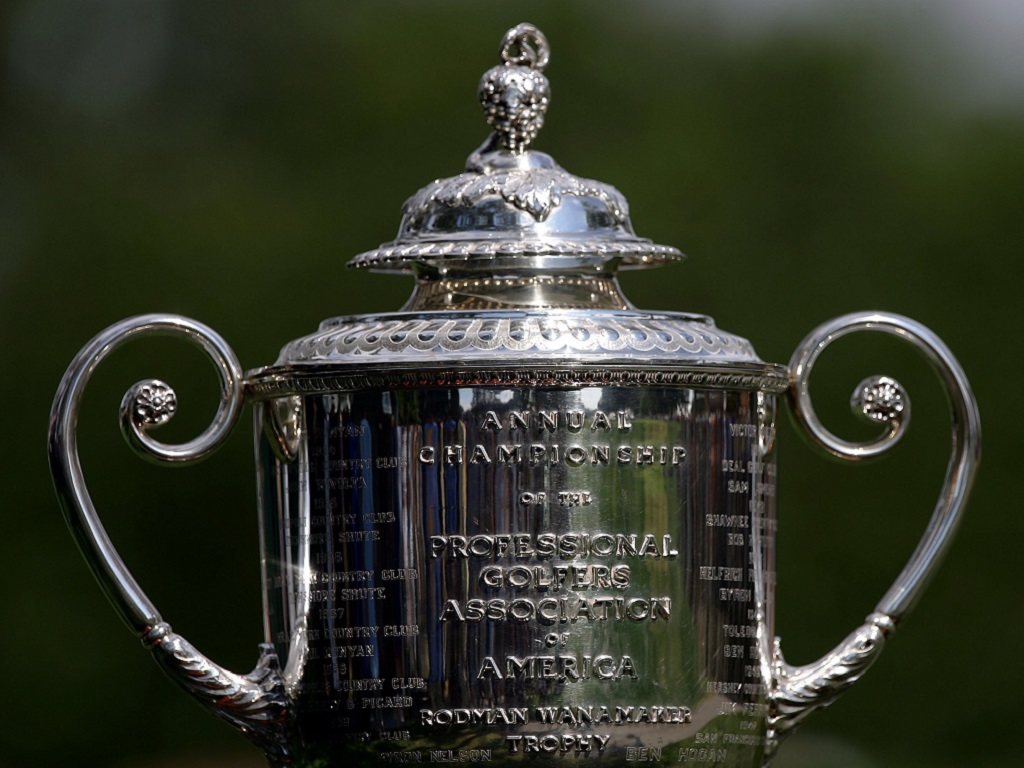
Aronimink is not a storied club, but when Donald Ross himself proclaimed it to be as good as he can design and build, one had to take notice. Jay Sigel was the pre-eminent male amateur golfer from the mid-1970s to the mid-1990s. He might have called any number of Philadelphia clubs home, but he chose Aronimink. It served him well. Gary Player won a PGA Championship here in 1962, and was followed by the 1993 winner … nobody. Aronimink gave that event away to Inverness, for reasons of which it is certainly not proud. So be it. We had to wait sixty-four years for the PGA to return to Newtown Square, but here we are. Aronimink has been neo-restored by Gil Hanse and team, to return Ross features with an eye toward defense against the dark arts, errrr, high-tech equipment.
Day one saw Rory McIlroy and Bryson DeChambeau dig big holes, to the tune of plus-four and plus-six, respectively. Since the first-round lead will be minus-three at worst, many shots will need to be made up for the power couple to reach contention. By nightfall, seven golfers held the day-one lead at three-under par 67. Shots and sticks caught our attention, and we are proud to present Five Things We Learned on Tech Thursday at the 2026 PGA Championship. Thanks to InsideTourGolfer, Today’s Golfer, and GolfWRX for initial equipment research.
First, meet Min Woo Lee
Min Woo Lee, aka Dr. Chipinski, has once again thrust himself into the conversation of Can he, will he, when will he? Lee has so much talent, wins not nearly as often as we believe that he should, and has no major near-misses (much less titles) on his wiki. The young Aussie is getting older and wiser, but is he able to avoid the scarring that holds the older and wiser back from breaking through? Philadelphia offers another opportunity. Min Woo signed for five birdies and two bogeys on day one, and grabbed a share of the opening-day lead at Aronimink. Winners transcend history and the moment, and Lee will need that sort of ascent to lift the Wannamaker on Sunday.
Second, meet Aldrich Potgeiter
The young South African golfer can rip driver with the best of them. Aronimink tips out at nearly 7400 yards, but beyond the fairway bunkers that ensnare only the mortals, Potgeiter can take his chances with wedge from the rough. On Thursday, he spent plenty of time in the spinach. Like Popeye, he used his muscles to gouge and thrash and dig his way out. Six birdies against three bogeys on the card brought AP in a three deep.
Third, meet Martin Kaymer
Not a major event takes place without a where’s he been throwback moment. We know that Martin Kaymer left the PGA and DP World tours for LIV golf, but the two-time (US Open and PGA) major winner has a lifetime exemption into at least one major event, and he seizes the opportunity each May. Kaymer joined the six-seven brigade with four birdies and a solitary bogey on day one. Kaymer was never a long hitter, and the years are kind to no golfer. The German champion will need to uncork every bottle of guile and strategy in his cabinet to remain in contention. For today, though, he occupies a rung on the ladder of Tour Tech.
Fourth, meet Scottie Scheffler
Let’s see, he’s the defending champion at the PGA, and he found his way back to the top tier with five birdies against two bogeys. To be a favorite and then play up to that stature and expectation is quite difficult. Just ask Rory, Bryson, and some of the other pre-tournament heartthrobs. Scheffler’s game is complete, and to knock him off the OWGR #1 pedestal, one needs to defeat him at the majors. Aronimink is the sort of course that fits Scheffler’s game. Better yet, it unfits the game of many of his challengers. Don’t expect Scheffler to go away anytime soon. Come Sunday, he’ll be around.
Fifth, meet Stephan Jaeger
Clocking in for the unheralded players shift are Ryo Hisatsune and Stephan Jaeger. Hisatsune logged seven birdies on day one, but gave most of them back with four bogeys. Still, he’s tied at the top for a time. Jaeger pitched five birdies against two bogeys, including a run of three consecutive, from holes four through six. Odds are that one of the two will hang around through 36 holes. Odds also suggest that both will be gone by Saturday evening. Still, the PGA Championship has historically been the major most likely to be won by an under-known. Both Hisatsune and Jaeger feature on that list, so good luck, lads!

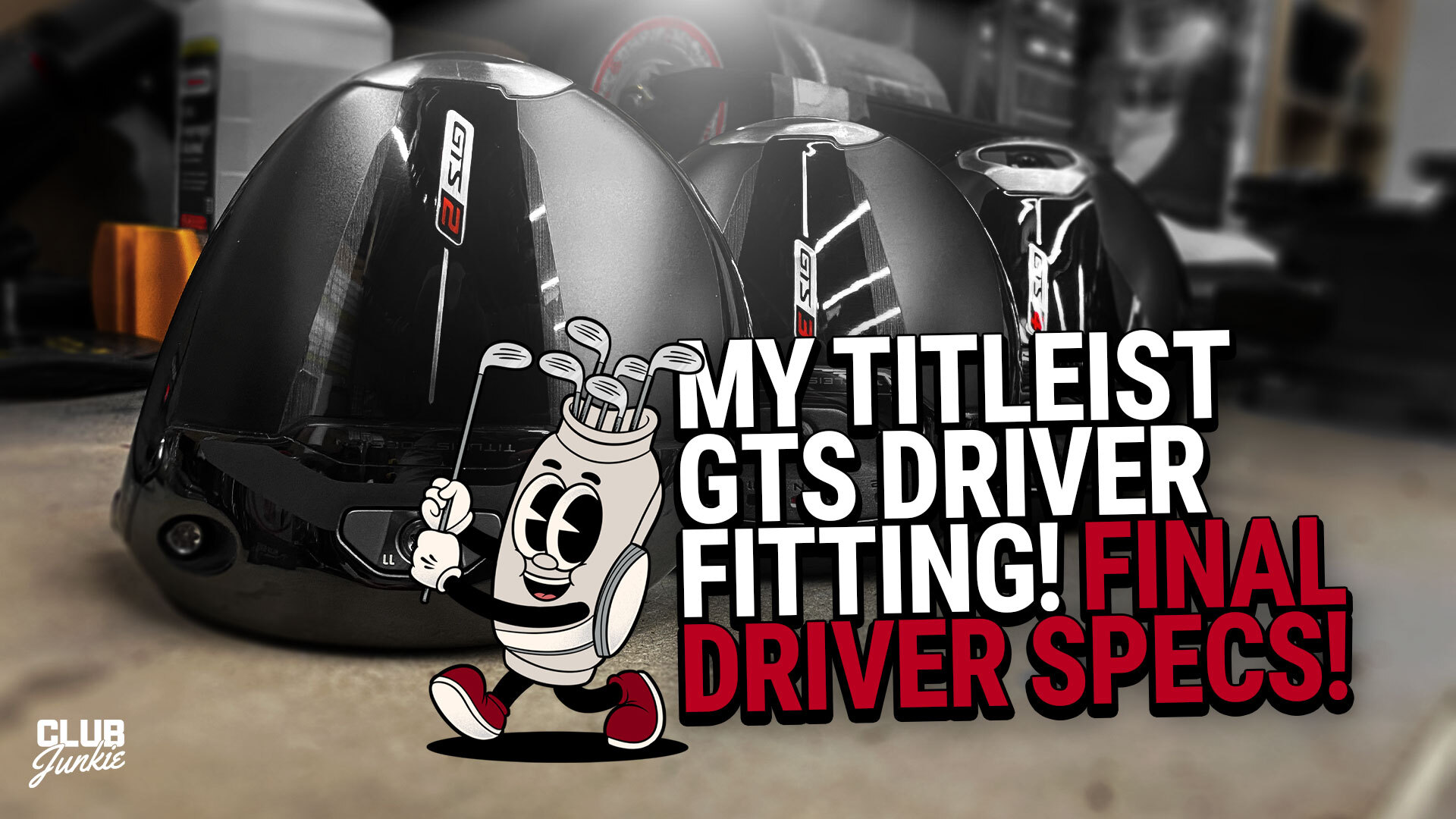
On this episode of the Club Junkie Podcast, I head to the Titleist Performance Institute for a full driver fitting with the new Titleist GTS lineup. We dive into the fitting process, talk about what made the biggest difference in performance, and break down how the different GTS heads and shaft combinations compare on the launch monitor. If you are thinking about a new driver setup for this season, there is a lot to take away from this one.
I also get into Brooks Koepka and the gear setup he brought to the PGA Championship, including the putters that caught my eye during the week. There are some interesting equipment trends showing up at the highest level right now and we break down what stands out.
To wrap things up, I talk about reshafting a few wedges, what I learned during the process, and swapping an adaptor onto a new shaft for another build project in the shop. A gear packed episode from start to finish for anyone who loves golf equipment and club building.
Follow Club Junkie everywhere:
Instagram: https://www.instagram.com/clubjunkiepod/
X: https://x.com/ClubJunkiePod
TikTok: https://www.tiktok.com/@clubjunkiepod
Threads: https://www.threads.com/@clubjunkiepod
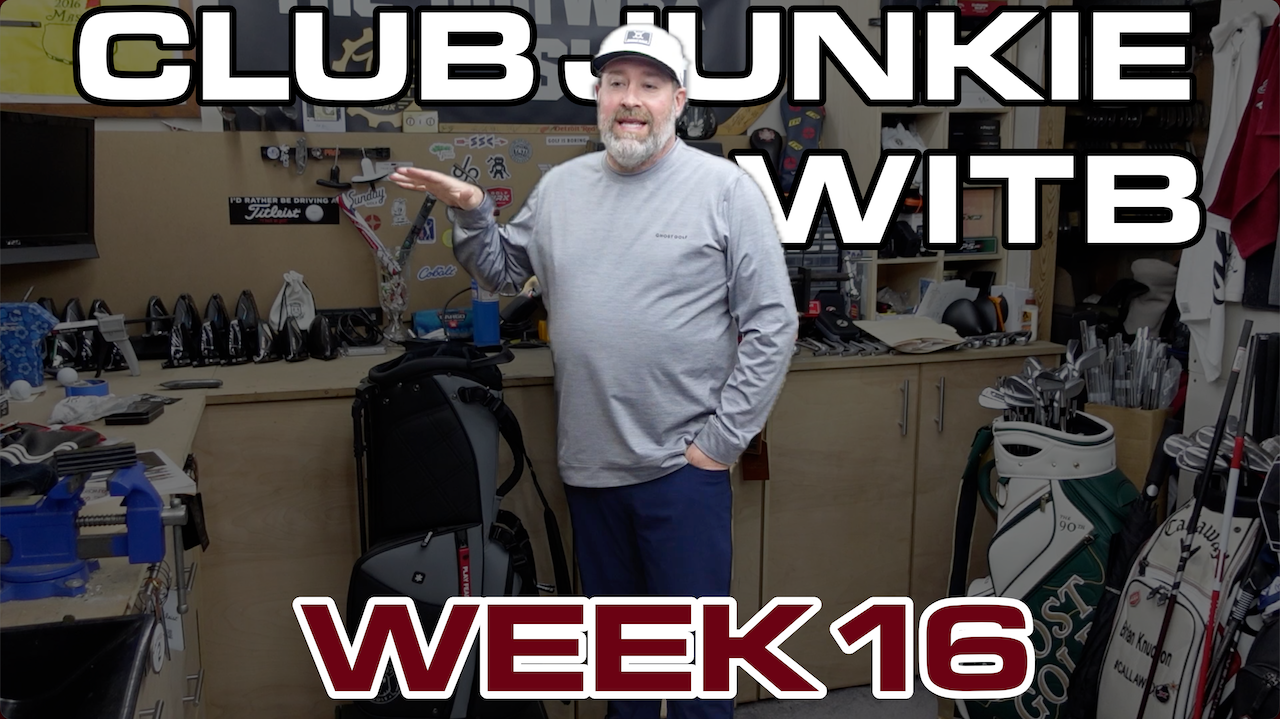
Excited for this week’s WITB as we get to add the new Titleist GTS woods to the bag! I was fit at Titleist’s TPI facility in Oceanside California a few weeks ago and my new clubs just showed up. I am also adding a cool set of irons that I built last year some wild custom wedges into a new golf bag. Speaking of the bag I have a new Ghost Anyday Black Ops stand bag that I will be using on my Motocaddy Remote M7 electric cart.
Driver: Titleist GTS3 (11 degrees @ 10.25)
Shaft: Fujikura Ventus Red 6s
3-wood: Titleist GT1 3Tour (14.5 degrees)
Shaft: Graphite Design Tour AD CQ-7s
5-wood: Titleist GTS (18 degrees)
Shaft: Fujikura Ventus Red 7s
9-wood: Titleist GT1 (24 degress)
Shaft: Fujikura Ventus Red 7s
Irons: Bettinardi CB24 (5-PW)
Shafts: KBS C-Taper Lite 110 stiff
Wedge: TaylorMade MG5 (50-09 SB)
Shaft: Mitsubishi MMT 125 Stiff
Wedge: TaylorMade MG5 (56-12 SB)
Shaft: Mitsubishi MMT 125 Stiff
Wedge: TaylorMade MG5 (60-08 LB)
Shaft: Mitsubishi MMT 125 Stiff
Putter: Dan Carraher ZT Proto
Ball: Callaway Chrome Tour
Bag: Ghost Anyday Black Ops Stand Bag

Justin Rose WITB 2026 (April): Full WITB breakdown with new McLaren irons

RBC Heritage Tour Report: More minis, course-specific setups, Spider & GTS launches

What’s the story behind Webb Simpson’s custom-stamped irons?

Cadillac Championship Tour Report: Spieth’s sizable changes, McLaren Golf launches, and more

Kristoffer Reitan’s winning WITB: 2026 Truist Championship

Cameron Young’s winning WITB: 2026 Cadillac Championship

Aaron Rai’s winning WITB: 2026 PGA Championship

Nelly Korda WITB 2026 (April)

Justin Rose on the switch to McLaren Golf, learnings from previous equipment moves

Photos from the 2026 PGA Championship


Patrick Reed WITB 2026 (May)
Driver: Titleist GT3 (9 degrees) Buy here. Shaft: Aldila Rogue Silver 130 M.S.I. 70 TX 3-wood: TaylorMade Qi35 (15 degrees)...

Aaron Rai’s winning WITB: 2026 PGA Championship
Driver: TaylorMade M6 (9 degrees) Shaft: Aldilda Synergy Blue 70 TX 3-wood: TaylorMade Qi10 (15 degrees) Shaft: Fujikura Ventus Blue...


Michael Block WITB 2026 (May)
Driver: TaylorMade Qi4D (9 degrees) Shaft: Fujikura Ventus Black VeloCore+ 5 X 3-wood: TaylorMade Qi4D (15 degrees @14.25) Shaft: Mitsubishi...


Bryson DeChambeau WITB 2026 (May)
Driver: Krank Formula Fire Pro (6 degrees) Shaft: Project X Prototype 3-wood: Krank Formula Fire (10 degrees) Shaft: LA Golf BAD...
-
 Whats in the Bag3 weeks ago
Kristoffer Reitan’s winning WITB: 2026 Truist Championship
-
Whats in the Bag2 weeks ago
Aaron Rai’s winning WITB: 2026 PGA Championship
-
 Tour Photo Galleries3 weeks ago
Photos from the 2026 PGA Championship
-
 Equipment2 weeks ago
GolfWRX Launch Report: 2026 Titleist GTS drivers
-

 Equipment2 weeks ago
PGA Championship Tour Report: Fitzpatrick, Koepka among big-name putter switches for Aronimink
-

 News2 weeks ago
WITB Time Machine: Phil Mickelson’s winning WITB, 2021 PGA Championship
-

 Equipment2 weeks ago
Which of Tiger’s major winning irons are your favorite? – GolfWRXers discuss
-

 Equipment2 weeks ago
Lead Tape Report: Adjusting the swingweight of the Wanamaker Trophy


PA PLAYA
Feb 11, 2014 at 5:50 pm
I couldn’t agree more with your thoughts about short game and putting. It has been, and will continue to be, the difference between winning and losing, especially in an event where it’s pretty much a given that just about every player on the team is at the very least a decent ball striker and wedge player.
Absolutely nothing against Ian Poulter, who single handedly turned the momentum against us in that final match Saturday afternoon at Medinah. He was the warrior who rallied the troops that evening, the catalyst for one of the most unbelievable comebacks in European RC history. You take away his ability to putt – he becomes just another run-of-the-mill Ryder Cupper. But those of us who’ve followed him over the past decade, those of us who pull for the Red White and Blue – he’s the one player we least want to see standing over a putt of any significance.
He’s fearless. He’s fearless because he knows that despite giving up 25+ yards off the tee, he can still get the ball into the hole in fewer strokes than his opponents in this event.
Not that team chemistry and all of these other performance aspects aren’t important, but if you don’t have a few great putters on your team who know no fear – you’re probably not going to win very often. It’s tough to find seasoned veterans who aren’t afraid of missing putts, and that pretty much describes all but one US Ryder Cup team over the past 15 years.
Mike H.
Feb 11, 2014 at 11:56 am
Finally someone else that thinks we need youth in the Ryder Cup. The last time the USA won they had a roster full of rookies. Yet we continually are told by the “experts” that you need experience on the team. The only “experience” some of these guys have is the experience of getting beat. It’s time to bring in guys like Spieth, English, and others.
Richie Hunt
Feb 11, 2014 at 3:10 pm
Thanks.
I think with youth the potential is that they may catch lightning in a bottle, much like the Euros did with some of their young players like Sergio and Olazabal. It also helps future teams because a young player may perform exceptionally well at one Ryder Cup and then not qualify for the next Ryder Cup and at least the captain can now consider that player based off their previous performance. Whereas if the young player is never selected, then in the next Ryder Cup it will be difficult for a captain to decipher if he’s worth picking or not.
The Europeans top-20 talent or so is pretty much event with the US top-20 talent. But the US Tour has an entirely deeper talent pool. It’s time that the US team and the people in charge start to try and use that deeper talent pool to their advantage.
IfIfIf
Feb 10, 2014 at 9:15 pm
http://www.youtube.com/watch?v=EnV8kpLotW4
10.00 and onwards….
Richie Hunt
Feb 10, 2014 at 8:23 pm
Thanks. I think the captains need to use statistics to best understand what format best suits the player and what players would likely work best together instead of pairing up players because they are friends. They also need to get every player playing on Day 1 if they can so they can figure out who is hot and who is cold, then ride the hot hands and keep the cold players on the sidelines. I think Furyk could have been a solid career Ryder Cupper if they kept him away from the Fourball format.
Brandel Chamblee
Feb 10, 2014 at 7:44 pm
Nice write up. I’m tired of watching the USA getting pounded by Europe as of late. The Ryder Cup reminds me of the movie miracle because USA puts out the best players even though the margin may be shrinking but we need to start putting out the right players. Pulter is the perfect example because he probably will never win a major but I would never bet against him playing Webb Simpson. USA needs more Keegan Bradley’s and Jordan spieths. I want to see tiger exclamation fist pumps. I love the energy and passion the Ryder cup brings. Furyk and Stricker are great players but I would rather have guys that are not afraid like Ricky fowler and don’t have the scars of previous cups. I love the money ball approach. Please do a follow up closer to the event and look at Europe as well if you can.
Teamer
Jul 9, 2014 at 4:32 pm
Fowler is right on. Corey Pavin thought so. How about his match play success, including Walker cup experience. He has fight and calmness not seen in to many of todays young players.