
Instruction
Which tee box is best for your game and enjoyment?


When we were young, we played baseball; now we play softball. We used to ski the expert slopes, but now we ski cross country. Our pickup basketball games against all comers have morphed into scheduled games in our 50-and-over leagues.
Why have things changed?
Because despite all the advances in medical technology, it is an undeniable fact that human beings age. And when we age, no matter how healthy our lifestyles, we simply cannot do the things we once did. There was a time when i could hit my driver more than 260 yards with a wooden club head and a balata golf ball. Now I can’t even hit it that far despite all the technological advances and improved turf conditions.
I’m 67 years young, and well into the back nine of my playing days. So what do I do? Should I quit playing because I can’t reach the par-4 holes or get near the par 5’s in two shots? To those of us born to this breed, that’s not an option. I still really love to play golf, so I have moved to golf’s version of the 50-and-over league. I play from the front tee, or in my case the white tees at most courses.
I don’t care that I’m a club professional; I’m going to play golf for maximum enjoyment of the game. For me, that amounts to perhaps 6,300-6,500 yards at the most. Hitting woods and hybrids into greens designed for 7-iron approach shots is not my idea of having fun. And I would urge all of you to consider the same.
My colleague and friend Tom Stickney and I have done some research, via Trackman stats, showing how far golfers carry their driver (and other clubs in their bag). We equated that to the proper length of golf course that golfer should play. If you might know, Tom Stickney is a Trackman Master Professional, and works with golfers of all levels.
The Stats (60-140 mph swing speeds)
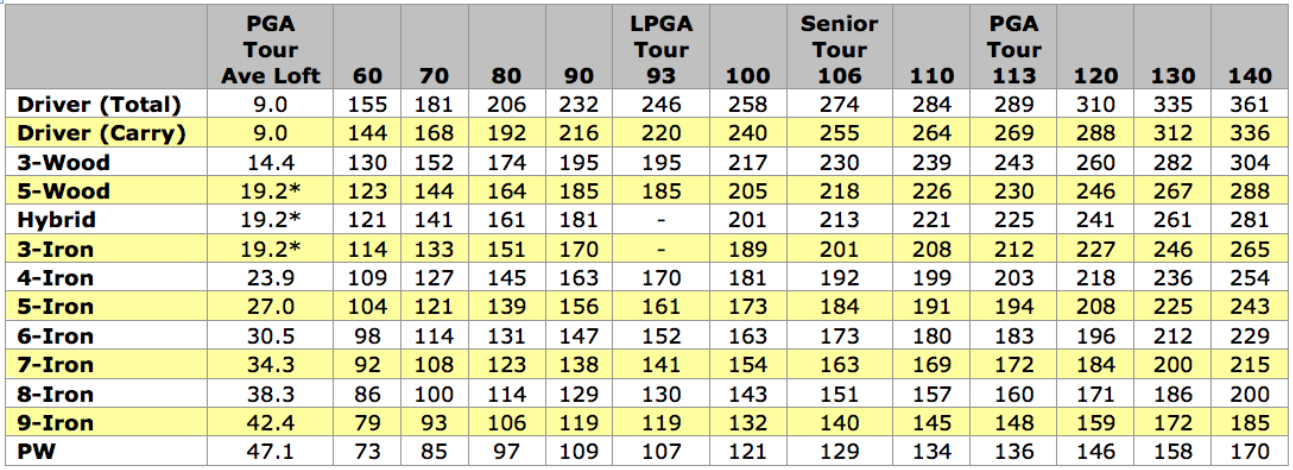
As you look at the chart above, you can see that club head speed is listed at the top along with the averages for each of the Tours. The average male amateur has a club head speed of 92 mph and carries the ball 191 yards with the driver. Now why is this SO much lower than the LPGA Tour Players’ average distance of 220? Because LPGA Tour players hit the ball in the correct part of the driver face in order to garner the most ball speed out of their club head speed. The average smash factor of the LPGA is 1.48 while the amateur golfers’ smash is down to 1.41, explaining the loss of distance for amateurs.
Related: Figure out your smash factor here.
It’s because of this fact that I cannot say enough good things about the idea of moving up a set of tees (or even two) for all levels of golfers. I know it hurts some players’ ego, but it’s really not that big of a deal if you stop to think about it. Seriously, why would you force yourself to play a longer course, relative to your ability level, than the professionals on the PGA Tour play? If you play tees too long for your distance, you’ll end up hitting longer clubs into the greens than the professionals. Does that make any sense? Or do you just enjoy aggravating yourself?
Sadly, we are all guilty of letting our ego determine where we play, myself included. But I want you to take this simple test for me. This weekend when you play, step up one set of tees for the first round, then step up two sets of tees for your second round of the weekend. Keep your stats on driving accuracy, greens hit, and clubs used and see how you do.
I bet you hit more greens, had closer approach shots, maybe even reached a par five in two for the first time in ages. Not to mention, your scores might even drop!
Also, ask yourself: Did you have more fun? Did you want to play an emergency nine? Did you feel less aggravated? If so, you have found the tees for you! The last time I checked golf IS recreation and something that you should enjoy. If not, you should find another hobby you enjoy more.
So, based on our research, every par-4 over 350-360 yards is a “long” par for the average golfer, since those holes require a drive and a mid-to-long iron approach. Now, there are ways the scorecard may not reflect actual length. For example, let’s say the par 5’s average 550 yards, as opposed to 500 yards. Those additional 200 yards are somewhat meaningless, simply because they requires an third shot with a mid- or short-iron instead of a wedge, which isn’t relevant to our discussion here. We are talking about par 4s and par 3s that force you to hit long irons, hybrids or fairway metals all day. And we’re suggesting that, if that’s the case, play it forward!



The LPGA Tour is kicking off its 2026 season this week at Lake Nona Golf and Country Club in Orlando, and the pros are dealing with something most Florida golfers rarely face: freezing temperatures.
“It’s colder here than in the UK at the minute, which is a first,” said England’s Charley Hull during Wednesday’s media day at the Hilton Grand Vacations Tournament of Champions.
Even Lydia Ko, who lives at Lake Nona, seemed surprised by the cold snap. “We’re pretty much getting to below zero in celsius here, which maybe in other parts of the country they would be thankful, but when you’re in Florida it is a little bit of a surprise,” she said.
If the world’s best players are adjusting their games for cold weather, recreational golfers should, too. Here’s how to play smart when the mercury drops.
Understand What Cold Does to Your Game
Before you change anything, you need to know what you’re fighting against. Cold air is denser than warm air, which means your ball won’t fly as far. Period.
Hull noticed this immediately during practice rounds at Lake Nona. She mentioned hitting a gap wedge into the 18th hole during a previous win but needing a 4-iron during Tuesday’s practice round. That’s a difference of four or five clubs for the same shot.
Action item: Expect to lose 5-10 yards on every club in your bag when temperatures dip below 50 degrees. Plan accordingly and don’t be stubborn about club selection.
Layer Up Without Restricting Your Swing
Hull admitted she wore three pairs of pants during practice. While that might be extreme for most of us, staying warm is critical to playing well in cold conditions.
Your muscles need warmth to function properly. When you’re cold, your body tightens up and your swing gets shorter and faster. Neither of those things help you hit good golf shots.
Action item: Wear multiple thin layers instead of one bulky jacket. Look for golf-specific cold weather gear that stretches with your swing. Keep hand warmers in your pockets between shots. And don’t forget a good hat because you lose significant body heat through your head.
Take More Club Than You Think You Need
This is where ego gets in the way of good scores. When it’s cold, the ball doesn’t compress as well off the clubface. Combined with denser air, you’re looking at serious distance loss.
The pros at Lake Nona are dealing with a course that measures 6,642 yards but plays much longer this week. If they’re adjusting, you should too.
Action item: Take at least one extra club on every approach shot. In temperatures below 40 degrees, consider taking two extra clubs. It’s better to fly the ball to the back of the green than to come up short in a bunker.
Adjust Your Expectations on the Greens
Cold weather affects putting in ways most golfers don’t consider. The ball is harder and doesn’t roll as smoothly. Your hands are cold, making it harder to feel the putter. And if there’s any moisture on the greens, they’ll be slower than normal.
Ko mentioned that she still sometimes reads the greens wrong at Lake Nona despite being a member for years. Cold weather makes that challenge even tougher.
Action item: Hit putts more firmly than usual. The ball needs extra speed to hold its line on cold greens. Take a few extra practice strokes to get a feel for the speed before you putt.
Embrace the Mental Challenge
Hull said something interesting about cold weather golf: “I like the mental toughness of it.”
That’s the right attitude. Everyone on the course is dealing with the same conditions. The player who stays patient and doesn’t get frustrated by the extra difficulty will come out ahead.
Action item: Lower your expectations by a few strokes. If you normally shoot 85, accept that 90 might be a good score in 40-degree weather. Focus on solid contact and smart decisions rather than perfect shots.
Warm Up Longer and Smarter
This might be the most important tip of all. Cold muscles are tight muscles, and tight muscles get injured easily.
World No. 1 Jeeno Thitikul revealed she’s been protecting a wrist injury that bothered her late last season. Cold weather makes those kinds of injuries more likely if you don’t prepare properly.
Action item: Spend at least 20 minutes warming up before your round. Start with stretching, then hit easy wedge shots before working up to your driver. Keep moving between shots on the course to maintain body heat and flexibility.
The pros at Lake Nona this week will adapt and compete at the highest level despite the cold. You can do the same at your local course by following these tips and keeping a positive attitude.
PGA Professional Brendon Elliott is an award-winning coach and golf writer. You can check out his writing work and learn more about him by visiting BEAGOLFER.golf and OneMoreRollGolf.com. Also, check out “Playing Through” now on R.org, RG.org’s partner site, each Monday.
Editor’s note: Brendon shares his nearly 30 years of experience in the game with GolfWRX readers through his ongoing tip series. He looks forward to providing valuable insights and advice to help golfers improve their game. Stay tuned for more tips!

Brooks Koepka is back on the PGA Tour, and whether you love him or hate him, the guy knows how to win when it matters. After his LIV Golf stint, the five-time major champion returns this week at the Farmers Insurance Open.
What makes Koepka fascinating? He doesn’t fit the mold. His swing isn’t textbook. He doesn’t obsess over mechanics. Yet he’s won three PGA Championships and two U.S. Opens, regularly making it look easier than guys with prettier swings.
So, what can average golfers learn from someone who treats the game so differently? Quite a bit.
Stop Overthinking Every Shot
Koepka describes his approach as “reactionary” rather than mechanical. While most tour pros grind over swing thoughts, Brooks sees the target and hits it. No mental checklist.
This might be the most valuable lesson for weekend golfers who’ve watched too many YouTube swing videos.
How to actually do this:
On the range, hit five balls where you stare at the target for three seconds prior to addressing the ball. Don’t think about grip or stance. Just burn that target into your brain. You’ll be shocked at how pure you hit it when your brain focuses on where the ball is going instead of how you’re swinging.
Next time you play, give yourself a rule: Once you pull the club, you’ve got 15 seconds to hit. Koepka is one of the fastest players on tour because he doesn’t give his brain time to sabotage him.
If you feel tension in your hands at address, you’re trying to control too much. Koepka’s grip pressure is famously light. Loosen up until the club almost feels like it might slip, then add just enough pressure to hold on. That’s your swing thought: soft hands, see the target.
This approach works better under pressure. When you’re standing over that shot with water left and OB right, the last thing you need is a mental checklist. See it, feel it, hit it.
Play to Your Strengths (Even If They’re Not Pretty)
Koepka uses a strong grip that wouldn’t pass muster in some teaching circles. But he’s built his game around what works for him, elite driving distance and recovery skills. He doesn’t try to be someone he’s not.
Here’s how to build your game like Brooks:
Look at your last five rounds and figure out where you’re actually gaining strokes. Bombing it off the tee, but can’t hit greens? Lean into it. Play courses where distance matters more than precision. On tight holes, grip down on your 3-wood instead of trying to thread a driver through a keyhole you’ll miss seven times out of ten.
Koepka knows he can scramble, so he’s not afraid to miss greens. If you’re deadly from 50 to 75 yards, start leaving yourself those distances on the par 5’s instead of going for them in two every time.
Know when to take your medicine. Koepka in the trees at the PGA? He’s punching out to 100 yards, not trying to bend a 6-iron around three oaks. You’re in the rough with a flyer lie and water short? Hit your 8-iron to the middle and move on. That’s not playing scared, that’s playing smart.
Save Your Best for When It Counts
Here’s a wild stat: Koepka’s putting average in majors is often more than a full stroke better per round than in regular events. He elevates when pressure is highest.
How does an amateur tap into that gear? It’s not about trying harder, it’s about caring differently.
Here’s what actually works:
Decide which rounds matter to you. Club championship? Member-guest? That annual trip with college buddies? Circle those dates and treat them differently. Koepka doesn’t care much about regular tour events, but majors? That’s when he locks in.
Two weeks before your big round, change your practice. Stop beating balls mindlessly. Play nine holes in which every shot has consequences. Miss the fairway? Hit from the rough on the next hole too. Three-putt? Twenty push-ups. Koepka’s practice intensity ramps up before majors because he’s rehearsing pressure, not just swings.
Develop a between-shot routine that resets your brain. Koepka is famous for his blank expression after bad shots. Try this: After any shot, take three deep breaths while walking, then find something specific to notice, a tree, a cloud, someone’s shirt. That’s your reset button. By the time you reach your ball, the last shot is gone.
The Bottom Line
Brooks Koepka’s return reminds us there’s no single path to success in golf. His “substance over style” approach proves that results matter more than looking good.
You don’t need a perfect swing; you need a reliable one that holds up under pressure. You don’t need to hit every shot in the book; you need the shots you can count on. And you don’t need to play great every time; you need to play great when it matters.
Welcome back, Brooks. Thanks for the reminder that golf is ultimately about getting the ball in the hole, not winning style points.
PGA Professional Brendon Elliott is an award-winning coach and golf writer. You can check out his writing work and learn more about him by visiting BEAGOLFER.golf and OneMoreRollGolf.com. Also, check out “Playing Through” now on R.org, RG.org’s partner site, each Monday.
Editor’s note: Brendon shares his nearly 30 years of experience in the game with GolfWRX readers through his ongoing tip series. He looks forward to providing valuable insights and advice to help golfers improve their game. Stay tuned for more tips!

Blades Brown made a big impression last week in the California desert, and not just because he’s only 18. He put up numbers that would catch any weekend golfer’s attention. Most of us won’t hit 317-yard drives or find 86% of our greens in regulation, but there’s a lot to learn from how Brown managed his game at The American Express.
Here are three practical lessons from his performance that you can use on your own course this weekend.
Step 1: Give Priority to Accuracy Over Distance Off The Tee
Brown’s driving stats are impressive. He averaged almost 318 yards off the tee, ranking 12th in the field. More importantly, he hit 76.79% of his fairways, tying for fourth place in the tournament.
Think about that ratio for a second. Brown could have swung harder, chased more distance and tried to overpower the course. Instead, he played smart golf and kept his ball in play.
Your Action Item: Next time you’re on the tee box, ask yourself a simple question before pulling the driver. Do you need maximum distance here, or do you need to be in the fairway? If there’s trouble lurking or the hole doesn’t demand every yard you can muster, take something off your swing. Grip down an inch. Make a three-quarter swing. Do whatever it takes to find the short grass. Brown’s approach illustrates that fairways lead to greens, and greens lead to birdies. He made 22 of them last week, along with an eagle.
The math is simple. When you’re hitting three out of every four fairways like Brown did, you’re giving yourself legitimate looks at the green with your approach shots. That’s when scoring happens.
Step 2: Commit To Hitting More Greens
This is where Brown really separated himself. He hit 62 of 72 greens in regulation, an 86.11% clip that tied for first in the entire field. Read that again. An 18-year-old kid tied for the lead in one of the most important ball-striking statistics in professional golf.
How did he do it? By keeping his ball in the fairway (see Step 1) and giving himself clean looks with mid-irons and wedges.
Your Action Item: Start tracking your greens in regulation. You don’t need a fancy app or a statistics degree. Just mark down whether you hit the green in the regulation number of strokes. Par 3s in one shot. Par 4s in two shots. Par 5s in three shots.
Once you know your baseline, set a goal to improve it by 10%. If you’re currently hitting five greens per round, aim for six. The beauty of this approach is that it forces you to think strategically about club selection and shot shape. Brown’s strokes gained approach number was positive (0.179), meaning he was better than the field average. You don’t need to be perfect. You just need to be on the dance floor more often.
When you hit more greens, you eliminate the need for heroic short game shots. Brown only had to scramble 10 times all week, and he got up and down 70% of the time. That’s solid, but the real story is that he rarely put himself in scrambling situations to begin with.
Step 3: Minimize Mistakes And Stay Patient
Here’s the stat that jumps off the page: Brown made only three bogeys all week. Three. In four rounds of professional golf against the best players in the world.
He also made just one double bogey. That kind of clean card doesn’t happen by accident. It happens when you play within yourself, avoid the big miss and trust that pars are never bad scores.
Your Action Item: Before your next round, decide that you’re going to play boring golf. No hero shots over water. No driver on tight holes just because you can. No aggressive pins when there’s a safe side of the green.
Brown’s performance shows us that consistency beats flash every single time. He didn’t lead the field in any single strokes gained category, but he was solid across the board. That’s how you post numbers and cash checks.
Give these three steps a try. Your scorecard will thank you.
PGA Professional Brendon Elliott is an award-winning coach and golf writer. You can check out his writing work and learn more about him by visiting BEAGOLFER.golf and OneMoreRollGolf.com. Also, check out “The Starter” now on R.org, RG.org’s partner site, each Monday.
Editor’s note: Brendon shares his nearly 30 years of experience in the game with GolfWRX readers through his ongoing tip series. He looks forward to providing valuable insights and advice to help golfers improve their game. Stay tuned for more tips!

RBC Heritage Tour Report: More minis, course-specific setups, Spider & GTS launches

Justin Rose WITB 2026 (April): Full WITB breakdown with new McLaren irons

Best fairway woods of 2026: The most versatile fairway woods + the most forgiving fairway woods

What’s the story behind Webb Simpson’s custom-stamped irons?

Cadillac Championship Tour Report: Spieth’s sizable changes, McLaren Golf launches, and more

The 24 players who can win the Masters

Rory McIlroy’s winning WITB: 2026 Masters

Kristoffer Reitan’s winning WITB: 2026 Truist Championship

J.J. Spaun’s winning WITB: 2026 Valero Texas Open

Cameron Young’s winning WITB: 2026 Cadillac Championship


Alex Fitzpatrick WITB 2026 (May)
Driver: Ping G440 LST (9 degrees) Shaft: Fujikura Ventus Black 6 X 3-wood: TaylorMade Qi4D (15 degrees) Shaft: Fujikura Ventus...

Kristoffer Reitan’s winning WITB: 2026 Truist Championship
Driver: Ping G440 Max (9 degrees) Shaft: Mitsubishi Tensei 1K White 60 TX 3-wood: Ping G440 Max (15 degrees) Shaft:...


WITB Time Machine: Rory McIlroy’s winning WITB, 2021 Truist Championship
Rory McIlroy’s victory at the 2021 Wells Fargo Championship 2021 (now the Truist Championship) marked a significant return to form,...


Collin Morikawa WITB 2026 (May)
Driver: TaylorMade Qi4D LS (8 degrees) Shaft: Mitsubishi Diamana D+ Limited 60 TX 3-wood: TaylorMade SIM Tour (14 degrees) Shaft:...
-
 Equipment2 weeks ago
Justin Rose WITB 2026 (April): Full WITB breakdown with new McLaren irons
-
 Equipment1 week ago
What’s the story behind Webb Simpson’s custom-stamped irons?
-
 Equipment2 weeks ago
Cadillac Championship Tour Report: Spieth’s sizable changes, McLaren Golf launches, and more
-
Whats in the Bag4 days ago
Kristoffer Reitan’s winning WITB: 2026 Truist Championship
-
 Whats in the Bag2 weeks ago
Cameron Young’s winning WITB: 2026 Cadillac Championship
-

 Whats in the Bag3 weeks ago
Nelly Korda WITB 2026 (April)
-

 Equipment2 weeks ago
Justin Rose on the switch to McLaren Golf, learnings from previous equipment moves
-

 Tour Photo Galleries2 weeks ago
Photos from the 2026 Cadillac Championship


Double Mocha Man
Dec 1, 2015 at 12:12 pm
Pebble Beach has a sign on the first tee. It reads:
0-5 handicap – Play the blue tees
6-12 handicap – Play the gold tees
13 and over – Play the white tees
And the starter asks for proof of handicap if you look like you’re on the wrong tees.
Steve
Nov 29, 2015 at 7:06 pm
Great article Dennis. I agree totally and hope that more weekend golfers take this to heart. I myself have been playing since I could walk and like you played persimmon woods and balata balls. My average drive back then was close to 285 yards, always been long with my woods. I played in HS and College, was also a PGA apprentice, and had a real solid game as equipment changed and course conditions improved over the years. I am 45 years old now and play to a 4 handicap, from the blue tees at most of the courses I frequent in central Florida, but lately I have moved forward to the white tees and have been enjoying myself way more on the course. Although, my scores have not dropped, in fact gone up a bit, I Notice things about my game that I took for granted before playing from the blue/back tees. I may play better than most weekend golfers my ego with age has subsided to enjoy the game I love more now. Just to add, my average drive is 285 still with newer equipment and 3 wood is 240-255 yards; my average 7 iron is about 155-160 and wedge is at 100 yards so playing closer allowes me to hit my targets easier and shorter putts. Again great article. Thanks
Josh
Nov 29, 2015 at 6:52 pm
I am a board member at a small 9 hole course in south MS. We constantly have to fight with the seniors about their tee placement. The course states about 6300 realisitically about 6000 from the mens. The bickering has gotten so bad the seniors have moved boxes early in the morning to a distance of (I measured this one time) about 4600 yards. Their reasoning? “some of the guys want some eagle putts” I am not kidding. The guy that hits a driver 135 wants some eagle putts. After a few months of fighting we just gave up and let them have it. Literally no one has improved handicap, they are happier, and the tournaments have gone smoother. This leaves me with the realization that it’s more mental (if you can get up and down to save par, does it matter if your miss was with a 4 or 9 iron?). Still a good read.
alan
Nov 29, 2015 at 1:51 pm
good article i see waaaay too many guys at my club playing from the tips when in all honesty they should consider playing the reds(seriously). i suppose its ego or naivete, but i makes for long frustrating rounds. the sad thing is i doubt if something was said to those guys they would consider change.
Milo
Nov 29, 2015 at 12:57 pm
I just play the front most tees, it’s definitely the best and most fun.
Mat
Nov 28, 2015 at 3:45 pm
Tees should be based on handicap, alone.
Dennis Clark
Nov 27, 2015 at 8:48 pm
I really enjoy stepping out of my regular role on this site from time to time, because I get to see how passionate readers on WRX really are about the game of golf. I’m a teacher and 90% of what I do is share experiences with you to help your game, but it’s nice to see an article about the game in general evoke as much positive response as this one. More ideas to come. Stay tuned! Thx
Wisconsin Terrapin
Nov 27, 2015 at 11:15 am
I’m one of those senior guys and am in the +/-85 mph driver range. I do play my course from the whites, with 2 par 4’s over 360. Starting with courses in the 6000-6200 I count par 4’s over 360 and par 3’s over 170. These are my tough holes. It’s not distance alone to decide on tees. For those manly guys that think they can compete at 6600 yards with a 210 driver against guys with a 260 yard drive – the bombers have to be really bad golfers. I can’t catch up if half the holes they have a GIR and I’m stuck with a GIR+1.
Jeff
Nov 26, 2015 at 7:23 am
I don’t think it’s about what makes the game “fun” or what gives you lower scores. The issue is, from which tees are you playing the course as designed? Short hitters who “want to play the whole course” or want to “challenge themselves” aren’t taking into account the huge role strategy plays in the game. If you need driver on every hole, and still can’t reach the fairway bunkers, you’re diminishing the decision-making aspect of the game. If you can’t hit through an occasional dogleg, or hit over certain fairway bunkers with a great drive, then you aren’t playing the course as it’s designed. Kid yourself that you’re “challenging” yourself, but you’re really reducing the challenge by taking away risk-reward choices.
Why play a well-designed course if you choose tees which make the design irrelevant? Move up (or back) until you have tough decisions to make!
Double Mocha Man
Nov 26, 2015 at 4:25 pm
I have never heard this before but it is sooooo right on.
mhendon
Nov 28, 2015 at 9:39 am
Jeff in principle your theory would seem to be valid. By moving up or back a tee one may indeed make the tee shot play the way intended by the course architect however this doesn’t solve the second half of the equation, The approach shot. For example player A plays the back tee which requires a 270 yard carry to clear the fairway bunker, player B plays an up tee that requires a 220 yard carry to get over the bunker. Now both players are left with a 150 yard approach to a tucked pin behind a steep faced bunker. Now this situation plays completely different for the two players. Player A can go right at the pin with a high 9 iron approach but for player B that’s not an option, he’ll have to play toward the center with a much lower flights 6 iron. The point being no golf course will play the way intended by the architect unless you play the way the course architect intended.
Jeff
Nov 28, 2015 at 7:39 pm
Good points. You should take into account approach shots when you’re deciding which tees to play. But I do feel the tee shot is the most important thing to consider. In the situation you give, at least player B isn’t playing tees that don’t allow him to even reach the bunker, giving him say 200 yards to that same pin! Most courses I’ve played, a player who can cut a corner or carry a strategic fairway hazard will at least have a good chance to reach the green. Just getting a GIR is a great goal for even a golfer with a handicap of 12 or 15.
When choosing which tees to play, there are a lot of things you should consider, and I feel maximizing the strategic value of the layout is the main thing I want to accomplish. Fun, variety, and pace of play are also important to me. As a fairly inconsistent 10-handicap player with a swing speed of about 95 MPH, I can play blue or white tees on most courses and break 80 on a good day. But the white tees give me MUCH more to think about, both on approaches and tee shots. There will be some holes where I can attack tucked pins. Even if I don’t face all the possible strategic choices the designer intended, I want to maximize them.
Double Mocha Man
Nov 28, 2015 at 8:19 pm
That’s why God gave you a foot. You kick the ball forward 30 yards.
Sean
Nov 25, 2015 at 11:11 pm
I started a thread about this very topic last year. A few members crucified me for suggesting that a golfer may have more fun by playing a more appropriate tee box. I sited a couple of examples (golfers hitting woods/hybrids into the majority of par 4’s, etc.), and those same golfers swearing, tossing clubs, and the like. One genius posted and asked how did I know these golfers weren’t having fun? 🙂
With a 192 carry average, most golfers should be playing tees under 6000 yards. Golf Digest suggests taking one’s 5-iron carry average and multiplying it by 36 to ascertain the yardage one should play.
viking62
Nov 27, 2015 at 3:24 pm
Problem with that rule of thumb about the 5 iron is the average golfer exaggerates the carry on their five iron by about 40 yards. But the rule seems about dead on to me.
I’m a 2 handicap and a pretty long hitter – I’m in the 110MPH range and about 275 carry or so, but I’m not good enough to play from 7000 yards, I hit it long enough to play 7000+ but so what. When I can regularly shoot in the 60s from the 6300-6700 I usually play – then I will move back (don’t see that happening anytime soon).
I play from 7000+ from time to time, and it’s fun. I realize most courses seem to be setup by the architect from the back tees, with the forward tees more of an after thought, but inevitably I shoot higher scores and it’s not as much fun overall. I also never do it when the course is crowded.
I’m also of the belief that 10+ stimped greens is ridiculous for all but the very best golfers. Slows down play and drives up cost. I always laugh when I hear private club guys with high handicaps tell me how they putt so much better on fast greens…because they make the odd long putt but neglect to figure out how many 3 and 4 putts they have.
Cash Game
Nov 28, 2015 at 10:40 pm
Dude you really are full of yourself. Your thread on someone saying you were a good golfer just shows how self-serving you are. Don’t hurt yourself with all the back patting.
mhendon
Nov 29, 2015 at 4:55 pm
Well based on the avg 5 iron distance times 36 formula the avg pro is playing courses to long for themselves.
mhendon
Nov 25, 2015 at 10:52 pm
I say play whatever tee’s make you happy just be courteous and let people through if you’re taking to long.
sean two
Nov 27, 2015 at 8:22 pm
Absolutely play what tees you enjoy. Just keep on pace with the group in front of you, be respectful of others and don’t let people like Sean force his self-serving opinions on you.
christian
Nov 25, 2015 at 10:23 pm
“So what do I do? Should I quit playing because I can’t reach the par-4 holes or get near the par 5’s in two shots? To those of us born to this breed, that’s not an option.”
Well, one option would be to accept you can’t do what you did when you were younger and calmy accept that you need 3 shots at certain par 4s to get on the green. I really don’t see why this would be such a horrible thing? Wouldn’t playing from forward tees just be cheating yourself, playing some sort of mind games with yourself? Odd.
Dennis clark
Nov 26, 2015 at 2:12 pm
Golf a mind game? Surely u jest :).
christian
Nov 25, 2015 at 10:04 pm
I went straigh to the comment section, without reading the article. I predict the answer to the question is “play from the whites or even the red tees, you will make more pars and feel good about your game”. I frankly disagree completely, I never understood the need for golf to introduce handicaps, different tees etc etc in order to segregate between players. I know some people think that that is the beauty of golf, but I don’t think so. Here is the course, play it to the best of your ability. If you aren’t mentally strong enough to accept that you can’t score as good as the next guy or woman, then that’s your personal problem. What’s next, lowering the hoops so everybody can slam dunk in order “to grow the game of basketball”? The whole concept is stupid and unnecessary to me.
sog10
Nov 25, 2015 at 10:18 pm
And if the best of your ability is hacking out a 130 from the tips, so be it – who cares about everyone else on the course? I
christian
Nov 25, 2015 at 10:28 pm
Completely different matter, I’m no pro but when I started out and didn’t hit the ball very well I STILL made sure I wasn’t slow. Being slow is just rude, and if you can’t do better than 130 yards from the tee, then no amount of forward tee’ing will make you play fast.
sog10
Nov 26, 2015 at 10:45 pm
Good for you. Reality is, some people will always play slow. Having them play 10 fewer shots per round will shorten their round, and if I am in the group behind them, my round. You can’t just ignore that by saying it is rude behavior.
Also, what happens when someone who hits it 200 steps up to a hole with a 230 forced carry? Head for the parking lot? Skip all holes like this? Just doesn’t make any sense for people to let their egos decide which tees to play.
christian
Nov 28, 2015 at 1:31 am
You just keep up if you need to hit many shots, if that means not taking practise swings, walking briskly between shots or whatever then so be it. I decided from the beginning I wouldn’t be a drag on the other players in my group, and made sure I didn’t waste other people’s time because I didn’t hit it well. I can EASILY be done, I know because I did it. To ‘take your time’ is just, yes, rude.
Hank
Nov 28, 2015 at 3:25 pm
Tee box selection may help a little in speeding up play but playing REAL ready golf is what is needed…READY golf you play when you get to your ball, and getting to your ball does not mean the whole group stops while Joe hits his second after a 25 yard tee shot, keep moving. (of course you stay out of his way)…and putting, I wish I had a dollar for every armature that thinks reading the greens from every angle is the magic bullet to making putts…and use the rules my group plays with , lost ball on tee shot or approach, one shot penalty ball played from best guess spot (never go back) Any putt over 25 feet and your first to green can be putted with flag in with no penalty if you make it hitting stick…now you can pull the flag for the rest of the group…..IF YOUR READY PLAY..
Double Mocha Man
Nov 29, 2015 at 4:00 pm
I am in full support of ready golf. But I see few play it. I have a friend who wants to play golf like the pros on TV and absolutely will not play ready golf. In fact, he won’t even swing until he knows you are looking at him. Fortunately for me I only play with him a few times a year. And always beat him playing ready golf, over which he grumbles to me that I am playing out of turn. Too funny.
Dennis clark
Nov 26, 2015 at 2:14 pm
The article was pretty good too
8thehardway
Nov 26, 2015 at 4:00 pm
Such rugged individualism…
handicaps make it easier to choose the right tee box
multiple tee boxes are cheaper than multiple hazards
it’s not “here is the course” like it’s Mt Everest. A fairway bunker that challenges a 270 yard tee shot is not a problem for those with 230-yard drives. When someone designs a golf course they think about things like that. And even on Mt Everest Sherpa fix the ropes and ladders – all you have to do is stroll out of base camp and begin your ascent to the next camp… not like it was for Hillary in 1953; when you think of rugged individualism, think of Hillary.
Double Mocha Man
Nov 26, 2015 at 4:32 pm
Ah, those sherpa caddies…
Ron
Nov 25, 2015 at 8:01 pm
Dennis – great article and comments. It’s really a personal decision we all face from time to time. Some courses suggest tee boxes just based on handicap, which I don’t think is a good parameter to use. (I’m 75 and play to about a 4 – so tee box is always a question for me when I go to a new course. And playing from >6500 is out of my comfort zone, although I’ve done it.) But playing from the “age-appropriate” tees (often only 5500-5600) seems short for me. So 6000 yards, or so, seems reasonable. But it IS fun to move up a tee and have a chance at a low score occasionally – and those tee boxes often bring a different set of decisions into play and some very different looks. I like the tee box decision to be made based on number of long irons, hybrids, and FW metals needed for the 4-pars – three or four are okay, but not all ten. Most 5-pars can be thought of as two decent shots followed by a short 3-par (and I don’t mind not being able to get on in two). Most 3-pars are reachable, some are long, some short … and all require good shots. So the 4-pars define the choice for me. But in general, I let my playing partners decide what works for them.
larrybud
Nov 25, 2015 at 3:28 pm
To play “forward” tees just because of the total yardage is not the way to do it. My home course is 6560, and I drive it about 230. However, I hit every club in the bag, from wedges to hybrids into greens. That’s because much of the yardage is in 3 of the 4 par 5s, so there are only 2-3 longer par 4s.
But I’ve played shorter courses in which much of the yardage is in the par 4s, or where you have forced layups on par 4, in which case the tee box you play is pretty much irrelevant because you’re going to hit your 2nd from the same spot every time.
The fact of the matter is that you just need to find a tee box (at a specific course) which will let you hit a larger variety of clubs into greens. Playing too close where you’re hitting wedges into greens all day long is just as silly as playing too far bag and hitting hybrids into greens all day long.
Coops
Nov 25, 2015 at 1:54 pm
Great article and comments. One aspect not mentioned is that by playing correct tees according to age/handicap, play will speed up for the entire field. Enjoyment levels will increase and more “aged” golfers will probably stay in the game longer!!
The titles of men’s/ladies tees should be eliminated completely and colours only used. This will encourage shorter hitters to play from correct tees with no damage to the good old EGO!!! This applies of course to both sexes, handicap and ability alone should dictate tee box selection.
Greg V
Nov 25, 2015 at 12:50 pm
I moved up to 6100 yards max when I turned 60; and less in the spring and fall. I drive it about 230, and of course, less in colder softer conditions.
I sometimes play with a friend who is a bit older, but 20 yards longer. He used to play mini Tours in Florida. I started playing from a shorter tee than him. I think that he didn’t like me doing that at first, but over time he has gotten accustomed to it. Since he enjoys my company, we still play together – but different tees.
8thehardway
Nov 25, 2015 at 12:40 pm
I’m 69 and hit 200-yard drives in summer; clothes and conditions take a 10% toll in distance during the winter but the dozen guys I play with suck it up and swing a little harder; by March their confidence is shot and their game has deteriorated. I don’t play as often when it’s cold but I move to the forward tees. Come spring I move back to the White tees and crunch them. Forward tees put the WIN in winter, yeah baby. I gain 40 yards, set scoring records and have a razor sharp short game; I’m brimming with confidence and pity the fool who thinks 20 years and 50 yards means something come spring.
So why not stay at the forward tees? Your opening paragraph says it all… “we” play basketball, baseball, etc. Lower scores are less satisfying than shared challenges and in an either/or situation I’ll give up the five strokes… that way when I go all ‘Tom Kite’ on them they have something to remember. Similar to playing baseball with your friends, but having them pitch you softballs – your hitting percentage might skyrocket but you’d lose some connection.
MARCUS
Nov 25, 2015 at 11:53 am
Seems I’m in need of going to see what my stats are on a trackman. Last time i was fitted had me at the 122mph with driver. and looking at the chart i can relate to all the club distances on it. people should realize that as the clubs drop so does there swing speed and most charts are based off driver swing speed from what i am see. good read for sure.
Tommy Leech
Nov 25, 2015 at 11:16 am
Table is reading incorrect, is not accounting for decreasing club head speed as you move up in clubs. I.E I can swing my driver 112 MPH and goes 284 YDS, I can only swing my 6i 90 MPH but it still goes 185, according to your table it should only go 147 YDS.
I’m guessing you left it like this to make it simpler for the reader, but I would be interested to see all the numbers broken down. How fast an average PGA tour player swings a PW and how far it travels.
Double Mocha Man
Nov 25, 2015 at 11:36 am
Tommy – Everything is based off your driver swing speed. It is assumed that with the shorter irons the swing speed will decrease, but relative only to your driver speed.
TL
Nov 25, 2015 at 1:20 pm
I understand, still would be interested to see what tour pros are actually swinging different clubs. I bet we would see a huge variance in 8i through PW among tour pros, because of all the different approaches to hit the shorter shot (160 and in). Interesting Stuff!
mhendon
Nov 26, 2015 at 8:20 pm
Tommy you’re not reading the chart right. It says for someone with a driver swing speed of around 112 they would hit there 6 iron about 180 to 185. So for you right on the money
Scottyrocket
Nov 25, 2015 at 9:21 am
I am 50 and a 10 HC. I usually play with younger guys that can hit the ball further and are lower HC. What do I do then? They always want to play the tips or intermediate tees. Even though I probably would score better, is it more fun to always be teeing off from different tees not to mention the endless ribbing I would get from my “friends?” In league they had us play from the reds one week, lowest score of the year for me so I believe that you are correct in your article not sure how to handle to social angle of this. Suck it up buttercup!?
sk33tr
Nov 25, 2015 at 6:14 am
This is exactly what the USGA should be focusing on (rather than another stupid rule). Amateurs have no idea which box to play and need some direction.
8thehardway
Nov 25, 2015 at 1:34 am
I’m 69 and the last three years I’ve played some rounds from the forward tees in Fall and Winter and it makes a huge difference in score – at least a four stroke difference despite cold, wet conditions. And it’s like playing a new course – new looks, different lines of play and I often have a choice of clubs off the tee – something my 200-yard drives leave no room for at 6,000 yards. I’ve seen someone’s swing get smoother and longer from the forward tees (eventually he returned to the white tees and dominated his foursome) and a younger, stronger golfer plays them when I do to practice using clubs he doesn’t use much from the Whites. Finally, while everyone’s struggling through the distance-sapping, doubt-inducing Winter cold, I’m coming into Spring in a great state of mind.
So why do I only play some rounds from forward tees? Your opening paragraph says it all… “we” play basketball, softball, etc. At day’s end score doesn’t compare with shared challenges, companionship and the chance to go ‘Tom Kite’ on someone 20 years younger and 50 yards longer. If your friends played baseball but pitched you softballs I suspect a stellar batting average wouldn’t compensate for the distance and differentiation inherent in choosing an easier, though more appropriate struggle.
john
Nov 24, 2015 at 11:56 pm
where did you come up with that graph lol?
140mph equals a carry of 330m? with what… 3000 rpm?
Dennis clark
Nov 25, 2015 at 9:09 am
Trackman.
Steven
Nov 24, 2015 at 9:51 pm
I remember watching a TV broadcast some years ago and one of the commentators (Judy Rankin?) said that if you are hitting more than 7 iron into the green on more than half of your par 4s you are playing tees that are too far back. I was hoping for something useful like that. The Trackman data doesn’t actually answer the question. Also, your claim that “We equated that to the proper length of golf course that golfer should play” doesn’t show up in your article. Here is what I would like to know, what club are tour pros hitting for their second shot on par 4s? If we knew that piece of information we would know which tees to use if we wanted to use the pros as a reference group.
Dennis Clark
Nov 24, 2015 at 10:37 pm
Rich Hunt, who writes for this site, can probably answer that best if he’s reading this post. Also remember “what club” is relative as well. For example I work with a few guys on Latin America Tour whose “stock” 7 iron is around 180 yards and reaches 90-95 feet at apex. It spins around 6200 RPMS with a dynamic loft of 20 degrees or so. BIG differences across the board for the guys at the top.
Double Mocha Man
Nov 24, 2015 at 9:19 pm
I guess I’m a contrarian. I don’t want to play in Yankee Stadium with the outfield walls drawn in. I don’t want to play in the Super Bowl as a kicker with the goal posts widened. I don’t want to play in the NBA with baskets that are 5 feet wide. Though that would be fun.
I want to stack myself up against the pros… and play the course they play. So if I’m young I want to play the blues or the blacks. If I’m a Senior I want to play the whites. When I’m 85 I’ll just drive the cart around the course and enjoy the setting. Always with my flask.
Dennis Clark
Nov 24, 2015 at 10:41 pm
DMM, If I were hitting in Yankee stadium, AGAINST BIG LEAGUE PITCHERS, believe me the distance of the outfield walls would be the least of my worries. Contact would be a miracle. :).
Double Mocha Man
Nov 25, 2015 at 11:43 am
Sometimes in golf “correct” contact seems to be a miracle.
Here’s one most people don’t think about: While Miguel Cabrera has to “muscle up” to hit a home run to center field the rest of us can swing an easy pitching wedge or 9-iron and achieve the same results. With a golf ball, of course.
Dennis clark
Nov 26, 2015 at 2:21 pm
I did that once. It was a blast. Hit a 9 iron from home plate to a flag in centerfield in PNC park. In front of 30K people. Part of 84 Lumber PGA Tour event promo. Actually did it 4 times. I think 10 feet was closest I came. Had I hold it it was one million bucks to a local charity!!!
Double Mocha Man
Nov 26, 2015 at 5:26 pm
That is so cool. I have never had the pleasure of doing that. Though once, while living in Miami, I wanted to hit a 7 iron into a 110 mph hurricane wind and see where the ball ended up. Chickened out because too much debris way flying around. And I don’t hit a very good knock down…
Mad-Mex
Nov 25, 2015 at 4:33 am
Now I understand the mind set of those that I encounter on the back tees on my way to the white tees, staff bags, 8.5 degree drivers with X-Stiff $500 shafts, covered with logo shirts and hats, $200 golf shoes and $200 sunglasses. They take 10 practice swings giving their buddies a swing by swing analysis of their swing. They proceed to tee their Pro-V 1’s , take another 5 swings the proceed to either top their shot 100 yards down, slice their shots into the rough or if by some miracle they hit the ball, it fails to reach the short cut grass. We are then treated to another analysis of their swing, of course we get to see this four times. When they finally make the green, they mark 6 inch triple bogey putts in order to allow their fellow pros to putt in from 50 feet out hoping to make it for a quadruple bogey. This “treat” goes on for 18 holes since they don’t allow anybody to play through since they paid their green fees too.
Double Mocha Man
Nov 25, 2015 at 8:50 pm
Hi Mad – Mex… I’ll assume you are talking about some of the same golfers I see on occasion. And yes, they are reprehensible and silly. Myself, I play to a 3.5 and get my drives into position (sometimes a position in the woods) 260 to 300 yards out, depending on fairway conditions.
christian
Nov 25, 2015 at 10:15 pm
This is so much BS, I have never ever met such a person through all my years of golfing. Neither have you probably, you just want to come on here and write something “cool”.
christian
Nov 25, 2015 at 10:13 pm
Agree completely. The course is what it is. I’m advocating one set of tees for all. It is what is is, just live with it. Some people think handicaps and different tees is what makes golf great, I think otherwise. I think it’s slightly belittling and completely unnecessary. It’s made for mentally weak people who can’t handle their limitations.
Tom
Nov 24, 2015 at 6:58 pm
So how do you recommend picking tees? Something like if more than 4 par 4’s are over average drive +avg 5i in length it’s too long? (My rule of thumb.) Or do you suggest something different?
Dennis Clark
Nov 24, 2015 at 7:31 pm
Well of course we have to pick a color; that’s just the way it’s set up. What Tom and I are suggesting is for maximum enjoyment consider moving up. Right now I can play par-mid 70s golf from 6400 yds or so. If I move to 6800, I add probably 3,4 shots. Anything near 7,000 I’m not breaking 80. But it’s not just the score. I just cant hit #3 hyrids and #5 wood’s and hold greens. So I’m chipping all day, rarely getting the fun of putting for birdie and just don’t enjoy it as much. The long 4s are the problem really. After 65 I personally lost a good amount of distance despite staying in relatively good shape. Just a suggestion for y’all. Thx
Shallowface
Nov 24, 2015 at 8:11 pm
Years ago I read about a novel approach to picking tees that revolves around how many birdies you make over the course of the season.
For example, this year I made 33 birdies on Par 3s. The average yardage of those holes was 148 yards. I multiplied 148 by 4, (the average number of Par 3s on most courses) for a total of 592.
I made 49 birdies on Par 4s, and the average yardage was 339 yards. I multiplied 339 by 10 (the average number of Par 4s on most courses) for a total of 3,390. I made 66 birdies on Par 5s with an average yardage of 493 yards, multiplied by 4 (the average number of Par 5s on most courses) for a total of 1,972. 592 + 3,390 + 1972 equals 5,954, and that number equates to the yardage of the course that I will likely enjoy the most. I’ve been keeping track of this stat for a few years now, and try to play right around 6,000 yards (55 year old 6 handicap with an average drive around 230) and I’ve enjoyed golf much more than I did beating myself to death playing longer courses.
Another simpler formula is take the distance you hit your 5 iron (or in my case 5 hybrid) and multiply it by 36. I hit that club around 160, and 160 times 36 equals 5,760. Pretty close to the number I found with the birdie formula.
Chris Loskie
Nov 26, 2015 at 1:24 am
Hmm pretty interesting. .. that seems pretty close. Mine comes out to a smidge under 6500 yrds.. thats the first thing I check on the card of a new to me course.. I always tell and stay right around that…
Bob Jones
Nov 25, 2015 at 3:25 pm
Multiply your average drive (carry + roll) by 25. That’s roughly the length of course that fits your game.
Another way is to look at the long par 4s. If you’ll have to hit a 4-iron (or hybrid) or longer on five of them or more to get there in two, those tees are too long for you.
Shallowface
Nov 25, 2015 at 3:47 pm
One of the courses I frequent is only 6300 from the tips, but it has 6 Par 3s and they average 185 yards from back there. Not gonna do that.
One thing that really gripes me though is courses that have multiple sets of tees, but put the white tees way forward of where the card says they should be. Put them where they are supposed to be and let me decide where to play, or else change the scorecard to reflect the new setup.
Double Mocha Man
Nov 26, 2015 at 5:22 pm
Multiply your pitching wedge distance by 50.
Kenneth
Nov 25, 2015 at 5:27 pm
I basically use this rule of thumb: If you hit good drives you should be rewarded with mid to low irons on most par 4’s.
Philip
Nov 24, 2015 at 6:07 pm
I often played the reds (at the time it was the proper tee for me) until nailed two seasons in a row for the club championship that put me in the blue tee group based on handicap. Since then I play from the whites (which is correct for me now, and likely too short once my long irons improve) and pepper my season with closer and farther tees to prevent autopilot club selection. Courses just need to get rid of the RED tees altogether, as I see some courses doing, and use other colours. For most men and women (I’ve received negative comments from both sexes when I play the reds), RED tees = ladies tees, not just another tee. Remove reds and you remove a lot of the stigma attached.
ca1879
Nov 24, 2015 at 4:34 pm
Preach the good word Dennis! I can’t get our club pros, all of them still in the bloom of their plus handicap careers, to even consider adding another set of tees in front of our Reds, even though the same problem you mention is experienced by our female club members. Our Reds are way too short for our competitive female members, and far too long for our dabblers. As a declining senior, like you, I would like more options than just jumping to the whites, since that leaves me with par 3s that are too short (lob wedge short!). Tee decks are pretty cheap, and having more of them spreads the wear and tear, and provides more options for mixed tee combinations. I don’t get why this is so hard to get done. It seems obvious, it’s an easy fix, it would do what they claim they want to do in making the game more fun for more levels of talent, and it doesn’t cost much. I suspect it’s because they just can’t see past the Men’s Blue tees with any clarity. Must be the testosterone.
Dennis clark
Nov 24, 2015 at 6:11 pm
I actually have found a hybrid course at our place which makes it nice. Play the blues on the 3s, and 2/3 of the 5’s and whites on most of the 4s. 6400ish. Makes it fun
Shallowface
Nov 25, 2015 at 3:49 pm
I like the idea of hybrid courses and would like to see more courses come up with layouts like this and have them rated for handicap purposes.
SV
Nov 24, 2015 at 4:00 pm
I moved up a tee box (about 250 yds) when I turned 65. My scores remained about the same, but it was a lot easier to shoot a score when I was hitting short irons into greens instead of mid-irons and hybrids. So, yes, I agree with the article.
Dennis clark
Nov 24, 2015 at 2:39 pm
Side spin is ok. Just play a lot courses with dog legs to the right. Or left:)
Dennis clark
Nov 24, 2015 at 2:37 pm
Come on M you’ve read all my other articles. You must have NO side spin by now ????