
Equipment
Why True Spec Golf’s acquisition of Club-Conex is so important


Custom club fitter True Spec Golf has purchased what is arguably one of the most important companies in golf club fitting, Club-Conex.
Club-Conex, based in Rockford, Ill., produces universal adapter systems that allow for the interchangeability of club heads and shafts regardless of manufacturer. Founded in 2004, Club-Conex’s products have helped consumers, instructors and custom fitters compare the performance of different golf club heads and shafts without the need to purchase multiple models of the same shaft.

Here’s how the testing/fitting process works without Club-Conex. Say a golfer is using an adjustable club head and shaft from Brand A, but wants to try that shaft in Brand B’s adjustable club head. Since each brand’s adjustability systems are incompatible with each other, the golfer has two options:
- Remove the shaft adapter from Brand A’s shaft, and install Brand B’s shaft adapter.
- Purchase an additional shaft and install Brand B’s shaft adapter in order to compare the performance of the two club heads at the same time.
Option 1 eliminates the ability to simultaneously test the clubs, while option 2 is expensive, forcing golfers to purchase an additional shaft and shaft adapter.
While only a small percentage of golfers will go to such lengths to compare products on their own, the ability of custom fitters to compare different models of club heads and shafts is essential to their businesses. Custom fitting companies can stock anywhere from a few to a few dozen different brands of golf clubs, each with their own unique adjustability systems. Many premium club fitters have taken the costly route of stocking multiple shafts for each type of club head in order to please consumers who are increasingly interested in trying a variety of expensive, aftermarket shafts, while others have turned to Club-Conex.

Club-Conex offers universal adpater systems for metal woods, as well as irons and wedges.
Forty of the top 100 club fitters in the U.S., as well as more than 1,000 club fitters worldwide are currently using Club-Conex, according to Hoyt McGarity, co-CEO of True Spec Golf, which has plans to expand on the five custom-fitting centers it has located in the U.S., Bahamas and Switzerland. McGarity and co-CEO Kyle Monfort were the leading forces behind the acquisition, which was rooted in concern that another custom fitting company would purchase Club-Conex.
“Imagine if I had to have designated shafts for each company?,” McGarity said. “I’d have 800 shafts on the wall. It wouldn’t be cost effective, and I’d be bankrupt.”
Club-Conex’ management and production will remain in Illinois and it will be “business as usual” for the company, according to a True Spec press release.
“We’re looking forward to assisting them in product evolution and marketing,” said Jeff Sparling, Director of Business Development for True Spec.
In 2014, Club-Conex’ UNIT-FIT driver assembly, which consists of a universal tip adapter and specific hosel sleeve that is paired to each manufacturer’s driver head, was approved by the USGA and R&A for tournament use.
McGarity said that he and Monfort plan to improve Club-Conex’s products as they examine current market trends, and will develop new options for teaching professionals at the PGA Merchandise Show in January.
Club-Conex’s products will continue to be sold through its website.
“The determination to sell the company was not only driven by financial reward, but one where the new ownership and I share a common vision for the growth of the company,” said Eric Burch, Club-Conex Founder. “I look forward to continuing to design products that help the club fitting business run more efficiently and I am eternally grateful for the past and continuing support.”


Equipment
Putters that never made it: Check out some of the best tour builds that didn’t make the cut

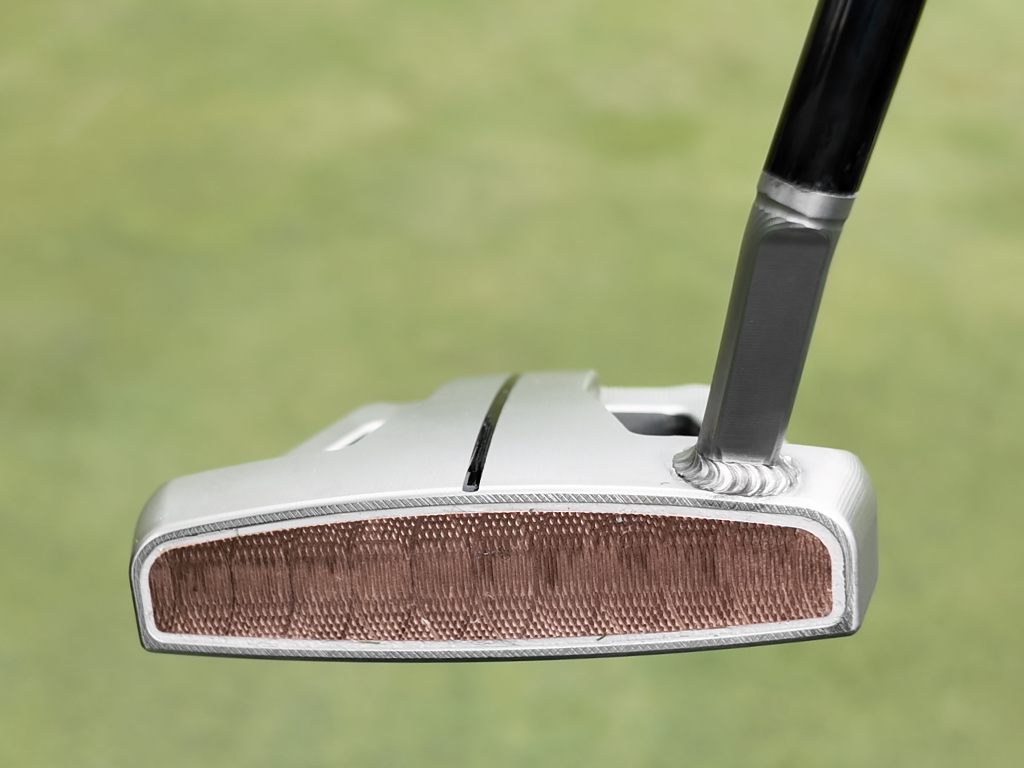
Arguably, the best perk of being a professional golfer on the PGA Tour is the ability to request or even just be handed pretty much any club you could think of. It happens more often than you think, usually with putters around the practice green from one event to the next. Come Wednesday, the Tour bags lining the edge of the putting surface become resting places for fallen flatsticks that never made the cut.
So let’s take a look at some of the best we’ve seen out on Tour this year that never made it to the competition. (You may notice none of Hideki Matsuyama’s custom Scotty Cameron putters made this list. There are too many.)
Let’s start with this custom Damascus Milled Odyssey Rossie made for Ryo Hisatsune. Featuring a single line and the short-slant hossel, we’ve seen plenty of Number 7 and jailbird heads featuring the Damascus Milled insert, but this is the first and only one we’ve spotted in a Rossie. Hisatsune primarily putts with an Odyssey Black Series iX #9, but we have seen him recently with a TaylorMade TP Collection SOTO, so there could be potential that the Damascus Milled Rossie could end up in the bag.

Everyone wants to be Cameron Young right now. We’ve had Justin Thomas and Tom Hoge both game the Scotty Cameron 9.5R prototype. Well, for the PGA Championship, Brooks Koepka nearly joined that list after requesting the same style of putter, with the full-length alignment line. But the Scotty Cameron reps took the request a step further and made one specially for Koepka with a Teryllium insert, similar to one in his previous Newport 2 gamers. The reason why this one didn’t go into play, though? Because it was too heavy.

Harry Hall was the third-best putter on Tour last year, so when Bettinardi made him a custom proto, you know it was going to be good. The custom BB28 blade features VDF face milling, a custom-welded single-bend shaft, and the owner’s initials – HH – on the sole of the putter. Hall, who usually games an Odyssey O-Works #7 W, has dabbled with a TaylorMade Spider Tour X already this year. Maybe there’s a chance this Bettinardi might make his bag.

Honestly, this one doesn’t need a description. It’s Kieth Mitchell’s custom Scotty Cameron Napa. One Scotty Cameron face stamp, two Scotty Dogs, two Scotty Cameron 7-Point Crowns and one Circle T. That is all. Oh, except for the Cashmere Cameron headcover.

Finally, and just for fun, how about we pour one out for this TaylorMade Spider Tour X made for Scottie Scheffler in its new torched finish. It’s unlikely we’ll see a putter change anytime soon from the best golfer in the world. In fact, he hit just two putts with it on the Harbour Town practice before going back to his trusty gamer.


Driver: Titleist GT3 (9 degrees) Buy here.
Shaft: Aldila Rogue Silver 130 M.S.I. 70 TX


3-wood: TaylorMade Qi35 (15 degrees)
Shaft: Fujikura Ventus Blue 7 X

7-wood: TaylorMade Qi35 (21 degrees)
Shaft: Fujikura Ventus Blue 8 X

Irons: Grindworks PR-202 (4), Grindworks PR-101A (5-PW)
Shafts: True Temper Dynamic Gold Tour Issue X100


Wedges: Cleveland RTX6 Tour Rack (52-10 Mid), Titleist Vokey Design SM10 (56-08M), SM11 (60-04T)
Shafts: True Temper Dynamic Gold Tour Issue S400


Putter: Scotty Cameron Tour Rat 1.5 Tour Prototype


Ball: Titleist Pro V1x
Grips: Golf Pride MCC


In our forums, our members have been discussing their favorite major winning irons used by Tiger Woods. WRXer ‘golferdude54’ kicks off the thread saying:
“Mizuno MP 14/29. Titleist 681T. Nike Forged Blades. TaylorMade P7TW.
Among these irons that helped Tiger win 15 majors, which is your favorite in terms of looks?”
And our members have been naming their favorites and why in response.
Here are a couple of posts from the thread, but make sure to check out the entire discussion and have your say at the link below.
- SwingBlade: “I prefer the early blades he played and the more recent TM TW’s especially because after Tiger had his major behavioral setbacks, part of Nikes support payback was making Tiger play a Nike putter and cease using his beloved uniquely customized Scotty putter.”
- ProjectX: “This (Nike Forged Blades) and there’s not even a close second.”
Entire Thread: “Which of Tiger’s major winning irons are your favorite? – GolfWRXers discuss”

Justin Rose WITB 2026 (April): Full WITB breakdown with new McLaren irons

RBC Heritage Tour Report: More minis, course-specific setups, Spider & GTS launches

What’s the story behind Webb Simpson’s custom-stamped irons?

Cadillac Championship Tour Report: Spieth’s sizable changes, McLaren Golf launches, and more

Kristoffer Reitan’s winning WITB: 2026 Truist Championship

Cameron Young’s winning WITB: 2026 Cadillac Championship

Aaron Rai’s winning WITB: 2026 PGA Championship

Nelly Korda WITB 2026 (April)

Justin Rose on the switch to McLaren Golf, learnings from previous equipment moves

Photos from the 2026 PGA Championship


Patrick Reed WITB 2026 (May)
Driver: Titleist GT3 (9 degrees) Buy here. Shaft: Aldila Rogue Silver 130 M.S.I. 70 TX 3-wood: TaylorMade Qi35 (15 degrees)...

Aaron Rai’s winning WITB: 2026 PGA Championship
Driver: TaylorMade M6 (9 degrees) Shaft: Aldilda Synergy Blue 70 TX 3-wood: TaylorMade Qi10 (15 degrees) Shaft: Fujikura Ventus Blue...


Michael Block WITB 2026 (May)
Driver: TaylorMade Qi4D (9 degrees) Shaft: Fujikura Ventus Black VeloCore+ 5 X 3-wood: TaylorMade Qi4D (15 degrees @14.25) Shaft: Mitsubishi...


Bryson DeChambeau WITB 2026 (May)
Driver: Krank Formula Fire Pro (6 degrees) Shaft: Project X Prototype 3-wood: Krank Formula Fire (10 degrees) Shaft: LA Golf BAD...
-
 Whats in the Bag3 weeks ago
Kristoffer Reitan’s winning WITB: 2026 Truist Championship
-
Whats in the Bag2 weeks ago
Aaron Rai’s winning WITB: 2026 PGA Championship
-
 Tour Photo Galleries3 weeks ago
Photos from the 2026 PGA Championship
-
 Equipment2 weeks ago
GolfWRX Launch Report: 2026 Titleist GTS drivers
-

 Equipment2 weeks ago
PGA Championship Tour Report: Fitzpatrick, Koepka among big-name putter switches for Aronimink
-

 News2 weeks ago
WITB Time Machine: Phil Mickelson’s winning WITB, 2021 PGA Championship
-

 Equipment2 weeks ago
Which of Tiger’s major winning irons are your favorite? – GolfWRXers discuss
-

 Equipment2 weeks ago
Lead Tape Report: Adjusting the swingweight of the Wanamaker Trophy


Pingback: TSG / Club-Conex feature on GOLFWRX.com - True Spec Golf
lew
Nov 12, 2015 at 2:50 pm
Im lost on why people think this is not great for golf. If you have shafts and adapters for a few different heads and brands you can use these to test between without the issues of pulling and re-glueing eventual killing the shafts.
From the fitters point the saving over having many shafts for each adapter passes is amazing.
From a customers view they should see some savings as it costs the fitter less too.
Win win win if u ask me.
Styles
Nov 10, 2015 at 6:33 pm
The article claims conex is important but doesn’t backup the headline assertion that the acquisition by true spec is important. It also doesn’t explain why conex is important. Are independent club fitters relevant to the 99% of golfers?
Steve
Nov 12, 2015 at 9:32 am
Definately makes no sense. Is it “so important” when it effects only 40/100 U.S top clubfitters and return effects less then 1/1000 golfers? This is a infomercial more or less, most likely paid by the company to write it.
Mat
Nov 10, 2015 at 4:12 pm
It sure would be nice if they sold to consumers…
Apprenti23
Nov 10, 2015 at 9:40 pm
They’ve been available for purchase by Joe Schmoe for the past ten years. You can buy them online through golfworks or either golfsmith, i can’t remember who sorry
Mat
Nov 11, 2015 at 1:27 am
Let me rephrase; it would be nice if they offered “off the shelf kits” or a simple online store that would let me just buy the parts I need, and take them to a club shop.
JD
Nov 11, 2015 at 11:11 am
http://www.clubconex.com/#!shop-all/cav5
Mike
Nov 10, 2015 at 2:40 pm
I wish this would be put out of business by an industry standard adapter…
Charlie
Nov 10, 2015 at 1:34 pm
Seriously, why? Did I miss part of the article?
George
Nov 10, 2015 at 1:01 pm
Nice advertising for True Spec, important not really
cho
Nov 10, 2015 at 2:36 pm
George.. they arnt sponsors but nice try.
Two clubfitters in the area I live has this setup and it is awesome. I can test any shaft I want and not just the ones the manufacturer has in their fitting cart. It also allows the small guy to only buy one shaft to cover all heads.
Steve
Nov 12, 2015 at 9:35 am
You would go to a fitter with only one shaft to try?
SKip
Nov 10, 2015 at 12:48 pm
Soooo, this acquisition is important because…..?
Joshuaplaysgolf
Nov 10, 2015 at 2:28 pm
Because the name on the building/products will be changing. ITS ASTRONOMICAL!!!!!
Actually, it’s huge because the dudes that started the company can move out of Rockford. I grew up about 30 miles west of there down route 20 and it’s gone steeply downhill in the past few years from quiet, mid-size Midwestern city to major drug hub riddled with daily violence. Not awesome. Good for those guys.
Tom
Nov 10, 2015 at 12:09 pm
This is great for the industry.