
Instruction
Hit your irons better with these two simple drills

“I’d like to hit my irons better.” That’s one of the most popular requests when students come for a lesson, so I decided to write an article about it for GolfWRX readers.
Luckily, there are two very simple drills that can help you achieve a more consistent and better quality strike. But before we continue, it’s important to understand one fundamental idea about quality ball striking with your irons. All good ball strikers, with no exception, will consistently produce a negative angle of attack when striking an iron off the ground.
Trackman defines angle of attack as “The up or down movement of the club head at the time of maximum compression.”
Simply, angle of attack (AoA) refers to whether the club head is ascending (moving up) or descending (moving down) into the golf ball. As a general rule, an AoA between -1 and -4 should be targeted with iron shots; this means that the club head will be moving on a line between 1 and 4 degrees downward when striking the ball
Low Point
An easy way to visualize a negative angle of attack is to take a look at the pictures below, provided very kindly by a friend of mine, Adam Young.
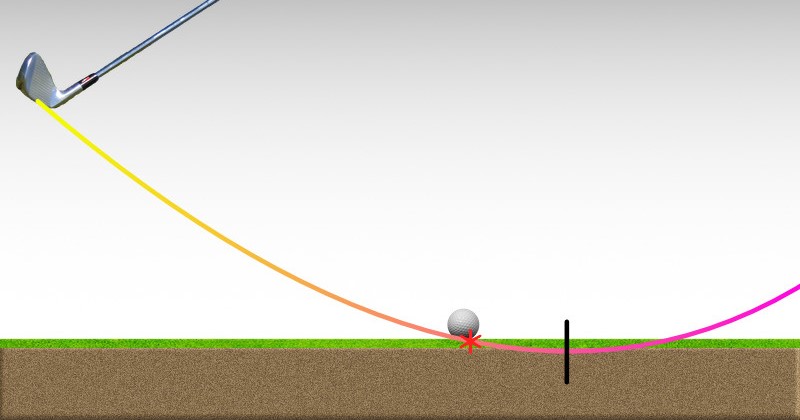
In this first picture, the lowest point of the swing (low point), marked by the black line, is positioned ahead, or target side of the ball. This naturally allows the club head to move downwards into the ball.
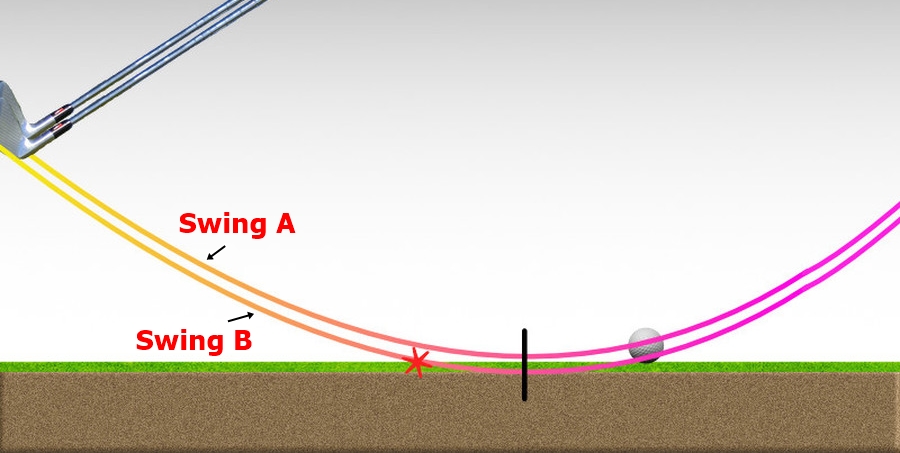
This second picture shows what most amateur golfers struggle with: a low point behind the ball. In both Swing A and Swing B in the second picture, the low point is positioned behind the ball. And when this happens, you will encounter problems with your irons.
- If you are lucky, you may just skim the ground (Swing A) at the low point and in fact still get some amount of club on the ball, often just catching the bottom 2 grooves and hurting your fingers on a cold morning. With this pattern, however, it is also likely that you will hit a lot of thins and tops, as your club moves “up” into the ball.
- If you aren’t so lucky and your swing arc is only a touch lower (Swing B), your club will hit the ground at the red star, resulting in big divots before the ball.
Now, from a technical prospective, I believe there are two main issues that often cause this striking problem. The first is when there is an “early release” or “casting” of the club from the top of the backswing. This happens when the angle between the lead arm and the shaft is lost too EARLY. Secondly, and the biggest issue for many club golfers, is when the body mass is too far back at impact, as players “get caught” on the trail, or back foot. This often happens when players go with their instincts and lean back while trying to lift the ball into the air. As a result, the positioning of the upper body at impact is poor and as with the first issue, it makes it very difficult to achieve a low point ahead of the ball.
So how can golfers combat these two issues?
Towel Drill
In this drill, place a thin towel about 6 inches behind the ball. Then, attempt to hit the golf ball while missing the towel. A good positioning of the towel will make it very difficult to not move the low point ahead of the ball, as a low point too far behind the ball will only result in hitting the towel.
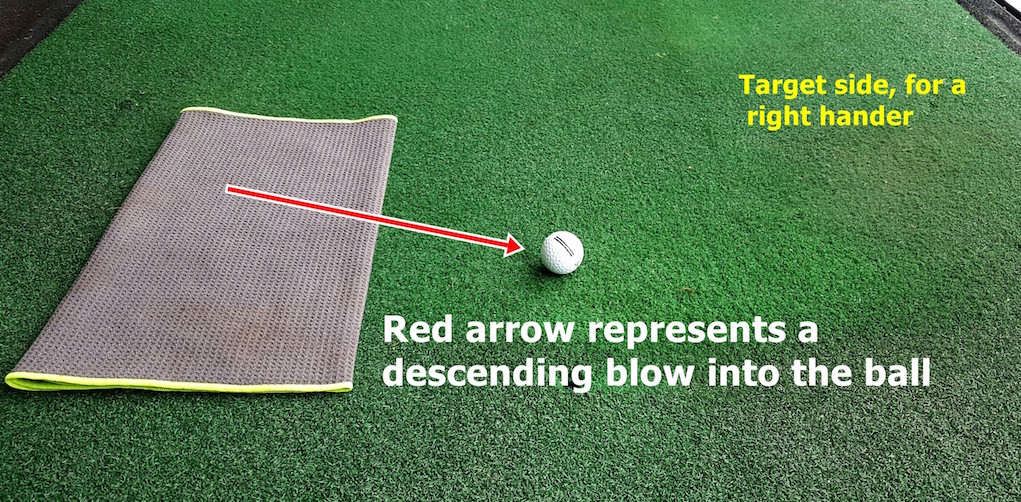
Please Note: I recommend a thin towel, as opposed very thick towel, which will encourage you to “chop” steeply onto the ball. Remember, a subtle angle of attack of around -1 degrees (down) is often ideal. Golfers do not want to go digging and get the club head moving down -10 degrees!
Alignment stick drill
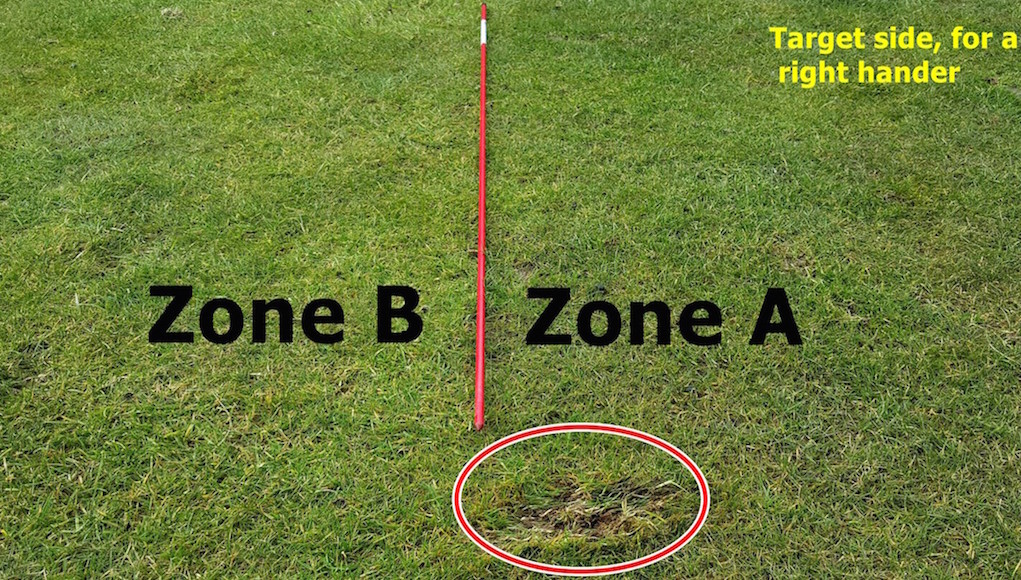
In this exercise, if you are fortunate enough to practice from short-cut grass, place an alignment stick as shown. Then, take your normal setup position with the club resting at the end of the stick. From there, make some swings and look to make some marks on the grass in Zone A. By this, I mean bruise or brush — maybe even take a shallow divot — but don’t go making big craters!

Any marks in Zone B mean that the low point occurred behind the ball, instead of ahead. Once satisfied that you can make some marks in Zone A consistently, have a go with a ball while attempting to replicate a similar swing movement.
Note: If you cannot access a grass driving range, use this same drill on a mat but instead of trying to mark the mat, place a small tee peg in Zone A. Then, try to hit the tee peg cleanly to again ensure that the low point is ahead of the ball.
Can it be really be that simple?
You will hopefully notice that the drills given involve ZERO technical information regarding positions or movements. Instead, they use something called a “task constraint.”
A TASK CONSTRAINT IS A BOUNDARY THAT ENCOURAGES THE LEARNER TO EMERGE WITH CERTAIN BEHAVIORS.
In simple terms, the constraint of the towel and alignment stick will allow your technique to evolve from the exercise, as opposed to deliberately thinking about it. For example, you will seriously struggle to miss the towel if you “release early” or “get stuck” on your trail side. The real beauty of this type of exercise is that you can often make the movement change without getting caught up in a barrage of swing thoughts. Ironically, it is excessive “attention” on your swing that will often result in bad shots.
Unfortunately, your friends on a Saturday morning may not allow you to use a towel in the weekly medal. With this in mind, do not become too reliant on the drills and vary up the usage in your practice sessions. Make sure to let go of your technical thoughts, and you’ll be amazed how quickly new, better habits can be formed.



The LPGA Tour is kicking off its 2026 season this week at Lake Nona Golf and Country Club in Orlando, and the pros are dealing with something most Florida golfers rarely face: freezing temperatures.
“It’s colder here than in the UK at the minute, which is a first,” said England’s Charley Hull during Wednesday’s media day at the Hilton Grand Vacations Tournament of Champions.
Even Lydia Ko, who lives at Lake Nona, seemed surprised by the cold snap. “We’re pretty much getting to below zero in celsius here, which maybe in other parts of the country they would be thankful, but when you’re in Florida it is a little bit of a surprise,” she said.
If the world’s best players are adjusting their games for cold weather, recreational golfers should, too. Here’s how to play smart when the mercury drops.
Understand What Cold Does to Your Game
Before you change anything, you need to know what you’re fighting against. Cold air is denser than warm air, which means your ball won’t fly as far. Period.
Hull noticed this immediately during practice rounds at Lake Nona. She mentioned hitting a gap wedge into the 18th hole during a previous win but needing a 4-iron during Tuesday’s practice round. That’s a difference of four or five clubs for the same shot.
Action item: Expect to lose 5-10 yards on every club in your bag when temperatures dip below 50 degrees. Plan accordingly and don’t be stubborn about club selection.
Layer Up Without Restricting Your Swing
Hull admitted she wore three pairs of pants during practice. While that might be extreme for most of us, staying warm is critical to playing well in cold conditions.
Your muscles need warmth to function properly. When you’re cold, your body tightens up and your swing gets shorter and faster. Neither of those things help you hit good golf shots.
Action item: Wear multiple thin layers instead of one bulky jacket. Look for golf-specific cold weather gear that stretches with your swing. Keep hand warmers in your pockets between shots. And don’t forget a good hat because you lose significant body heat through your head.
Take More Club Than You Think You Need
This is where ego gets in the way of good scores. When it’s cold, the ball doesn’t compress as well off the clubface. Combined with denser air, you’re looking at serious distance loss.
The pros at Lake Nona are dealing with a course that measures 6,642 yards but plays much longer this week. If they’re adjusting, you should too.
Action item: Take at least one extra club on every approach shot. In temperatures below 40 degrees, consider taking two extra clubs. It’s better to fly the ball to the back of the green than to come up short in a bunker.
Adjust Your Expectations on the Greens
Cold weather affects putting in ways most golfers don’t consider. The ball is harder and doesn’t roll as smoothly. Your hands are cold, making it harder to feel the putter. And if there’s any moisture on the greens, they’ll be slower than normal.
Ko mentioned that she still sometimes reads the greens wrong at Lake Nona despite being a member for years. Cold weather makes that challenge even tougher.
Action item: Hit putts more firmly than usual. The ball needs extra speed to hold its line on cold greens. Take a few extra practice strokes to get a feel for the speed before you putt.
Embrace the Mental Challenge
Hull said something interesting about cold weather golf: “I like the mental toughness of it.”
That’s the right attitude. Everyone on the course is dealing with the same conditions. The player who stays patient and doesn’t get frustrated by the extra difficulty will come out ahead.
Action item: Lower your expectations by a few strokes. If you normally shoot 85, accept that 90 might be a good score in 40-degree weather. Focus on solid contact and smart decisions rather than perfect shots.
Warm Up Longer and Smarter
This might be the most important tip of all. Cold muscles are tight muscles, and tight muscles get injured easily.
World No. 1 Jeeno Thitikul revealed she’s been protecting a wrist injury that bothered her late last season. Cold weather makes those kinds of injuries more likely if you don’t prepare properly.
Action item: Spend at least 20 minutes warming up before your round. Start with stretching, then hit easy wedge shots before working up to your driver. Keep moving between shots on the course to maintain body heat and flexibility.
The pros at Lake Nona this week will adapt and compete at the highest level despite the cold. You can do the same at your local course by following these tips and keeping a positive attitude.
PGA Professional Brendon Elliott is an award-winning coach and golf writer. You can check out his writing work and learn more about him by visiting BEAGOLFER.golf and OneMoreRollGolf.com. Also, check out “Playing Through” now on R.org, RG.org’s partner site, each Monday.
Editor’s note: Brendon shares his nearly 30 years of experience in the game with GolfWRX readers through his ongoing tip series. He looks forward to providing valuable insights and advice to help golfers improve their game. Stay tuned for more tips!

Brooks Koepka is back on the PGA Tour, and whether you love him or hate him, the guy knows how to win when it matters. After his LIV Golf stint, the five-time major champion returns this week at the Farmers Insurance Open.
What makes Koepka fascinating? He doesn’t fit the mold. His swing isn’t textbook. He doesn’t obsess over mechanics. Yet he’s won three PGA Championships and two U.S. Opens, regularly making it look easier than guys with prettier swings.
So, what can average golfers learn from someone who treats the game so differently? Quite a bit.
Stop Overthinking Every Shot
Koepka describes his approach as “reactionary” rather than mechanical. While most tour pros grind over swing thoughts, Brooks sees the target and hits it. No mental checklist.
This might be the most valuable lesson for weekend golfers who’ve watched too many YouTube swing videos.
How to actually do this:
On the range, hit five balls where you stare at the target for three seconds prior to addressing the ball. Don’t think about grip or stance. Just burn that target into your brain. You’ll be shocked at how pure you hit it when your brain focuses on where the ball is going instead of how you’re swinging.
Next time you play, give yourself a rule: Once you pull the club, you’ve got 15 seconds to hit. Koepka is one of the fastest players on tour because he doesn’t give his brain time to sabotage him.
If you feel tension in your hands at address, you’re trying to control too much. Koepka’s grip pressure is famously light. Loosen up until the club almost feels like it might slip, then add just enough pressure to hold on. That’s your swing thought: soft hands, see the target.
This approach works better under pressure. When you’re standing over that shot with water left and OB right, the last thing you need is a mental checklist. See it, feel it, hit it.
Play to Your Strengths (Even If They’re Not Pretty)
Koepka uses a strong grip that wouldn’t pass muster in some teaching circles. But he’s built his game around what works for him, elite driving distance and recovery skills. He doesn’t try to be someone he’s not.
Here’s how to build your game like Brooks:
Look at your last five rounds and figure out where you’re actually gaining strokes. Bombing it off the tee, but can’t hit greens? Lean into it. Play courses where distance matters more than precision. On tight holes, grip down on your 3-wood instead of trying to thread a driver through a keyhole you’ll miss seven times out of ten.
Koepka knows he can scramble, so he’s not afraid to miss greens. If you’re deadly from 50 to 75 yards, start leaving yourself those distances on the par 5’s instead of going for them in two every time.
Know when to take your medicine. Koepka in the trees at the PGA? He’s punching out to 100 yards, not trying to bend a 6-iron around three oaks. You’re in the rough with a flyer lie and water short? Hit your 8-iron to the middle and move on. That’s not playing scared, that’s playing smart.
Save Your Best for When It Counts
Here’s a wild stat: Koepka’s putting average in majors is often more than a full stroke better per round than in regular events. He elevates when pressure is highest.
How does an amateur tap into that gear? It’s not about trying harder, it’s about caring differently.
Here’s what actually works:
Decide which rounds matter to you. Club championship? Member-guest? That annual trip with college buddies? Circle those dates and treat them differently. Koepka doesn’t care much about regular tour events, but majors? That’s when he locks in.
Two weeks before your big round, change your practice. Stop beating balls mindlessly. Play nine holes in which every shot has consequences. Miss the fairway? Hit from the rough on the next hole too. Three-putt? Twenty push-ups. Koepka’s practice intensity ramps up before majors because he’s rehearsing pressure, not just swings.
Develop a between-shot routine that resets your brain. Koepka is famous for his blank expression after bad shots. Try this: After any shot, take three deep breaths while walking, then find something specific to notice, a tree, a cloud, someone’s shirt. That’s your reset button. By the time you reach your ball, the last shot is gone.
The Bottom Line
Brooks Koepka’s return reminds us there’s no single path to success in golf. His “substance over style” approach proves that results matter more than looking good.
You don’t need a perfect swing; you need a reliable one that holds up under pressure. You don’t need to hit every shot in the book; you need the shots you can count on. And you don’t need to play great every time; you need to play great when it matters.
Welcome back, Brooks. Thanks for the reminder that golf is ultimately about getting the ball in the hole, not winning style points.
PGA Professional Brendon Elliott is an award-winning coach and golf writer. You can check out his writing work and learn more about him by visiting BEAGOLFER.golf and OneMoreRollGolf.com. Also, check out “Playing Through” now on R.org, RG.org’s partner site, each Monday.
Editor’s note: Brendon shares his nearly 30 years of experience in the game with GolfWRX readers through his ongoing tip series. He looks forward to providing valuable insights and advice to help golfers improve their game. Stay tuned for more tips!

Blades Brown made a big impression last week in the California desert, and not just because he’s only 18. He put up numbers that would catch any weekend golfer’s attention. Most of us won’t hit 317-yard drives or find 86% of our greens in regulation, but there’s a lot to learn from how Brown managed his game at The American Express.
Here are three practical lessons from his performance that you can use on your own course this weekend.
Step 1: Give Priority to Accuracy Over Distance Off The Tee
Brown’s driving stats are impressive. He averaged almost 318 yards off the tee, ranking 12th in the field. More importantly, he hit 76.79% of his fairways, tying for fourth place in the tournament.
Think about that ratio for a second. Brown could have swung harder, chased more distance and tried to overpower the course. Instead, he played smart golf and kept his ball in play.
Your Action Item: Next time you’re on the tee box, ask yourself a simple question before pulling the driver. Do you need maximum distance here, or do you need to be in the fairway? If there’s trouble lurking or the hole doesn’t demand every yard you can muster, take something off your swing. Grip down an inch. Make a three-quarter swing. Do whatever it takes to find the short grass. Brown’s approach illustrates that fairways lead to greens, and greens lead to birdies. He made 22 of them last week, along with an eagle.
The math is simple. When you’re hitting three out of every four fairways like Brown did, you’re giving yourself legitimate looks at the green with your approach shots. That’s when scoring happens.
Step 2: Commit To Hitting More Greens
This is where Brown really separated himself. He hit 62 of 72 greens in regulation, an 86.11% clip that tied for first in the entire field. Read that again. An 18-year-old kid tied for the lead in one of the most important ball-striking statistics in professional golf.
How did he do it? By keeping his ball in the fairway (see Step 1) and giving himself clean looks with mid-irons and wedges.
Your Action Item: Start tracking your greens in regulation. You don’t need a fancy app or a statistics degree. Just mark down whether you hit the green in the regulation number of strokes. Par 3s in one shot. Par 4s in two shots. Par 5s in three shots.
Once you know your baseline, set a goal to improve it by 10%. If you’re currently hitting five greens per round, aim for six. The beauty of this approach is that it forces you to think strategically about club selection and shot shape. Brown’s strokes gained approach number was positive (0.179), meaning he was better than the field average. You don’t need to be perfect. You just need to be on the dance floor more often.
When you hit more greens, you eliminate the need for heroic short game shots. Brown only had to scramble 10 times all week, and he got up and down 70% of the time. That’s solid, but the real story is that he rarely put himself in scrambling situations to begin with.
Step 3: Minimize Mistakes And Stay Patient
Here’s the stat that jumps off the page: Brown made only three bogeys all week. Three. In four rounds of professional golf against the best players in the world.
He also made just one double bogey. That kind of clean card doesn’t happen by accident. It happens when you play within yourself, avoid the big miss and trust that pars are never bad scores.
Your Action Item: Before your next round, decide that you’re going to play boring golf. No hero shots over water. No driver on tight holes just because you can. No aggressive pins when there’s a safe side of the green.
Brown’s performance shows us that consistency beats flash every single time. He didn’t lead the field in any single strokes gained category, but he was solid across the board. That’s how you post numbers and cash checks.
Give these three steps a try. Your scorecard will thank you.
PGA Professional Brendon Elliott is an award-winning coach and golf writer. You can check out his writing work and learn more about him by visiting BEAGOLFER.golf and OneMoreRollGolf.com. Also, check out “The Starter” now on R.org, RG.org’s partner site, each Monday.
Editor’s note: Brendon shares his nearly 30 years of experience in the game with GolfWRX readers through his ongoing tip series. He looks forward to providing valuable insights and advice to help golfers improve their game. Stay tuned for more tips!

Justin Rose WITB 2026 (April): Full WITB breakdown with new McLaren irons

RBC Heritage Tour Report: More minis, course-specific setups, Spider & GTS launches

What’s the story behind Webb Simpson’s custom-stamped irons?

Cadillac Championship Tour Report: Spieth’s sizable changes, McLaren Golf launches, and more

Kristoffer Reitan’s winning WITB: 2026 Truist Championship

Cameron Young’s winning WITB: 2026 Cadillac Championship

Aaron Rai’s winning WITB: 2026 PGA Championship

Nelly Korda WITB 2026 (April)

Justin Rose on the switch to McLaren Golf, learnings from previous equipment moves

Photos from the 2026 PGA Championship


Patrick Reed WITB 2026 (May)
Driver: Titleist GT3 (9 degrees) Buy here. Shaft: Aldila Rogue Silver 130 M.S.I. 70 TX 3-wood: TaylorMade Qi35 (15 degrees)...

Aaron Rai’s winning WITB: 2026 PGA Championship
Driver: TaylorMade M6 (9 degrees) Shaft: Aldilda Synergy Blue 70 TX 3-wood: TaylorMade Qi10 (15 degrees) Shaft: Fujikura Ventus Blue...


Michael Block WITB 2026 (May)
Driver: TaylorMade Qi4D (9 degrees) Shaft: Fujikura Ventus Black VeloCore+ 5 X 3-wood: TaylorMade Qi4D (15 degrees @14.25) Shaft: Mitsubishi...


Bryson DeChambeau WITB 2026 (May)
Driver: Krank Formula Fire Pro (6 degrees) Shaft: Project X Prototype 3-wood: Krank Formula Fire (10 degrees) Shaft: LA Golf BAD...
-
 Whats in the Bag3 weeks ago
Kristoffer Reitan’s winning WITB: 2026 Truist Championship
-
Whats in the Bag2 weeks ago
Aaron Rai’s winning WITB: 2026 PGA Championship
-
 Tour Photo Galleries3 weeks ago
Photos from the 2026 PGA Championship
-
 Equipment2 weeks ago
GolfWRX Launch Report: 2026 Titleist GTS drivers
-

 Equipment2 weeks ago
PGA Championship Tour Report: Fitzpatrick, Koepka among big-name putter switches for Aronimink
-

 News2 weeks ago
WITB Time Machine: Phil Mickelson’s winning WITB, 2021 PGA Championship
-

 Equipment2 weeks ago
Which of Tiger’s major winning irons are your favorite? – GolfWRXers discuss
-

 Equipment2 weeks ago
Lead Tape Report: Adjusting the swingweight of the Wanamaker Trophy


Pingback: Master Your Golf Swing: Perfect Angle of Attack – Linked Greens
Pingback: Hitting The Golf Ball Too Low With Your Irons? Here’s How To Hit It Higher - (MUST READ Before You Buy)
Steven
Apr 27, 2016 at 1:27 pm
Great Advice Thomas. I know one of the things I am working on right now is improving impact position. Anything to help get the divot on the correct side of the ball will help me.
I also think this article illustrates an important point in instruction. Instructors know the end results (well balanced swing, etc.), but many of them will get there a different way. I like this drill because it helps me visualize where to hit the ground. The added benefit is my weight shift and lag should improve. Others may teach it a different way, but I personally like this one.
Dave T
Apr 26, 2016 at 7:40 am
Whatever you do don’t mix up these two drills! I was doing the ‘towel” drill but using an alignment stick instead. After each successive shot I kept moving the stick closer and closer to the ball. BAM! I hit the stick and helicoptered it out into the range! Talk about walk of shame going out to retrieve it. Oh, and if you hit driveway markers hard enough they will break!
Steve
Apr 26, 2016 at 6:14 am
One of the better instructional articles I’ve read in a while. Nice job.
Brad
Apr 25, 2016 at 2:23 pm
Love it! I used to lay a tee against the backside of the ball and think about hitting the tee instead of the ball…think I’m going to try the towel drill after work
Michael
Apr 25, 2016 at 1:29 pm
So with the alignment stick drill, I assume that the golfer straddles the alignment stick.
TheCityGame
Apr 26, 2016 at 11:42 am
that’s how he diagrammed it, but there’s no reason not to put the alignment stick on the other side so you don’t need to straddle it. Or a tee. No need for a alignment stick. Just want a visual cue for where you place the ball to make sure you’re taking a divot in the right spot.
Mike
Apr 25, 2016 at 1:03 pm
My instructor would have a pocketful of dimes and place one an inch or two in front of the ball. The goal was to swing through and clip the dime, with the ball just getting in the way. It helped me, as I would be guilty of leaning back ever so slightly to add loft on a shallow swing.
parker
Apr 23, 2016 at 8:44 pm
I think this is the single most important drill anyone can do (towel drill vs alignment stick drill… its really the same thing). The technical points of a golf swing lose their impact if you can’t get your club on the ball properly.
To add my two cents, I recommend spending time on this drill before working on a new swing move, to make sure you are indeed starting with a solid strike, and then doing it again after working on the new move, to make sure you don’t take a step backwards in your striking.
The other good thing about this drill is that it provides real feedback and ignores whatever you feel. I use CB irons and I swing very hard, and I find that slightly fat or thin shots still feel solid, but come up a little short. If my clubs are going short on the range, I’ve learned to check this drill first before trying to mess with my swing. For me, it’s usually a simple posture and balance issue that messes up my low point, instead of something more mechanical.