
Instruction
Testing Brandel Chamblee’s “Restricted Hips” swing theory on Trackman

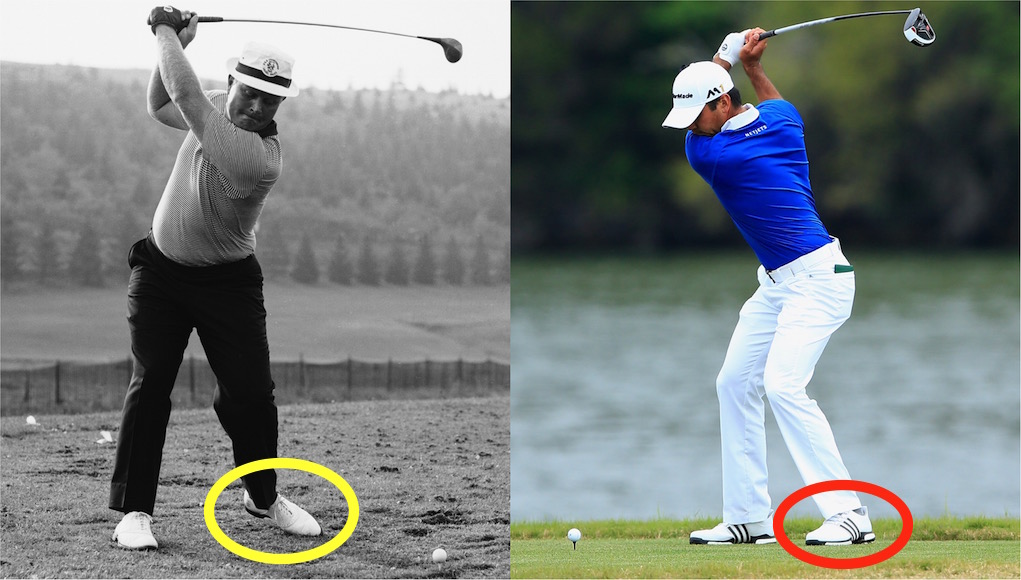
Brandel Chamblee — a famously controversial, but tremendously knowledgable golf analyst — has taken a very firm public stance on the way golfers should use their hips during the golf swing. He believes that golfers should let their front foot come off the ground in the backswing, allowing the hips to turn mostly unrestricted, rather than the new-age philosophy of restricting the hip turn for control and power. In fact, he says that restricting the hips may be the cause of long-term injuries that have become common on the PGA Tour.
Watch his take in the video below.
And I agree with Chamblee to a point, although I often teach the golf swing both ways to my students; and let me tell you why.
If I have a person who is lacking clubhead speed, tends to lift the club with their arms to the top, has issues with an over-the-top delivery, requires more swing width at the top or needs more distance, I will allow them to have a more unrestricted motion to the top, as Chamblee suggests.

Above, you can see a full hip turn to the top with a left heel that has come up off the ground, creating a fuller shoulder turn and a deeper club position at the top. This allows the hips and shoulders to move into a more rotated position and thus keeps the club in the air longer and should produce more clubhead speed.
However, if the player has radical misses, rips the club inside their body on the takeaway, gets stuck on the way down, needs more stability at the top or lacks control not distance, I will often “shorten” them up a touch. In other words, I restrict their hip turn.

In this photo, you can see a tighter overall turn the top, a shorter and wider arm-swing, a more center body position over the ball, and a reduced hip turn (compared to the photo above) to the top.
Let me make it clear that, to me, there is a huge difference between a true “restriction” and simply tightening up the backswing. While I don’t believe in full restriction in most any circumstance, since it hampers the body’s natural motion, I might reduce it slightly if necessary to gain control. As you can see above, the hips have still turned but they are tighter than the free-flowing hip actions seen with Jack Nicklaus or Mickey Wright, to use Chamblee’s examples. Neither are incorrect, just different, and have different roles for different player issues.
So let’s examine the Trackman data with a 7 iron using the two different concepts: hip restriction vs. unrestricted hips.

The white circle on the Trackman screen shot above show the shots with the more restricted hip action (RH = restricted hip action) while the yellow shots were hit with unrestricted hip action (UH = unrestricted hip action) to the top.
- RH produced a carry average of 148.4 yards, a short shot of 141 yards and a long shot of 155.6 yards giving us a dispersion of 14.6 yards.
- UH produced a carry average of 157.9 yards, a short shot of 152.8 yards and a long shot of 164 yards giving us a dispersion of 11.2 yards.
- RH produced a club-head speed of 80.7 miles per hour, while the UH gave the golfer 84.5 miles per hour.
- The path of the RH was -1.1 from outside to inside and the path of the UH was 0.8 degrees from the inside.
- With more clubhead speed, we saw higher shots as shown by the graph of the shot patterns.
NOTE: In each of the data tiles you will see a number in the lower left hand corner. This is the average for all shots hit, and the +/- is the difference off the average the current shot is overall.
The Restricted Hip Turn Swing

What I like about a tighter hip turn:
- More control for the longer hitters.
- Variances in clubhead speed and carry distances are smaller.
- Big misses are diminished.
What I don’t like:
- Easier for arms to dominate the swing.
- Over-the-top motions are more prevalent.
- Shorter-and-tighter swings can easily become immobile if over-cooked by the player.
The Unrestricted Hip Turn Swing

What I like about the unrestricted hip turn:
- Easier to get loaded and behind the ball at the top for the less flexible players.
- More clubhead speed and more distance.
- Easier to come from the inside.
What I don’t like:
- Easier to transition “back,” but harder to get forward.
- Easier to get the weight on the outside heel of the rear foot.
- Misses tend to be much worse (long and left is a killer).
So… what’s the best way for you to swing?
- If you hit the ball far enough for the courses you play and you lack control, you might want to consider tightening up your hip your hip turn.
- If you need more distance and higher shots into the greens, you might want to consider releasing your hips to the top.
For more information regarding the fuller hip rotation, pick up Chamblee’s book “The Anatomy of Greatness.”



The LPGA Tour is kicking off its 2026 season this week at Lake Nona Golf and Country Club in Orlando, and the pros are dealing with something most Florida golfers rarely face: freezing temperatures.
“It’s colder here than in the UK at the minute, which is a first,” said England’s Charley Hull during Wednesday’s media day at the Hilton Grand Vacations Tournament of Champions.
Even Lydia Ko, who lives at Lake Nona, seemed surprised by the cold snap. “We’re pretty much getting to below zero in celsius here, which maybe in other parts of the country they would be thankful, but when you’re in Florida it is a little bit of a surprise,” she said.
If the world’s best players are adjusting their games for cold weather, recreational golfers should, too. Here’s how to play smart when the mercury drops.
Understand What Cold Does to Your Game
Before you change anything, you need to know what you’re fighting against. Cold air is denser than warm air, which means your ball won’t fly as far. Period.
Hull noticed this immediately during practice rounds at Lake Nona. She mentioned hitting a gap wedge into the 18th hole during a previous win but needing a 4-iron during Tuesday’s practice round. That’s a difference of four or five clubs for the same shot.
Action item: Expect to lose 5-10 yards on every club in your bag when temperatures dip below 50 degrees. Plan accordingly and don’t be stubborn about club selection.
Layer Up Without Restricting Your Swing
Hull admitted she wore three pairs of pants during practice. While that might be extreme for most of us, staying warm is critical to playing well in cold conditions.
Your muscles need warmth to function properly. When you’re cold, your body tightens up and your swing gets shorter and faster. Neither of those things help you hit good golf shots.
Action item: Wear multiple thin layers instead of one bulky jacket. Look for golf-specific cold weather gear that stretches with your swing. Keep hand warmers in your pockets between shots. And don’t forget a good hat because you lose significant body heat through your head.
Take More Club Than You Think You Need
This is where ego gets in the way of good scores. When it’s cold, the ball doesn’t compress as well off the clubface. Combined with denser air, you’re looking at serious distance loss.
The pros at Lake Nona are dealing with a course that measures 6,642 yards but plays much longer this week. If they’re adjusting, you should too.
Action item: Take at least one extra club on every approach shot. In temperatures below 40 degrees, consider taking two extra clubs. It’s better to fly the ball to the back of the green than to come up short in a bunker.
Adjust Your Expectations on the Greens
Cold weather affects putting in ways most golfers don’t consider. The ball is harder and doesn’t roll as smoothly. Your hands are cold, making it harder to feel the putter. And if there’s any moisture on the greens, they’ll be slower than normal.
Ko mentioned that she still sometimes reads the greens wrong at Lake Nona despite being a member for years. Cold weather makes that challenge even tougher.
Action item: Hit putts more firmly than usual. The ball needs extra speed to hold its line on cold greens. Take a few extra practice strokes to get a feel for the speed before you putt.
Embrace the Mental Challenge
Hull said something interesting about cold weather golf: “I like the mental toughness of it.”
That’s the right attitude. Everyone on the course is dealing with the same conditions. The player who stays patient and doesn’t get frustrated by the extra difficulty will come out ahead.
Action item: Lower your expectations by a few strokes. If you normally shoot 85, accept that 90 might be a good score in 40-degree weather. Focus on solid contact and smart decisions rather than perfect shots.
Warm Up Longer and Smarter
This might be the most important tip of all. Cold muscles are tight muscles, and tight muscles get injured easily.
World No. 1 Jeeno Thitikul revealed she’s been protecting a wrist injury that bothered her late last season. Cold weather makes those kinds of injuries more likely if you don’t prepare properly.
Action item: Spend at least 20 minutes warming up before your round. Start with stretching, then hit easy wedge shots before working up to your driver. Keep moving between shots on the course to maintain body heat and flexibility.
The pros at Lake Nona this week will adapt and compete at the highest level despite the cold. You can do the same at your local course by following these tips and keeping a positive attitude.
PGA Professional Brendon Elliott is an award-winning coach and golf writer. You can check out his writing work and learn more about him by visiting BEAGOLFER.golf and OneMoreRollGolf.com. Also, check out “Playing Through” now on R.org, RG.org’s partner site, each Monday.
Editor’s note: Brendon shares his nearly 30 years of experience in the game with GolfWRX readers through his ongoing tip series. He looks forward to providing valuable insights and advice to help golfers improve their game. Stay tuned for more tips!

Brooks Koepka is back on the PGA Tour, and whether you love him or hate him, the guy knows how to win when it matters. After his LIV Golf stint, the five-time major champion returns this week at the Farmers Insurance Open.
What makes Koepka fascinating? He doesn’t fit the mold. His swing isn’t textbook. He doesn’t obsess over mechanics. Yet he’s won three PGA Championships and two U.S. Opens, regularly making it look easier than guys with prettier swings.
So, what can average golfers learn from someone who treats the game so differently? Quite a bit.
Stop Overthinking Every Shot
Koepka describes his approach as “reactionary” rather than mechanical. While most tour pros grind over swing thoughts, Brooks sees the target and hits it. No mental checklist.
This might be the most valuable lesson for weekend golfers who’ve watched too many YouTube swing videos.
How to actually do this:
On the range, hit five balls where you stare at the target for three seconds prior to addressing the ball. Don’t think about grip or stance. Just burn that target into your brain. You’ll be shocked at how pure you hit it when your brain focuses on where the ball is going instead of how you’re swinging.
Next time you play, give yourself a rule: Once you pull the club, you’ve got 15 seconds to hit. Koepka is one of the fastest players on tour because he doesn’t give his brain time to sabotage him.
If you feel tension in your hands at address, you’re trying to control too much. Koepka’s grip pressure is famously light. Loosen up until the club almost feels like it might slip, then add just enough pressure to hold on. That’s your swing thought: soft hands, see the target.
This approach works better under pressure. When you’re standing over that shot with water left and OB right, the last thing you need is a mental checklist. See it, feel it, hit it.
Play to Your Strengths (Even If They’re Not Pretty)
Koepka uses a strong grip that wouldn’t pass muster in some teaching circles. But he’s built his game around what works for him, elite driving distance and recovery skills. He doesn’t try to be someone he’s not.
Here’s how to build your game like Brooks:
Look at your last five rounds and figure out where you’re actually gaining strokes. Bombing it off the tee, but can’t hit greens? Lean into it. Play courses where distance matters more than precision. On tight holes, grip down on your 3-wood instead of trying to thread a driver through a keyhole you’ll miss seven times out of ten.
Koepka knows he can scramble, so he’s not afraid to miss greens. If you’re deadly from 50 to 75 yards, start leaving yourself those distances on the par 5’s instead of going for them in two every time.
Know when to take your medicine. Koepka in the trees at the PGA? He’s punching out to 100 yards, not trying to bend a 6-iron around three oaks. You’re in the rough with a flyer lie and water short? Hit your 8-iron to the middle and move on. That’s not playing scared, that’s playing smart.
Save Your Best for When It Counts
Here’s a wild stat: Koepka’s putting average in majors is often more than a full stroke better per round than in regular events. He elevates when pressure is highest.
How does an amateur tap into that gear? It’s not about trying harder, it’s about caring differently.
Here’s what actually works:
Decide which rounds matter to you. Club championship? Member-guest? That annual trip with college buddies? Circle those dates and treat them differently. Koepka doesn’t care much about regular tour events, but majors? That’s when he locks in.
Two weeks before your big round, change your practice. Stop beating balls mindlessly. Play nine holes in which every shot has consequences. Miss the fairway? Hit from the rough on the next hole too. Three-putt? Twenty push-ups. Koepka’s practice intensity ramps up before majors because he’s rehearsing pressure, not just swings.
Develop a between-shot routine that resets your brain. Koepka is famous for his blank expression after bad shots. Try this: After any shot, take three deep breaths while walking, then find something specific to notice, a tree, a cloud, someone’s shirt. That’s your reset button. By the time you reach your ball, the last shot is gone.
The Bottom Line
Brooks Koepka’s return reminds us there’s no single path to success in golf. His “substance over style” approach proves that results matter more than looking good.
You don’t need a perfect swing; you need a reliable one that holds up under pressure. You don’t need to hit every shot in the book; you need the shots you can count on. And you don’t need to play great every time; you need to play great when it matters.
Welcome back, Brooks. Thanks for the reminder that golf is ultimately about getting the ball in the hole, not winning style points.
PGA Professional Brendon Elliott is an award-winning coach and golf writer. You can check out his writing work and learn more about him by visiting BEAGOLFER.golf and OneMoreRollGolf.com. Also, check out “Playing Through” now on R.org, RG.org’s partner site, each Monday.
Editor’s note: Brendon shares his nearly 30 years of experience in the game with GolfWRX readers through his ongoing tip series. He looks forward to providing valuable insights and advice to help golfers improve their game. Stay tuned for more tips!

Blades Brown made a big impression last week in the California desert, and not just because he’s only 18. He put up numbers that would catch any weekend golfer’s attention. Most of us won’t hit 317-yard drives or find 86% of our greens in regulation, but there’s a lot to learn from how Brown managed his game at The American Express.
Here are three practical lessons from his performance that you can use on your own course this weekend.
Step 1: Give Priority to Accuracy Over Distance Off The Tee
Brown’s driving stats are impressive. He averaged almost 318 yards off the tee, ranking 12th in the field. More importantly, he hit 76.79% of his fairways, tying for fourth place in the tournament.
Think about that ratio for a second. Brown could have swung harder, chased more distance and tried to overpower the course. Instead, he played smart golf and kept his ball in play.
Your Action Item: Next time you’re on the tee box, ask yourself a simple question before pulling the driver. Do you need maximum distance here, or do you need to be in the fairway? If there’s trouble lurking or the hole doesn’t demand every yard you can muster, take something off your swing. Grip down an inch. Make a three-quarter swing. Do whatever it takes to find the short grass. Brown’s approach illustrates that fairways lead to greens, and greens lead to birdies. He made 22 of them last week, along with an eagle.
The math is simple. When you’re hitting three out of every four fairways like Brown did, you’re giving yourself legitimate looks at the green with your approach shots. That’s when scoring happens.
Step 2: Commit To Hitting More Greens
This is where Brown really separated himself. He hit 62 of 72 greens in regulation, an 86.11% clip that tied for first in the entire field. Read that again. An 18-year-old kid tied for the lead in one of the most important ball-striking statistics in professional golf.
How did he do it? By keeping his ball in the fairway (see Step 1) and giving himself clean looks with mid-irons and wedges.
Your Action Item: Start tracking your greens in regulation. You don’t need a fancy app or a statistics degree. Just mark down whether you hit the green in the regulation number of strokes. Par 3s in one shot. Par 4s in two shots. Par 5s in three shots.
Once you know your baseline, set a goal to improve it by 10%. If you’re currently hitting five greens per round, aim for six. The beauty of this approach is that it forces you to think strategically about club selection and shot shape. Brown’s strokes gained approach number was positive (0.179), meaning he was better than the field average. You don’t need to be perfect. You just need to be on the dance floor more often.
When you hit more greens, you eliminate the need for heroic short game shots. Brown only had to scramble 10 times all week, and he got up and down 70% of the time. That’s solid, but the real story is that he rarely put himself in scrambling situations to begin with.
Step 3: Minimize Mistakes And Stay Patient
Here’s the stat that jumps off the page: Brown made only three bogeys all week. Three. In four rounds of professional golf against the best players in the world.
He also made just one double bogey. That kind of clean card doesn’t happen by accident. It happens when you play within yourself, avoid the big miss and trust that pars are never bad scores.
Your Action Item: Before your next round, decide that you’re going to play boring golf. No hero shots over water. No driver on tight holes just because you can. No aggressive pins when there’s a safe side of the green.
Brown’s performance shows us that consistency beats flash every single time. He didn’t lead the field in any single strokes gained category, but he was solid across the board. That’s how you post numbers and cash checks.
Give these three steps a try. Your scorecard will thank you.
PGA Professional Brendon Elliott is an award-winning coach and golf writer. You can check out his writing work and learn more about him by visiting BEAGOLFER.golf and OneMoreRollGolf.com. Also, check out “The Starter” now on R.org, RG.org’s partner site, each Monday.
Editor’s note: Brendon shares his nearly 30 years of experience in the game with GolfWRX readers through his ongoing tip series. He looks forward to providing valuable insights and advice to help golfers improve their game. Stay tuned for more tips!

Justin Rose WITB 2026 (April): Full WITB breakdown with new McLaren irons

RBC Heritage Tour Report: More minis, course-specific setups, Spider & GTS launches

What’s the story behind Webb Simpson’s custom-stamped irons?

Cadillac Championship Tour Report: Spieth’s sizable changes, McLaren Golf launches, and more

Kristoffer Reitan’s winning WITB: 2026 Truist Championship

Cameron Young’s winning WITB: 2026 Cadillac Championship

Aaron Rai’s winning WITB: 2026 PGA Championship

Nelly Korda WITB 2026 (April)

Justin Rose on the switch to McLaren Golf, learnings from previous equipment moves

Photos from the 2026 PGA Championship


Patrick Reed WITB 2026 (May)
Driver: Titleist GT3 (9 degrees) Buy here. Shaft: Aldila Rogue Silver 130 M.S.I. 70 TX 3-wood: TaylorMade Qi35 (15 degrees)...

Aaron Rai’s winning WITB: 2026 PGA Championship
Driver: TaylorMade M6 (9 degrees) Shaft: Aldilda Synergy Blue 70 TX 3-wood: TaylorMade Qi10 (15 degrees) Shaft: Fujikura Ventus Blue...


Michael Block WITB 2026 (May)
Driver: TaylorMade Qi4D (9 degrees) Shaft: Fujikura Ventus Black VeloCore+ 5 X 3-wood: TaylorMade Qi4D (15 degrees @14.25) Shaft: Mitsubishi...


Bryson DeChambeau WITB 2026 (May)
Driver: Krank Formula Fire Pro (6 degrees) Shaft: Project X Prototype 3-wood: Krank Formula Fire (10 degrees) Shaft: LA Golf BAD...
-
 Whats in the Bag3 weeks ago
Kristoffer Reitan’s winning WITB: 2026 Truist Championship
-
Whats in the Bag2 weeks ago
Aaron Rai’s winning WITB: 2026 PGA Championship
-
 Tour Photo Galleries3 weeks ago
Photos from the 2026 PGA Championship
-
 Equipment2 weeks ago
GolfWRX Launch Report: 2026 Titleist GTS drivers
-

 Equipment2 weeks ago
PGA Championship Tour Report: Fitzpatrick, Koepka among big-name putter switches for Aronimink
-

 News2 weeks ago
WITB Time Machine: Phil Mickelson’s winning WITB, 2021 PGA Championship
-

 Equipment2 weeks ago
Which of Tiger’s major winning irons are your favorite? – GolfWRXers discuss
-

 Equipment2 weeks ago
Lead Tape Report: Adjusting the swingweight of the Wanamaker Trophy


Pingback: Tiger Woods Club Head Speed: Unveiling the Power Behind the Swing – PrestwickCountryClub.net
Paul
May 18, 2017 at 2:32 pm
Well done article.
I unrestricted my hips and picked up a little from Kelvin as well. added up to 15 MPH.
miuralovechild
Feb 4, 2017 at 9:52 pm
Patrick Rodgers has ZERO hip turn and he bombs the hell out of it. I wonder if he’s a hack when his timing gets off being that he has to use more arms and hands than others. Spin might be an issue too. A lot of clubhead rotation through the hitting zone.
Ray Kearney
Jan 9, 2017 at 12:02 pm
Tom:
Very insightful information. Having listened to Chamblee discuss and promote his theory/book recently, I came to the conclusion that most of it is geared toward elite players and those who hit many many balls over a long period of time.
Its a bit like us average golfers buying the latest driver guaranteeing 20 more yards, yes but only if you move it like the pro’s do, many times there is very little benefit to the average golfer i think…
I play from a 1 HC, am 52 and found that what works for me is actually a blend of both RH and UH techniques. I simply pull my trail foot back a couple inches, which increases my ability to get a full turn, but keep my lead foot essentially planted. It has given me more distance, a much better turn, far better accuracy. Once i moved away from a fully restricted hip turn, the nagging aches i had were (and still are) gone..
Just my 2 cents…
Cheers.
Jack
Jan 8, 2017 at 8:32 am
LOL Chamblee, let’s just ignore that Jack Nicklaus had/has major issues with his hips. These pros play and practice a lot and hit the ball really hard. Basically any swing will cause injuries. All pro players in all sports get injured. Humans break down. The only way they will curb injury is to swing not as hard or just play less. Freddy Couples had the smoothest looking swing but he still had back issues. Why’s that?
Scientific Golfer
Jan 7, 2017 at 7:31 pm
It all comes down to spinal torsion, and the fact that that the upper thoracic spine vertebra slightly allow rotatation while the lumbar lower spine doesn’t. Lock your hips and rotate, then your thoracic spine is highly stresses at T12-L1, or where your thoracic spine merges into the lumbar spine. Sitting a lot will also hurt your spine at T12-L1 (look it up on google image) over time due to poor spinal posture, and where most recreational golfer suffer.
Golfers who cannot create a spread between the hips and shoulders (X-Factor), mainly due to stiff spinal and back muscles… and obesity however slight , will rotate their shoulders in synchrony with their hips…. iow, the hips, torso and shoulders all rotate as one unit…. not exactly a Power Package! This is okay with wedges but really bad with the driver and long clubs.
Most professional athletes will sacrifice their bodies for the big bucks and early painful retirement, but that’s not necessary for recreational and even good amateur golfers. It’s safety first for a long golf life.
La
Jan 8, 2017 at 2:49 am
What about long arms
Steve Wozeniak
Jan 7, 2017 at 5:05 pm
Nope…..The “restricted” hip theory is NOT why this kid hurt his back…..nice try……
Clue, it’s on the other side…….
Steve Wozeniak PGA
http://www.stevewozeniak.com
Forsbrand
Jan 7, 2017 at 2:25 pm
It all comes down to your body build and type of body you have centre f gravity and flexibility.
At the end of the day we all have to play within ourselves. Dear old Seve was a prime example of smashing the ball around the course in his early years and then came back trouble which he had to deal with he could no longer hit everything flat out just the occasional one.
Nice article and Brandel consistently puts his neck on the block, well done Brandel be a shepherd not a sheep!
HaHo
Jan 13, 2017 at 8:47 am
Is your first name Anders?
Frank Gifford
Jan 7, 2017 at 8:45 am
TOM, great article.
Do you think it would benefit all if they used the restricted swing on shorter irons for more control and the unrestricted for the longer irons and woods?
I just realized that I do this.
tom stickney
Jan 7, 2017 at 9:30 pm
It can be done but it would be tough
wrxer
Jan 7, 2017 at 7:34 am
Shamblee measures 176cm or so…what does he know about swings for tall players?
Looking at Mr Stickney’s swing with an #8: he rotates the shoulders in a fairly flat degree.
Wish I could ever do that. My posture won’t let me. Better follow advice from Harvey Penick: mimic a proper swing from somebody with a comparable body frame.
What really works on the back is the angle of the waist in relation to the legs.
That requires a steep rotation of the shoulders. Dustin Johnson is unreal.
Btw Jack Nicklaus had a left hip replacement years ago.
When it comes to Shamblee’s leg action it looks lively but weak. No strength in the left leg at all. In the top of the swing he looks unstable. One soft push and he would tumble over.
Eg Michelle’s arm is wide but not deep. Her legs are fully loaded with energy to keep traction.
Pretty sure she outhits Chamblee by a mile any day in their careers.
Bob Pegram
Jan 7, 2017 at 6:33 am
When hips are not restricted, it is possible to have too little or too much hip turn, especially on the downswing. Letting the hips gets too far ahead of the arms and hands can cause pull hooks. The hips turn so far left before impact that the clubhead is pulled across the line to the left for a RH golfer. Too little hip movement on the downswing leads to leaving the weight on the back foot and also cutting across the target line.
Kevin B
Jan 7, 2017 at 1:52 am
Monte has been saying this for a while on the forums now.
Double Mocha Man
Jan 6, 2017 at 10:40 pm
Mr. Stickney… is it possible to have an unrestricted hip turn but still keep the left foot firmly on the ground?
Tom Stickney
Jan 6, 2017 at 11:04 pm
Yes you can but few players have the physical ability
Jmac
Jan 6, 2017 at 10:00 pm
I used a “restricted” swing, (actually that referenced earlier here – The Don Trahan 3/4 limited turn) for over 5 years with success as a champ on the range, chump on the course. By putting that ‘governor” on my turn, I introduced a tighter, more suspect to stress nature on my rounds. It also produced horrid golfer’s elbow (an injury not mentioned here!) in my lead left arm. I feel the shorter, more compact swing resulted in a more violent snap down into/thru the ball – elbow micro tears of inner side. But, as mentioned – I was a range wizard, especially the irons.
FFWD to current swing of +3 seasons taught by Shawn Clement, we open up everything turning back, like Brandel Chamblee is talking about in “Anatomy…” My distance is longer, the elbow is not stressed nearly as much due to smoother tempo & flow, but misses are more often.
A final observation from a very fit 53 yo weekly player – By attempting to lift & plant my front heel/foot a lot off the ground using what Chamblee is talking, I have now encountered massive front left knee pain (inner). I don’t need the doctor, I can tell this is a small meniscus tear as a runner since ’83 would know with these knees. So, I have the current dilemma of either re-grooving back into the Restricted Trahan method (prefer not) or hoping I can continue playing better without that injury by keeping my front foot down again. I had quite the turn without this move, got greedy and saw the pics posted of the greats who lifted their front foot and now suffer the knee injury.
chinchbugs
Jan 6, 2017 at 8:30 pm
Saw Chamblee and instantly hit dislike…should I have read the article first? 😛
john
Jan 6, 2017 at 7:43 pm
I agree with Tom.
Years ago when I was 44 (handicap 7) , I noticed teh modern swing kept the heel on the ground. I started doing that and my handicap dropped to 3 – my misses were not nearly as frequent or bad. 3 years later, I ended up with a bad back and unable to golf for 2 years. After multiple back shots, and PT for two years, I was able to play again.
Fastforward to now, I do about 20 minutes of regular stretching and now I am 60 and a 4 handicap, as low as 3.2 this past year. I still keep my left heel very quiet, although I do lift it slightly.
I think the general golfer would be much better off doing a fitness and stretching program for at least one year BEFORE taking any lessons or changing his swing. That way, his body will be ready to perform better.
I wish I had…
JR
Jan 6, 2017 at 5:32 pm
Brandels premise and what you wrote about are two entirely different subjects.
tom stickney
Jan 6, 2017 at 5:45 pm
I wrote about the pros and cons of the two swing which is what BC discusses in his book
JR
Jan 6, 2017 at 5:30 pm
Brandells premise and what you wrote about are two entirely different topics.
Lynn
Jan 6, 2017 at 3:43 pm
Tom, I would like to agree with your statements here but unfortunately the (limited) data you provided here do not support your statements. I dislike Chamblee as much as anyone else but your analysis is wrong. I would call it confirmation bias but it doesn’t even confirm your statements, it goes against them. I ran a quick stats analysis on your numbers.
Dispersion RH 14.6 > UH 11.2 yards
Dispersion RH 4.5 > UH 3.2 MPH
Std Dev RH 4.7 > UH 3.2 yards
Std Dev RH 1.48 > UH 0.94 —Unrestricted more consistent in every parameter you provided.
It also appears that the biggest miss on right AND left side were with restricted hips. I’m just not sure how you can say that “restricted hips” are better in any facet. Would love to hear your thoughts.
tom stickney
Jan 6, 2017 at 5:47 pm
A free hip turn works for certain players while it does not for others…the data is just to show an example
Lynn
Jan 6, 2017 at 6:08 pm
Appreciate the response. I too want to believe that “unrestricted hips” produce less consistent results, mainly just to prove Chamblee wrong if we’re being honest. Do you have any data to support this? The data you showed only furthered the idea that restricting the hips is not a good idea. A study with your students would be very interesting.
Tom Stickney
Jan 6, 2017 at 11:06 pm
Thx. Will see what I can do.
Mat
Jan 7, 2017 at 4:42 am
Thank you, Lynn. I was thinking the exact same. What I think is missing here is a point Tom made in the article. When you go UH, your misses are terrible. There were not any terrible shots in the data. Therefore, the super-preliminary hypothesis might be UH is better if you don’t fire hard left. (Guess what my miss is…)
tom stickney
Jan 7, 2017 at 9:35 pm
Mat-
Good point that I forgot to mention, I often take out the mishits in the series of shots I hit in my articles in efforts to show the readers what the main shot patters are in general
John
Jan 6, 2017 at 3:40 pm
I just recently realized that I was unconsciously restricting my hip turn when playing outside on actual golf course. For some reason when I play inside on a simulator I don’t restrict my hip turn. Seems like on the actual golf course I’m trying to shorten & tighten up (maybe tense up) my swing whereas on the sim I just let it rip.
Lance
Jan 6, 2017 at 3:28 pm
Cmon people it’s more the jump up at impact than hip turn that is devastating on backs. If you want a hurt back you will straighten your lead leg while retaining spine tilt. Compression and twisting equal bad back
Arik
Jan 6, 2017 at 12:55 pm
There is no correct way to swing a club, just as there’s no one way to throw a dart. You either have a mind and determination that allows you to “score” and “win”, or you dont. There are however ways to injure and damage your body through repetitive motion. In youth you may posses the ability/flexibility to learn any way to swing. eventually it will catch up in age. Some players peak early with a beginners mind, and then cant perform ever again after a monumental meltdown. Others peak later after much perseverance and practice, but never dominate. And some, well….they just have it. Snead, Nicklaus, Tiger, Phil Taylor, and now Michael Van Gerwen. You cant teach a prodigy’s throw like you cant take a prodigy’s swing, just like you cant teach someone who cant pick up and throw a baseball with any velocity how to be a major league pitcher. Simple as that!
TIm
Jan 6, 2017 at 8:17 pm
Agree, the 2 or 3% of golfers that REALLY play to a zero or better handicap are just simply born with what used to be called hand/eye coordination…same with all pro sports..the best are simply the best…what makes golf worth it’s salt is the amateur doing what ever he can to make a few pars, and the best at that are the ones that figured out how to do it with what ever swing or hit they can figure out.
BIG STU
Jan 7, 2017 at 4:18 am
Exactly you nailed it in a nutshell
DaveMac
Jan 6, 2017 at 12:47 pm
Never watched the video because of this!
“PLEASE TURN OFF YOUR AD BLOCKER
This video is unavailable if an ad blocker is running. Please disable and reload the page to start the video.”
Forcing me to watch adverts will drive me away.
Ray Kearney
Jan 9, 2017 at 11:53 am
Agreed.
Brian
Jan 6, 2017 at 12:42 pm
I personally like the unrestricted hip turn swing. I’m plenty flexible and hit the ball far enough for my tastes (250 – 270 carry, depending on strike quality). I actually find it easier to “get forward”, which is listed as a con, with the raised heel. At the start of the transition from back to downswing, I plant the heel and that act immediately starts my weight to the front side.
Rob
Jan 6, 2017 at 11:48 am
This is interesting to me. I grew up playing golf with the “restricted hip turn.” and years of trying to drive a ball 350 put a heavy strain on my back. A few years a go I slipped a disc in my lower back (in an incident unrelated to golf) and after much rehab I am pain free but I started to dread playing golf because the restricted hip turn swing was wreaking havoc. I have tried many times unsuccessfully to change to an unrestricted hip turn swing with little success as it just felt wrong and unnatural to me so I was forced to improvise. I still play with a restricted hip turn but I have shortened up my swing and try to swing as smooth as possible without any lurching at the ball to try and kill it. I picture David Toms, DLIII, or Ernie Else before every swing. Enjoyment is the name of the game now, I’ve certainly lost some distance (but I haven’t moved up a tee box yet as I like the challenge of a longer course) but I typically play in windy conditions and that swing lends itself well to solid contact and lower and controlled ball flight.
Its all about finding a swing that works best for you.
TIm
Jan 6, 2017 at 8:23 pm
try the swing as sold by the Trahan’s perfect for restricted swingers….a swing that lets the older folks use the power they still have in their arms to get the ball out there. Just go to a tournament D J Trahan is playing in and watch him hit balls on the driving range…long straight shots with out all the turning.
Steve
Jan 6, 2017 at 11:14 am
As a back pain sufferer (I have arthritis in my lowest 4 vertebrae) I can tell you from personal experience that the unrestricted hip turn is the one of the 2 ways I play without pain. The other is a version of Natural Golf/Moe Norman style with a greatly restricted backswing, no hip turn, and a slight hip “bump” to transfer weight to the left side. The problem with the former is a little less control, the latter is a loss of distance, regardless of what Graves Golf(the current “owner” of the “Moe Norman method” claims. I actually use both depending on the shot and course conditions.
I’ve been able to help my turn by focusing on stretching exercises and on distance by increasing hand, wrist and forearm strength thru resistance training. By spring I hope to be back to the distance I had 10 years ago.
Grizz01
Jan 6, 2017 at 10:56 am
I’m a product of the late 60’s and 70’s swing. I’ve always lifted the heel like a Nicklaus. Something that was not addressed is the shoes. More directly the spikes. Since soft spikes have become mandatory I find replanting the foot harder and the left foot tends to slip more often. Especially in damp to wet conditions.
Bob Pegram
Jan 7, 2017 at 6:21 am
Get the Champ spikes that protrude the most (yellow and black). I had the same problems with Black Window spikes (the first soft spikes) when they were new. I almost threw my back out when my back foot slipped just before impact. Champ spikes solved the problem.
Frank McChrystal
Jan 6, 2017 at 10:48 am
I think the restricted hips swing got started when driver technology allowed the pros to be very long off the tee while still playing the same course distances. So along come some genius coaches who sold the idea of gaining more control with less hip turn since the new equipment allowed this style to dominate while the courses were still effectually shortened. And the lemmings jumped on board with this fatally flawed concept much to the demise of the human body. Check out your anatomy 101 and note the ball and socket joints are at the head of the femur below the pelvis and the entire pelvis rotates on top of these ball and socket joints. The spine above the pelvis was not designed to rotate no matter how much as you want to believe it. The real problem is how easy it is to teach the flawed method of today and get some instant results whereas to teach and learn the body friendly move of the past greats requires a lot of study. Golf, which was once the sport for a lifetime is now simply a cash cow for orthopedic surgeons and chiropractors. Hogan and Snead must look down with sad amusement at the amount of gym time required by the pros just to “get ready and stay strong enough” to play golf. The evidence is clear and the punishment is fitting the crime.
alexdub
Jan 6, 2017 at 10:47 am
Great article, Tom. Thanks for the time you took in putting this all together.
JJVas
Jan 6, 2017 at 10:44 am
Excellent article, but Chamblee’s premise was ignored. As someone with back issues who has done both, and still experiments based on the state of my game, I can assure you (anecdotally, of course) that Chamblee’s point about more movement being easier on the back is accurate. I can also assure you that your point about a restricted hip swing being more accurate is, well… accurate. At 41, if I had to do it all over again, I would learn a move like Vijay and depend on a little fade to control my ball. Equipment is so good these days, you can dial in everything else, and a big loose move along with way more yoga than weights would take care of the rest. As much as I’m amazed by someone like Jason Day, I worry that he’ll be forced into retirement or irrelevant in ten years.
Kevin Johnson
Jan 6, 2017 at 10:01 am
Well, nice article but you didn’t even address Chamblee’s point. He wasn’t comparing UH to RH as which technique makes a better golfer. He was saying that the RH turn adds to the demise of the players health. TrackMan cannot determine the torque being sustained by a golfer’s body nor to what degree damage, if any, is being done.
Ian
Jan 6, 2017 at 10:24 am
+1
tom stickney
Jan 6, 2017 at 5:49 pm
Understood; however to understand both swings it is nice to see how the ball reacts. I think everyone agrees that restricting the hips is harder on the back
Patrick
Jan 6, 2017 at 9:59 am
I do not think that the swing is as large of a factor with regard to back issues on the tour as much as the work out regiments are. A lot of these players go to the gym lift massive amounts of weight then go straight to the range and bash balls for hours. The art of building muscles is breaking them down and then letting them repair, I just don’t know if a lot of the guys on tour who are hitting the weights hard are allowing for the proper recovery. Jason Day and Tiger Woods by golf standards are more bulkier and have worked to attain that through their style of workouts. I just think that is causing them more issues than their swing IMO. Had a friend who saw Tiger Woods in the gym during the Presidents Cup. Said he was over head squatting 185+ that is absolutely insane and no need for any golfer to have to do. Go try just taking the bench press bar lift it over your head and attempt to do a squat while keeping the bar above your head (arms straight) your lower back will be destroyed.
AC
Jan 6, 2017 at 10:45 am
I wholeheartedly agree. There’s a point where the stress becomes irritable. Inflammation occurs as well as imbalances that only add to rate or vulnerability to injury.
farmer
Jan 6, 2017 at 11:46 am
Patrick, this a very cogent point, and one I’ve wondered about. Going to the gym for an hour, hitting balls for an hour, playing a round of golf, hitting balls for another hour, rinse and repeat day after day is an insane schedule, even for a young guy.
Amac
Jan 6, 2017 at 11:54 am
Absolute rubbish. Strength and mobility if performed correctly will lengthen a career Just. because it’s insane to you to another it is not, it’s relative.
Tiger Woods swing go try the knee snap and head dive into the ball – that would put me in traction!
TR1PTIK
Jan 6, 2017 at 1:19 pm
The only reason your back would be destroyed in this scenario (apart from an improper movement) is that you have not developed the muscles necessary to support it.
I feel strain on my lower back just trying to putt sometime and I promise you it has nothing to do with my gym routine. It has everything to do with the disproportion of weight to the front of my body (known as a large stomach) and the lack of proper body conditioning.
For any skinny guys who claim to have the same problem and swear that the gym wouldn’t help them one bit, I encourage you to invest in a foam roller, a good massage therapist, and a good chiropractor. Everything in our bodies is linked together one way or another and when one part of the body is weaker/looser or stronger/tighter than another, you can bet there will be issues.
Rick
Jan 6, 2017 at 9:55 am
Hi Tom,
This is the type of article that can help all golfers improve. I thing great teachers understand that there is more than one way to swing the golf club. Nice job and thank you for the great information.
tom stickney
Jan 6, 2017 at 5:49 pm
Thank you for your comments
SD
Jan 6, 2017 at 9:49 am
Interesting stuff, but Chamblee is riding on others’ coat tails and, apparently, getting the credit. Discussions like this and advocating the straightening of the rear knee etc during the backswing to enable greater hip rotation have been ongoing on web sites like ‘The Sandtrap’ for quite a long time.
tom stickney
Jan 6, 2017 at 5:50 pm
I know BC personally and I will tell you that he has a very detailed understanding of the swing- while I don’t always agree 100% with him, I do respect his understanding of the mechanics
CG
Jan 6, 2017 at 9:25 am
I think there’s a 3rd method that Brandel overlooks completely, and that is the player who has plenty of free flowing internal hip rotation but does not lift the front foot. Leaner and more flexible players can easily rotate the hips 45 degrees or more while moving just a bit to the inside of the front foot but without getting up on the toe. I know Chamblee is a good/bad right/wrong guy but he is ignoring the concept of swinging to maximize the body that you have instead of to match someone else.
Scott
Jan 6, 2017 at 9:19 am
The issue with the unrestricted swing is if the hips start swaying or having too much lateral movement, which is a swing killer. It also leads to an increase need for better tempo and timing that you probably do not have. Hence, Tom’s comment on the big pull hook.
I agree with Tom on adding or subtracting hip rotation to improve results, but ultimately, it is going to be up to the golfer and what is comfortable for them. I find excess hip rotation and knee bend uncomfortable and I am trying to eliminate the need for perfect tempo and timing.
Brandon
Jan 6, 2017 at 10:24 am
You make some good points but if you believe the last sentence you wrote then you don’t understand this type of swing. First thing., in order to perform a heel planted backswing rephires MORE knee bend than the heel release, secondly, if used properly, allowing the heel to come off the ground instead of forcing the lift does not require more timing because replanting the heel is the same exact move that players with planted heels do when their knee bend increases at the start of the downswing. No matter what swing you perform, you have to have tempo, in reality, the need for tempo never increases or decreases significantly enough to warrant one technique over the other. It is the same with one plane vs two plane. You need tempo & timing to walk and you need the same internal tempo and timing to run. just because you increase your stride, effort and speed doesnt mean the tempo & timing changes. If the timing difference was that significant the the players of old should be some of the greatest musicians and dancers of all time
tom stickney
Jan 6, 2017 at 5:52 pm
I can hold my knees at any flex and keep the rear knee in the same condition to the top…it’s not about the amount; it’s about the effect on the hips/back
MR B
Jan 6, 2017 at 9:04 am
do you believe restricting hip turn leads to back injury like so many on these forums?
tom stickney
Jan 6, 2017 at 5:53 pm
I will say that true “restriction” is harder on the body unless you have ample flexibility which most people do not have
SV
Jan 6, 2017 at 9:01 am
Very good article. I would think that for the majority of golfer the unrestricted swing would be easier and better. I do have a question though: The data indicates dispersion, at least for this sample, is less for the unrestricted swing. However, you state misses are bigger with an unrestricted swing. Am I missing something or are you talking about really bad swings or in general?
David Hill
Jan 6, 2017 at 8:39 am
This is an incredibly insightful article, thank you so much. I go back and forth between the two, depending on the state of my game, and hope to adapt as needed with this knowledge going forward.