
Opinion & Analysis
What Tiger Woods Has In Common With Bill Russell (Hint: It’s Isolation)

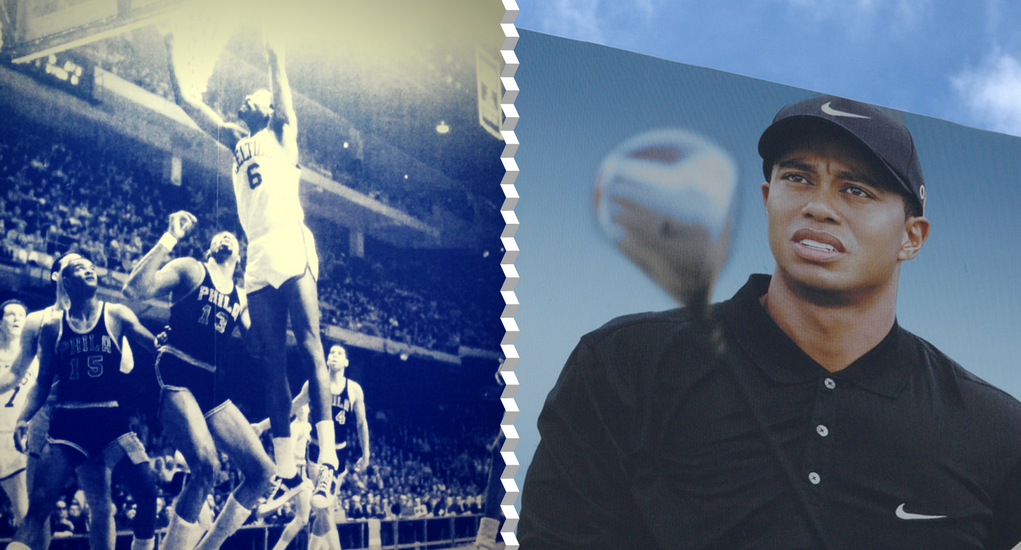
Shaking hands with Steve Scott standing on the green of the 38th hole of the final match in the 1996 U.S. Amateur, Tiger Woods ascended into greatness with his third-straight U.S. Amateur victory. In a feature for the September 2nd issue of Sports Illustrated that year, Jaime Diaz captured a quote from Tiger referencing his second-round 66 in the 1996 Open Championship. Looking back now, there’s a freedom one can only hope Tiger will find again. “Something really clicked that day, like I had found a whole new style of play,” Woods said. “I finally understood the meaning of playing within myself. Ever since, the game has seemed a lot easier.”
That’s quite a bold statement for someone who, beginning five years earlier, held the top national amateur title in the country from the time he was 15 until he turned pro at the age of 20. Three consecutive USGA Junior titles followed by three consecutive USGA Amateurs. He was in the conversation among Bobby Jones and Jack Nicklaus as the greatest amateur player to ever live. It seems golf only got easier for the young superstar. We all know his record between 1996 and 2013. No need to lay it out. But something happened along the way.
On Memorial Day of this year, news broke that Tiger had been arrested on suspicion of Driving Under the Influence. A mugshot appeared not a half hour after his release from police custody in Jupiter, Florida. What followed was a statement on his website claiming full responsibility for his actions.
“There was no alcohol involved,” Woods wrote. “I didn’t realize the mix of medications had affected me so strongly.”
It would be easy to speculate as to why Tiger was found on the side of the road. He did have back surgery recently (his fourth back surgery), on top of multiple other surgeries and procedures over the years; he’s practically the bionic man at this point. But speculation about his habits doesn’t provide any context into the Tiger we are seeing now. For context, we need understand who Tiger is as a figure. And for that, we need to go back a little further.
In 1957, the Boston Celtics made a deal with the St. Louis Hawks to acquire the second-round draft pick, and ultimately, the man who would change the dynamic of basketball forever.
William (Bill) Felton Russell was a 6-foot 10-inch towering figure, and in a league full of slow white guys, he dominated down low and simply outpaced everyone else on the court. For his career, Russell averaged over 15 points per game, over 22 rebounds per game, and 4.3 assists. Russell also won 11 championships with the Boston Celtics over the course of 13 seasons, two of which were as a Player/Coach (‘68 and ‘69). The numbers are astonishing and are the part of the story we still talk about today, but it’s not the most important part. Bill Russell was the first black superstar in the NBA.
In a story for Rhino Press, David Valerio writes this about Russell: “He was also 6-feet 10-inches, an athletic monster who blocked and dunked on players, actions previously unknown in the NBA. No one dunked. No one blocked. It was unheard of. Yet the arrival of Bill Russell signaled the start of a new era in league history; it signaled the arrival of black players into the NBA. Bill Russell was not the first black NBA player — such well-known names as Chuck Cooper, Harold Hunter, and Nat “Sweetwater” Clifton broke the race barrier first. But none of you know their names, because they weren’t superstars like Bill Russell was; they couldn’t lead teams to championships in addition to being named the league’s Most Valuable Player. Bill Russell was a star who helped change the face of the NBA forever, for Russell was not only the premier black NBA player, but he was also a black man who fought against racism in both its perceived and actual forms.”
Bill Russell wasn’t the first black athlete in his sport. But he was the first to ascend into superstardom. Sound familiar?
Tiger wasn’t the first black player to grace the PGA Tour; he was preceded by the likes of Calvin Peete (12 wins on the PGA Tour including the Harry Vardon and Byron Nelson Awards in 1984), Jim Thorpe (three wins on PGA Tour, 13 on the Champions Tour), Charlie Sifford (the first black player on the PGA Tour and won twice), and Lee Elder (the first black man to play in The Masters in 1975). What made Tiger different from his contemporaries is almost identical to what was different about Bill Russell. They finished paving a road others had started and seemed to do it on sheer willpower and work ethic.
Yes, for as long as we can remember, it was assumed that Tiger would be gunning for Nicklaus’ record, but it’s one thing for people to assume it’s going to happen and it actually happening. In Bill Simmons’ The Book of Basketball, he tells the story of how he perceived what made Larry Bird so great to Celtics fans. “In the big scheme of things,” Simmons writes, “Number 33 [Bird] was an extremely tall and well-coordinated guy who did his job exceptionally well. That’s it. You can’t call him a superhero because he wasn’t saving lives or making the world a better place. At the same time, he possessed heroic qualities because everyone in New England bought into his invincibility.
“He came through too many times for us. After a while, we started expecting him to come through, and when he still came through, that’s when we were hooked for good.”
What Simmons describes in his book about Larry Bird is the same thing we came to expect from Tiger essentially as soon as he slid on his first green jacket. Tiger was an invincible athlete who was also truly breaking the racial barrier in an elitist sport. Standing on the shoulders of Charlie Sifford, Calvin Peete, Jim Thorpe, and Lee Elder, Tiger climbed higher than any professional golfer ever had, much like Bill Russell. It didn’t matter the situation; Tiger always hit to shot that kept him in it, or he always sank the putt to extend a match or take the lead. What also came with that invincibility was isolation. Simmons goes on to write about Russell, “Maybe the city [Boston] would have accepted an African-American sports hero in the fifties and sixties — eventually it accepted many of them — but never someone as complex and stubborn as Russell.” Again, where Russell and Tiger are the same, people never really connected with Tiger as a persona, they were just in awe of his sheer dominance.
While Bill Russell was winning championships like older brothers win wrestling matches, he was also absorbing shots to his character and his abilities for no reason other than the color of his skin. David Valerio goes on to write in his piece, “While Russell was on tour with an exhibition team prior to the 1961-62 season, Russell and a teammate were denied service in a restaurant when their team was scheduled to play a game in Lexington, Kentucky. Russell and his team then refused to play in the city and flew back home, generating a large amount of controversy.” What followed that incident laid the groundwork for how Russell would be perceived the rest of his career, and to many, still is. Valerio continues, “In response to this, and other issues, Russell became resentful of the media and fans’ attentions, as he believed it all to be sarcastic and hollow. This resentment held over to his reactions with the local Boston fans. As a result of this, and many other events, Russell never particularly warmed to Boston, a city notorious for its racism, even as he continued on to win an exorbitant amount of championships for its team.”
 As late as 1997, Fuzzy Zoeller made his infamous quote on Tiger’s achievements thus far: “He’s doing quite well, pretty impressive. That little boy is driving well and he’s putting well. He’s doing everything it takes to win. So, you know what you guys do when he gets in here? You pat him on the back and say congratulations and enjoy it and tell him not to serve fried chicken next year. Got it. Or collard greens or whatever the hell they serve.”
That was a mere 20 years ago.
As we look back at Bill Russell’s career, it makes total sense that he isolated himself from the media. Why would he give them the time of day? They weren’t out there playing his game. They weren’t sweating on the practice court alone before anyone else showed up; it was just him. And his will to beat the hell out of everyone else. That’s it. Simmons claims he was complex, and I’m sure there are aspects of him that are, but it seems he just wanted to be left alone to play his game and beat everybody else that tried to join him. Had Dan Jenkins been covering basketball in Russell’s prime, he might have felt the need to write a (fake) interview with him for Sports Illustrated, because something tells me he wouldn’t have sat down with Jenko either. For many reasons, Russell spent essentially the entire 90s living a reclusive life in the Pacific Northwest.
As we sit and ponder over the next few days, and throw around comments about whether Tiger will ever play golf again, we need to also think about what Jack Nicklaus had to say about a man whom he refers to as a friend.
“I feel bad for Tiger. Tiger’s a friend. He’s been great for the game of golf. He needs our help. I wish him well.”
It’s easy to forget that Tiger Woods is not just a brand and not just a legendary golfer. He’s a person, a father, and a man who dominated a tour that until 1961 no black man had ever been allowed to even join. Like Russell, even well into the height of his career, when he was at the top of the mountain, he had to endure comments rooted in racism, even if they may not have been ill-intentioned. Tiger just wanted to play his game better than anyone who’d ever lived. All the other stuff was simply a by-product, and eventually, the by-product got in the way, making it harder to play within himself.
In a 2010 piece from Bleacher Report titled The Psychology Behind Greatness: Tiger Woods Imbalance, Vincent Heck writes, “The Tiger Woods we knew before could do no wrong. Now, to many, he’s an immoral, arrogant cheater who can’t be trusted.” Heck also goes on to cite Thomas G. Seabourne, Ph.D., from The Journal of Sports Psychology: “Learning to cope and deal with counter-productive tendencies that an athlete may experience is important. Their ability to do so will impact on their overall performance and may interfere or facilitate the athlete in striving for an optimal performance.”
The point of Heck’s piece, at the time, was that prior to the Thanksgiving incident of 2009, Tiger had received virtually zero criticism on or off the course. Sure, a little poking here and there about his language when he duck-hooked a tee shot, but it was minimal. He was invincible inside the ropes. After his affairs came to light that all changed on a dime, and it’s been a rocky road ever since. Each injury and withdrawal drew more and more scrutiny, and the number of times his integrity has been called into question is equal only to the number of Fast and Furious movies we’ll have to endure over the next decade.
Some can say that he’s isolated himself, I may even be in this camp on occasion, but when you sit down and think about the surmounting pressure he’s received over the last decade, who can blame him? In a TIME interview with Lorne Rubenstein from 2014, you can see the shift in his mindset after having kids. Lorne asked, “How do you feel about the way the media have covered you?”
“There’s no accountability in what they say,” Tiger responded. “And what they say, it’s like it’s gospel, there’s no source behind it. Nothing like, yeah, I talked to X number of players, I talked to this player, this player, this player. It’s none of that.”
He would go on further in response to Rubenstein’s question about what’s written about him. “You don’t read what’s written about you? Was there a time when you did?” Rubenstein asked.
Tiger’s response, “Not really. And that has served me well. It has served me well. Like my Dad said when I was young, Were any of these guys there? If anybody has any kind of perspective on it, it would be the caddy. He saw the shot, he understood what the circumstances were. Other than that, there’s nobody else. So what’s their take on it? Who cares? They weren’t there. They didn’t see how difficult it was, what’s going on.”
Reading the TIME article, you get the sense Rubenstein’s question wasn’t just about what goes on inside the ropes. And even though Tiger’s response defaults to golf, you know it’s hinting at what goes on outside the ropes.
We don’t know what it’s like to be the most famous athlete in the world for one second, much less for nearly 20 years. We don’t know what it’s like to feel the pressure of representing an entire race in a sport that has a history of blatant prejudice. Bill Russell and Tiger Woods know what that’s like. As do many others in American sports, but I don’t, and you probably don’t either.

It’s impossible to know what is going through Tiger’s head, but thinking back to the 20-year-old Tiger who said, “Something really clicked that day, I felt like I had found a whole new style of play. I finally understood what it meant to play within myself,” here’s to hoping he can do that again. It might seem easy to an outsider, the Tiger we once knew is a larger than life figure, you’d think playing within that framework would come easy. But the Tiger we don’t know is the one he needs to play within, and that battlefield seems to be getting smaller by the day.
Photo credit: Flickr/Lorianne DiSabato, Marcia Cirillo, rajapal





Opinion & Analysis
Brandel Chamblee PGA Championship Q&A: Rose’s huge McLaren risk, distracted LIV pros and why Aronimink suits the bombers


PGA Championship week is here, and Brandel Chamblee did not hold back in our latest discussion ahead of the season’s second major.
In our 2026 PGA Championship Q&A, golf’s leading analyst made the case that PIF pulling LIV’s funding has left its players competing in a state of confusion, called Justin Rose’s mid-season equipment switch a huge risk at 45, and explained why Aronimink will be a bombers’ delight this week.
Check out the full Q&A below.
Gianni: With the PIF confirming that they’re pulling funding from LIV at the end of the season, what impact do you expect that to have on the LIV players competing at the PGA Championship?
Brandel: I would imagine that they have all been thrown into a state of confusion, and will be distracted, not knowing where they are going to play next year and not knowing exactly their road back to either the DP World Tour or the PGA Tour. Or in Rahm’s case, being tied to a sinking ship for the next few years, likely playing for pennies on the dollar in events that no one cares about or watches.
I doubt this would put him in the best frame of mind to compete at his highest level. Keeping in mind, however, that majors are the only time that LIV disciples get to play in events that matter, so never disregard the motivation they have to prove to the world they are still relevant.
Gianni: Justin Rose switched to McLaren Golf equipment mid-season while playing some of the best golf of his career. What do you make of the change?
Brandel: I don’t really know what to make of Rose switching equipment. It seems a huge risk on his part, even though it is likely, in my opinion, that the clubs he’s playing are similar, if not the exact grinds, to what he was playing previously, with a McLaren stamp on them.
Having said that, at best, it is a distraction when he seemed to be as dialed in with his game as any 45-year-old could be and trending in the majors to perhaps do something that would definitely put him in the Hall of Fame. At worst, given the possibility that these clubs aren’t just duplicates of his old set stamped with McLaren on them, he’s made an equipment change that would take time, and 45-year-old athletes don’t have the time to do such things.
Gianni: Aronimink has only hosted a handful of professional events since it hosted the 1962 PGA Championship. What kind of test does it present, and does a course with less recent major championship history tend to level the playing field?
Brandel: Even though Aronimink has only hosted a handful of meaningful professional events, it has been fairly discerning in who can win there. When Keegan Bradley won the BMW Championship on the Donald Ross masterpiece in 2018, he was the 2nd best iron player on tour coming into that week. When Nick Watney won the AT&T at Aronimink in 2011, he was 2nd in strokes gained total coming into the week.
In 2020, Aronimink hosted the KPMG Championship, and Sei Young Kim won. On the LPGA that year, she was first in greens in regulation, putts per green in regulation, and scoring average on the way to being the LPGA player of the year. And then there is the 1962 PGA Championship won by Gary Player, who eventually became just one of a few players to win the career grand slam on the way to winning 9 majors. It is a formidable test, and if it’s not softened by rain, it will bring out the best in the upper echelons of the game.
Gianni: Is there a specific hole at Aronimink that you think will do the most to decide the winner?
Brandel: The hardest hole at Aronimink in each of the three tour events that have been played there since 2010 has been the long par-3 8th hole, with the par-4 10th being the second hardest, so most of the carnage will happen around the turn, but with the par-5 16th offering opportunities for bold plays and the tough closing holes at 17 and 18, the finish is likely to be frenetic.
Gianni: The PGA Championship has always sat in the shadow of the other majors. What does the ideal PGA Championship look like in your eyes, and what would it take for it to carve out its own identity?
Brandel: The PGA Championship, to whatever degree it suffers from the comparison to the other three majors, is still counted just as much when adding them up at the end of one’s career. Almost 1/3 of Nicklaus’ major wins were the five PGA Championships he won. Walter Hagen won 11 majors, five of which were PGA Championships.
Tiger Woods twice in his career won back-to-back PGA Championships, and those four majors count just as much as the other 11 he won. The PGA may not have the prestige of the other three, but it carries the same weight. Having said that, I preferred the identity that it had as the last major of the year.
Gianni: You nailed your Masters picks. Rory won, Scottie finished solo second, and Morikawa surged to a tie for seventh. Who are your top 3 picks for the PGA Championship and why?
Brandel: I am not a huge fan of majors played on golf courses that have been shorn of most of the trees, although I understand some of the agronomic reasons for doing so and of course the ease with which it allows members to play after errant drives. However, at the highest level, it all but eliminates any strategy off the tee and turns professional golf into an even bigger slugfest. That means that it will likely be a bomber’s delight this week, but fortunately, Scottie Scheffler is long enough to play that game and straight enough to play it better than anyone else.
The major championships give us very few surprises anymore, going back to the beginning of 2012, so the last 57 majors played, the average world rank of the winners has been better than 15th in the world. So look at the highest ranked and longest drivers who are on form coming into the PGA Championship who also have great short games as the surrounds at Aronimink are very challenging. That’s Scottie Scheffler by a mile and then McIlroy and Cameron Young with a far bigger nod towards DeChambeau than I gave him at the Masters.


In this episode of the Club Junkie Podcast, we dive into one of the most interesting flatstick releases of the year with a full review of the new TaylorMade SYSTM 2 putters. After spending time on the greens, I break down what makes this design stand out, where it performs, and why it has me completely torn between loving it and fighting it. If you are into feel, alignment, and consistency, this is one you will want to hear about.
We also take a look at some of the putters in play on the PGA Tour last week. From familiar favorites to a few surprising setups, there is always something to learn from what the best players in the world are rolling with under pressure.
To wrap things up, I walk through the process of building a set of JP Golf Prime irons paired with Baddazz Gold Series shafts. From component selection to performance goals, this is a deep dive into what goes into creating a unique custom set and why this combo has been so intriguing.


This year my 50th birthday. Gosh, where has the time gone?
As a teenager in rural Missouri, some of my junior high and high school years felt interminable. Graduation seemed light years away. But the older I get, the faster life seems to fly by.
I’m also increasingly aware of my mortality. My dad died recently. Earlier this year, a friend and fellow PGA of America professional and I were texting about our next catch-up. The next message I received was news of his unexpected passing at 48. Shortly after, a woman I dated in college succumbed to cancer at 51.
Certainly, one can share perspective at any age. Seniors help freshmen, veterans guide rookies. But reaching this milestone feels like as good a time as any to do one of those “what would I tell my younger self?” articles.
I’ve had a uniquely varied career in golf. I started as a 27-year-old, average-length-hitting, 14-handicap computer engineer and somehow managed to turn pro before running out of money, constantly bootstrapping my way forward. I’ve won qualifiers and set venue records in the World Long Drive Championships, finished fifth at the Speedgolf World Championships, coached all skill levels as a PGA of America professional, built industry-leading swing speed training programs for Swing Man Golf, helped advance the single-length iron market with Sterling Irons®, caddied on the PGA TOUR and PGA TOUR Champions, and played about 300 courses across 32 countries.
It’s been a ride, and I’ve gone both deep and wide.
So while I can consult and advise from a lot of angles, let me keep it to a few things I’d tell the average golfer who wants to improve.
1. Think About What You Want
Everyone has their own reason for picking up a golf club.
Oddly, as a professional athlete, I’m not internally driven by competition. That can be challenging, as the industry currently prioritizes and incentivizes competition over the love of the game.
For me, I love walking and being outdoors. Nature helps balance my energy. I prefer courses that are integrated into the natural beauty of their surroundings. I’m comfortable practicing alone. I’m a deep thinker, and I genuinely enjoy investigating the game, using data and intuition to unearth unique, often innovative insights. I’m fortunate to be strong and athletic, so I appreciate the chance to engage with my abilities. Traveling feels adventurous. I could go on.
You don’t have to overthink it like I do. For you, it might be as simple as hitting balls to escape work, hanging out with friends, and playing loosely with the rules and the score.
The point is to give yourself permission to play for your own reasons, and let that be enough.
But if improvement is your goal, thinking about your destination—and when you want to get there—is important, because it dictates the steps you need to take. When I set out to go from a 14-handicap to the PGA TOUR as quickly as possible, the steps I needed were very different from those of a working golfer trying to break 90 in six months. That’s also different from someone who just wants a few peaceful hours outside each week, away from work or family.
None of these goals are better than the others, but each requires a different plan that you can work backward from.
2. There Are Lots of Things That Can Work
One of the challenges of golf is that, although there are rules for playing, there aren’t clear, industry-wide standards for how to best play the game. There’s a lot of gray area.
You might hear a top coach or trainer insist that a certain move is the best way to swing or train. Then you dig a bit deeper and, much to your confusion and frustration, another respected coach or trainer says something completely different. I don’t think anyone is trying to confuse you—at least I hope not. It’s just where the industry is right now.
You have to be careful with advice from tournament pros, too. They might be great at scoring, but they’re also human and sometimes just as susceptible as amateurs to believing things that don’t really move the needle. Tour players might describe what they feel, but that’s not always what they’re actually doing when assessed with technology.
I recently ran a test on my YouTube channel (which connects to my GolfWRX article “How to use your hands in the golf swing for power and accuracy”), and, interestingly, two of the most commonly taught hand actions produced the worst results in the test.
Coaches can certainly help. If you find someone you connect with to help navigate, that’s great. But there are many ways to get the ball in the hole. In the current landscape, you may need to seek multiple opinions, think critically, and use your own intuition to discern what seems true and whose advice resonates with you.
I’d recommend seeking someone who is open-minded and always learning, because things constantly change. Absolutes like “correct” or “proper” should raise a red flag. AI can be useful, but it tends to confidently repeat popular advice, so proceed with caution.
3. Get Custom Fit
If you’re serious about becoming a better player, getting custom fit is hugely important. There’s no sense fighting your equipment if you don’t have to. Most better players get fit these days and, if they don’t, they’re usually skilled enough to work around clubs that aren’t ideal.
If you plan to play for a long time, it’s worth spending a little more upfront to get something that truly fits you and your game, rather than continually buying and discarding equipment.
Equipment rules haven’t really changed significantly since the early 2000s. To stay in business, manufacturers keep pushing those limits. If you pull a bunch of clubs and balls off the rack and test them, you’ll find differences. I’ve tested two new drivers and seen a 30-yard total distance gap. Usually, the issue isn’t bad equipment; it’s that the combination of components simply isn’t the best fit.
It’s like wearing a new pair of floppy clown shoes. Sure, they’re shoes—but you won’t sprint your best in them compared to track shoes that fit perfectly.
Be wary of what’s called custom fitting, too. Sometimes the term is used as a marketing strategy rather than an actual fitting. In some retail settings, fitters may be incentivized to steer you toward higher-priced components. That doesn’t automatically mean it’s not the best fit, but you should be aware of potential biases.
I learned a version of this lesson outside of golf. Years ago, I bought a tennis racquet at a big box store from a seemingly knowledgeable employee who thought it would suit me best. The racquet gave me tennis elbow, and I spent months recovering with rest and acupuncture. The next season, I invested more time and money to find what actually fit me, and I walked away with something amazing that I still play with years later.
So if you’re going to get fit, be smart about it.
Find someone you believe has deep knowledge—possibly with certifications, but not necessarily. Make sure there’s a wide inventory across many brands. Check recent reviews for the individual fitter if possible. Make sure you trust that the fitter has your best interests at heart. If they’re wearing a hat or shirt with a specific brand’s logo, proceed with caution. Unless you specifically want a certain brand or look, be wary of upsells, especially if two options perform nearly the same.
Also, while golf is called a sport of integrity, there’s a thread of manipulation in the industry. I once drafted an equipment article for an industry magazine, structured just like one of their previous popular stories, with matching word count and great photos. The assistant editor loved it; it was useful to readers and required little work on his part. But the editor-in-chief nixed the story. When I asked why, I was told it was because I wasn’t an advertiser. It turned out the article I’d modeled mine after was a paid ad cleverly disguised as editorial content.
I really dislike games, clickbait, and fear-based manipulation. I hope this changes, but golfers deserve to know it exists.
4. Distance and Strategy Matter
There’s a real relationship between how far you hit the ball and your scoring average, even at the PGA TOUR level.
I experienced this early in my pro career. I started as a power hitter, swinging in the high 120s and breaking 200 mph ball speed with a stock driver.
Back then, some instructors advised swinging at 80%, so I tried slowing down for more accuracy. That worked fine on shorter, tighter courses. But on longer setups, I was coming into greens with too much club, and par 5s stopped being realistic opportunities. Later, when I tested the “80%” idea with a radar, it wasn’t 80% at all. For me, and for most golfers I’ve tested, it was more like going above 92 to 96% of max before full swing control started to noticeably drop off.
If you want more distance, there are swing technique changes that can help. See my author profile for previous articles. Technical changes can be dangerous to play with, though. A lot of golfers want consistency too, and it can be disruptive when you constantly change swing thoughts and mechanics.
The low hanging fruit is usually custom fitting, as mentioned above.
From there, if you have a big banana ball swing that’s fairly reliable but you just need more distance, consider swing speed training at Swing Man Golf. If you’re starting from zero, the first level program using driver swings, a radar to measure speed, and simple resistance bands can move the needle quickly to the tune of 12 to 16 mph and 30 to 40 yards, plus what you gain on iron distance as well.
Strategy matters too. For a golfer shooting in the 90 to 100 range, I’ll share a demo I’ve done when golfers have hired me for their golf vacations. I’d play at average golfer speeds and distances, hitting a smooth hybrid off the tee, maybe 190 yards. I wouldn’t aim at the fairway. Instead I’d aim between the biggest trouble, like the center of the tree line. Then I’d cruise a 6-iron about 160 to a safer area short of greenside bunkers or other major trouble. From there it might be a wedge or a simple pitch, depending on hole length. Go middle unless you are almost 100% confident you will keep it on the green by aiming closer. Then it’s a lag putt for par, followed by a tap-in.
It’s not flashy, but if you want to break 90 or 100 more regularly, something that keeps you out of big trouble like this can be super effective.
This is also where a playing lesson can help. If a coach tells you what to do and where to aim, you’d be surprised at how many shots can get dropped just having the coach be your decision maker until you get the hang of it. In some of those cases, you don’t even need to make much if any technical changes. You might already be there with a playable swing. It could just be better decision making that gets you around the course with a lower score.
Okay, I hope something here was useful for you.
Thanks for being with me all these years, and I wish you and your game the best.

RBC Heritage Tour Report: More minis, course-specific setups, Spider & GTS launches

Justin Rose WITB 2026 (April): Full WITB breakdown with new McLaren irons

Best fairway woods of 2026: The most versatile fairway woods + the most forgiving fairway woods

What’s the story behind Webb Simpson’s custom-stamped irons?

Cadillac Championship Tour Report: Spieth’s sizable changes, McLaren Golf launches, and more

The 24 players who can win the Masters

Rory McIlroy’s winning WITB: 2026 Masters

Kristoffer Reitan’s winning WITB: 2026 Truist Championship

J.J. Spaun’s winning WITB: 2026 Valero Texas Open

Cameron Young’s winning WITB: 2026 Cadillac Championship


Alex Fitzpatrick WITB 2026 (May)
Driver: Ping G440 LST (9 degrees) Shaft: Fujikura Ventus Black 6 X 3-wood: TaylorMade Qi4D (15 degrees) Shaft: Fujikura Ventus...

Kristoffer Reitan’s winning WITB: 2026 Truist Championship
Driver: Ping G440 Max (9 degrees) Shaft: Mitsubishi Tensei 1K White 60 TX 3-wood: Ping G440 Max (15 degrees) Shaft:...


WITB Time Machine: Rory McIlroy’s winning WITB, 2021 Truist Championship
Rory McIlroy’s victory at the 2021 Wells Fargo Championship 2021 (now the Truist Championship) marked a significant return to form,...


Collin Morikawa WITB 2026 (May)
Driver: TaylorMade Qi4D LS (8 degrees) Shaft: Mitsubishi Diamana D+ Limited 60 TX 3-wood: TaylorMade SIM Tour (14 degrees) Shaft:...
-
 Equipment2 weeks ago
Justin Rose WITB 2026 (April): Full WITB breakdown with new McLaren irons
-
 Equipment1 week ago
What’s the story behind Webb Simpson’s custom-stamped irons?
-
 Equipment2 weeks ago
Cadillac Championship Tour Report: Spieth’s sizable changes, McLaren Golf launches, and more
-
Whats in the Bag4 days ago
Kristoffer Reitan’s winning WITB: 2026 Truist Championship
-
 Whats in the Bag2 weeks ago
Cameron Young’s winning WITB: 2026 Cadillac Championship
-

 Whats in the Bag3 weeks ago
Nelly Korda WITB 2026 (April)
-

 Equipment2 weeks ago
Justin Rose on the switch to McLaren Golf, learnings from previous equipment moves
-

 Tour Photo Galleries2 weeks ago
Photos from the 2026 Cadillac Championship


The dude
Jun 3, 2017 at 9:46 pm
SHANK!!!!!…….sorry Bill for putting your name in the same sentence with TW….maybe that should have been the title….wow….fail…
Mat
Jun 3, 2017 at 6:57 pm
I agree the parallels are there, but for one difference. “Hello, World.” I love watching him as an athlete, but as someone who worked as a ballboy in the NBA, I saw early on that the things that make athletes great is exactly what makes them make bad decisions. It’s a straight line. Tiger asked for the media scrutiny because he knew, and Nike knew, that’s how dollars entered the PGA.
Bill Russell dealt with institutional racism when Tiger had people saying “it’s about time”. I think the point of isolation is fair, but it isn’t at all what Bill Russell faced in the 1960’s. Sure, they each reserved themselves, but I don’t think it’s fair to Bill Russell. His problems were from others, where Tiger’s problems originate from the tendencies and teachings of his dad, his own behaviour and addiction, and were multiplied by the fame that multiplied his paychecks. These things are not the same, and to conflate them unfairly minimises what Russell went through.
dcorun
Jun 3, 2017 at 6:35 pm
He has been the center of attention right or wrong since we was a child on The Mike Douglas Show. IMHO he lost his moral compass when his dad passed away. His dad taught him how to be successful but, wasn’t around to teach him how to handle post success which everyone whether athlete or not has to accept someday.
Frankie
Jun 3, 2017 at 2:45 pm
In terms of competing, it’s more like Bill Russell and Jack Nicklaus (both won the most NBA Finals and majors, respectively), while Tiger is similar to Michael Jordan (both were the most dominant in their prime).
johnnie d
Jun 2, 2017 at 11:22 pm
I’m getting real tired of writers speculating on what people think just so they can justify a paycheck. This is pure conjecture without any evidence that Bill and Tiger think this way. All the supporting data is second-hand. If the author had done his homework by interviewing Bill and Tiger and thus came to his conclusions, then I’d think differently, but there was no original research. I hope the GolfWRX editors are listening as this was totally BS.
Jasian Day
Jun 3, 2017 at 10:07 am
Getting real tired of writers speculating….
Hope ya got a time machine then
AlbieT
Jun 2, 2017 at 9:41 pm
People love Woods for his golf and then somehow thought he is this or that kind of person. When news came out that contradicted that “thought” they go crazy. Ridiculous! Tiger gave us his golf excitement and that to me was enough. It was a gift to watch him at his peak, period. He does not have to apologize to me ever.
Hawkeye77
Jun 2, 2017 at 9:21 pm
Tiger hasn’t walked 6 inches in Bill Russell’s shoes. Their careers certainly are not comparable (Russell = personal team focus and team sport, Tiger not at all – not enough room to get into all that’s wrong with comparing their careers), their life experiences not even close to comparable and nothing about the end (if Tiger is done) is comparable. Oh, they are athletes of color who are hard to get to know, right. Russell is a man and all that implies and deep, thoughtful, reflective, highly intelligent, engaging at times, but “isolation” used superficially makes for a very superficial article and a comparison just to publish something.
Bert
Jun 2, 2017 at 7:28 pm
+1
Golfgirlrobin
Jun 2, 2017 at 7:19 pm
I first met Bill Russell in 1984 when he used to show up at all the basketball games of the small San Francisco Bay Area college I attended. He was friendly and outgoing, used to shoot baskets after the games, hang out with students and was just generally awesome. Due to work stuff, I continued to see him well into the late 90’s. Maybe he hated the media, and who could blame him, but the idea that he was some unapproachable, introverted hermit just isn’t true.
Ben Jones
Jun 2, 2017 at 3:01 pm
Bottom line, he doesn’t have the swing and game anymore. It all boils down to thinking you have a great swing and game and growing confidence that you can make it happen. Too bad he doesn’t swing like the picture at the end. Tiger had a great golf swing. He fed off that perfection under Butch and even though he changed it, he had enough carry over and short game to do well. But he had to keep changing until it got really bad. If your swing is good, you will play good. Success builds confidence, we all know that. Tiger has neither a good swing or confidence. He is beat down. His body is beat down. We will never see him play like he once did.
Tim
Jun 2, 2017 at 2:31 pm
So no one wants to tackle why he is always referred to as being a “black” athlete? His mother was Thai. His dad had black, white, and Native American heritage. Why isn’t he referred to as an Asian or Thai athlete?
Jasian Day
Jun 2, 2017 at 5:21 pm
Math scores
Mike C
Jun 2, 2017 at 11:31 am
Great article. Both Tiger and Russell are viewed by many as Jerks (and maybe they are). But, as you point out, it ain’t easy being them.
Adam Crawford
Jun 2, 2017 at 12:20 pm
Thanks, I agree. And again, I don’t think any of that is an excuse for actions taken. But I think it’s important to try and understand “why” as opposed to just passing judgment. Of course, it’s virtually all speculation, and correlation doesn’t equal causation, but looking at what happened and trying to gain an understanding has some value.
H
Jun 2, 2017 at 11:17 am
Eldrick is not black. He is more Thai-Chinese than he is black. IF Eldrick has emphasized that aspect, and leaned more on his mother’s culture than his father’s side, none of this would have happened. But then he may never have been the golfer that he came to be. But that may have been a good thing, to be a more well-rounded person, than a skirt-chasing monster he came to be, a behavior he learned from his horrible father.
God Shamgod
Jun 2, 2017 at 11:50 am
Wait, are you suggesting that Tiger’s infidelity is due to his father being black? That is sad and pathetic.
Joe Golfer
Jun 2, 2017 at 3:18 pm
I’m not sure if he is suggesting that or not. If he is, then it is indeed shameful of him.
There was a very long Sports Illustrated article a while back. I don’t recall the issue, but it had Tiger on the cover with the headline “What Happened” and the author was named Alan Shipnuck, should you wish to try to google it. Within the article, it did indicate that Tiger’s father was unfaithful to his own wife and was a “skirtchaser”, so to speak. So perhaps that person (H) who wrote that was referring only to Tiger’s father specifically and not an entire race. That said, the way he phrased things does sound bad.
Jasian Day
Jun 2, 2017 at 11:14 am
Compare Tiger to Princess Diana….
Her car troubles were well documented too
larrybud
Jun 2, 2017 at 10:04 am
Sorry, but Tiger in 2017 is nowhere near the same, not even close, not in the same UNIVERSE as Russell in the 60s turmoil of race riots, and does a disservice to what Russell went through and the time that he played.
Tiger screwed up, a few times. Why is that so hard for people to say or acknowledge? The Tiger apologists will blame it on things like race, the media, his caddy, and the Tiger haters will just pile on and not recognize the guy is human, first and foremost, and makes mistakes just like everybody else.
Sure, it’s hard the average guy to be sympathetic with a superstar multi-millionaire, which to us appear to have everything in the world at their fingertips, but that doesn’t make them supermen who make perfect decisions all the time. In the end, we all end up 6 feet under.
I hope Tiger can turn things around, at least personally. If he every plays golf again at a decent level, that will just be icing on the cake for those of us who lived through his 10 years of golf greatness.
ooffa
Jun 2, 2017 at 9:05 am
This has got to be the dumbest article Golfwrx has ever posted. Complete foolishness. Tiger is a mess. that’s it! That’s all! It has nothing to do with anything else.
Are you bored Crawford? This is really lazy work on your part. You are better and smarter than this drivel.
Grizz01
Jun 2, 2017 at 2:58 pm
I commented on why Tiger is a mess. And my comment was removed. You cannot be honest about it. No one once it out in the open. I thought GolfWRX was going to get away from the politcally correct. Apparently they’ve gotten to big already and have to please the advertising dollars and censor stuff now.
Frank McChrystal
Jun 2, 2017 at 9:04 am
Michael Jackson.
K
Jun 2, 2017 at 12:57 pm
Thumbs up
Joseph
Jun 2, 2017 at 8:59 am
Very little in common in my view. Russell came into the league and was quickly followed by a succession of other black superstars, including Wilt, the Big O and others within a couple of years. He played a team sport and was the ultimate team player as the Celtics record proves. I was luckily able to see him play often as a kid at the Cincinnati Gardens for $3. Russell appeared thoughtful and reserved, but Tiger was aloof and imperious. Part of that may be golf, but from what one reads, that was Tiger’s personality and it appears that he has no friends. That has little to do with his race, there are a lot of people of all races who share that trait.
K
Jun 2, 2017 at 12:59 pm
Exactly. Team sport vs. loner sport. Not even in the same league. What Eldrick has done to himself after he got caught cheating with all them women, isolating himself because of his actions is not even close to Russel’s experience. What the heck is this article about, anyway?
Jack Nash
Jun 2, 2017 at 8:06 am
I see little comparison between Russel and Woods. Russel is a humble superstar, while Woods is just the opposite. Russel defined his position in his sport while Woods defined his at the same time as a technological boom hit the golf world.
birdie
Jun 2, 2017 at 9:10 am
tiger was always one of the last to adopt new technology. not sure what that has to do with anything.
Adam Crawford
Jun 2, 2017 at 10:20 am
The humbleness is simply one aspect of their personality. I think that just because there is one attribute that doesn’t seam to match up doesn’t mean their paths are dissimilar. When looking at the arc of their career and the impact they had on their respective sports, the arcs are strikingly similar.
AceW7Iron
Jun 2, 2017 at 7:54 am
Why must it always boil down to skin color in America? Its never because they Guy or Gail is just a human being with faults and temptations that are as old mankind itself…No…in America it always stops at the epidermis which in reality is the most outward layer of a human being.
I submit to you that TW’s problem is NOT with his skin covering but rather lies deeper within…much closer to his heart. The Man had it all & still has considerably more than most in the WORLD. Tiger should be in his prime and encouraging generations of fans to do well in life but it appears he is too busy popping fuzzies…a choice only he could make. Its foolish to blame his woes on others…There is only one Man living in his skin that makes the call…HIM
Jim
Jun 2, 2017 at 9:31 am
99% thought Tiger’s mixed ethnicity and skin color were as iimportant as his talent. If a white country club kid won 3 US Ams he woulda got great 7 figure offers, but certainly not the 8 figure deal and recruitment to be the global face of a brand – essentially replacing Michael Jordan…
A few shitbirds aside, Tiger had ZERO racism to deal with compared to Russell
Adam Crawford
Jun 2, 2017 at 10:23 am
I apologize if you thought the entire premise was trying to prove that skin color was an excuse for his actions recently, it wasn’t. But I think there is a wide misunderstanding, or lack of attention, to the amount of pressure felt by someone like Tiger Woods. I also think, that some of his actions may have been curtailed had he been surrounded by dear friends like so many of us have, the friends that keep us in check. With the level of fame achieved and the amount of pressure on an athlete of his caliber (Russell the same), it’s understandable for someone to retreat within themselves, and when that happens, there is no outside “voice of reason” telling us when something may be a bad decision. I know I’ve had many a friend talk me out of what I thought was a good decision at the time, but in retrospect would have been a disaster. If someone is isolated, then they may not have that type of friend to curtail poor choices.
ooffa
Jun 2, 2017 at 10:45 am
Ya, Sure, Whateva,
K
Jun 2, 2017 at 1:02 pm
“I know I’ve had many a friend talk me out of what I thought was a good decision at the time”
Now that’s hilarious, in regards to how you got to publish this worthless article.
Adam A
Jun 2, 2017 at 1:18 pm
What does skin color have to do with both men living in isolation? As true as it is that both men were trail blazers in their particular sport when it came to dominance in a game filled with mostly white men. Their isolation seems more about personality than race.