
Instruction
A Missing Element in Golf Instruction: Arc Height Control

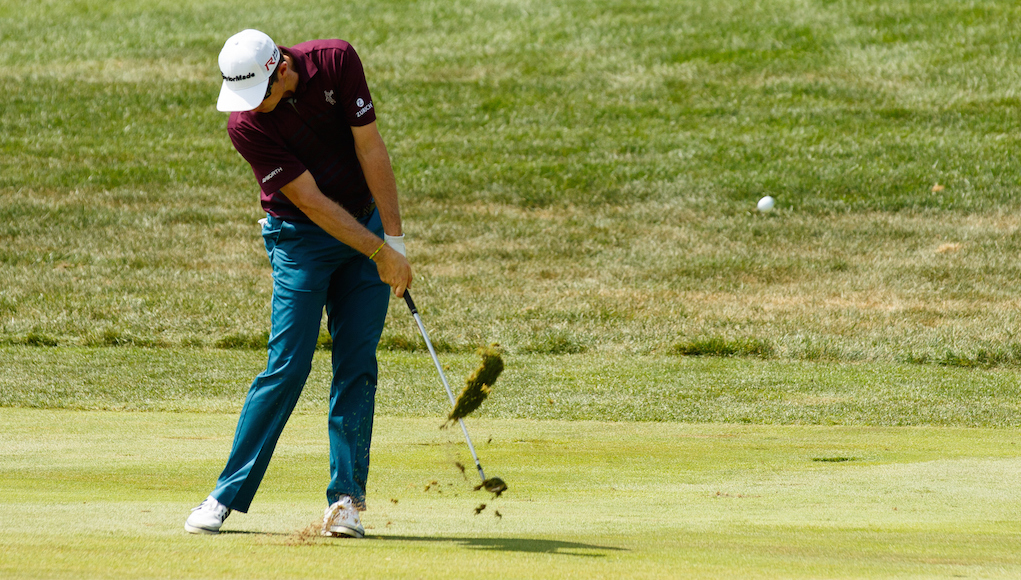
Every golfer wants to know how to strike the ball like a pro, and strike quality alone is such an important element. It determines:
- Energy transfer into the ball (and hence maximal distance)
- Spin rates
- Consistency of clubface delivery
- Gear effect
All of the above factors will affect our ability to hit greens in regulation, the leading correlator to lower scores.
Low Point
As discussed HERE, the pros hit their irons from the ground with a descending blow, where the club is traveling on the downward part of the arc, strikes the ball, and then enters the turf. In order to do this, it is necessary to have the lowest point of your swing arc in front of the ball to some degree as seen in the video below.
There are a million videos/books/bits of information out there regarding low point control, but they are missing a key element. It’s called “Arc Height Control.”
Arc Height
Having a low point that is in front of the ball is not enough in itself, although it is a necessary starting point. If your low point is in front of the ball, we have to match it with the correct “depth.” Think of this as the depth at which the club goes into the turf. Some golfers dig deep into the ground, while other golfers pick the ball off the top of the turf.
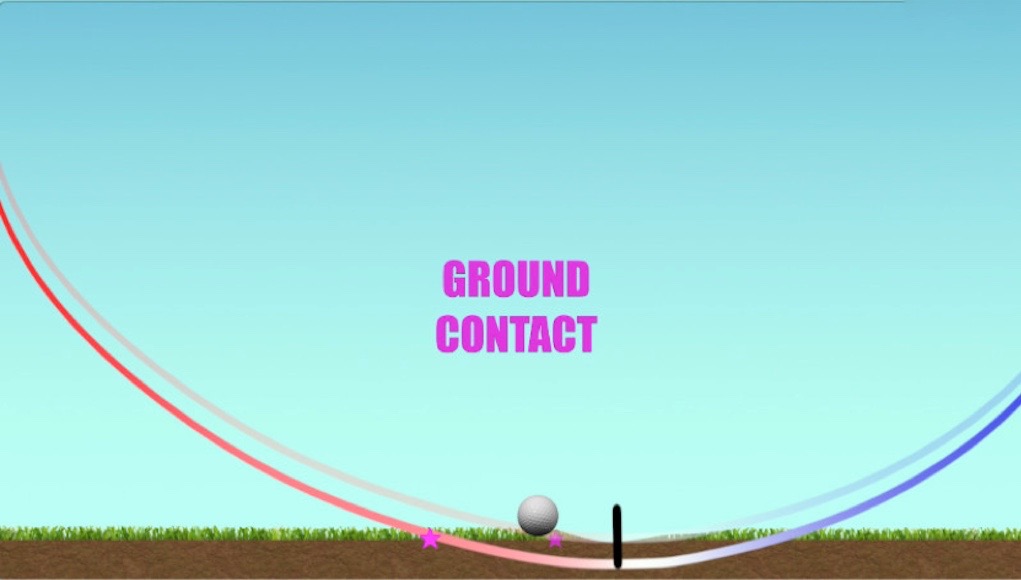
In the above picture, we see how a deeper swing arc (bottom) produces a ground contact that is farther back than a higher swing arc (semi-transparent). The video below explains how, with a good low point location, we can:
- Still hit a fat shot if our arc gets too deep.
- Hit the ball thin if our arc gets too high.
What Controls Arc Height?
In basic form, anything that gets your hands closer to or farther from the ball at impact (in 3D space) will change arc height. This is where it gets infinitely complex.
If we are to look at body motions in the golf swing, there could be many reasons why we might see a change in arc height. All of the following can create a change in arc height:
- A change in knee flex
- A change in lead shoulder distance from the ground
- A change in lead shoulder rotation
- A change in spine angle
- A change in lead arm flex
- A change in release/amount of shaft lean aft impact compared to address
These six elements are only the tip of the iceberg, too.
Technique
When I am teaching arc height in a live lesson, I look for patterns. For example, is the player consistently too deep, or consistently too high with their swing arc? If there is a pattern, I may look at the body motion and see if there is something we can change to improve this pattern.
For example, if a player is hitting deep divots behind the ball consistently, and this correlates with a big drop in head height, we could reduce the head drop or add more “jump” through impact. I know that teaching a “jump” might be controversial, but many of the world’s best players move their bodies in a squat-jump fashion. It can actually be a nice way to shallow the swing arc while adding speed. Ever see the jump moves that the long-drive champions use?
I will always consider what I feel is best for the player and what I think they can manage more easily, as well as other goals. For example, there might be ways to add “arc-raising” moves and improve swing path at the same time.
Skill Drills
Any technical changes to your golf swing should be made with an experienced instructor, however, there are ways that every single golfer can improve their control of arc height without consciously-directed motion changes. Through using skill drills (think “tasks” that improve your coordination while subtly improving your technique unconsciously), we can get quite dramatic improvements in our ability to strike the ball.
The video below shows a great skill drill for all golfers using a bottle cap. It’s particularly effective for golfers suffering with fat shots that are created by a deep arc depth.
The bottle-cap drill fits in with the latest motor learning science in that it has an external focus, or a focus placed outside of our body. These kinds of drills improve coordination by focusing golfers on one task, which allows our subconscious mind to improve our ability to coordinate all of the moving parts (shoulder, arm, knees etc.) into a workable solution.
I have developed many drills similar to this that deal with specific issues, such as low-point issues or arc- depth issues. You can learn more about those drills on my website: www.AdamYoungGolf.com/The-Strike-Plan
Conclusion
I hope this article provided you some value. Here are the summary points:
- Having a good low point position helps, but it is not enough. We also have to control the height/depth of our swing arc.
- Many body movements can contribute to the arc height changing.
- Technical changes should be done under the supervision of a competent instructor, but skill drills will improve all golfers regardless of swing style. They are tasks that improve the coordination of all the moving parts with an external focus. All of the leading motor learning science says practicing with an external focus is ideal for optimal learning and retention.



The LPGA Tour is kicking off its 2026 season this week at Lake Nona Golf and Country Club in Orlando, and the pros are dealing with something most Florida golfers rarely face: freezing temperatures.
“It’s colder here than in the UK at the minute, which is a first,” said England’s Charley Hull during Wednesday’s media day at the Hilton Grand Vacations Tournament of Champions.
Even Lydia Ko, who lives at Lake Nona, seemed surprised by the cold snap. “We’re pretty much getting to below zero in celsius here, which maybe in other parts of the country they would be thankful, but when you’re in Florida it is a little bit of a surprise,” she said.
If the world’s best players are adjusting their games for cold weather, recreational golfers should, too. Here’s how to play smart when the mercury drops.
Understand What Cold Does to Your Game
Before you change anything, you need to know what you’re fighting against. Cold air is denser than warm air, which means your ball won’t fly as far. Period.
Hull noticed this immediately during practice rounds at Lake Nona. She mentioned hitting a gap wedge into the 18th hole during a previous win but needing a 4-iron during Tuesday’s practice round. That’s a difference of four or five clubs for the same shot.
Action item: Expect to lose 5-10 yards on every club in your bag when temperatures dip below 50 degrees. Plan accordingly and don’t be stubborn about club selection.
Layer Up Without Restricting Your Swing
Hull admitted she wore three pairs of pants during practice. While that might be extreme for most of us, staying warm is critical to playing well in cold conditions.
Your muscles need warmth to function properly. When you’re cold, your body tightens up and your swing gets shorter and faster. Neither of those things help you hit good golf shots.
Action item: Wear multiple thin layers instead of one bulky jacket. Look for golf-specific cold weather gear that stretches with your swing. Keep hand warmers in your pockets between shots. And don’t forget a good hat because you lose significant body heat through your head.
Take More Club Than You Think You Need
This is where ego gets in the way of good scores. When it’s cold, the ball doesn’t compress as well off the clubface. Combined with denser air, you’re looking at serious distance loss.
The pros at Lake Nona are dealing with a course that measures 6,642 yards but plays much longer this week. If they’re adjusting, you should too.
Action item: Take at least one extra club on every approach shot. In temperatures below 40 degrees, consider taking two extra clubs. It’s better to fly the ball to the back of the green than to come up short in a bunker.
Adjust Your Expectations on the Greens
Cold weather affects putting in ways most golfers don’t consider. The ball is harder and doesn’t roll as smoothly. Your hands are cold, making it harder to feel the putter. And if there’s any moisture on the greens, they’ll be slower than normal.
Ko mentioned that she still sometimes reads the greens wrong at Lake Nona despite being a member for years. Cold weather makes that challenge even tougher.
Action item: Hit putts more firmly than usual. The ball needs extra speed to hold its line on cold greens. Take a few extra practice strokes to get a feel for the speed before you putt.
Embrace the Mental Challenge
Hull said something interesting about cold weather golf: “I like the mental toughness of it.”
That’s the right attitude. Everyone on the course is dealing with the same conditions. The player who stays patient and doesn’t get frustrated by the extra difficulty will come out ahead.
Action item: Lower your expectations by a few strokes. If you normally shoot 85, accept that 90 might be a good score in 40-degree weather. Focus on solid contact and smart decisions rather than perfect shots.
Warm Up Longer and Smarter
This might be the most important tip of all. Cold muscles are tight muscles, and tight muscles get injured easily.
World No. 1 Jeeno Thitikul revealed she’s been protecting a wrist injury that bothered her late last season. Cold weather makes those kinds of injuries more likely if you don’t prepare properly.
Action item: Spend at least 20 minutes warming up before your round. Start with stretching, then hit easy wedge shots before working up to your driver. Keep moving between shots on the course to maintain body heat and flexibility.
The pros at Lake Nona this week will adapt and compete at the highest level despite the cold. You can do the same at your local course by following these tips and keeping a positive attitude.
PGA Professional Brendon Elliott is an award-winning coach and golf writer. You can check out his writing work and learn more about him by visiting BEAGOLFER.golf and OneMoreRollGolf.com. Also, check out “Playing Through” now on R.org, RG.org’s partner site, each Monday.
Editor’s note: Brendon shares his nearly 30 years of experience in the game with GolfWRX readers through his ongoing tip series. He looks forward to providing valuable insights and advice to help golfers improve their game. Stay tuned for more tips!

Brooks Koepka is back on the PGA Tour, and whether you love him or hate him, the guy knows how to win when it matters. After his LIV Golf stint, the five-time major champion returns this week at the Farmers Insurance Open.
What makes Koepka fascinating? He doesn’t fit the mold. His swing isn’t textbook. He doesn’t obsess over mechanics. Yet he’s won three PGA Championships and two U.S. Opens, regularly making it look easier than guys with prettier swings.
So, what can average golfers learn from someone who treats the game so differently? Quite a bit.
Stop Overthinking Every Shot
Koepka describes his approach as “reactionary” rather than mechanical. While most tour pros grind over swing thoughts, Brooks sees the target and hits it. No mental checklist.
This might be the most valuable lesson for weekend golfers who’ve watched too many YouTube swing videos.
How to actually do this:
On the range, hit five balls where you stare at the target for three seconds prior to addressing the ball. Don’t think about grip or stance. Just burn that target into your brain. You’ll be shocked at how pure you hit it when your brain focuses on where the ball is going instead of how you’re swinging.
Next time you play, give yourself a rule: Once you pull the club, you’ve got 15 seconds to hit. Koepka is one of the fastest players on tour because he doesn’t give his brain time to sabotage him.
If you feel tension in your hands at address, you’re trying to control too much. Koepka’s grip pressure is famously light. Loosen up until the club almost feels like it might slip, then add just enough pressure to hold on. That’s your swing thought: soft hands, see the target.
This approach works better under pressure. When you’re standing over that shot with water left and OB right, the last thing you need is a mental checklist. See it, feel it, hit it.
Play to Your Strengths (Even If They’re Not Pretty)
Koepka uses a strong grip that wouldn’t pass muster in some teaching circles. But he’s built his game around what works for him, elite driving distance and recovery skills. He doesn’t try to be someone he’s not.
Here’s how to build your game like Brooks:
Look at your last five rounds and figure out where you’re actually gaining strokes. Bombing it off the tee, but can’t hit greens? Lean into it. Play courses where distance matters more than precision. On tight holes, grip down on your 3-wood instead of trying to thread a driver through a keyhole you’ll miss seven times out of ten.
Koepka knows he can scramble, so he’s not afraid to miss greens. If you’re deadly from 50 to 75 yards, start leaving yourself those distances on the par 5’s instead of going for them in two every time.
Know when to take your medicine. Koepka in the trees at the PGA? He’s punching out to 100 yards, not trying to bend a 6-iron around three oaks. You’re in the rough with a flyer lie and water short? Hit your 8-iron to the middle and move on. That’s not playing scared, that’s playing smart.
Save Your Best for When It Counts
Here’s a wild stat: Koepka’s putting average in majors is often more than a full stroke better per round than in regular events. He elevates when pressure is highest.
How does an amateur tap into that gear? It’s not about trying harder, it’s about caring differently.
Here’s what actually works:
Decide which rounds matter to you. Club championship? Member-guest? That annual trip with college buddies? Circle those dates and treat them differently. Koepka doesn’t care much about regular tour events, but majors? That’s when he locks in.
Two weeks before your big round, change your practice. Stop beating balls mindlessly. Play nine holes in which every shot has consequences. Miss the fairway? Hit from the rough on the next hole too. Three-putt? Twenty push-ups. Koepka’s practice intensity ramps up before majors because he’s rehearsing pressure, not just swings.
Develop a between-shot routine that resets your brain. Koepka is famous for his blank expression after bad shots. Try this: After any shot, take three deep breaths while walking, then find something specific to notice, a tree, a cloud, someone’s shirt. That’s your reset button. By the time you reach your ball, the last shot is gone.
The Bottom Line
Brooks Koepka’s return reminds us there’s no single path to success in golf. His “substance over style” approach proves that results matter more than looking good.
You don’t need a perfect swing; you need a reliable one that holds up under pressure. You don’t need to hit every shot in the book; you need the shots you can count on. And you don’t need to play great every time; you need to play great when it matters.
Welcome back, Brooks. Thanks for the reminder that golf is ultimately about getting the ball in the hole, not winning style points.
PGA Professional Brendon Elliott is an award-winning coach and golf writer. You can check out his writing work and learn more about him by visiting BEAGOLFER.golf and OneMoreRollGolf.com. Also, check out “Playing Through” now on R.org, RG.org’s partner site, each Monday.
Editor’s note: Brendon shares his nearly 30 years of experience in the game with GolfWRX readers through his ongoing tip series. He looks forward to providing valuable insights and advice to help golfers improve their game. Stay tuned for more tips!

Blades Brown made a big impression last week in the California desert, and not just because he’s only 18. He put up numbers that would catch any weekend golfer’s attention. Most of us won’t hit 317-yard drives or find 86% of our greens in regulation, but there’s a lot to learn from how Brown managed his game at The American Express.
Here are three practical lessons from his performance that you can use on your own course this weekend.
Step 1: Give Priority to Accuracy Over Distance Off The Tee
Brown’s driving stats are impressive. He averaged almost 318 yards off the tee, ranking 12th in the field. More importantly, he hit 76.79% of his fairways, tying for fourth place in the tournament.
Think about that ratio for a second. Brown could have swung harder, chased more distance and tried to overpower the course. Instead, he played smart golf and kept his ball in play.
Your Action Item: Next time you’re on the tee box, ask yourself a simple question before pulling the driver. Do you need maximum distance here, or do you need to be in the fairway? If there’s trouble lurking or the hole doesn’t demand every yard you can muster, take something off your swing. Grip down an inch. Make a three-quarter swing. Do whatever it takes to find the short grass. Brown’s approach illustrates that fairways lead to greens, and greens lead to birdies. He made 22 of them last week, along with an eagle.
The math is simple. When you’re hitting three out of every four fairways like Brown did, you’re giving yourself legitimate looks at the green with your approach shots. That’s when scoring happens.
Step 2: Commit To Hitting More Greens
This is where Brown really separated himself. He hit 62 of 72 greens in regulation, an 86.11% clip that tied for first in the entire field. Read that again. An 18-year-old kid tied for the lead in one of the most important ball-striking statistics in professional golf.
How did he do it? By keeping his ball in the fairway (see Step 1) and giving himself clean looks with mid-irons and wedges.
Your Action Item: Start tracking your greens in regulation. You don’t need a fancy app or a statistics degree. Just mark down whether you hit the green in the regulation number of strokes. Par 3s in one shot. Par 4s in two shots. Par 5s in three shots.
Once you know your baseline, set a goal to improve it by 10%. If you’re currently hitting five greens per round, aim for six. The beauty of this approach is that it forces you to think strategically about club selection and shot shape. Brown’s strokes gained approach number was positive (0.179), meaning he was better than the field average. You don’t need to be perfect. You just need to be on the dance floor more often.
When you hit more greens, you eliminate the need for heroic short game shots. Brown only had to scramble 10 times all week, and he got up and down 70% of the time. That’s solid, but the real story is that he rarely put himself in scrambling situations to begin with.
Step 3: Minimize Mistakes And Stay Patient
Here’s the stat that jumps off the page: Brown made only three bogeys all week. Three. In four rounds of professional golf against the best players in the world.
He also made just one double bogey. That kind of clean card doesn’t happen by accident. It happens when you play within yourself, avoid the big miss and trust that pars are never bad scores.
Your Action Item: Before your next round, decide that you’re going to play boring golf. No hero shots over water. No driver on tight holes just because you can. No aggressive pins when there’s a safe side of the green.
Brown’s performance shows us that consistency beats flash every single time. He didn’t lead the field in any single strokes gained category, but he was solid across the board. That’s how you post numbers and cash checks.
Give these three steps a try. Your scorecard will thank you.
PGA Professional Brendon Elliott is an award-winning coach and golf writer. You can check out his writing work and learn more about him by visiting BEAGOLFER.golf and OneMoreRollGolf.com. Also, check out “The Starter” now on R.org, RG.org’s partner site, each Monday.
Editor’s note: Brendon shares his nearly 30 years of experience in the game with GolfWRX readers through his ongoing tip series. He looks forward to providing valuable insights and advice to help golfers improve their game. Stay tuned for more tips!

RBC Heritage Tour Report: More minis, course-specific setups, Spider & GTS launches

Justin Rose WITB 2026 (April): Full WITB breakdown with new McLaren irons

Best fairway woods of 2026: The most versatile fairway woods + the most forgiving fairway woods

What’s the story behind Webb Simpson’s custom-stamped irons?

Cadillac Championship Tour Report: Spieth’s sizable changes, McLaren Golf launches, and more

The 24 players who can win the Masters

Rory McIlroy’s winning WITB: 2026 Masters

Kristoffer Reitan’s winning WITB: 2026 Truist Championship

J.J. Spaun’s winning WITB: 2026 Valero Texas Open

Cameron Young’s winning WITB: 2026 Cadillac Championship


Alex Fitzpatrick WITB 2026 (May)
Driver: Ping G440 LST (9 degrees) Shaft: Fujikura Ventus Black 6 X 3-wood: TaylorMade Qi4D (15 degrees) Shaft: Fujikura Ventus...

Kristoffer Reitan’s winning WITB: 2026 Truist Championship
Driver: Ping G440 Max (9 degrees) Shaft: Mitsubishi Tensei 1K White 60 TX 3-wood: Ping G440 Max (15 degrees) Shaft:...


WITB Time Machine: Rory McIlroy’s winning WITB, 2021 Truist Championship
Rory McIlroy’s victory at the 2021 Wells Fargo Championship 2021 (now the Truist Championship) marked a significant return to form,...


Collin Morikawa WITB 2026 (May)
Driver: TaylorMade Qi4D LS (8 degrees) Shaft: Mitsubishi Diamana D+ Limited 60 TX 3-wood: TaylorMade SIM Tour (14 degrees) Shaft:...
-
 Equipment2 weeks ago
Justin Rose WITB 2026 (April): Full WITB breakdown with new McLaren irons
-
 Equipment1 week ago
What’s the story behind Webb Simpson’s custom-stamped irons?
-
 Equipment2 weeks ago
Cadillac Championship Tour Report: Spieth’s sizable changes, McLaren Golf launches, and more
-
Whats in the Bag3 days ago
Kristoffer Reitan’s winning WITB: 2026 Truist Championship
-
 Whats in the Bag1 week ago
Cameron Young’s winning WITB: 2026 Cadillac Championship
-

 Whats in the Bag3 weeks ago
Nelly Korda WITB 2026 (April)
-

 Equipment2 weeks ago
Justin Rose on the switch to McLaren Golf, learnings from previous equipment moves
-

 Tour Photo Galleries2 weeks ago
Photos from the 2026 Cadillac Championship


Pingback: 1?? Top 8 h? quang hi?u chi?u cao m?i nh?t n?m 2022
sam
Sep 13, 2017 at 3:31 pm
Harrand is a bitter bitter person who blames others for his failure as a baseball pitcher, because they mislead him with their scientific advice.
Dr. F.
Aug 26, 2017 at 12:24 pm
Rob Harrand:
So what’s your diagnosis of elite athlete brain cramps when they try to scientifically understand their sport? Let me give you my answer.
Elite athletes are natural athletes and they grow into their sport until they hit their ceiling, and then as adults they seek answers to their limitations.
They look to scientific analysis and that messes up their juvenile brains. Yes, most of these athletes in their teens and twenties are still children no matter how mature they may sound.
Science baffles their simplistic minds, and they crash in confusion. Their athletic abilities are ‘artistic’ and resides in their ‘unconscious’ minds. It just happens because they are naturals!
Give them conscious scientific instruction and their childish unconscious mind is thrown into chaos. They don’t have enough intellectual brain power to handle the new reality.
I see that attitude in your braggadocio — my speed, my vertical, my athletic record. Because you’re successful doesn’t mean you can teach others.
Look, science is a b!tch and if you try to embrace her without a basic knowledge of physics, math, anatomy, psychology, she will screw you up. That’s what your failed friends experienced mainly because those who attempted to inject science into their sports mind were incompetent.
Golf is in turmoil scientifically.Other sports such as olympic sports have utilized scientific knowledge to the max. Other sports such as ol’ boy team sports not so much. Golf primitively.
Now tell us how you think science can be effectively used to help golfers, or are you just an elite level athletic luddite.
Rob Harrand
Aug 26, 2017 at 6:56 pm
Oh you’re Dr. F now! How’s that working out for you? Any better? You sure write poorly for a doctor. Hmmm…
Anyway, I’m good and I couldn’t care less about your angry, inchorent babble. You’re going off on tangents and no one cares. Good luck with the new title.
ooffaa
Aug 27, 2017 at 12:58 pm
Cut and running back to your perfect world? Why did you come here anyway with your attack on the article author Adam Young? You avoid answering basic questions about your academic qualifications, likely because you have none. You are a fraud.
stephenf
Aug 30, 2017 at 9:59 am
Pure ad hominem. Address the substance or don’t bother responding.
stephenf
Aug 30, 2017 at 11:20 am
Actually, there’s a core commonality between what both of you are saying — that good players tend to be good because they’ve set a task for the body to accomplish with a club, the body does it, and they feel “this,” not an infinitely parsed set of linear instructions. It’s just that you (Rob) seem to be saying this is how it ought to be and is a kind of genius in itself (which is more or less my position), and “Dr. F” is flexing his alleged scientific-elite muscles and saying these guys are functioning at instinctive and primal levels and are either disinclined or not capable (most of them, anyway) of getting the science right. Or maybe he’s just saying the science is _different_, but to the degree that he’s saying that, I don’t know what the relevance here is. It ends up being just academic.
Have no idea if this guy is an actual scientist, but continuing to insist that “I have the science, you don’t, ordinary people don’t understand it like I do” is really just another form of posing out here. Maybe he knows something worth knowing, maybe not. What you’re saying here and what “ooffaa” says below tends to make me think he’s the same guy I’ve seen doing this kind of voguing on other posts, but I’m not that interested in finding out, honestly. I’m just interested in responding on the substance of what is said.
Aside from that is the question of whether knowing whatever he knows would help somebody play better or enjoy the game more. More generally, it’s the question of what role disintegrative or dissectional analysis plays in performance. So, for instance, is an athlete or musician who plays with a whole-body feel and who isn’t aware of dissected bits of analysis somehow inferior? Was Snead inferior as a golf thinker to Dr. F because he resisted too much dissection? Jack Grout and Jack Nicklaus? Is the person who drives a car — who, with life at stake, merges into traffic, brakes at the right time and at the right rate, switches lanes while unconsciously calculating rates of acceleration and deceleration, taking in a wide range of variables and factors, etc., without thinking about the science of every separate movement, the anatomy of the foot on the accelerator and the brake, the way the eyes and ears receive stimuli that are processed by the brain, the speed of neural responses, etc., working at a lower level or a higher level than the scientist who looks at those things in a lab? Was Snead working at a lower or higher level than somebody on Trackman or some other analysis hardware? Was Grout, or Toski, or Flick, or even Leadbetter or Harmon, working at a lower or higher level than the guy reading the swing monitor at the local golf school or discount store?
That’s not to say there isn’t a role for science. I’m totally interested in it myself, starting with being one of the only people to really digest Cochran and Stobbs (Search for the Perfect Swing) back when only a few golf nerds were paying attention to it. There have been many other analyses since then, of course, and other systems and ways of thinking about the science of the swing. Certain aspects of the Ralph Mann thing are valid and interesting, for instance. But it’s always a double-edged sword, and I would say that to some extent analysis is on a separate track, sort of like how the research of physics as it applies to auto production is different from what a Formula One driver does and needs to think about, or not think about. Those two tracks inform each other at certain points, but one doesn’t substitute for the other. And I’m not sure the genius of the body and brain are being given full accord by people like Dr. F.
EngineerBob
Aug 30, 2017 at 3:50 pm
If you are only interested in the ‘substance’ you should tell us what your academic qualifications are to post what you posted. Harrand too, otherwise both of you are only anonymous pedants.
Rob Harrand
Aug 30, 2017 at 6:03 pm
Ok I have a PhD from USC. My IQ is 170 and I’m a certified member of Mensa. I’ve never picked up a golf club let alone played sports or taught anyone. Better? Am I qualified in your eyes now?
Chipolte
Sep 7, 2017 at 8:12 pm
Yer qualified to teach the golf swing… theoretically.
Rob Harrand
Aug 30, 2017 at 5:44 pm
I agree. I think everything you’ve written here is well thought out.
A Cheetah can run upwards of 75 MPH. There is an absolute ton of science involved. However, a Cheetah knows none of it. It’s pure, innate, instinct. If it were possible for the Cheetah to consciously internalize and process all of the science occurring, it would only serve to slow him down.
Regardless, I don’t really care how someone achieves whatever it is they’re trying to achieve. Whether it be a science experiment with sensors and isolated drills and gadgets or externalizing on a focal point, so be it. Whatever works for the individual is all that matters.
Personally, I love science. I’m a natural “thinker”. I enjoy learning how things work. However, in my experience both playing and coaching and being around both elite and average every day athletes, the overwhelming majority of human beings perform at their best with a quiet mind… similar to being in “the zone”.
Like I said earlier, I think sports-science and technology has its place. I think it’s a truly great feedback tool, I just don’t think it’s always the best instructional tool. If anyone disagrees with that, fine. Like I said, no one person knows it all. No need to be totally outraged and condescending.
allan a
Aug 30, 2017 at 6:59 pm
“… with a quiet mind…”. IOW… ignorance is bliss…. particularly if you operate with an athletic brainlet.
Still no academic qualifications? Wonder why.
Rob Harrand
Aug 30, 2017 at 7:48 pm
And what exactly is your claim to fame? Let’s hear it. Please. By all means. Let’s hear all your “academic qualifications”, accolades, all the books you’ve read, all the success stories of all of your students. You seem to have it all figured out. Seriously man, I’m looking forward to hearing it.
It’s absolutely amazing how someone can take issue with what I just wrote. I literally just wrote “regardless, I don’t really care how someone achieves whatever it is they’re trying to achieve. Whether it be a science experiment with sensors and isolated drills and gadgets or externalizing on a focal point, so be it. Whatever works for the individual is all that matters”… and yet you still throw stones.
Shows your true character.
Andrew Cooper
Aug 24, 2017 at 10:28 am
Not sure how a golfer consciously trying to squat then jump is going to help them to consistently find the sweet spot on a club head moving 100mph+? In the split second from top of the backswing to impact?
Sure some long hitters do that, but it’s confusing what happens in the swing (and what we see) with what you should be thinking of doing.
Lover
Aug 24, 2017 at 9:01 pm
Exactly
Rob Harrand
Aug 25, 2017 at 12:40 am
I agree 100%. I liked the article but to me, this is a result, not a focal point. Or at least it should be.
Lorne
Aug 25, 2017 at 2:53 pm
Your focal point externalizing is simply “mind over matter” subconscious intent.
It may work for you but it won’t work for the average non-athletic recreational golfer who refuses to condition his body and won’t make a commitment to intensive practice.
Your approach is elite and impractical for most golfers.
Rob Harrand
Aug 25, 2017 at 6:13 pm
No, it’s actually not. If you don’t understand, please don’t comment and insinuate that I don’t know what I’m talking about. It’s worked with everyone I’ve coached and has been adopted by mainstream Baseball and is working wonders.
And please, do tell, what does work for the non-athletic, recreational golfer who refuses to condition their body and won’t make a commitment to intensive practice? Praying? Give me a break.
ooffaa
Aug 26, 2017 at 12:13 pm
What does work for the non-athletic recreational golfer? Simple. They come to this open forum to declare their love for their new clubs — aka ‘gearheads’. This forum is full of them.
Andrew Cooper
Aug 26, 2017 at 3:54 am
Lorne, External focus training is the opposite of elite and impractical! It’s saying here’s a task, here’s the tool, let your instincts work out how to perferom the task, and use trial and feedback to refine how you’re doing it. So swing the club and move the bottle cap, hit a tee, brush the grass e.t.c. It’s nothing new, just Harvey Penick and others didn’t label it with a scientific term. Too high, too low, just right-that’s a much more practical way to learn arc height control. Trying to swing a club head travelling at 100+mph and conciously thinking about what height you want it come into the ball, within a 1/2″ margin for success and failure, with an instruction to keep your head still, knees flex, lead shoulder rotation e.t.c. is probably going to be tough for most golfers.
stephenf
Sep 1, 2017 at 2:57 am
bing.
stephenf
Sep 1, 2017 at 3:06 am
I really wonder what would happen if somebody used modern quantified measuring capabilities to test the old Ernest Jones approach, which is really along these lines. For anybody who’s not familiar, it’s the idea that a swinging motion will teach your body “parts” what to do — in other words, that we get causality backward in observation after observation regarding the swing. We think of moves B, T, and X as making the swing happen, when in fact a swinging motion tends to make BTX happen along with every other letter in the alphabet. One of the smartest things I ever heard anybody say about the swing has been repeated by several teachers down through the last four or five generations, but the earliest iteration of I ever heard was from Seymour Dunn: Never confuse what happens in the swing with something you have to try to do. That would be a total game-changer for a lot of players, if they caught hold of it.
Again, that’s not to say there’s _never_ a right occasion for working on parts — Penick, Grout, Toski, Flick, Jones, et al. certainly did it when they thought it was appropriate — but rather that the direction ought to be less dissectional and disintegrative, and less focused on working with individual body movements except when needed for remediation, never as an end in itself.
Andrew Cooper
Sep 1, 2017 at 5:11 am
Absolutely agree. Dunn was spot on; confusing what happens with what you should be trying to do. But it happens all the time, probably more than ever now with all the exposure to swing analysis, and bio mechanists breaking down every moving part. We’re conditioned into doing it. You can’t watch TV golf for 5 minutes before a slow mo analysis telling us what went “wrong” with a tour players’ swing, or showing a particular move that explains why they’re on tour and you’re not. We’re told, look at Hogan’s/Garcia’s amazing lag, or Nicklaus’s leg drive, or how “connected” Faldo/Price are or, today (and this article throws it in too even though it seems aimed at a higher handicapper simply trying not to top the ball or stick the club in the ground), look at this long drive champ and his “squat-jump” move and all the GRF-why don’t you try to do that too?!
Rob Harrand
Sep 1, 2017 at 2:49 pm
Yep! Brilliant. Better not let the miserable “academic” forum trolls see this.
stephenf
Aug 30, 2017 at 11:41 am
It’s totally not. See Facebook post above. This is simply one of those “whatever a current player is doing, you try it too” things.
If you go to the list of greatest players in history, the only one you’re going to see with a “squat-jump” is Woods, and his greatest stretches came when he was doing this the least.
Scott
Sep 1, 2017 at 8:40 am
Yep. And ANYONE recommending that move should not be handing out advise. Sure a select few can do it at a high level. A few out of millions. This article is a “shank” based on that comment alone. Now this guy wants people to swing like long drive guys? How many of the long drive guys can break 80, or 90.
Rob Harrand
Aug 23, 2017 at 4:34 pm
By FAR, the biggest problem I’ve encountered over and over again, in all my years of Pitching professionally, playing College Basketball and competing in Long Drive, is that the overwheming majority of sports instructors teach almost everything as a conscious movement. It’s a massive, detrimental mistake. The goal should be to 1) make sure you properly conceptualize what exactly it is you’re trying to accomplish, 2) externalize on a focal point and 3) let “intent” subsconsciously dictate technique. When you do these things, you’re going to improve far more quickly than breaking things down into a hundred different pieces, using beach balls and garden hoses and whatever the hell else, as training aids. You’re also going to reduce your risk of injury because you’re not going to be forcing artifical positions. Lastly, you’re going to eliminate any chance of paralysis by analysis, which, as we’ve seen with numerous big time athletes, can totally destroy a career. Everything else should be handled in the weight room (strength, mobility, flexibility, etc). We overcomplicate everything and it’s ridiculous.
Rob.
Dr. Freud
Aug 23, 2017 at 6:32 pm
Rob, you simply don’t understand Learning & Motor Control Science as it applies to adults.
A child’s growing brain can do what you prescribe because children are like plastic sponges. Adults cannot learn effectively in this manner because their mature brains resist change. Adults must train in slow conscious segments and then work to put it all together into their unconscious mind.
Go buy a college textbook on L&MC, read, study and even ask for professional academic help on things you don’t understand.
Furthermore, your “intent” is simply “desire” or at worse “hope”.
As for you “subconscious” state of mind, that does not exist in the science of psychology. You are either operating consciously or unconsciously/automatic.
Your ‘subconsciousness’ is simply sliding in or out of consciousness or unconsciousness. It’s like a ‘twilight zone’ state of mind and unstable too.
When golfers say they feel “effortless power” they are talking about an automatic unconscious state of mind after experiencing good results.
Rob Harrand
Aug 23, 2017 at 9:31 pm
Dr. Freud is it? Quite the self-appointed title.
“Go buy a college textbook on L&MC, read, study and even ask for professional academic help on things you don’t understand”.
Is your PhD in condescension by chance?
For what it’s worth, I’ve spent 25 years as an athlete, up to the professional level. I’ve been around elite High School, College and Professional athletes my entire life. I’ve worked with several of the biggest names in sports instruction and strength training in the world and I’ve spent my entire adult life training athletes of all ages, in multiple sports. Lastly, I built myself a 96 mph fastball, a 44 inch vertical and a swing-speed approaching 150 mph, using the very approach I referenced.
On the flip side, I’ve seen first hand what happens to athletes when they break everything down, micro-analyze every aspect of their body and technique and perform countless repetitions of gimmicky drills, and it’s not good. Not mentally or physically.
Now by no means am I delusional or arrogant enough to think one man knows it all but I do know that quieting the mind and keeping things as simple and natural as possible should be the goal of every instructor. The more talented the individual, the less instruction they typically require.
Other than condescending, I don’t know who you are or what your claim to fame is, but the fact that you see fault in this approach tells me everything I need to know.
alan a
Aug 24, 2017 at 10:21 pm
Questions: Have you studied any scientific subjects that you applied to your teaching of sports? It seems golf is on a scientific binge with force plates, 3D video imaging, K-Vest, Trackman, etc.. Have you ever used these scientific instruments to analyze a golf swing? What is your opinion about formal scientific approach to sports? Thanks.
Rob Harrand
Aug 25, 2017 at 12:39 am
Based on some of the responses on these forums, I’m not sure if this is an angry, loaded question or you’re genuinely curious, but I’ve used all of the above. I love science and I’m definitely not one of these old school, anti-science guys. I think sports-science and technology is a great FEEDBACK tool that definitely has its place. I just don’t think it’s always the best TEACHING tool. That might sound contradictory but it’s actually not.
allan a
Aug 25, 2017 at 3:07 am
You’ve obviously developed a successful teaching technique based on personal accomplishments and experiences. Do you have any scientific academic qualifications in teaching sports or is it only experiential? Thanks.
Steve Wozeniak
Aug 24, 2017 at 1:39 pm
Rob……..is spot on!!!! Hey GolfWRX why don’t you get him to do a few articles for you.
Steve Wozeniak PGA
ooffaa
Aug 24, 2017 at 3:05 pm
Rob is a jock and you are a suckup.
Rob Harrand
Aug 24, 2017 at 6:36 pm
And you offer nothing of value so why bother commenting?
ooffaa
Aug 24, 2017 at 9:27 pm
It’s obvious you are a dumb jock and Steve too.
Rob Harrand
Aug 25, 2017 at 12:29 am
Sure, if that’s what makes you happy. Done yet?
ooffaa
Aug 25, 2017 at 2:22 pm
Article author Adam Young ignores your silly attacks. Does that make you happy?
Engineer Grad Golfer
Aug 24, 2017 at 3:40 pm
Wozeniak:– “Let me first talk about a quick definition. If I took a string with a rock attached to its end, held it between my thumb and forefinger and twirled my fingers around that rock would spin around on the end of the string as well. The faster I twirled the faster the rock would fly through the air. My hand would represent an inner moving force (centripetal force) the rock would represent the resulting outer moving force (centrifugal force) and the two forces would be equal. In short, the inner force controls and determines the outer force that is centripetal force. Translated to golf, centripetal force allows you to swing the club powerfully and repetitively.”
_______________________
Steve, if you were an engineering student you would get a big fat “F” in physics for this explanation of centripetal and centrifugal force. Fyi, there is no centrifugal force in a rotating system, none. You are making up this force because you ‘feel’ something pulling you out. Your Newtonian frame of reference is wrong wrong wrong.
MechEngBob
Aug 24, 2017 at 10:14 pm
LOL, that’s right. If you have two equal and opposite forces you have a static situation and nothing moves. Since centripetal force is applied in rotatory movement there can be no equal and opposite centrifugal force otherwise rotation would stop. Simple Statics & Dynamics 101.
Adam Young
Aug 28, 2017 at 11:45 am
Hi Rob. I am a big proponent of constraints led and task led learning, which promotes self-organization of better movements/skills without conscious thought (my book, The Practice Manual, is one of the first books to talk about those concepts as it relates to golf). The towel drill in this article, for example, helps players to improve arc-height control and low point position without thinking about the movement.
Landru
Aug 29, 2017 at 1:07 am
In short, how does “constraints-led learning” promote better movements/skills? I’m thinking about those large plastic hoops the golfer stands inside and swings/slides his club shaft on the hoop ‘plane’. Am I correct in my example?
My suspicion is that constraint learning actually dumbs-down the non-conscious mind and there is no carryover from training to performing. Perhaps you can clarify. Thanks.
Rob Harrand
Aug 23, 2017 at 4:33 pm
Remember this: “The body will organize itself to accomplish the task”.
ooffaa
Aug 24, 2017 at 3:30 pm
I always thought the brain organized the body.
Adam Young
Aug 28, 2017 at 11:54 am
Ooffaa – the body includes the brain 😉 – however, important to note that organisms without brains can also self-organize (single celled organisms, for example).
Landru
Aug 29, 2017 at 12:57 am
No…. the brain possesses a separate quantum existence…. believe it
ADIDAG
Aug 23, 2017 at 3:47 pm
What ever happened to “what can you repeat”
That’s the lost element
stephenf
Aug 30, 2017 at 11:42 am
Nah. Too simple to make a lot of money on.
Heich
Aug 23, 2017 at 3:22 pm
Once again,
“This is where it gets infinitely complex.”
You don’t know how to teach. You should not teach. This is not the way to say things to people who are trying to learn. This is an idiotic statement. Who would want to do something that is the most complex thing? If it’s infinite, it’s not solvable.
Goo
Aug 23, 2017 at 4:33 pm
Yeah. Hyperbole and superfluousness hasn’t done anybody any good, evah
Lorne
Aug 24, 2017 at 4:00 pm
Why are you resorting to personal attacks? You obviously cannot challenge nor understand the out of context statement that you oppose. Be fair and discuss politely.
Heich
Aug 24, 2017 at 6:29 pm
I quantified my reasoning quite succinctly, whereas the writer of the article used hyperbole and superfluousness and made it impossible for any human to ever achieve the goals he proposed by saying it was “infinitely complex.” If you do not understand mathematical equations perhaps you should butt out
ooffaa
Aug 24, 2017 at 9:31 pm
Who are you to tell somebody not to teach if that is their livelihood? Perhaps you should butt out.
Tata
Aug 25, 2017 at 3:06 am
Good, I can feel your anger. Strike me down with all of your hatred and your journey towards the dark side will be complete!
Lover
Aug 26, 2017 at 2:13 am
Surely you must have had really bad teachers sometime in your life at some point in something you wanted to learn? I think people need to speak up and tell bad teachers that they are doing a bad job if somebody else does a better job of it, just like in anything career.
Lover
Aug 24, 2017 at 9:01 pm
Oh why don’t you boys both kiss and make up
Adam Young
Aug 28, 2017 at 12:04 pm
Hi Heich. My “infinitely complex” statement was surrounding the amount of variables involved (and many ways in which those variables can operate). Unfortunately, it is infinitely complex (if you don’t believe me, have a go at explaining the body movements required to control low point alone).
HOWEVER (not shouting, just highlighting an important part), complex does not mean difficult or impossible. Just as “simple” does not mean “easy”.
The reason for me explaining the complexity of the subject is to show golfers that they would be foolish to try to control each variable. They are better off (for the most part) focusing on certain external tasks (such as the towel drill) to improve the coordinational aspects of this skill, while self-organizing better technique.
The tasks present a simple, singular focus, which automatically resolves the complex movement patterns requires. Just like the focus of “grab the glass of water” self organizes the complex arm, shoulder, finger and wrist movements needed (as well as forces).
It’s a basic rule of motor learning. It would be disingenuous of me to claim that controlling low point was “simple” or involved few variables. And when I have left this statement out in the past, many commenters ask “what do I do with my body to achieve this”.
Landru
Aug 29, 2017 at 12:58 am
You can’t swing and think at the same time …. believe it
larrybud
Aug 23, 2017 at 2:03 pm
Seems to be the arc depth isn’t something which you would or could specifically teach, but just to be aware of. It’s a result of everything else before it.
Adam Young
Aug 28, 2017 at 11:56 am
Hi Larry, – you can specifically teach this, I do it every day. You can do it through multiple routes (direct mechanics or, my preferred, tasks/visuals which achieve the desired result).
Jm
Aug 23, 2017 at 1:57 pm
Do long drivers and tour pros actually physicallyy implement/initiate a squat- jump move or does that move simply occur organically as they unwind and sequentially fire certain muscle groups in a certain order? I’ve heard using the ground so many times yet never heard anyone say whether this is a proactive or reactive force. Also just because a muscle fires or activates does that happen due to conscious effort or due to previous body part/muscle group movements? Pretty sure what a self aware golfe feels is not reflected in real data because so many forces are at work on multiple planes fighting for position so to speak
Adam Young
Aug 28, 2017 at 11:53 am
Hi Jm. Long drivers push into the ground so hard (to aid speed and rotation) that they often jump post impact. You are right, this is likely a non-conscious thing and more of a reaction to creating speed.
Landru
Aug 29, 2017 at 1:01 am
How about jumping PRE-impact ….. just a millisecond before impact?
Scott
Sep 1, 2017 at 8:58 am
LOL! I love it!! Maybe we make a new game and combine golf and basketball. “golfetball”. And we can get the South Park guys to make a movie!
Chipolte
Sep 7, 2017 at 8:17 pm
Golf = Archery + Shuffleboard
allan a
Aug 23, 2017 at 12:40 pm
Excellent article on iron ball striking. I like the reference to conscious and unconscious states during the golf swing practice and play. Drills will train our brain consciously so that we can perform unconsciously or automatically. Btw, there is no “subconscious” state of mind even though it may feel like it.
Adam Young
Aug 28, 2017 at 11:50 am
Good point Allan – I refer to the subconscious only as most people define it.
Chipolte
Sep 7, 2017 at 8:18 pm
People are ignorant about the mind.
David
Aug 23, 2017 at 11:20 am
this seems like something already discussed in teaching and called something different to make it seem new man.
I think you got nothing with this. how is this different from establishing the low point? I just think this is mumbo jumbo.
Adam Young
Aug 23, 2017 at 12:09 pm
Hi David.
Low-point position (ahead of or behind the ball) is very different to the height/depth of the swing arc. Most information has concerned the front to back location of the low-point, without discussing depth. Both are critical if you want a quality strike.
David
Aug 23, 2017 at 12:40 pm
thanks. each players “depth” with vary based on the attack angle right? so how can you say this isn’t being diusucssed? each player will have a different “depth”. Shallow swing arcs vs. steeper swing arcs. Zach Johnson vs. henrick stenson for example (I don’t have their trackman numbers but it seems about safe enough to assume.)
Adam Young
Aug 28, 2017 at 11:49 am
Hi David, yes, the low point and depth combo will be different for every player. Steeper AOA’s tend to have/need deeper arcs to function – although there are several cases where this is not true. While it is too complicated to explain in a comment, I have an article on my site called “Angle of attack, myths and misconceptions” where I give visuals and explain. Hope that helps.
acemandrake
Aug 23, 2017 at 10:19 am
Great article. Question: I dip (lower) my body on the downswing. Do you have any thoughts/drills that could help me “maintain my level”?
Maybe the Bottle Cap Drill Clip? Others?
Thanks!
Adam Young
Aug 23, 2017 at 12:11 pm
Hi Ace,
The bottle cap drill is great for this. However, you don’t need to maintain your level – for example, many players have a squat-rise move (there are several reasons why this may be more beneficial than maintaining your height).
acemandrake
Aug 23, 2017 at 6:42 pm
Interesting, thanks!
Scott
Sep 1, 2017 at 9:01 am
And several reasons on why that would destroy any chance you have to hit a golf ball consistently…
Bob Jones
Aug 23, 2017 at 9:31 am
Several years ago I had a playing lesson, in which I was hitting about an 80-yard pitch into a tight pin. My first practice swing brushed the tips of the grass, my second contacted the ground, and the third went through the grass — all in the same spot, all of them decent swings. The pro said each of those swings would have sent the ball a different distance and that if I wanted to zero in on pitching distances, I had to get that depth issue fixed.
Same years before that, I was at an LPGA tournament following the Paula Creamer group. They were waiting on the tee of a par 3 for the green to clear. Creamer made three practice swings and hit the ground at the same spot, with the same sound, each time. That’s what we’re talking about.
Excellent article on an important swing feature you never read about.