
Equipment
Blade vs. Mallet putters: What the top-50 players are using (OWGR and SG: Putting)


“Blade versus mallet” is becoming more of a relevant argument over the past several years as more and more PGA Tour pros are opting for mallet putters with higher MOI (moment of inertia, a measure of forgiveness) instead of the classic Anser-style putters that most pros once employed. But, exactly how many top golfers are actually using mallets instead of blades now?
That’s what I wanted to find out. In order to do so, I simply looked up the top-50 golfers in the Official World Golf Rankings (OWGR) and went through recent Getty Images (as close to August 9, 2018 as possible) to determine whether they’re currently using a blade or mallet putter. I then repeated the process with the current top-50 golfers in Strokes Gained: Putting as per PGA Tour’s website on August 9.
What’s the point of this? Well, each golfer is different and you should definitely get fit before making a putter purchase. But to me, it’s just interesting to see how many top golfers and great putters are using mallets compared to blade-style putters, and how any stigma surrounding mallet putters is all but gone. Heck, even Tiger Woods recently switched to a mallet-style putter.
Note: Using an Odyssey rep’s suggestion, I classified Phil’s Odyssey No. 9 putter as a “modified blade,” as well as a few other blade-style heads that have MOI-raising designs i.e. Patrick Cantlay’s Cameron Concept, Ricky Barnes’ and Anirban Lahiri’s No. 9-style heads, and Billy Horschel’s PXG. So these putters were included in the “blade” category. If you disagree with calling these modified blades, I understand.
Let’s get to the numbers.
Top 50 players in the OWGR

Mallet (22-out-of-50): 44 percent
- Dustin Johnson (No. 1 in the OWGR)
- Justin Thomas (No. 2)
- Justin Rose (No. 3)
- Jon Rahm (No. 7)
- Jason Day (N0. 10)
- Henrik Stenson (No. 17)
- Xander Schauffele (No. 19)
- Webb Simpson (No. 20)
- Tyrrell Hatton (No. 25)
- Kyle Stanley (No. 26)
- Kevin Kisner (No. 27)
- Ian Poulter (No. 31)
- Kiradech Aphibarnrat (No. 32)
- Brian Harman (No. 33)
- Charley Hoffman (No. 35)
- Branden Grace (No. 36)
- Pat Perez (No. 38)
- Kevin Na (No. 41)
- Daniel Berger (No. 43)
- Ross Fisher (No. 46)
- Luke List (No. 47)
- Cameron Smith (No. 49)
Blade (28-out-of-50): 56 percent
- Brooks Koepka (No. 4)
- Rory McIlroy (No. 5)
- Francesco Molinari (No. 6)
- Jordan Spieth (No. 8)
- Rickie Fowler (No. 9)
- Tommy Fleetwood (No. 11)
- Patrick Reed (No. 12)
- Alex Noren (No. 13)
- Bubba Watson (No. 14)
- Paul Casey (No. 15)
- Hideki Matsuyama (No. 16)
- Marc Leishman (No. 18)
- Phil Mickelson (No. 21)
- Bryson DeChambeau (No. 22)
- Sergio Garcia (No. 23)
- Patrick Cantlay (No. 24)
- Matt Kuchar (No. 28)
- Tony Finau (No. 29)
- Rafa Cabrera Bello (30)
- Louis Oosthuizen (No. 34)
- Satoshi Kodaira (No. 37)
- Matthew Fitzpatrick (No. 39)
- Thorbjorn Olesen (N0. 40)
- Byeong Hun An (No. 42)
- Gary Woodland (No. 44)
- Haotong Li (No. 45)
- Si Woo Kim (No. 48)
- Zach Johnson (N0. 50)
Top 50 players in SG: Putting

Mallet (28-out-of-50 players): 56 percent
- Jason Day (No. 1 in SG:Putting)
- Greg Chalmers (No. 3)
- Daniel Summerhays (No. 5)
- Webb Simpson (No. 6)
- Kevin Kisner (No. 7)
- Justin Rose (No. 8)
- Peter Malnati (No. 9)
- Beau Hossler (No. 10)
- Graeme McDowell (No. 12)
- Dustin Johnson (No. 14)
- Seamus Power (No. 15)
- Brian Harman (No. 16)
- Denny McCarthy (No. 21)
- Tyrrell Hatton (No. 22)
- Chesson Hadley (No. 23)
- Derek Fathauer (No. 26)
- Ben Crane (T27)
- Nicholas Lindheim (T27)
- Branden Grace (No. 32)
- Austin Cook (No. 33)
- Brandt Snedeker (No. 35)
- Aaron Wise (No. 36)
- Justin Thomas (No. 37)
- Brett Stegmaier (No. 39)
- Tiger Woods (T44)
- Patton Kizzire (No. 46)
- Brandon Harkins (No. 48)
- Kiradech Aphibarnrat (No. 50)
Blade (22-out-of-50 players): 44 percent
- Phil Mickelson (No. 2)
- Alex Noren (No. 4)
- Emiliano Grillo (No. 11)
- Patrick Rodgers (No. 13)
- Johnson Wagner (No. 17)
- Brian Gay (No. 18)
- Michael Thompson (No. 19)
- Whee Kim (No. 20)
- Billy Horschel (No. 24)
- Hunter Mahan (No. 25)
- Wesley Bryan (No. 29)
- Jimmy Walker (No. 30)
- Bud Cauley (No. 31)
- Paul Casey (No. 34)
- Michael Kim (No. 38)
- Matt Kuchar (No. 40)
- Martin Laird (No. 41)
- Dominic Bozzelli (No. 42)
- Ricky Barnes (No. 43)
- Anirban Lahiri (T44)
- Russell Henley (No. 47)
- Rickie Fowler (No. 49)
For those keeping track at home, this means that 8-of-the-top-10 in Strokes Gained: Putting are currently using mallet putters. On the flip side, 3-of-3 major champions in 2018 used blade putters to win. Again, not exactly sure what this means. But it’s interesting.
What do you take away from these results?




Equipment
Putters that never made it: Check out some of the best tour builds that didn’t make the cut

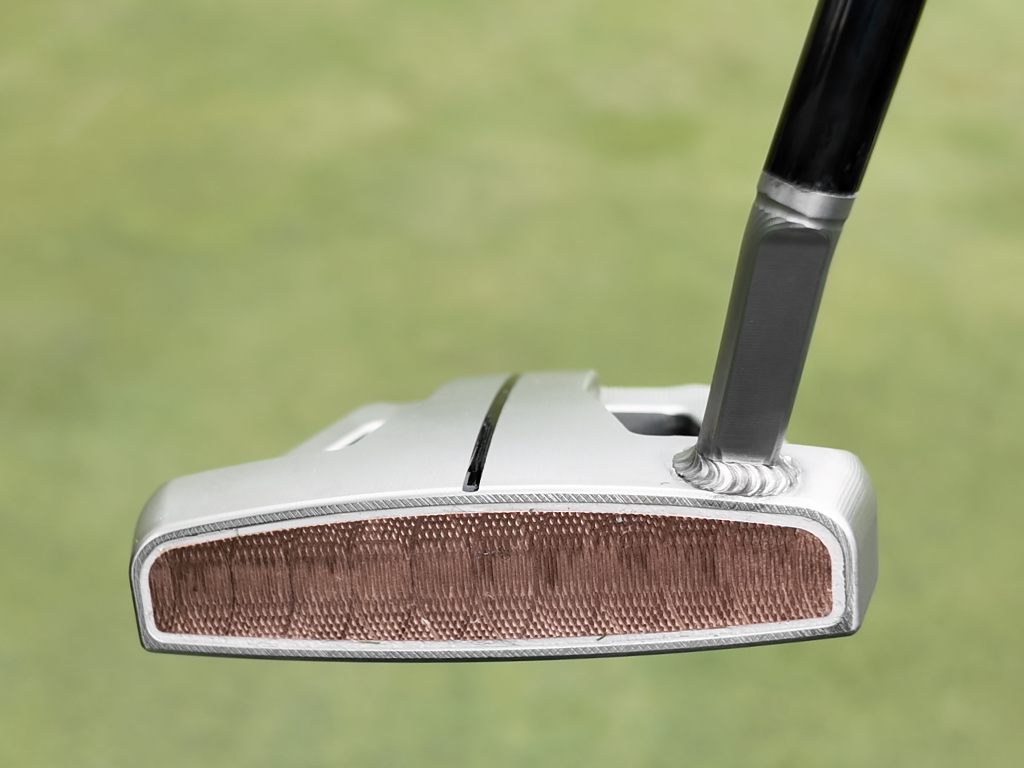
Arguably, the best perk of being a professional golfer on the PGA Tour is the ability to request or even just be handed pretty much any club you could think of. It happens more often than you think, usually with putters around the practice green from one event to the next. Come Wednesday, the Tour bags lining the edge of the putting surface become resting places for fallen flatsticks that never made the cut.
So let’s take a look at some of the best we’ve seen out on Tour this year that never made it to the competition. (You may notice none of Hideki Matsuyama’s custom Scotty Cameron putters made this list. There are too many.)
Let’s start with this custom Damascus Milled Odyssey Rossie made for Ryo Hisatsune. Featuring a single line and the short-slant hossel, we’ve seen plenty of Number 7 and jailbird heads featuring the Damascus Milled insert, but this is the first and only one we’ve spotted in a Rossie. Hisatsune primarily putts with an Odyssey Black Series iX #9, but we have seen him recently with a TaylorMade TP Collection SOTO, so there could be potential that the Damascus Milled Rossie could end up in the bag.

Everyone wants to be Cameron Young right now. We’ve had Justin Thomas and Tom Hoge both game the Scotty Cameron 9.5R prototype. Well, for the PGA Championship, Brooks Koepka nearly joined that list after requesting the same style of putter, with the full-length alignment line. But the Scotty Cameron reps took the request a step further and made one specially for Koepka with a Teryllium insert, similar to one in his previous Newport 2 gamers. The reason why this one didn’t go into play, though? Because it was too heavy.

Harry Hall was the third-best putter on Tour last year, so when Bettinardi made him a custom proto, you know it was going to be good. The custom BB28 blade features VDF face milling, a custom-welded single-bend shaft, and the owner’s initials – HH – on the sole of the putter. Hall, who usually games an Odyssey O-Works #7 W, has dabbled with a TaylorMade Spider Tour X already this year. Maybe there’s a chance this Bettinardi might make his bag.

Honestly, this one doesn’t need a description. It’s Kieth Mitchell’s custom Scotty Cameron Napa. One Scotty Cameron face stamp, two Scotty Dogs, two Scotty Cameron 7-Point Crowns and one Circle T. That is all. Oh, except for the Cashmere Cameron headcover.

Finally, and just for fun, how about we pour one out for this TaylorMade Spider Tour X made for Scottie Scheffler in its new torched finish. It’s unlikely we’ll see a putter change anytime soon from the best golfer in the world. In fact, he hit just two putts with it on the Harbour Town practice before going back to his trusty gamer.


Driver: Titleist GT3 (9 degrees) Buy here.
Shaft: Aldila Rogue Silver 130 M.S.I. 70 TX


3-wood: TaylorMade Qi35 (15 degrees)
Shaft: Fujikura Ventus Blue 7 X

7-wood: TaylorMade Qi35 (21 degrees)
Shaft: Fujikura Ventus Blue 8 X

Irons: Grindworks PR-202 (4), Grindworks PR-101A (5-PW)
Shafts: True Temper Dynamic Gold Tour Issue X100


Wedges: Cleveland RTX6 Tour Rack (52-10 Mid), Titleist Vokey Design SM10 (56-08M), SM11 (60-04T)
Shafts: True Temper Dynamic Gold Tour Issue S400


Putter: Scotty Cameron Tour Rat 1.5 Tour Prototype


Ball: Titleist Pro V1x
Grips: Golf Pride MCC


In our forums, our members have been discussing their favorite major winning irons used by Tiger Woods. WRXer ‘golferdude54’ kicks off the thread saying:
“Mizuno MP 14/29. Titleist 681T. Nike Forged Blades. TaylorMade P7TW.
Among these irons that helped Tiger win 15 majors, which is your favorite in terms of looks?”
And our members have been naming their favorites and why in response.
Here are a couple of posts from the thread, but make sure to check out the entire discussion and have your say at the link below.
- SwingBlade: “I prefer the early blades he played and the more recent TM TW’s especially because after Tiger had his major behavioral setbacks, part of Nikes support payback was making Tiger play a Nike putter and cease using his beloved uniquely customized Scotty putter.”
- ProjectX: “This (Nike Forged Blades) and there’s not even a close second.”
Entire Thread: “Which of Tiger’s major winning irons are your favorite? – GolfWRXers discuss”

Justin Rose WITB 2026 (April): Full WITB breakdown with new McLaren irons

RBC Heritage Tour Report: More minis, course-specific setups, Spider & GTS launches

What’s the story behind Webb Simpson’s custom-stamped irons?

Cadillac Championship Tour Report: Spieth’s sizable changes, McLaren Golf launches, and more

Kristoffer Reitan’s winning WITB: 2026 Truist Championship

Cameron Young’s winning WITB: 2026 Cadillac Championship

Aaron Rai’s winning WITB: 2026 PGA Championship

Nelly Korda WITB 2026 (April)

Justin Rose on the switch to McLaren Golf, learnings from previous equipment moves

Photos from the 2026 PGA Championship


Patrick Reed WITB 2026 (May)
Driver: Titleist GT3 (9 degrees) Buy here. Shaft: Aldila Rogue Silver 130 M.S.I. 70 TX 3-wood: TaylorMade Qi35 (15 degrees)...

Aaron Rai’s winning WITB: 2026 PGA Championship
Driver: TaylorMade M6 (9 degrees) Shaft: Aldilda Synergy Blue 70 TX 3-wood: TaylorMade Qi10 (15 degrees) Shaft: Fujikura Ventus Blue...


Michael Block WITB 2026 (May)
Driver: TaylorMade Qi4D (9 degrees) Shaft: Fujikura Ventus Black VeloCore+ 5 X 3-wood: TaylorMade Qi4D (15 degrees @14.25) Shaft: Mitsubishi...


Bryson DeChambeau WITB 2026 (May)
Driver: Krank Formula Fire Pro (6 degrees) Shaft: Project X Prototype 3-wood: Krank Formula Fire (10 degrees) Shaft: LA Golf BAD...
-
 Whats in the Bag3 weeks ago
Kristoffer Reitan’s winning WITB: 2026 Truist Championship
-
Whats in the Bag2 weeks ago
Aaron Rai’s winning WITB: 2026 PGA Championship
-
 Tour Photo Galleries3 weeks ago
Photos from the 2026 PGA Championship
-
 Equipment2 weeks ago
GolfWRX Launch Report: 2026 Titleist GTS drivers
-

 Equipment2 weeks ago
PGA Championship Tour Report: Fitzpatrick, Koepka among big-name putter switches for Aronimink
-

 News2 weeks ago
WITB Time Machine: Phil Mickelson’s winning WITB, 2021 PGA Championship
-

 Equipment2 weeks ago
Which of Tiger’s major winning irons are your favorite? – GolfWRXers discuss
-

 Equipment2 weeks ago
Lead Tape Report: Adjusting the swingweight of the Wanamaker Trophy


Pingback: What styles of putters are used by the 50 best players in the world? (2022 update) – GolfWRX – 0-cialis.com
Pingback: Hvilken stil af pinde bruges af de 50 bedste spillere i verden? (Opdatering 2022) - GolfWRX - comwpvip
Pingback: Vilken typ av stick använder de 50 bästa spelarna i världen? (uppdatering 2022) – GolfWRX - com4yuuu
Pingback: Blade vs. mallet: What style putters do the Top-50 players in the world use? (2022 update) – GolfWRX
HDTVMAN
Aug 19, 2018 at 4:37 pm
I have an actual Ping reproduction of the 1A putter with the PP58 midsize grip in my bag…AND I LOVE IT!!!
Wiger Toods
Aug 17, 2018 at 7:57 am
Centre-shafted mid-mallets are clearly the wave of the future.
OK, maybe not, but they should be. 🙂
Benny
Aug 15, 2018 at 2:48 pm
SAM Lab is awesome but what happens is it shows all the mistakes. Which we try to correct. Some of the best putters in the world have putted great with all types. Balanced, flow, whatever gives them confidence. Cool article. They did another years back with top wedge players and what they use. Keep it up Golfwrx!
Gepetto
Aug 11, 2018 at 1:45 pm
As a follow up, it would be fascinating to know how many of the top putters use a conventional, left hand low or claw grip and then to know which of these use a mallet or blade. Thanks for the great article!
Commoner
Aug 11, 2018 at 8:36 am
A refresher course in English Composition is needed.
doug
Aug 11, 2018 at 1:33 pm
This is conversational english…. ya whitey racist golf ball !!!
Ritch Gallagher
Aug 10, 2018 at 7:24 pm
To be a little more data centric, how many of the players listed as using mallets are using the new models that have some toe hang versus face balanced. I think whatever works best is the path to follow. I have tried a variety over the years but always wind up with my 18 year old Ping B60. I also like to take my 50 plus year old Bullseye flange that I bought in high school in the sixties. It still feels great.
anton
Aug 10, 2018 at 11:57 pm
does your bullseye feel great in your hands, during the stroke or at impact?
Bugh
Aug 10, 2018 at 7:20 pm
A putter is a man’s symbol of his gonadal weapon whipped out on the shaved green to drop that lil’ ball into da hole.
anton
Aug 10, 2018 at 11:55 pm
a man and his putter shall not be parted… it’s a matter of golf and life.
engineer bob
Aug 10, 2018 at 6:25 pm
Two points about putters and putting:
1. ‘feel’ for pros is sensing and controlling the putting stroke. Feel for the rest of us is the pleasant sensation of impact on the sweet spot, and nothing more.
2. MOI = Moment of Inertia or Force of Resistance to motion. High MOI putters impede the putting stroke, but deaden the lousy feel of off center hits. Choose your poison.
anton
Aug 10, 2018 at 11:59 pm
but a big black heavy putter will get the ball into the hole with greater force.
Jeff LeFevre
Aug 10, 2018 at 5:56 pm
Ok so were now calling Anser style putters blade putters what are we calling a wilson 8802 or similar putters?
shawn
Aug 10, 2018 at 6:13 pm
Obsolete ??!!! 😀
anton
Aug 11, 2018 at 12:00 am
LOL !
Jaap
Aug 10, 2018 at 4:20 pm
Almost all my new golfino Customers end up in the mother of all mallet putters.. the odyssey rossie. What they are looking for is balance..
what would be a more interesting test is how many out of the top 50 owgr And PG stats use bigger (super stroke) grips..
joro
Aug 10, 2018 at 2:14 pm
So the Companies are pushing their newest and greatest, usually Mallets. Those who use the “Blades” are using proven models, usually Ping style or my 8802 which has been in the Closet while I succumbed to the hype and the Mallet. I brought out my 8802 forged and POW, back to holing more and more “gimmees”.
So again, either you can or you can’t. Buy what you like and what works, not what some top Pro who can put with a broom uses.
shawn
Aug 10, 2018 at 6:12 pm
But joro…. the pros practice their putting stroke endlessly with any putter they choose to use. Ams and rec golfers want a putter that will guide them through the putting stroke without practice… and even read the green and pot the putt too!!!
christian
Aug 11, 2018 at 10:51 am
Holing out gimmies doesn’t seem very impressive?
joro
Aug 25, 2018 at 8:46 am
Well Christian, holing out and a gimme are not the same in case you did not know. Our gimmes are 6 inches or less and I am very good at that distance. I take it you may have trouble from that distance? You should practice more.
Have a nice game and enjoy your Golf.
Justin
Aug 11, 2018 at 3:34 pm
Exactly, Joro! We can make case study after case study of which type of putter is the “right” putter, depending on what criteria we choose.
Leftshot
Aug 10, 2018 at 1:15 pm
This suggests we mere mortals should all be using high MOI putters, which are mostly mallets. If the players with the most skill and the most time to practice favor putters that give more forgiveness, we’d be fools to give up this added forgiveness.
shawn
Aug 10, 2018 at 6:10 pm
If you can consistently hit the ball on the putter sweet spot you don’t need high MOI… ever think of that?!! 😮
Paul
Aug 10, 2018 at 12:26 pm
I was fitted after going through a SAM Putting Lab session some years back.They recommended a Bettinardi BB-27 blade which I bought. Liked the putter but struggled with it. Keep in mind I developed a mild case of the yips that would come and go. This putter was 340G in weight. Many times I would leave putts short. Finally after a number of years a friend told me I should try a center shafted mallet. There is a PGA Superstore close to me with a huge selection of putters. After hours of putting with various models, I really liked the Scotty Cameron Futura 5s. It had two 10g inserts in the bottom of the mallet. The putter was very expensive. I searched on eBay and found the same putter with two 15g inserts. It was a floor model and absolutely like brand new. Never used on the course. Also I saved over $100.00 going this route. I am happy to say I have halved the number of 3 putts on 18 holes. Normally I would 3 putt at least 6 holes on average and sometimes more. With my old putter there was never a short putt I couldn’t miss. Now I’m consistently making those 2.5 to 3 foot putts. The mallet putter made a huge difference to me. It also is face balanced. Hey I win a few bets now also. With my old putter, my friends would make side bets amongst themselves, if I was going to 3 putt a hole or not. As they say, what are friends for!!!
Sl
Aug 10, 2018 at 1:08 pm
So, what you’re saying is, that the science at the SAM putt lab is totally bogus and useless. I knew it! lol
Paul
Aug 10, 2018 at 3:45 pm
Actually the Sam Putt Lab was very useful. It showed that when I addressed the ball with my putter, I was always leaving it 2 degrees open. I automatically compensated for it by cutting across my putts even though I didn’t realize it. Also it showed that when I thought the blade was centered behind the ball it actually wasn’t. I had to adjust the line on my putter so it was actually farther to the right of the ball a little bit to be actually centered. The Sam Putt Lab was definitely worth it. The lasers they use don’t lie.
ogo
Aug 10, 2018 at 12:08 pm
If you pull the putter with your lead hand get a blade.
If you push the putter with your trail hand get a mallet.
If you can’t bend over due to back pain get a broomstick.
Joe Joe
Aug 12, 2018 at 9:26 am
What if you’re trying to keep your hands neutral and putt 100% with your shoulders?
JP
Aug 16, 2018 at 12:42 pm
I’m a right-hand dominant putter, and I love putting with a blade. Your canned advice doesn’t cut it.
Regis
Aug 10, 2018 at 12:05 pm
I go back to a time where most pros were gaming bullseye putters. Those were blades. Anser style putters were ‘mallets”. Now Ansers are blades.There are Ansers with “Wings”. I gained a real mallet putter for years. My buddies called it my potato masher. That head over was the size of a briefcase
Brad
Aug 10, 2018 at 10:30 am
I recently went through a Sam Putting Lab session where I was willing to accept whatever type of putter was recommended for me. Ironically I ended up with a putter style I would have never chosen for myself on my own. It’s amazing what the right fit will do for your game. Blade or Mallet, be sure to get properly fit as noted in the article.
Chris Pierson
Aug 10, 2018 at 9:55 am
Andrew- Awesome study! Would love to know and see if there’s anything a bit deeper like what is the most popular mallet, most successful mallet, most popular alignment, and maybe look into grips as well. A lot of Odyssey 7’s and TMAG spiders!
Getemgoose
Aug 10, 2018 at 8:37 am
I was actually doing that comparison myself a few days ago. Really cool to see the breakdown. Great article.
DB
Aug 10, 2018 at 8:28 am
Very interesting. However, I suspect it really doesn’t matter that much. If you forced everyone to use a blade putter (or mallet), I suspect the same people would rise to the top in the putting stats.
Shooter McGavin
Aug 10, 2018 at 7:40 am
This kind of means nothing since a lot of mallets now are 4:30 toe hang. I’d rather see a break down of players that use face balanced vs. toe hang putters. Would be interested to see how successful the SBST stroke is on tour.
Day, DJ, JT, Rahm, Tiger… all toe hang mallets.
John Lancaster
Aug 10, 2018 at 3:22 am
It means Rory should get himself a “RORS” spider and green can become the new red….
Brad
Aug 10, 2018 at 1:06 am
It simply means that we should use the putter that works best for us, whether that’s a blade, mallet, or a…wedge? Tip of the hat to you Robert Streb…
Jamie
Aug 9, 2018 at 5:40 pm
Wilson 8802 or George Low Wizard 600 are BLADE putters, not all the Ping Anser knockoffs. This is how mass delusion starts.
shawn
Aug 9, 2018 at 10:01 pm
Absolutely correct… and add to that the Cashin, Bullseye and Spalding T.P. Mills style putters are true BLADE putters… because they don’t have heel-toe weighting like the Anser-style putters. It’s important to make the distinction to stop the mass delusion.
The dude
Aug 10, 2018 at 12:53 am
That ship Has left the port…….Anser style is “blade”.
shawn
Aug 10, 2018 at 11:53 am
Answer style is now called a “blade” to make it sound more potent. Karsten designed the heel-toe weighted Anser for the mass market which cannot consistently hit the ball on the putter sweet spot. Maybe pros have the same problem given their search for an effective way to hold the putter grip.
joro
Aug 10, 2018 at 2:23 pm
Just a little tidbit of info. I was on the first Ping staff and Karsten told me the design was as you stated. The most important thing to him in Putting was feel and should, later proven in testing . So he make the hard material head for sound and the small grip for feel, later copied by Scotty when he ditched the Platinum for steel. Tiger said the Platinum was too soft.
Christens wife named the Putter the Answer but he had to remove a letter on the name to fit on the hosel and it became the ANSER. A great Putter. I had the first Left Handed ANSER made in Redwood City that he gave me. He was a great man and although his clubs were ugly at first, they got pretty really fast. Just a ramble on my part.
shawn
Aug 10, 2018 at 6:06 pm
Thank you, joro… for your historical insight and cogent explanation of “feel” of impact. What about the feel for the back and fore stroking of the putter? The hosel offset destroys putting feel due to added eccentricity. Why didn’t Karsten stay with the true pendulum style 1A model?
Suncoast9
Aug 10, 2018 at 4:24 pm
Terminology has changed over the years. When I started golfing in the 60’s there were three categories for putters: blade, flanged, and mallet.
Blade putters (such as the Bullseye) had identical faces on the front and back.
Flanged putters had a small flare on the back, usually near the bottom. There were flanged putters long before Ping, but I can’t remember any model names. I would say the Anser fell into the flanged category.
Mallet putters of the day were half-round in shape, with larger heads than blades and flanges, although much smaller than today’s offerings. I remember the term “potato masher” from the 70’s, but can’t recall if it was a specific model name or just a generic term for all mallets.
Christopher
Aug 15, 2018 at 12:07 pm
It is depressing that we’re now calling heel-toe weighted game improvement putters a blade. But Golf WRX did best of list of blades a while ago which featured cavity backs. I understand that putters like the Bullseye, Wilson 8802, the TP Mills and Tad Moore putter ranges have gone out of fashion. Even Scotty had the Circa ’62 line (and others) blade range and they were beauties, but it’s lamentable that we’re changing the meaning for no real reason.
If a club offers any kind of perimeter weighting, it’s not a blade.