
Equipment
When it comes to golf club design, to copy is to create


If you have roamed the forums of GolfWRX and read a post about any non-Ping milled putter, you have most assuredly read the phrase, “Oh, you mean…nice Ping Anser!”
In fact, it’s usually a race to see who posts it first!
Needless to say, it’s a very worn out phrase and warrants a need for GolfWRX forums to incorporate a text recognition protocol to automatically inhibit that combination of words from being posted again. I digress…
Certainly, Karsten deserves praise for his ingenuity and eternal influence on the game of golf and the equipment used to play it. Widely considered the inventor of perimeter weighted golf clubs, Karsten is responsible for such greats as the 1959 Ping A-1, the 1966 Anser, and the first cavity back irons, the Ping 69.

But, was he really the first to develop a perimeter-weighted golf club? No.
Copying is an essential part of creation. It’s also a very natural process; in fact, it’s exactly what us humans are, a multitude of cells that have been copied, split and multiplied. So as we look for inspiration, we look to what’s already been made and seek ways to improve upon it.
Henry Ford said it best
“I invented nothing new. I simply assembled the discoveries of other men behind whom were centuries of work. Had I worked fifty or ten or even five years before, I would have failed. So it is with every new thing. Progress happens when all the factors that make for it are ready, and then it is inevitable. To teach that a comparatively few men are responsible for the greatest forward steps of mankind is the worst sort of nonsense.”
As we look at the historic design of the 1966 Ping Anser, we see an interesting correlation to putters that came before it. The idea of perimeter weighting a putter didn’t start with the Anser, nor did it start with the A1. I believe it successfully started with the John Reuter, Jr. Bullseye design and the John Letters Golden Goose putters. (Ryan Barath of GolfWRX, recently produced a short video on the Bullseye answering the question, “Why was it great?”)
The Bullseye and the Golden Goose putters were separately introduced to the U.S. and British golf markets in the mid-1940s. This unique scenario is commonly referred to as “multiple discovery,” where the same innovation emerges from different places at or near the same time. Since Karsten was based in the U.S., the Bullseye is the most likely influencer.
At the time of the Bullseye’s creation, center-shafted putters were illegal, but Reuter believed he could create a more stable putter by placing the shaft as close to the center as possible and leave a small protruding heel opposite the toe, thus bringing more balance to the putter.
Karsten certainly was aware of the Bullseye design, as was the entire golfing world. In my opinion, Karsten made strong improvements to its design by creating the A-1, a remarkably similar design and even a material look, further exaggerating the principles of perimeter weighting by removing weight from the center of the putter and placing it in the heel, toe, and sole of the putter head. It also could be considered the father to many of the center-shafted SeeMore putters used today. The innovation of the A-1 thus led the way for the historic Ping Anser, another variation of a close-to-center-shafted putter with weight removed from the center and redistributed to the heel and toe.
 The fact of the matter is, Karsten did not invent perimeter weighting, but he was the one who exploited its benefits, pushed the technology to the limit, and made it look really cool in the process. The most unique aspects to the Anser design was the flat flange in the middle, allowing alignment aids to be added, and the plumbers neck, which allowed the axis of the shaft to pass close to center without actually doing it, further allowing the face of the putter at address to be visible.
Having the visionary ability to see something and make it better is the trademark of a great inventor. It’s worth noting some of the other major innovations that lead the way for John Reuter, Jr’s and Karsten’s inspiration.
- In 1919, W. F. Fitz Maurice patented the idea of attaching weight to a golf club to increase the swing weight, what we would consider today as lead tape.
- Then in 1930, E. E. Tucker patented the idea of the first adjustable driver and putter, allowing the use of weighted screws to be added to the toe and heel of a putter, or the back of the driver.
- In 1961, D. Rains Et Al, who patented the changeable weight putter, allowing for the adjustment of the putter’s head weight with a removable solid bar that passed through the center.

Not all inspiration needs to come from golf either. Just this year, Mizuno released the T20 wedges and used the inspiration of a much more common item, tire tread. Tire tread allows water to be dispersed in different directions upon contact and improve grip. Mizuno engineers used this idea and made micro-grooves that are placed in a perpendicular format to the main grooves, to direct water away, thereby improving clubface contact in wet conditions and maintaining more spin than a wedge without it.
Many forward-thinking engineers lead the way and prepared the environment for all of the advancements that we use today. While we often point to one individual being responsible for some breakthrough golf technology, it should be remembered that the innovations of today are almost always inspired by the innovations of our predecessors.


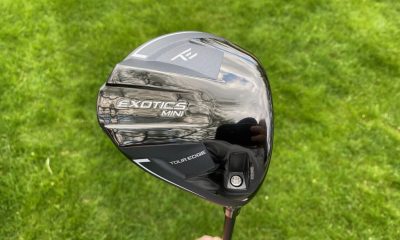


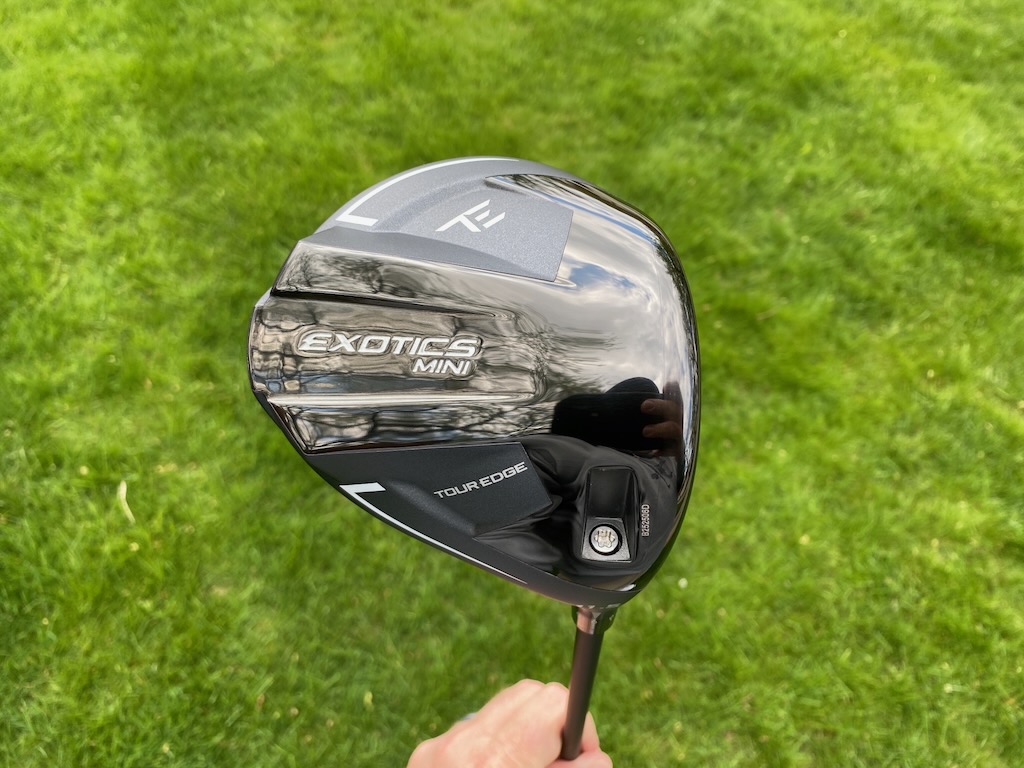
Tour Edge Golf has today introduced the all-new Exotics mini driver, engineered to deliver a powerful combination of speed, control, and versatility in the long game.
The Exotics Mini combines a titanium face with a stainless-steel body in design to balance ball speed with stability and control, creating a versatile option at the top end of the bag.

At the core of the design is Tour Edge’s proprietary Combo Brazing technology, a high-precision thermal bonding process that seamlessly fuses a titanium cup face to a stainless-steel body into a single, continuous structure. By eliminating energy loss found in traditional multi-piece constructions, Combo Brazing is designed to deliver faster face response, more efficient energy transfer, and a uniquely powerful yet controlled feel.

The multi-material construction also allows mass to be positioned lower and deeper in the head in a bid to increase stability, while the thin titanium face is engineered to maintain ball speed across a wider impact area.

“While the initial goal was to enhance control and versatility in the long game, Combo Brazing ultimately drove measurable gains in ball speed and distance within the mini driver category. In robot testing, we’ve documented higher ball speeds, higher launch, reduced spin, and increased carry and total distance compared to leading models.” – Vice President of R&D Matt Neeley

In addition to distance performance, the Exotics mini emphasizes forgiveness through a heavier stainless-steel body that shifts mass toward the perimeter. This configuration increases MOI relative to traditional all-titanium mini drivers, helping preserve ball speed and directional stability on off-center strikes. Paired with Pyramid Face Technology from the Exotics metalwood line, the design is intended to support consistent speed across the face.

To further enhance MOI, a lightweight carbon fiber crown frees additional mass that is strategically repositioned low and deep in the head in design to improve stability and promote optimal launch with controlled spin.

“We designed the Mini to be about five millimeters shallower than other mini drivers on the market. That change improves playability off the deck. From a clean fairway lie, it can function as a strong 3-wood alternative while still providing control off the tee.” – Tour Edge CEO David Glod
An adjustable hosel system allows for loft and lie tuning to dial in trajectory and shot shape, while a fixed 13-gram rear weight helps stabilize the head through impact to improve dispersion consistency. The Exotics Mini Driver is available in 11.5 and 13.5-degree lofts in right-handed models.

Pricing & Availability
The Exotics Mini Driver is available for pre-order beginning today for $399.99 USD at touredge.com, and will be available for purchase at retail outlets worldwide on May 22, 2026.

In our forums, our members have been pitting a Srixon ZXi combo against a TaylorMade P7CB/770 combo. WRXer ‘edutch22’ is on the hunt for a new set of irons and kicks off the thread saying:
“Looking at picking up a new set of irons and think I’ve narrowed it down to Srixon ZXi combo or Taylormade P7CB/770 combo. I am currently a 5 cap and allbeit I feel irons are my weakness. My miss is a little to the toe side. I am decently steep at 4-5 down. Always thought I am high spin but recently on trackman my 7 was spinning at 5800 roughly.
My question or looking for thoughts on which one would benefit me more from a forgiveness standpoint? Or is there another iron is should be looking at entirely? I only get to play about once or twice a week, if I am not playing a 2-3 day event. Thanks in advance.”
And our members have been sharing their thoughts and suggestions in response.
Here are a few posts from the thread, but make sure to check out the entire discussion and have your say at the link below.
- manima1: “You just can’t go wrong with Srixon ZXi7.”
- MattM97: “You have to hit them to know, the V-Sole on the Srixon can be make or break for many.”
- dmeeksDC: “P7CB is more forgiving for me than ZXi7 because my main miss is low middle and the P7CB still flies and spins great on that miss. These are both really nice irons but I like the P7CB more than the Zxi7 and the P770 (or P790) more than the Zxi5. The Srixons are larger so if that gives you confidence that is the way to go. I don’t feel like I get any benefit from the V-sole and the P7CBs live up to their high Maltby forgiveness rating so the TaylorMades have been great for me.”
Entire Thread: “Srixon ZXi combo or TaylorMade P7CB/770 combo? – GolfWRXers discuss”

At GolfWRX, we are a community of like-minded individuals who all experience and express our enjoyment of the game in many ways.
It’s that sense of community that drives day-to-day interactions in the forums on topics that range from best driver to what marker you use to mark your ball. It even allows us to share another thing we all love – buying and selling equipment.
Currently, in our GolfWRX buy/sell/trade (BST) forum, @pianoman0123 has a 2024 Wilson Staff CB/Blade combo up for grabs.

From the listing: “2024 Wilson Staff CB/Blade Combo. 4-8 irons are CB’s and the 9,PW are Blades. 5-PW have Project X 6.0 Shafts and the 4 Iron has a Steelfiber CW110 Stiff Shaft. Standard Length, Lie and Lofts. These are in very good condition the shafts just don’t work for me. Like new Lamkin Grips on the 5-PW and a stock Golf Pride on the 4 Iron. $525 OBO.”
To check out the full listing in our BST forum, head through the link. If you are curious about the rules to participate in the BST Forum, you can learn more here: GolfWRX BST Rules

RBC Heritage Tour Report: More minis, course-specific setups, Spider & GTS launches

Justin Rose WITB 2026 (April): Full WITB breakdown with new McLaren irons

Best fairway woods of 2026: The most versatile fairway woods + the most forgiving fairway woods

What’s the story behind Webb Simpson’s custom-stamped irons?

Cadillac Championship Tour Report: Spieth’s sizable changes, McLaren Golf launches, and more

The 24 players who can win the Masters

Rory McIlroy’s winning WITB: 2026 Masters

Kristoffer Reitan’s winning WITB: 2026 Truist Championship

J.J. Spaun’s winning WITB: 2026 Valero Texas Open

Cameron Young’s winning WITB: 2026 Cadillac Championship


Alex Fitzpatrick WITB 2026 (May)
Driver: Ping G440 LST (9 degrees) Shaft: Fujikura Ventus Black 6 X 3-wood: TaylorMade Qi4D (15 degrees) Shaft: Fujikura Ventus...

Kristoffer Reitan’s winning WITB: 2026 Truist Championship
Driver: Ping G440 Max (9 degrees) Shaft: Mitsubishi Tensei 1K White 60 TX 3-wood: Ping G440 Max (15 degrees) Shaft:...


WITB Time Machine: Rory McIlroy’s winning WITB, 2021 Truist Championship
Rory McIlroy’s victory at the 2021 Wells Fargo Championship 2021 (now the Truist Championship) marked a significant return to form,...


Collin Morikawa WITB 2026 (May)
Driver: TaylorMade Qi4D LS (8 degrees) Shaft: Mitsubishi Diamana D+ Limited 60 TX 3-wood: TaylorMade SIM Tour (14 degrees) Shaft:...
-
 Equipment2 weeks ago
Justin Rose WITB 2026 (April): Full WITB breakdown with new McLaren irons
-
 Equipment1 week ago
What’s the story behind Webb Simpson’s custom-stamped irons?
-
 Equipment2 weeks ago
Cadillac Championship Tour Report: Spieth’s sizable changes, McLaren Golf launches, and more
-
Whats in the Bag3 days ago
Kristoffer Reitan’s winning WITB: 2026 Truist Championship
-
 Whats in the Bag1 week ago
Cameron Young’s winning WITB: 2026 Cadillac Championship
-

 Whats in the Bag3 weeks ago
Nelly Korda WITB 2026 (April)
-

 Equipment2 weeks ago
Justin Rose on the switch to McLaren Golf, learnings from previous equipment moves
-

 Tour Photo Galleries2 weeks ago
Photos from the 2026 Cadillac Championship


JP
Oct 2, 2019 at 10:47 am
Is this written in defense of scotty cameron?
Adam
Oct 2, 2019 at 10:06 am
This article seems very unnecessary. Copying is not creating, that is objective, in fact it’s the opposite. The problem is some manufacturers will blatantly copy and not cite inspiration. Having said that I don’t feel club most manufacturers go into it trying to be creative and design the “answer” like Karsten was. At this point it’s tinkering proven designs and using marketing tactics to help them stand out.