
Equipment
Greatest Ping irons of all time

Ping Golf started as a family putter company simply working out of a garage. Today, it is one of the most forward-thinking, technology and data-driven golf companies in the world producing clubs in every category—all while still being 100-percent family-owned and operated. That’s something that can’t be said about any of the other major golf OEMs.
From a garage to an entire campus, which is what Ping likes to call its headquarters in Phoenix, Arizona, the company has produced some of the most iconic sets of irons ever made, and essentially invented game improvement clubs. And Ping still owns the title for producing the top-selling iron of all time. To look back at the history of Ping irons is to look at a timeline of constantly improving products and technology—and just like our other lists, some models stand out from the crowd.
These are the greatest Ping irons of all time.
Ping i3 (Blade & O-Size) – Released 2000

The Ping i3 makes its way onto this list for several reasons. It was the very first Ping iron to incorporate the CT—Custom Tuning Port—something that has become a staple in Ping designs. It was also the first series to offer both a smaller players version and a game improvement club in the i (eye) series with the i3 Blade and the i3 O-Size. The O-Size moniker was eventually retired with the introduction of the G series and the G2—a name that has become synonymous with easy-to-hit clubs.
As an “engineering” company first, the CTP allowed Ping to precisely control the clubhead weight without having to use tip weights in the hosels and up the shaft. Although it is common practice in club building, using tip weights shifts the center of gravity of the head closer to the hosel of the club (it is in no way a practical shift) or even noticeable, but from a design perspective, it exists, and Ping went the extra mile to reduce the effects.
The other thing the CTP did and still does to this day: eliminate unwanted vibration to improve the feel of the club. The i3 design was so popular, Ping only tweaked it with an improved sole when the i3+ launched two years later. The “Blade” head profile found a third life when it was brought back again years later with the i10.

Ping S59 – Released 2003

The S-Series forever changed the way better players viewed Ping irons. The irons that kicked off the revolution were the Ping S59‘s—one of the smallest, lowest launching, most workable Ping irons ever made (until the Blueprints came along).
It’s not that lower handicap players didn’t like previous Ping irons, because they had full PGA and LPGA Tour rosters that had no issue, but what drove the S59’s development was a demand from younger players who were part of Ping’s substantial college program for a more blade-like design—something Ping had never done before.
The key design element of the S59 is the stabilizing bar across the cavity above the CTP. It helps with producing a solid feel and precise distance control. Not long after the original S59, a newer version came along that was essentially the same club but with different aesthetics including a buffed sole and back along with for the very first time on a Ping iron—a ferrule!

A couple of fun facts on the S59s
- Bubba Watson famously used them for over a decade on tour. As a player with no shortage of clubhead speed that loves to work the ball, he found no advantage to the newer models that boosted MOI until the S55.
- In 2004, Ryan Moore used S59s irons to accomplish one of the most impressive seasons of amateur golf in the modern era when he won the U.S. Amateur (USGA), the Western Amateur (WGA), the U.S. Amateur Public Links (USGA), and the NCAA individual championship.
Ping ISI – Released 1998

The Ping ISI represents a bygone era of Ping irons. They were one of the last designs released before the CTP was introduced, and they were also the last series of irons that were produced in three different materials at varying price points: stainless steel, nickel, and BeCu beryllium copper.
The starburst pattern in the back cavity created extra stability behind the thinner face to improve feel, and there are subtle design cues to the Zing with the oversized toe and heel pieces to boost MOI.
There was a second version, the ISI K, which only came in stainless steel and was a larger head shape to the standard ISI. There are still one of the most popular irons of that era, but like many Ping irons of the ’90s they forever lived in the shadow of the Eye 2 and the many versions that were launched.
Ping Rapture – Released 2006

The Rapture irons earn their place on this list for what they represent in Ping’s iron and company history. The Rapture irons were the very first Ping irons to utilize a multi-material construction by combining a stainless steel body, thin titanium face, and tungsten toe weight to create the highest MOI iron Ping had ever produced to that point. The entire Rapture line was introduced as a separate premium line of clubs in 2006 and also showcased Ping’s first carbon composite crown driver.
From a company history perspective, the Rapture irons were also the very first irons to be made overseas. Up until 2006, every single Ping iron was produced in Ping’s own privately owned casting facility Dolphin, Inc (side note they manufacture products for several industries outside of golf and recently moved into a new facility just a couple of years ago when their previous plant was in the way of highway expansion).
Technology in the Rapture irons eventually trickled down to other club designs—like the S57’s, released in 2009, which had the same tungsten toe weighting to increase MOI in the much smaller shaped S-Series iron.
Ping Eye 2 – Released 1982

Buckle up for this history lesson!
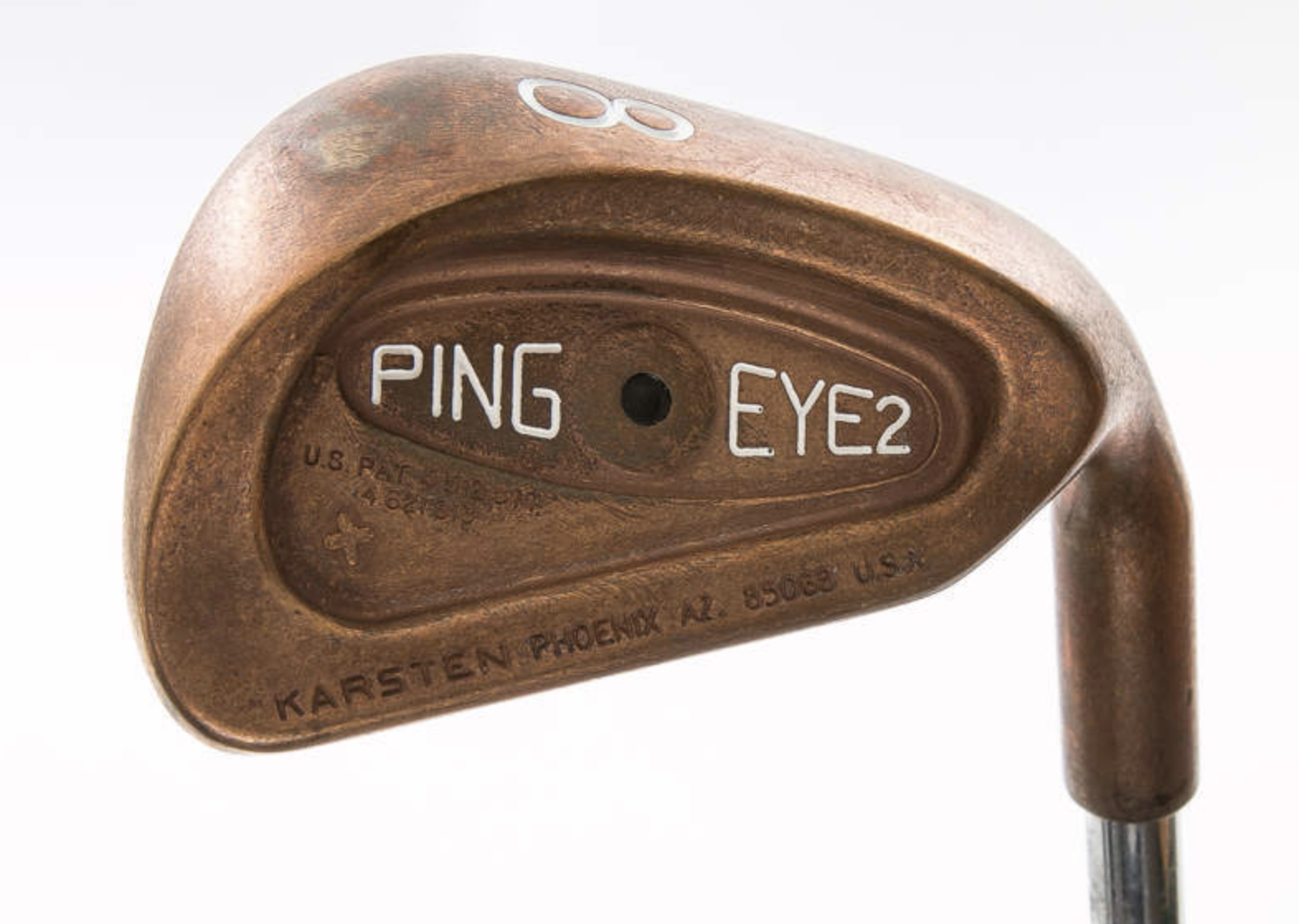
The Ping Eye 2 is the best-selling set of irons of all time…period. I could write pages on this iron design and the simple brilliance of it. It was also the first Ping iron to be offered in beryllium copper (see title image).

The design was originally introduced in 1982 as the follow-up to the original Ping Eye iron, which got its name from the eye-shaped cavity that created the perimeter weighting. The Eye 2‘s were produced for over a decade and went through several iterations in shape, sole profile, and groove designs—the first being in 1984 when they upgraded from V to U grooves to increase spin consistency.
Then in 1985, Ping introduced what is known as the “square groove model.” The groove design itself is identical to the “U groove” with the only changes occurring in the spacing of the grooves on the face and a slight radius added. This reduced the surface area between the groove but did not change the distance between the inside edges of the grooves, which Karsten believed as an engineer was the proper way to measure groove spacing and not at the top of the radius—it was well within the rules of golf.

Unfortunately, the USGA and Karsten didn’t see eye to eye (no pun intended) on the grooves and this created one of the most monumental lawsuits in the history of golf. Here is the CliffsNotes version
- After already being in production for several years with tens of thousands of sets sold, it was well documented that Ping Eye 2 irons seemed to spin a ball more than other irons. At the timem USGA regulations for golf equipment didn’t have a specific method to measure grooves, and Karsten measured from their vertical walls (see above graphic), while the USGA measured the groove from where the groove radius met the face. The variance between the two measuring methods was .005 inch, but the USGA still wanted to deem then non-conforming.
- The famous shot that really caused this to get out of hand was an 8-iron from the rough hit by Mark Calcavecchia at the 1989 Open Championship at Troon that not only hit the green but almost sucked back—out of the rough!
- Karsten decided to take the USGA to court and in August, 1989, sued the USGA and the R&A for $100 million on the grounds of restraint of trade. Karsten Manufacturing (Ping) settled out of court with the USGA in 1991.
- Karsten brought a similar $100 million lawsuit towards the PGA Tour in 1991 after they attempted to enact a local rule that Eye 2’s could not be played on tour. Both Jack Nicklaus and Arnold Palmer (who we should note didn’t use Ping irons) were on the side of the Tour. The Tour was seriously concerned about the financial damage the lawsuit would have if they lost.
- Most of the golfing world had sided with Ping in the court of public opinion, and only six days before the lawsuit was scheduled to go to trial, Karsten Solheim changed his mind and agreed to settle out of court. No money, beyond lawyers fees, was ever paid, and in return Karsten only required the USGA along with the PGA Tour grandfather in the Eye 2 model in question, made from 1985 to 1989. This is why when the USGA officially changed the groove rule in 2010 some players went back to the last ’80s model Ping wedges because they were still conforming based on the 1991 lawsuit.
During all of this, Ping Eye 2 irons continued to sell extremely well, which is why, to this day, it’s difficult not to come across a set at either a local muni, used club rack, or even the odd club at a swap meet. They were seemingly everywhere and helped make Ping the company it is today.
Soon after, the Eye 2+ (Plus) model was introduced with an improved sole design, and with it one of the most famous wedges of all time was born. Check out the video below for the full explanation by yours truly.
GolfWRXers, what is your favorite Ping iron of all time?




In a golf world where players are looking to eke out every yard possible, usually by lengthening their drivers to add clubhead speed, there’s one player at the PGA Championship who’s going in the opposite direction. In fact, for Rickie Fowler, his goal off the tee is not about gaining extra distance or yards north to south, but rather about shrinking the misses from east to west.
Ahead of the PGA Championship and the week prior at the Truist Championship. Fowler mentioned to Cobra Tour Rep Ben Schomin that the driver didn’t quite swing feel the same as everything in the bag. As a result, and with Schomin’s suggestion to try and sync everything up with the big stick, Fowler decided to test out a shorter length shaft.
“He’s been at 45 (inches), and he’d been at 45 for a few weeks, 44 1/8 (inches) is really is where he is been living really for the most part, for the last couple of years, and is where he is been comfortable,” Schomin told GolfWRX. “It just felt like it was a little long and loose on him.”
Interestingly, Fowler ranks 40th in Driving Accuracy this year on the PGA Tour. It’s his most accurate season with the driver since the start of the decade. But sometimes for players, feel is more important than statistics.
“It was really more of a trying to get the swing to feel the fluidness from club to club to club to try to get it to feel the same,” Schomin added. “And so we took it down to 43 and a quarter, and it was a touch of a ball speed loss, just based on that overall club head speed. But honestly, he squared it up probably a little better. The right miss wasn’t nearly as far. So really, overall down-range dispersion tightened up a fair amount, and he felt confident in swinging it.”
The change in length had Fowler’s caddie, Ricky Romano, beaming at how well he had driven during Tuesday’s practice round at Aronimink. So much so, he was asking Schomin not to suggest changes anymore.
Fowler’s shaft-shortening is one of a few driver adjustments he’s made this season, and to Schomin’s credit, it’s thanks to the fact that he and the rest of the Cobra team had Fowler fit very well into three of the four heads in the Cobra OPTM lineup.
“He had three distinct drivers and the biggest decision was trying to decide which worked best at that time,” Schomin told GolfWRX previously. “He’s played the majority of the season with OPTM X, but has also played a couple of tournaments with OPTM LS. His overall driving stats have been good.”
At the RBC Heritage earlier this spring, Fowler switched drivers, changing from his Cobra OPTM X and into the Tour, low-loft Max K model that Gary Woodland used to win just a few weeks prior.
Now for the PGA Championship, Fowler’s back in the X head, but still using the UST Mamiya LIN-Q PowerCore White 6TX shaft, just a little bit shorter.
“Will he stay there? I’m not sure,” Schomin added. “Could we end up say at like 43 and 7.5 (of an inch). If it’s giving him the same feel of consistency through the bag, then I think we might end up just a touch longer. But if he likes where he is at, he’s confident where he is at, that’s really all that matters.”
If there’s more testing, though, just don’t tell his caddie.

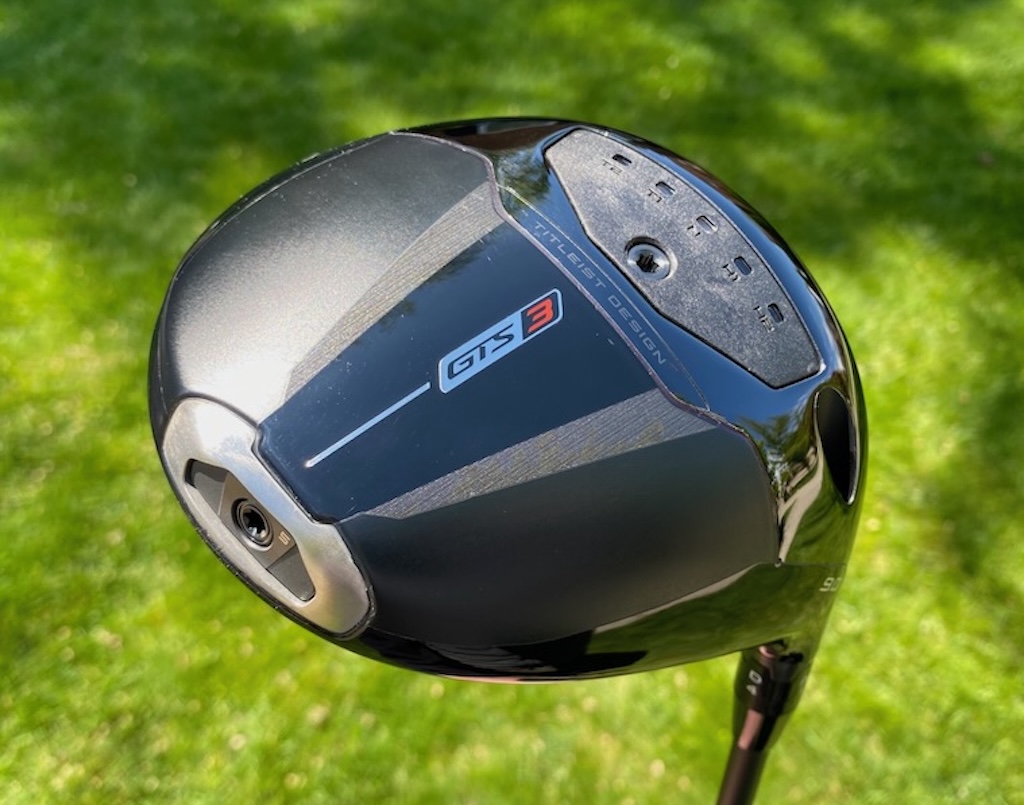
What you need to know: As is customary for the Fairhaven-based company, Titleist officially announced today that its GTS drivers are headed to retail, following a successful tour release. The GTS2, GTS3, and GTS4 drivers will be available in golf shops June 11.
Since debuting at the Texas Children’s Houston Open, the new GTS lineup has quickly gained traction on the PGA Tour, with more than 50 players already making the switch to a GTS2, GTS3, or GTS4 driver. Among them are Justin Thomas and Jordan Spieth.

Justin Thomas’ Titleist GTS2 driver (Greg Moore, GolfWRX)
According to Titleist, the GTS series builds upon the performance foundation established by the GT Series, while introducing several major technological advancements, including a new Split Mass Frame construction, refined aerodynamics, and an updated Speed Sync face design.

2026 Titleist GTS drivers: What’s new, key technology
Split Mass Frame and thermoform body
At the center of the new GTS lineup is a redesigned internal structure: the Split Mass Frame. This technology works with a full-thermoform body made from Titleist’s Proprietary Matrix Polymer (PMP), a lightweight composite that enables engineers to reposition mass more efficiently throughout the head. Compared to the previous GT generation, GTS drivers feature nearly double the PMP material, increasing from 13 grams to 26 grams, while maintaining the sound and feel preferred by better players.
The weight savings from the thermoform construction allowed Titleist engineers to strategically separate mass placement inside the head. Specifically, more weight is pushed rearward to improve stability and forgiveness, while additional mass is positioned low and forward to optimize speed, launch, and spin.
In short, golfers are able to maintain ball speed and consistency across both centered and off-center strikes.

Faster aerodynamics
Titleist also refined the aerodynamic shaping of the GTS heads to help players generate more clubhead speed.
The tails of the new GTS2 and GTS3 heads have been raised compared to previous models, helping airflow stay attached to the crown and sole longer during the swing. According to Titleist, the improved airflow reduces drag and increases speed without affecting launch conditions or center of gravity placement.
Typically, aerodynamic gains can compromise forgiveness or launch characteristics, but the weight savings from the Split Mass Frame allowed engineers to preserve preferred CG locations.

New Speed Sync face
The new Speed Sync Face design is engineered to improve ball speed retention across a larger portion of the face. A reinforced perimeter structure helps maximize face deflection and COR on centered strikes, while the upper portion of the support ring is opened up to increase speed on high-face impacts, a common strike location for many golfers. The face also features a variable thickness design to preserve speed and performance across a wider impact area.
Expanded adjustability
Each GTS model includes a dual-weighting system to fine-tune launch, spin, and shot shape more precisely than previous generations. GTS2 uses interchangeable forward and aft weights, while GTS3 and GTS4 combine a rear weight with an adjustable forward track weight system.
Tour-inspired face graphics
The new lineup features redesigned high-contrast face graphics to improve alignment and framing at address, according to Titleist. Sharp visual lines are designed to make it easier to center the golf ball and to perceive loft more easily at setup.

Additional model details
GTS2

- The GTS2 is the most forgiving model, designed for golfers seeking maximum stability and consistent speed across the face.
- It produces high launch with mid spin and features a larger, confidence-inspiring profile behind the ball.
- Standard weighting includes an 11-gram forward weight and a 5-gram rear weight, with additional fitting configurations available.
GTS3

- The GTS3 is aimed at players who want more control over launch, spin, and shot shaping.
- Compared to GTS2, the GTS3 offers lower launch and spin while featuring a more compact profile and deeper face design preferred by many stronger players.
- The head features an adjustable forward-track weight system to further fine-tune center of gravity placement.
GTS4

- The lowest-spinning option in the lineup, GTS4 is built for golfers looking to reduce excessive spin and maximize total distance.
- Unlike previous “4” models from Titleist, the new GTS4 features a full 460cc profile that improves forgiveness and stability while retaining its low-spin DNA.
- Like GTS3, it includes a forward track weighting system for precise fitting adjustments.

What Titleist says
“When we talk about driver design, it’s never about the one feature or benefit — it’s about all of them,” said Stephanie Luttrell, Titleist’s Senior Director of Metalwood R&D. “Ball speed, forgiveness, spin stability, adjustability, exceptional sound and feel… these are all attributes that golfers care about. It’s our job to design a lineup that elevates performance across the board without sacrificing in key areas, and we feel we’ve done that with GTS.”
“We know that forward CGs drive speed with great launch and spin characteristics, but you need to be able to do that with an inertial stability that still preserves ball speed, launch and spin consistency on off-center hits,” Luttrell said. “We’ve never before been able to hit these CG positions and inertia properties at the same time, and we’re achieving that because of GTS’ construction.”
Club Junkie’s take
I feel like every time there is a new Titleist wood release, I figure they can’t outdo their previous driver. And every year, I am wrong and impressed with the performance. The GTS fits right into that narrative again, as I didn’t know where Titleist could go from GT, but they pushed the limits again, and my fitting proved the smart people there found ways to improve.
My past four Titleist drivers have been a 2 series as my swing typically requires a little height, spin, and forgiveness so I figured I would just get a new GTS2 and be on my way. During the fitting, I was impressed by the new GTS construction, its added PMP material, and the advanced adjustability on each model. My fitter, Joey, got to work putting together a GTS2 and we started there. The launch and spin were great, and the consistency on misses was very tight. My average ball speed with the GTS went up a little bit as the new Speed Sync face creates more speed away from the center.
Joey then built up a GTS3 in 11 degrees, but I figured this wouldn’t have the stability I needed for tight dispersion on my miss hits. That thought was quickly erased after a few shots, and I really liked the more center start line and reduced draw on the misses I was seeing. We tried a few different settings and shafts to dial in the details in order to get the best fit. Having a forward and rear weight in the head allowed Joey to set up the GTS3 with a heavier rear weight to keep the launch and spin up, while the Sure Fit hosel set flat created a more center start line for me. My misses were not nearly as far left, and I was really impressed with the consistency on the spin and launch when I didn’t hit it in the center.
Titleist again created a wood line in GTS that delivers improvements over previous drivers while keeping the traditional look and feel you expect. More adjustability, better off-center speed, and 3 drivers that are playable over a wider range of players should make these extremely successful in fittings.
Pricing, specs, availability
GTS2 lofts: 8, 9, 10, 11 degrees (RH/LH)
GTS3 lofts: 8, 9, 10, 11 degrees (RH/LH)
GTS4 lofts: 8, 9, 10 (RH/LH)
Featured shafts
- Project X Titan Black
- Mitsubishi Tensei 1K White
- Mitsubishi Tensei 1K Blue
- Mitsubishi Tensei 1K Red
Premium shafts
- Graphite Design Tour AD DI
- Graphite Design Tour AD VF
- Graphite Design Tour AD FI
Available for fittings and pre-sale now.
In golf shops worldwide beginning June 11.
Price: $699 (standard), $899 (premium)


Titleist has today introduced its new GTS2 and GTS3 fairways.
Lower and deeper center of gravity (CG) positions, new adjustable heel-toe weights and advanced clubface innovations drive total performance in the two tour-proven models.
- Tour-inspired polished clubfaces: To help players see more of the clubface at address.
GTS2 Fairway


The new GTS2 fairway is designed with a shallower face and a larger profile than GTS3, ideal for players with more sweeping deliveries with their fairway metals.


GTS2’s new face height, inspired by tour feedback, was designed shallower than the prior generation GT2 model and more in line with the GT1 fairway. Each loft in GTS2 leverages a shallower profile except for the 13.5-degree, which maintains a slightly taller face.

With its new dual-weighting system, the ‘2’ model now has heel-toe CG adjustability.
Lofts: 13.5, 15.0, 16.5, 18.0, 21.0
Dual-weight system: 11-gram weight in heel, 5-gram weight in toe (standard)
GTS3 Fairway


The new GTS3 fairway is designed with a deeper face and a more compact profile, ideal for players who hit down on the golf ball more with their fairway metals.

New to the GTS3 family is a 21-degree offering, giving players two distinct profiles in Titleist’s 7-wood loft.


RBC Heritage Tour Report: More minis, course-specific setups, Spider & GTS launches

Justin Rose WITB 2026 (April): Full WITB breakdown with new McLaren irons

Best fairway woods of 2026: The most versatile fairway woods + the most forgiving fairway woods

What’s the story behind Webb Simpson’s custom-stamped irons?

Cadillac Championship Tour Report: Spieth’s sizable changes, McLaren Golf launches, and more

The 24 players who can win the Masters

Rory McIlroy’s winning WITB: 2026 Masters

Kristoffer Reitan’s winning WITB: 2026 Truist Championship

J.J. Spaun’s winning WITB: 2026 Valero Texas Open

Cameron Young’s winning WITB: 2026 Cadillac Championship


Alex Fitzpatrick WITB 2026 (May)
Driver: Ping G440 LST (9 degrees) Shaft: Fujikura Ventus Black 6 X 3-wood: TaylorMade Qi4D (15 degrees) Shaft: Fujikura Ventus...

Kristoffer Reitan’s winning WITB: 2026 Truist Championship
Driver: Ping G440 Max (9 degrees) Shaft: Mitsubishi Tensei 1K White 60 TX 3-wood: Ping G440 Max (15 degrees) Shaft:...


WITB Time Machine: Rory McIlroy’s winning WITB, 2021 Truist Championship
Rory McIlroy’s victory at the 2021 Wells Fargo Championship 2021 (now the Truist Championship) marked a significant return to form,...


Collin Morikawa WITB 2026 (May)
Driver: TaylorMade Qi4D LS (8 degrees) Shaft: Mitsubishi Diamana D+ Limited 60 TX 3-wood: TaylorMade SIM Tour (14 degrees) Shaft:...
-
 Equipment2 weeks ago
Justin Rose WITB 2026 (April): Full WITB breakdown with new McLaren irons
-
 Equipment1 week ago
What’s the story behind Webb Simpson’s custom-stamped irons?
-
 Equipment2 weeks ago
Cadillac Championship Tour Report: Spieth’s sizable changes, McLaren Golf launches, and more
-
Whats in the Bag4 days ago
Kristoffer Reitan’s winning WITB: 2026 Truist Championship
-
 Whats in the Bag2 weeks ago
Cameron Young’s winning WITB: 2026 Cadillac Championship
-

 Whats in the Bag3 weeks ago
Nelly Korda WITB 2026 (April)
-

 Equipment2 weeks ago
Justin Rose on the switch to McLaren Golf, learnings from previous equipment moves
-

 Tour Photo Galleries2 weeks ago
Photos from the 2026 Cadillac Championship


one word
Oct 7, 2023 at 6:36 pm
Great post! I’m a big fan of Ping irons and have tried a few over the years. I think my favorite is the PING G5.
Yes Or No Spinner
Jan 31, 2023 at 7:06 pm
Great post! I’m a big fan of Ping irons and have tried a few over the years. I think my favorite is the PING G5.
Jeff Hoagland
Jan 23, 2023 at 4:15 pm
Love my i3 blades. Just started playing with them again and wondered why I ever stopped! Bought them when my oldest daughter was born 19 years ago. Both are fantastic!
Bob
Oct 11, 2022 at 11:36 pm
The ISI is the sum of Karsten Solheim’s work in irons and wedges to the mid 90’s. He died in early 2000. It combined all the best features of the Eye and Zing series into this final design.
I have 3 sets of irons that I will never sell and the ISI is one of them.
Jack
May 6, 2023 at 3:04 pm
What are the other two set?
P.T.Deming
May 28, 2023 at 12:59 am
I still love my ISI-K irons. I have hit newer Callaways , Taylor Made’s and newer Ping’s. The newer clubs are nice but gimme my good old Ping ISI-K’s please!!
tungsten rings
Apr 18, 2022 at 4:50 am
I got this website from my buddy who informed me about this
website and now this time I am browsing this site and reading very informative
content at this place.
Mark Woytalewicz
Jul 7, 2021 at 10:30 am
Shot my best round ever (69) with the ISI-S Nickel irons in the late 90’s. I have a set of the be-cu ISI-S for the last 10 years, sent them to Ping to be re-shafted, gripped, and cleaned up, I take them out once in a while, last time out shot 73 with 30 year old irons, not the arrow, it’s the Indian.
Donn Rutkoff
Mar 19, 2021 at 2:29 pm
Quick question. I have a ISI 5 iron, it is copper color but does not say BeCu anywhere. did Ping put “BeCu” anywhere on the ISI copper heads? It is genuine Ping, a z-Z65 shaft and old Ping stripey grip.
mick
Apr 27, 2020 at 1:45 pm
PING I3 Blades. Still awesome !!!
Growing in Ping Appreciation
Apr 21, 2020 at 8:45 am
I was never a fan of Ping irons growing up and thought they should be illegal. However, since seeing the progression of the iron development over the years and going to Phoenix to see the facilities, I have a tremendous appreciation for the family, the company and the engineering of the designs. I liked several models since 2000 but loved the i10 with ZZ lite. At the time, it was one of the best irons I had ever played. The S57, S56 and S55 were tremendous as well. Now, the iblade is my all time favorite iron! The iblade looks wonderful, is solid, soft, and glides through the turf exceptionally well for me. The trajectory is beautiful and the ball stops great. other than the fact I love to play blades and test new things, it will be hard to get these out of my bag. I may have to get a back-up set!
BillyG
Apr 20, 2020 at 11:32 pm
When was the micro taper offered as the stock shaft in the Eye 2?
Shallowface
Apr 21, 2020 at 7:56 am
It never was the stock shaft, but it was an option they offered for years.
BillyG
Apr 21, 2020 at 8:40 pm
Thanks! I had a set of copper Eye 2 that had that shaft. I did not know the year because they were used. Thought maybe the shaft offering could help. Wish I had not sold them because they were 1-LW. Even had an old Dale Head Anser.
M.Coz
Apr 20, 2020 at 4:22 pm
Without the K-1 there may have never been any Ping iron business! They were dramatically different from anything ever made up to that point. Nothing was even close. Popularized investment cast irons, first really successful offset iron. The first playable and well used 1-iron that by itself found its way into golf bags everywhere especially on Tours round the world. I still have my set of K-1s that I used in College, mine are the flat soled Pre-Dot model. I haven’t played the set in over 46 years, although I continued to carry the 1-iron for many years afterwards. They had really light swingweights and they were a club longer than any other clubs at that time. Interestingly the Eye 2s were actually shorter in distance.
Mark
Apr 20, 2020 at 2:32 pm
I had Ping Eye-2 Red Dot 1-SW back in 83-88. If I remember correctly, I had to wait for them since Ping was backlogged. I eventually sold them to my friend who still has them. I go over to his house just to look at them from time to time.
Chilidip68
Apr 20, 2020 at 12:35 pm
Interesting that you have the S59 2 iron pictured. I have a set of the S59’s I played from ’03-’13. That 2 iron has “negative” bounce and I found it unplayable. The 3 iron was fine for me. I emailed Ping at the time and they said it was to help get under the ball but I think as a design it was a fail. Interested to hear anyone else’s experience with that. I get the concept but just don’t think it works.
Stanley
Apr 30, 2020 at 9:24 am
That’s pretty interesting. Unfortunately, I don’t have have experience with these. But I can say that delofting a club tends to take away bounce. I wonder if the sole was designed specifically for the 2 iron
Stump
Apr 20, 2020 at 12:25 pm
When I started golf, the Eye2 was the HOT club…I could barely afford a no name set of clubs and I longed to have a set of Eye2s. After 30 years, I finally bought a set of the old Eye2s. They are fun to take out occasionally.
CaryK
Apr 20, 2020 at 11:33 am
One of the more interesting stories not mentioned is the Ping Eye2 +/no/+ model that had the highly desired square grooves with the new and improved Eye2+ sole and rear cavity design. They were only made from Nov 1989 to Mar 1990. So it was a VERY limited run. This model does NOT have the “+” symbol in the back cavity. It might be the holy grail of Ping irons. And it’s all part of the Ping lure.
As an FYI, I still have a brand new (numbers matching; 1-LW) set of these historic irons in my closet!
MikeB
Apr 20, 2020 at 11:04 am
Ping Zings were my very first set of brand name irons, even had the Zing2 driver. Also owned all three versions of the ISI irons, stainless, copper and nickel. The BeCu ones I had the longest, and shot my lowest round, 5 under 67 in the late 90’s. I remember playing on sand based soil for the first time, with the BeCu, in Santee, SC, and about cried when the softness of the copper met sand, oh my the “gouging” on the face! Being anal isn’t very relaxing, kept plenty of Coca-Cola on hand to keep them nice and shiny. Recieved a matching numbers set of EYE2’s BeCu as a birthday gift back in the early 2000’s, played them one time, then returned them. With the grooves, didn’t like the enhanced spin because everything kept coming up short, aside from that, they felt great but didn’t replace the ISI’s. Played the TiSI driver, cringed at the time paying I think $200, until the face caved, and was sent the TiSI Tec as a replacement. Was definitely a PING fanboy back in the day, still use on occasion for fun the 1A putter, and have Glide 2 wedges in the bag.
David G Scheiffele
Apr 20, 2020 at 10:15 am
Still gaming the I3 Blades after 20 years. I may need to switch shafts soon, but they don’t look any different than after the first season of play.
Bob Jones
Apr 20, 2020 at 9:46 am
When I bought new irons in 2000, it came down to the Ping i3+ and the Hogan Apex blades. Hogan won, but only because of looks. The i3+ were really good irons, too.
Mike arnokd
Apr 20, 2020 at 8:35 pm
They are Tanks. Great USA made irons.
Keith Finley
Apr 20, 2020 at 9:43 am
ISI is not well-liked generally. It was supposed to unite the playability of the eye 2 and stability of Zing 2. It did not.
For many people, the G10 and S58 are benchmark irons – and the last made in USA.
My list (having owned 27 sets of Pings over the years… )
Karsten 1 – ridiculously playable still, started it all.
Eye 2 + – subtle improvements to the icon.
Zing 2 – less ugly than Zing, still fun to play.
G10 – loft to loft practically indistinguishable from new G series for most players.
S56 – finally got the S formula right.
Blueprint – just because.
Colin K
Apr 20, 2020 at 12:18 pm
I don’t agree at all on the ISIs. In fact, I think many people (including, the story goes, Karsten S himself) regarded them as the very best of the ‘classic’ Ping irons. They were a huge improvement on the toe-heavy Zings and the super-thick topline Zing 2s, and were the only Ping iron ever to be released in steel, BeCu and BeNi (as well as oversized, although the ISI-Ks were as clunky as the Zing/2s.
Geoffrey Holland
Apr 20, 2020 at 9:29 am
I’ve had sets of k2s, k3+, and isi nickel. The best Ping club I’ve ever had though is your basic eye 2 1 iron, either steel or beryllium.
I’ve never owned a Ping wood but I did probably hit the longest drive I ever hit the very first time I ever swung an old laminated eye 2 driver. Just ridiculously long.
JB
Apr 20, 2020 at 8:59 am
How in the world are the S55’s not on the list???
Clay
Apr 20, 2020 at 8:51 pm
I have to agree here, I still have a set of S55’s in great condition and haven’t found anything that beats them. A limited few irons are as good, but not better.
gallas2
Apr 21, 2020 at 9:18 am
agree. S55’s are still used on tour (Mackenzie Hughs and others) and Champions tour (Scott McCarron). Also conspicuous is their absence are my all time fav Ping i5’s. Used by many tour pros including Calcavechia (who used them in part to set the tour record 9 birdies in a row at Canadian Open I believe….)
Shallowface
Apr 20, 2020 at 8:52 am
I have a soft spot for the older Pings, particularly the EYE and the Karsten II. I just preferred the shape of those heads to the EYE2.
I still regularly use the I3 O-Size irons and the original EYE2 Sand Wedge.