
Opinion & Analysis
An in-depth talk: Golf course architect Brandon Johnson

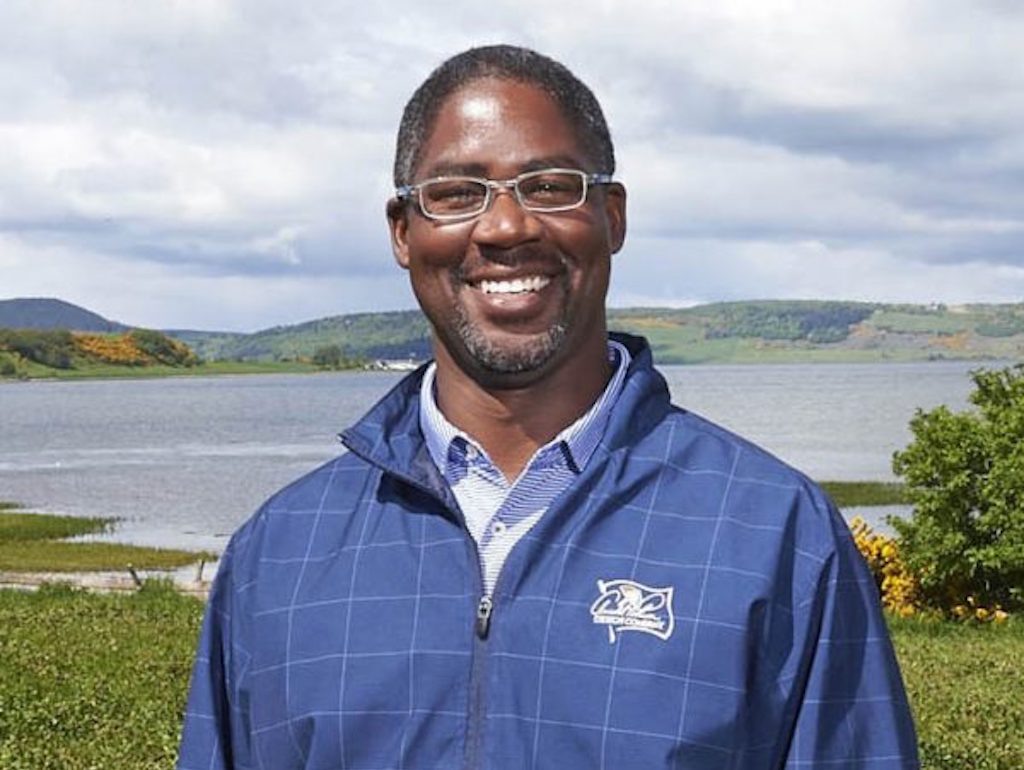
If you’ve followed my GolfWRX career arc, you know that I’m a fan of golf course architecture. I’ve had the opportunity to interview Bill Coore and Tom Doak, discuss course strategy with Scott Witter, Chris Wilczynski, Keith Rhebb and others. Each one is a unique talent, and has left a decided and positive mark on the game of golf on planet Earth. However, this is the first opportunity that I have had to interview a one-of-a-kind golf course architect. I won’t say any more about why he is one of a kind; you’ll soon figure it out. Brandon Johnson currently works in the employ of the Arnold Palmer Design Company. Without any delay, enjoy nine questions with Mr. Johnson.

Castle Stuart new course architects Brandon Johnson (Glasses) and Thad Leyton.
1. Tell us a bit about yourself, and how golf came to be a part of your life.
BJ: I’m the son of an electrical engineer and school teacher, little brother to my sister, a devoted husband, a father of two wonderful kids, a special needs cat and someone who loves all kinds of good cuisine.
Music has always been a central part of my life. My dad played several instruments plus joined The Spiritual Renaissance Choir later in his life, my mom played the piano and has a beautiful voice, and my sister played the cello. My first desire was to play the saxophone like my Dad but when the saxophone section was full by registration time I decided to follow in my sister’s footsteps and play the cello.
The cello was my primary instrument as I played in organized orchestras from grade school through graduate studies and received a minor in music at NCSU along the way. My parents arranged piano lessons for several years, enjoyed the instrument and wish to this day I had continued. One reason had to be my fascination with the drums. During my 9th-10th grade years I began playing the drums and joined two local neighborhood garage bands. Fun times!! As an adult I’ve enjoyed my struggle to learn how to play the acoustic guitar.
Playing and competing in sports has always been a hobby. Before golf started to consume all my attention playing organized soccer, baseball, or pickup basketball with friends in the neighborhood kept me active.
Golf became my main focus when I was 12. One summer day my friend invited me to play. We went to the now extinct Sharon Golf Club, paid our three dollar greens fee and dribbled the ball on the hard pan fairways all day. My fascination, intrigue and love for the game grew instantly and I proceeded to fill my summers, weekends and time after school at the golf course.
2. At what point in your life did you determine that golf course architecture was more than an interest?
BJ: Shortly after taking up the game, I developed a strong interest in seeing and learning about different courses. Playing and trying to get better was still the primary focus, and would be for several more years, but the seed had been planted. Like a lot of kids who played, my childhood dream was to become a PGA Tour professional. I missed that and being a rock star drummer by a mile!
Sketching and drawing was a hobby growing up and I owe that introduction and inspiration to my older sister who is the true artistic talent in the family. My sketch subjects were objects and themes I found interesting. Soon those drawings of still life scenes, cars, pretend inventions and cartoon figures, turned into golf holes from the coffee table book “Golf Courses of the PGA Tour” that my parents gave me for Christmas. New golf hole ideas and routings soon followed.
By high school I began to contemplate college options, potential career paths and interesting majors to pursue. Right or wrong, I was counseled to take technical drafting instead of continuing art classes. While not the ideal foundation for an aspiring golf course architect, it confirmed my suspicion that engineering and building architecture was going to be too rigid for me. Drafting class wasn’t a total loss as it was helpful in learning how to draw and read technical plans but more importantly to visualize, in this case objects, in 3D.
My interest in art, nature, architecture and love of golf led me to blindly pursue a degree in Landscape Architecture as a way to become a golf course architect.
In retrospect, I was fortunate to even get into the NC State School of Design. NC State was the only Undergraduate program that incorporated an interview and portfolio of artwork as part of the admissions process. Little did I know, it was a competitive program and they were searching for artistic talent. I cobbled together my sketches from 7th and 8th-grade art class along with one of my sketch routing plans to round out my portfolio of technical drafting drawings. The jury must have seen my love for golf and the excitement in my face when explaining the details of my conceptual routing plan.
Attending NC State would prove to be a wonderful experience and career-defining decision.
3. As you moved toward a career in GCA and design, which architects inspired you?
BJ: In golf course architecture my initial inspiration was sparked from two very different eras, Pete Dye, and later Mike Stranz, being the ultimate modern architects, and Donald Ross coming from golf architectures early defining era.
Seeing the work of Pete Dye on PGA Tour telecasts, mainly TPC Sawgrass and Harbour Town growing up, sparked my interest in golf course design. I used to record the telecasts and replay the pros’ swings in slow motion, or pause certain positions, as a way to learn the golf swing and improve my game. When TPC Sawgrass or Harbour Town was on, I found myself looking at the architecture in the background of those still or slow motion images. What was so striking on the screen was radically different from the courses I had access to. I became hooked, even obsessed with the game, and the architecture that was influencing the shots required to play it. That spark of interest grew and led me to pursue golf course architecture as a career.
I came to know and appreciate the work of Donald Ross through one of his lessor known courses. He is credited with the front nine at Fort Mill Golf Club. (George Cobb designed the back nine) My friends and I first played Fort Mill during a practice round for a junior event named after my first golf pro Walter Renyolds. It was a fun and solid front nine with an efficient route over gentle terrain. Learning to tackle those slick, crowned, and tilted greens under tournament pressure was a daunting task! We used to play there several times during the summers and also venture out to Lancaster and Chester also credited to Ross.
The work of Mike Stranz has been a huge source of inspiration too. His work stands in a category of its own with how dramatic, fanciful, artistic and daring it is. The visual presentation of his bold sweeping forms, contours and horizon lines, in my opinion, are some of the most memorable “created” holes in golf. His work is more than just optics as they are a blast to play and full of contour, variety and strategic interest.
I first saw Tobacco Road the day after playing Pinehurst #2 for the first time. (Years before the Coore & Crenshaw restoration) The two experiences couldn’t have been more different. I’ve seen several more Stranz original works and look forward to seeing all of them one day soon.
Inspiration can and should be drawn from all kinds of sources. The study of nature and landforms helps to inspire the creation of contours and features that best emulate it. As a student studying Landscape Architecture I was drawn to historic landscapes, gardens and urban city centers. Invaluable design insight and inspiration was gained from personal experiences at all the major English, French, Italian and Spanish landscapes. Even golf architecture’s current natural, links or rugged design vs the manicured or parkland experience can be traced back to identical debates early practitioners had concerning the ideal or preferred English landscape or garden.
Non-golf and non-landscape architecture inspiration helps expand the mind too. The building architect Anton Gaudi is one of my favorites, artists like the Impressionists, Salvador Dali, M.C. Escher, and music from the Baroque Era to the present, in my opinion, are all excellent sources of material to study that sheds light on how other artists use a process, creatively solve problems, and break away from confining historic norms and traditions to push their craft forward and develop new interpretations of their art form.
There is a plethora of interesting golf architecture in the world, old and historic to new and modern. It is important to look back, study and draw inspiration from historic architecture to discover and learn about the architects and courses of the “Golden Age” but that should not be a binding principle. Exploring modern and contemporary golf architecture is equally as important, maybe even more important if golf is to find and develop new horizons.
It is essential to keep looking forward as the game continues to evolve. The “Golden Age” architects defined the architecture of their time, Pete Dye ushered in a new era appropriate for his time and our generation should continue to look forward to discover the appropriate architecture for tomorrow. At some level, it will always be inspired by or in reaction to its history but the players and technology of today are different from the players and technology from 100 years ago. Golf architecture needs to creatively bridge the two eras to progress and I look forward to the fun challenge of developing my unique interpretation.
4. Your first stop was as design coordinator for The First Tee. What did that position include and what projects resulted?
BJ: After completing two internships at the PGA Tour Design Services office and one as a member of the construction crew at TPC Deere Run the position at The First Tee became available. Even though the industry was buzzing no one seemed to be hiring. I knocked on a ton of architect’s doors, made phone calls and sent numerous resumes but never got an answer. This was my only viable professional option to get into golf architecture at the time.
The First Tee was still an unproven and undefined concept when I started but it had the full weight of the industry behind it. My initial role was to serve as a clearinghouse and primary point of contact for TFT Regional Directors, their emerging chapters and the golf industry. It was a wonderful opportunity for me to be housed out of the PGA Tour Design Services office, learn from their staff and process yet be somewhat independent on TFT projects. I traveled the entire country consulting with our chapters and the local officials they were partnering with, evaluating all kinds of potential sites, creating and evaluating budgets, project schedules and anything else associated with setting up projects. It evolved into a mountain of concept and construction plan production for all these different sites I was visiting. The effort and timeline required to getting a project from its inception to completion is arduous and long. Unfortunately, several really wonderful opportunities were never completed or moved forward after I left.
For 7 years I worked with TFT of Connecticut on multiple sites around Hartford, additional holes at existing courses, short courses, practice facilities, you name it. TFT Connecticut was connected to the PGA Tour event, TPC River Highlands and had plans for a statewide facility. Adjacent to the TPC River Highlands was an old quarry pit and field used for parking. We had some thoughtful and interesting plans to use that space for a facility that simultaneously fixed the inadequate practice facility at the club and other tournament set up issues as part of a joint partnership. Just as my time with TFT was ending the project was finally gaining momentum.
Coincidentally, they eventually completed the project with a former Palmer Design Associate that started with The Tour as I was departing. The driving range portion remained from my efforts but the configuration of the practice holes are different.
There is a similar story with TFT Chattanooga. I must have looked at six or seven sites and produced even more conceptual plans, budgets, schedules with them. We had an interesting brownfield site connected with a new community development project that would have included a wildly natural and fun 9-hole course and short game/short course and practice facility. I’ve always dreamt, even hoped, that one day I’d get a call that the project would move forward. It had the potential to be a model for how golf and great golf course architecture could be the catalyst for responsible environmental remediation, development and become a positive focal point for the community.
Milan Moore with PGA Tour Design completed the practice facility portion of the TFT Pueblo project that occupied a large portion of my time at TFT. I’m not sure if they ever completed the nine-hole course designed to accompany it.
There were tons of other interesting projects and odds and ends. A few projects of note did come to fruition. One larger project that I worked on was the Thunderbirds Golf Course, later renamed Vistal in Phoenix, Arizona. We completely redesigned an existing 18-hole course. Sadly, it no longer exists. The renovation of the municipal golf course El Rio Alvarez in Tucson, Arizona was another fun and successful project. Ken Kavanaugh and I worked together on revitalizing that local gem. I did some master planning and consulting for the City Courses in Shreveport, Louisiana and oversaw an extremely low budget greens project at Querbes. The additional master plan work on the other course(s) showed promise but they never materialized past the concept stage.
5. You made the move from TFT to Palmer Design. What compelled that decision?
BJ: Personally it was a very difficult decision to make because I really loved working for The First Tee, working with and learning from some of the most knowledgeable, passionate, and kind-hearted individuals I know who dedicated their lives to making golf a more accessible game.
We had a special group back then and I’m proud to have contributed to the cause. The bonus was developing so many wonderful friendships along the way, friendships that will last a lifetime.
The First Tee was growing rapidly and evolving in those early years. What was once a facility-based effort was now changing as the Life Skills programming was becoming the focus and backbone of the organization. Professionally, I had a once in a lifetime opportunity. One, to work for and directly with Arnold Palmer, a man I respected and admired and two, to grow as a designer/architect while also contributing to the company and its forward evolution by sharing my own thoughts, ideas and experiences. There are not too many opportunities in this industry so, when Thad Layton informed me the company was moving to Orlando from Ponte Vedra Beach, FL and there might be an opening, I knew I needed to investigate the opening door.
Oddly enough a lot of the tradition-breaking proposals and designs we are seeing today that receive so much praise and attention, short courses, alternate route configurations, non 9 or 18 configurations, duel use spaces between practice holes/short game areas/driving ranges, putting courses and proper forward tee options, were all ideas and concepts TFT and its chapters were advocating for in its facility-based models. We received some resistance to these ideas. Some didn’t think it was “real golf”, others could not find a way to make the operations and economics work. I’m glad to see the public and industry embrace them more today. We have some fun and exciting plans in the hopper that would add to the conversation when the projects more forward.
6. How long have you been with Palmer design, and to which projects have you contributed most?
BJ: I started in August of 2006 so it will be 14 years in just under a month. Below is a selected short list of projects:
-NCSU – Lonnie Poole Golf Course (my Alma mater…Go Pack!)
-Pure Scene – Kunming China
-Bay Hill Renovation (It was a team effort but Thad and I took the lead)
-Wexford Renovation
-Spring Island – Old Tabby Links Renovation
-PGA National – Palmer Course Renovation (2007 and 2018)
-Lakewood National (Commander and Piper Courses)
7. Which have been your favorite holes, or parts of holes, that hold your signature?
BJ: I’m glad you didn’t restrict me to just one favorite course, hole or feature! It’s nearly an impossible task to distill the canon of interesting architecture and features down to “one” favorite.
It is even challenging to compile a complete list of favorites as something you, or others, find worthy of inclusion will invariably be left out.
I recently wrote an article for the July 2020 issue of Golf Architecture Magazine about a select few of my “Favorite Features” that I’ve studied and experienced over the years. One or two of them might not be typical or obvious while others should have wide consensus.
Having a “signature” might not be accurate but there are strategic principles that form and guide my thinking and thoughts or ideas I enjoy discovering on properties or incorporating into holes. Below is a short sample:
-“Meaningful Width”
– Greens and green sites that use angle, contour and a variety of pin locations that influence tee shot and approach shot decision making
-Contending with obscured or blind approach shots. Especially when they are the consequence of avoiding challenging the ideal line due to a well-placed hazard or feature.
– Contours the feed, collect and shed the ball
Favorite Holes
#8 Wexford – It is one of the shorter Par 5 holes at Wexford. The majority of players should be able to get close to the green in two and those with slightly above average length should experience a high rate of success going for the green in two, especially when the course is playing firm and fast.

I’ve always been drawn to this hole for its simplicity and how subtle and nuanced the strategic requests are yet how important it is to recognize those clues, plan, and position shots accordingly or deal with the potentially disastrous ramifications of being out of position.
The foundation of my changes during the 2011 renovation were simple. Nudge the green slightly to the right, eliminate the large, flat fairway bunkers that only gobbled errant shots, and convert that space to fairway. These simple moves now incorporated an existing stand of tall pine trees found just beyond the landing area on the right and injected layers of strategy the previous version lacked.
A small singular bunker signifies the ideal line down the left side of the fairway. This opens up the best view and angle to challenge the three center line cross bunkers for your lay up or attempt to reach the green in two. Tee shots that drift too far right risk being partially blocked out by the trees or having to negotiate over hanging limbs to get back into position.
The small square shaped green, with an elevated front left pin nestled against a front left bunker is gently pitched going away from the player. A medium depth swale fronts the right portion of the green. A counter intuitive leave long will avoid tricky recovery situations and allow the player to use contour to their advantage. The same contour that defends the aggressive play in two or the deft pitch after a lay-up.
#12 Pure Scene
Working in China was fun, interesting, challenging and one of the most enlightening experiences in my professional career. There is a long back story to completing the course and this hole, one that I won’t expand upon here. After a frantic call from our client explaining how new government regulations would drastically change our routing during the middle of construction and that we needed to be on site in two days, we found this hole.

A short to mid length Par 3 with the beautiful Lake Dianchi in the background. I like how the back left pin location just dangles on the cliff edge.
#15 Pure Scene
Another hole with a long back story resulting from a different set of circumstances that forced us to depart from our original routing.

This short drivable par 4 has a massive and inviting fairway with a green at the final destination that ranks as one of the smallest I’ve ever built. (#9 at Wexford is another contender) The narrow sliver of green sits on the edge of the hill/cliff side with an infinity view to the country side beyond. The prevailing wind will play a factor here assisting tee shots down the right side for the better angle while also bringing the far cliff edge into play. Contours allow tee shots to drift farther off line long and/or left resulting in short, down prevailing wind pitches to a very narrow and shallow green. Long left approach and recovery shots to a back pin must navigate confounding contours. Bold and smart plays will lead to success here.
#11 Old Tabby Links
We altered this hole the most during our 2012 renovation of Spring Island – Old Tabby Links.

This hole provides the membership with variety and choice. We kept the left and right tee options but made sure they looked and played different. We retained the original yardages on the left tee complex and shortened/converted play from the right tee angle into a drivable Par 4. Width, centerline bunkers, obscured views from select angles, and pin locations that bring different contours or features into play depending on the angle of approach make this hole interesting and fun to play.
Favorite Features or parts of a hole
#4 NCSU – Lonnie Poole Golf Course – We found and utilized the natural ground contour as the main strategic feature of the hole. One can ride the ridge, past the left cross bunker onto the green with a well-placed shot or have that same ridge shed balls further left behind the bunker or right into a swale leaving a tricky angled pitch.
#5 NCSU – Lonnie Poole Golf Course – The combination of utilizing the bold, natural rolling terrain, protruding right tree line and extended fairway cut to the far right and left extremes creates, in my opinion, a fun tee shot where local knowledge is key. (The original fairway line extended farther right then the one they mow currently) One can be lulled to sleep here thinking there is gracious space at the landing area but favoring the left half with a well-positioned ball, or blowing it over and/or past the tree line if you’re long enough, are the best plays.
#5 Lakewood National-Commander Course (Back Right Pin and Green surround) – The main defending feature of the green and complex is the back right, thimble sized, dome with a devilish pin location on top. No bunkers guard this green, just the long pond down the left side of a fairway that is plenty generous for one to confidently avoid a watery disaster. A ridge tumbles down beyond a diagonal cross bunker on the right, approximately 85 yards out, providing a safe and effective way to avoid the lake while still accessing the green and front pin locations. The fun, challenge and decision making begins when that feeding ridge is over played and balls funnel down behind this back dome.

During the Korn Ferry Suncoast LECOM Classic a Feb 16, 2019 tweet on my account and Thad Layton’s, my design partner, shows the dilemma of being on the wrong side of this contour. What the video does not show is 1) His playing partner, who was in the exact same spot, successfully nestle his recovery next to the hole for a birdie. 2) The mental deliberation both players went through to try and figure out the best play.
Position is key as I’ve utilized this dome contour from a different angle to escape being out of position on the lake bank and feed a ball down to the back left pin next to the water.
8. Describe for us the perfect place to build a golf course.
BJ: First, I know some stunning sites in the U.S. and in different locations around the globe that we believe would be perfect or “ideal” ground for golf. They just need the right partners, organization and/or investments. As an architect always in search of ideal projects to devote all our time towards and channel our passion and creativity into, I’d be missing an opportunity if I didn’t float those opportunities into the universe!
The first instinctive thought, and where the majority of golf architecture might fall back on, are origins in wind swept, sandy dunescapes with wispy fescue and marram grasses blanketing rumpled and wrinkled terrain that’s been perfectly sculpted over decades by nature’s masterful touch. It is hard to find fault with this setting.
Adding a raucous ocean battering a shoreline of both rocky cliff edge and sandy dunes to anchor the site and serve a dual role as the ultimate hazard and sublime vista only makes it better.
Ideally, the accompanying landscape palette would be native yet unique. A palette so full and rich with variety that evolves across the site. The routing would take you on an exploratory journey of the sites highlight reel, incredible views overlooking the most majestic, distant and unspoiled landscapes, intimate and cozy outdoor rooms whose features almost engulf you and then burst into another stunning landscape.
There are other factors to consider though. Climate – my preference would be a location with majority days of sunshine, warm, but not too hot. Certainly not muggy or humid. Mild to cool mornings that warm up to comfortable temperatures where shorts or lose long pants are comfortable. (68F – 78F) Perhaps a bit of breeze that, depending on the season or global weather patterns, doesn’t produce a predictable prevailing wind.
Taking your question a little further into a dream scenario, a place where the summer solstice was the norm and not a one-day a year occurrence would be perfect! This would allow for the maximum number of rounds to be played. Players could structure days to take advantage of the daylight, play nine before the work day starts and nine or 18 in that wonderful glow of evening light.
The added bonus of no flies, mosquitos, no-see-ums or other tiny biting insects that cause distress would really make it perfect! Do you know such a place?
One of the reasons I believe golf is the ultimate game and chess match is that our field of play is constantly changing. Chess is a wonderful cerebral game filled with an infinite number of combinations and strategies, but the board and pieces remain the same. The natural ground upon which we play and compete in golf embodies so much variety and character. Ever changing weather conditions play a pivotal role in every golf round thus making the physical, mental and strategic requests that much more complex. Exceptional golf architecture, and how it interprets the varied ground upon which it rests, is a beautiful process and one that creates several versions of the “perfect” location. Inspired architecture on stunning foothill terrain with wildflower fields and snow-capped mountain backdrops on glacier formed contours (with cool water running over smooth pebbles in a creek bed) can be every bit has beautiful and captivating as architecture on a course intertwined in the rugged desert landscape or the traditional ideal seaside links course with massive dunes, marram grass and fescue waving in the breeze.
As an architect I love being inspired by the site and the challenge of finding and unlocking golf holes on that precious land and interpreting how ideal golf could be played over it in new fresh forms.


9. What question have we not asked, that you wish we had? Ask it and answer it, please.
BJ: A few years ago, Digital Links Magazine asked, “As an African-American, have you ever experienced any difficulties working in the golf industry?” An appropriate question three years ago and perhaps even more timely in today’s social and cultural climate. While I appreciated the question, and that someone generally cared about my experience, I also struggled with the question. It was a short answer interview format, this was the first time any writer or journalist asked me such a question, so I wrestled to answer this question that needed a more robust and contextualized conversation surrounding it.
I won’t expand upon that original answer here, nor ask another question, but I will use it has reference and context for a broader statement because the greater, more contextualized conversation goes far beyond my personal experiences.
“There were many pioneers in golf’s history who blazed trails, broke down cruel access barriers and endured tremendous hardships to play and enjoy the game they loved as equals to everyone in society. Golf owes them a huge debt of gratitude. Everyone has to overcome obstacles and blockades in life, I’ve had my fair share, but because of those heroic efforts my personal experience and exposure to the game was much different than theirs. I’m fortunate to have had so many generous people help, support, encourage and guide me from day one to the present. Any success I’ve experienced can be attributed to their helping hands.
While our society has evolved we must still recognize that we are not perfect and this wonderful game of golf that we love and are so passionate about, can and should, be more inclusive and representative of the world’s rich and diverse cultural, ethnic, racial and gender makeup.
I hope to help make this a reality.”
As you reached out to me to participate in this interview our nation, and eventually the greater international community, was engulfed in the raw, emotional reaction to the brutal and unnecessary death of George Floyd. The country was just beginning to tear off the final scabs of racial injustice and inequity wounds that have festered below the surface and plagued our countries history for too many generations.
This event sparked an unprecedented national conversation and collective grappling with our countries historical and current understanding of how race, racism and racial inequity continues to influence and shape every sector of our society. A modern realization that the racial, ethnic, cultural, religious and socio-economic divide still exists and is wider than most believed, experienced or cared to realize until now. This is a hard truth and reality to resolve but one we must all face in order to move forward, together, and forge a new history that will be unburdened by its past.
The game of golf is beautiful. The game of golf is elegant. The game of golf is a connector. Wonderful friendships and experiences that cross racial, ethnic and cultural lines are formed and nurtured through participation in the game. There is nothing wrong with the game of golf. Unfortunately, the history of golf and its governance, is as equally entangled with the racial inequity and injustices of its time as the rest of our nation.
Yes, golf and its governing bodies have eliminated the nonsensical segregation rules and clauses that once wrongfully guided our pure game. That was an obvious and easy first step but not one that crumbled the foundation behind those practices or eliminated the impacts that years of inequitable treatment caused. Unfortunately, the continued government, management, operation and economics that structure our great game continue to be tainted by its history of racial, ethnic, religious and gender exclusion practices whose remnants still remain embedded within despite recent efforts to change.
Golf needs to fully reconcile its history of racial exclusion and reluctance to evolve in a multi-cultural society. Only then can we fully understand how the residue of past laws, practices and social, cultural and economic biases continue to stifle meaningful forward progress. When this occurs golf will be freed to move forward and thrive like never before.
I encourage the greater golf community, public golf and private member participants, elite players to the long handicap, and industry leaders to the wider golf market to help transform this game we all claim to love so dearly, into a welcoming, inclusive, vibrant game that is rich with the diversity and talent of our world. A game and structuring industry that supports golf and leads society to be a better version of itself.
Is this too much to ask of a game? A sport? NO. Not a sport as beautiful as golf. Not a sport whose participants extol the virtues of sportsmanship, integrity, honesty and personal enforcement of competitive rules. It is not too much to ask of a sport that raises BILLIONS of charitable dollars for communities and causes around the globe. It is time for the collective golf community to demonstrate how, through sport and the life long bonds created from it, will play a vital role in eradicating systemic racism and lead change towards a peaceful, diverse and inclusive society.


Opinion & Analysis
Brandel Chamblee PGA Championship Q&A: Rose’s huge McLaren risk, distracted LIV pros and why Aronimink suits the bombers


PGA Championship week is here, and Brandel Chamblee did not hold back in our latest discussion ahead of the season’s second major.
In our 2026 PGA Championship Q&A, golf’s leading analyst made the case that PIF pulling LIV’s funding has left its players competing in a state of confusion, called Justin Rose’s mid-season equipment switch a huge risk at 45, and explained why Aronimink will be a bombers’ delight this week.
Check out the full Q&A below.
Gianni: With the PIF confirming that they’re pulling funding from LIV at the end of the season, what impact do you expect that to have on the LIV players competing at the PGA Championship?
Brandel: I would imagine that they have all been thrown into a state of confusion, and will be distracted, not knowing where they are going to play next year and not knowing exactly their road back to either the DP World Tour or the PGA Tour. Or in Rahm’s case, being tied to a sinking ship for the next few years, likely playing for pennies on the dollar in events that no one cares about or watches.
I doubt this would put him in the best frame of mind to compete at his highest level. Keeping in mind, however, that majors are the only time that LIV disciples get to play in events that matter, so never disregard the motivation they have to prove to the world they are still relevant.
Gianni: Justin Rose switched to McLaren Golf equipment mid-season while playing some of the best golf of his career. What do you make of the change?
Brandel: I don’t really know what to make of Rose switching equipment. It seems a huge risk on his part, even though it is likely, in my opinion, that the clubs he’s playing are similar, if not the exact grinds, to what he was playing previously, with a McLaren stamp on them.
Having said that, at best, it is a distraction when he seemed to be as dialed in with his game as any 45-year-old could be and trending in the majors to perhaps do something that would definitely put him in the Hall of Fame. At worst, given the possibility that these clubs aren’t just duplicates of his old set stamped with McLaren on them, he’s made an equipment change that would take time, and 45-year-old athletes don’t have the time to do such things.
Gianni: Aronimink has only hosted a handful of professional events since it hosted the 1962 PGA Championship. What kind of test does it present, and does a course with less recent major championship history tend to level the playing field?
Brandel: Even though Aronimink has only hosted a handful of meaningful professional events, it has been fairly discerning in who can win there. When Keegan Bradley won the BMW Championship on the Donald Ross masterpiece in 2018, he was the 2nd best iron player on tour coming into that week. When Nick Watney won the AT&T at Aronimink in 2011, he was 2nd in strokes gained total coming into the week.
In 2020, Aronimink hosted the KPMG Championship, and Sei Young Kim won. On the LPGA that year, she was first in greens in regulation, putts per green in regulation, and scoring average on the way to being the LPGA player of the year. And then there is the 1962 PGA Championship won by Gary Player, who eventually became just one of a few players to win the career grand slam on the way to winning 9 majors. It is a formidable test, and if it’s not softened by rain, it will bring out the best in the upper echelons of the game.
Gianni: Is there a specific hole at Aronimink that you think will do the most to decide the winner?
Brandel: The hardest hole at Aronimink in each of the three tour events that have been played there since 2010 has been the long par-3 8th hole, with the par-4 10th being the second hardest, so most of the carnage will happen around the turn, but with the par-5 16th offering opportunities for bold plays and the tough closing holes at 17 and 18, the finish is likely to be frenetic.
Gianni: The PGA Championship has always sat in the shadow of the other majors. What does the ideal PGA Championship look like in your eyes, and what would it take for it to carve out its own identity?
Brandel: The PGA Championship, to whatever degree it suffers from the comparison to the other three majors, is still counted just as much when adding them up at the end of one’s career. Almost 1/3 of Nicklaus’ major wins were the five PGA Championships he won. Walter Hagen won 11 majors, five of which were PGA Championships.
Tiger Woods twice in his career won back-to-back PGA Championships, and those four majors count just as much as the other 11 he won. The PGA may not have the prestige of the other three, but it carries the same weight. Having said that, I preferred the identity that it had as the last major of the year.
Gianni: You nailed your Masters picks. Rory won, Scottie finished solo second, and Morikawa surged to a tie for seventh. Who are your top 3 picks for the PGA Championship and why?
Brandel: I am not a huge fan of majors played on golf courses that have been shorn of most of the trees, although I understand some of the agronomic reasons for doing so and of course the ease with which it allows members to play after errant drives. However, at the highest level, it all but eliminates any strategy off the tee and turns professional golf into an even bigger slugfest. That means that it will likely be a bomber’s delight this week, but fortunately, Scottie Scheffler is long enough to play that game and straight enough to play it better than anyone else.
The major championships give us very few surprises anymore, going back to the beginning of 2012, so the last 57 majors played, the average world rank of the winners has been better than 15th in the world. So look at the highest ranked and longest drivers who are on form coming into the PGA Championship who also have great short games as the surrounds at Aronimink are very challenging. That’s Scottie Scheffler by a mile and then McIlroy and Cameron Young with a far bigger nod towards DeChambeau than I gave him at the Masters.


In this episode of the Club Junkie Podcast, we dive into one of the most interesting flatstick releases of the year with a full review of the new TaylorMade SYSTM 2 putters. After spending time on the greens, I break down what makes this design stand out, where it performs, and why it has me completely torn between loving it and fighting it. If you are into feel, alignment, and consistency, this is one you will want to hear about.
We also take a look at some of the putters in play on the PGA Tour last week. From familiar favorites to a few surprising setups, there is always something to learn from what the best players in the world are rolling with under pressure.
To wrap things up, I walk through the process of building a set of JP Golf Prime irons paired with Baddazz Gold Series shafts. From component selection to performance goals, this is a deep dive into what goes into creating a unique custom set and why this combo has been so intriguing.


This year my 50th birthday. Gosh, where has the time gone?
As a teenager in rural Missouri, some of my junior high and high school years felt interminable. Graduation seemed light years away. But the older I get, the faster life seems to fly by.
I’m also increasingly aware of my mortality. My dad died recently. Earlier this year, a friend and fellow PGA of America professional and I were texting about our next catch-up. The next message I received was news of his unexpected passing at 48. Shortly after, a woman I dated in college succumbed to cancer at 51.
Certainly, one can share perspective at any age. Seniors help freshmen, veterans guide rookies. But reaching this milestone feels like as good a time as any to do one of those “what would I tell my younger self?” articles.
I’ve had a uniquely varied career in golf. I started as a 27-year-old, average-length-hitting, 14-handicap computer engineer and somehow managed to turn pro before running out of money, constantly bootstrapping my way forward. I’ve won qualifiers and set venue records in the World Long Drive Championships, finished fifth at the Speedgolf World Championships, coached all skill levels as a PGA of America professional, built industry-leading swing speed training programs for Swing Man Golf, helped advance the single-length iron market with Sterling Irons®, caddied on the PGA TOUR and PGA TOUR Champions, and played about 300 courses across 32 countries.
It’s been a ride, and I’ve gone both deep and wide.
So while I can consult and advise from a lot of angles, let me keep it to a few things I’d tell the average golfer who wants to improve.
1. Think About What You Want
Everyone has their own reason for picking up a golf club.
Oddly, as a professional athlete, I’m not internally driven by competition. That can be challenging, as the industry currently prioritizes and incentivizes competition over the love of the game.
For me, I love walking and being outdoors. Nature helps balance my energy. I prefer courses that are integrated into the natural beauty of their surroundings. I’m comfortable practicing alone. I’m a deep thinker, and I genuinely enjoy investigating the game, using data and intuition to unearth unique, often innovative insights. I’m fortunate to be strong and athletic, so I appreciate the chance to engage with my abilities. Traveling feels adventurous. I could go on.
You don’t have to overthink it like I do. For you, it might be as simple as hitting balls to escape work, hanging out with friends, and playing loosely with the rules and the score.
The point is to give yourself permission to play for your own reasons, and let that be enough.
But if improvement is your goal, thinking about your destination—and when you want to get there—is important, because it dictates the steps you need to take. When I set out to go from a 14-handicap to the PGA TOUR as quickly as possible, the steps I needed were very different from those of a working golfer trying to break 90 in six months. That’s also different from someone who just wants a few peaceful hours outside each week, away from work or family.
None of these goals are better than the others, but each requires a different plan that you can work backward from.
2. There Are Lots of Things That Can Work
One of the challenges of golf is that, although there are rules for playing, there aren’t clear, industry-wide standards for how to best play the game. There’s a lot of gray area.
You might hear a top coach or trainer insist that a certain move is the best way to swing or train. Then you dig a bit deeper and, much to your confusion and frustration, another respected coach or trainer says something completely different. I don’t think anyone is trying to confuse you—at least I hope not. It’s just where the industry is right now.
You have to be careful with advice from tournament pros, too. They might be great at scoring, but they’re also human and sometimes just as susceptible as amateurs to believing things that don’t really move the needle. Tour players might describe what they feel, but that’s not always what they’re actually doing when assessed with technology.
I recently ran a test on my YouTube channel (which connects to my GolfWRX article “How to use your hands in the golf swing for power and accuracy”), and, interestingly, two of the most commonly taught hand actions produced the worst results in the test.
Coaches can certainly help. If you find someone you connect with to help navigate, that’s great. But there are many ways to get the ball in the hole. In the current landscape, you may need to seek multiple opinions, think critically, and use your own intuition to discern what seems true and whose advice resonates with you.
I’d recommend seeking someone who is open-minded and always learning, because things constantly change. Absolutes like “correct” or “proper” should raise a red flag. AI can be useful, but it tends to confidently repeat popular advice, so proceed with caution.
3. Get Custom Fit
If you’re serious about becoming a better player, getting custom fit is hugely important. There’s no sense fighting your equipment if you don’t have to. Most better players get fit these days and, if they don’t, they’re usually skilled enough to work around clubs that aren’t ideal.
If you plan to play for a long time, it’s worth spending a little more upfront to get something that truly fits you and your game, rather than continually buying and discarding equipment.
Equipment rules haven’t really changed significantly since the early 2000s. To stay in business, manufacturers keep pushing those limits. If you pull a bunch of clubs and balls off the rack and test them, you’ll find differences. I’ve tested two new drivers and seen a 30-yard total distance gap. Usually, the issue isn’t bad equipment; it’s that the combination of components simply isn’t the best fit.
It’s like wearing a new pair of floppy clown shoes. Sure, they’re shoes—but you won’t sprint your best in them compared to track shoes that fit perfectly.
Be wary of what’s called custom fitting, too. Sometimes the term is used as a marketing strategy rather than an actual fitting. In some retail settings, fitters may be incentivized to steer you toward higher-priced components. That doesn’t automatically mean it’s not the best fit, but you should be aware of potential biases.
I learned a version of this lesson outside of golf. Years ago, I bought a tennis racquet at a big box store from a seemingly knowledgeable employee who thought it would suit me best. The racquet gave me tennis elbow, and I spent months recovering with rest and acupuncture. The next season, I invested more time and money to find what actually fit me, and I walked away with something amazing that I still play with years later.
So if you’re going to get fit, be smart about it.
Find someone you believe has deep knowledge—possibly with certifications, but not necessarily. Make sure there’s a wide inventory across many brands. Check recent reviews for the individual fitter if possible. Make sure you trust that the fitter has your best interests at heart. If they’re wearing a hat or shirt with a specific brand’s logo, proceed with caution. Unless you specifically want a certain brand or look, be wary of upsells, especially if two options perform nearly the same.
Also, while golf is called a sport of integrity, there’s a thread of manipulation in the industry. I once drafted an equipment article for an industry magazine, structured just like one of their previous popular stories, with matching word count and great photos. The assistant editor loved it; it was useful to readers and required little work on his part. But the editor-in-chief nixed the story. When I asked why, I was told it was because I wasn’t an advertiser. It turned out the article I’d modeled mine after was a paid ad cleverly disguised as editorial content.
I really dislike games, clickbait, and fear-based manipulation. I hope this changes, but golfers deserve to know it exists.
4. Distance and Strategy Matter
There’s a real relationship between how far you hit the ball and your scoring average, even at the PGA TOUR level.
I experienced this early in my pro career. I started as a power hitter, swinging in the high 120s and breaking 200 mph ball speed with a stock driver.
Back then, some instructors advised swinging at 80%, so I tried slowing down for more accuracy. That worked fine on shorter, tighter courses. But on longer setups, I was coming into greens with too much club, and par 5s stopped being

RBC Heritage Tour Report: More minis, course-specific setups, Spider & GTS launches

Justin Rose WITB 2026 (April): Full WITB breakdown with new McLaren irons

Best fairway woods of 2026: The most versatile fairway woods + the most forgiving fairway woods

Gary Woodland’s winning WITB: 2026 Texas Children’s Houston Open

What’s the story behind Webb Simpson’s custom-stamped irons?

Cadillac Championship Tour Report: Spieth’s sizable changes, McLaren Golf launches, and more

The 24 players who can win the Masters

Rory McIlroy’s winning WITB: 2026 Masters

Kristoffer Reitan’s winning WITB: 2026 Truist Championship

J.J. Spaun’s winning WITB: 2026 Valero Texas Open


Alex Fitzpatrick WITB 2026 (May)
Driver: Ping G440 LST (9 degrees) Shaft: Fujikura Ventus Black 6 X 3-wood: TaylorMade Qi4D (15 degrees) Shaft: Fujikura Ventus...

Kristoffer Reitan’s winning WITB: 2026 Truist Championship
Driver: Ping G440 Max (9 degrees) Shaft: Mitsubishi Tensei 1K White 60 TX 3-wood: Ping G440 Max (15 degrees) Shaft:...


WITB Time Machine: Rory McIlroy’s winning WITB, 2021 Truist Championship
Rory McIlroy’s victory at the 2021 Wells Fargo Championship 2021 (now the Truist Championship) marked a significant return to form,...


Collin Morikawa WITB 2026 (May)
Driver: TaylorMade Qi4D LS (8 degrees) Shaft: Mitsubishi Diamana D+ Limited 60 TX 3-wood: TaylorMade SIM Tour (14 degrees) Shaft:...
-
 Equipment2 weeks ago
Justin Rose WITB 2026 (April): Full WITB breakdown with new McLaren irons
-
 Equipment1 week ago
What’s the story behind Webb Simpson’s custom-stamped irons?
-
 Equipment2 weeks ago
Cadillac Championship Tour Report: Spieth’s sizable changes, McLaren Golf launches, and more
-
Whats in the Bag3 days ago
Kristoffer Reitan’s winning WITB: 2026 Truist Championship
-

 Whats in the Bag1 week ago
Cameron Young’s winning WITB: 2026 Cadillac Championship
-

 Whats in the Bag3 weeks ago
Nelly Korda WITB 2026 (April)
-

 Equipment2 weeks ago
Justin Rose on the switch to McLaren Golf, learnings from previous equipment moves
-

 Tour Photo Galleries2 weeks ago
Photos from the 2026 Cadillac Championship


CP
Jul 19, 2020 at 3:07 pm
Great interview! Johnson answers are so thoughtful and genuine. It would be nice to see pictures of each of the holes he talks about so we could see the features he mentions.