
Equipment
The Fujikura Fit-On Academy Experience

 The Fujikura Fit-On Academy gives the everyday golfer a fitting experience that is fit for a pro. Using proprietary software, Fujikura compiles measurements of every club and all aspects of a swing in order to recommend the perfect shaft. The Academy is headed by Pat McCoy, a PGA of America member with years of experience fitting tour pros. McCoy and his staff find the “unique, one-of-a-kind thumbprint for a swing” that every golfer has.
Depending on the fitting package chosen, your experience can include a tour of the R&D Facility. During this time, you may hear something like when we visited McCoy and his intern Marshall Thompson:
“We at Fujikura needed a place where we could quickly test shafts and evaluate product quickly and easily for all of our customers and tour professionals. We test inside with Trackman and have an additional facility where we can test performance outdoors. Ultimately we also wanted to be able to bring in the consumer to see how we fit tour professionals and give them the experience and information to improve their game. We have many different heads to try out, nearly every one on the market and just about every golf ball so that we can fit any golfer. The common denominator with all of that is, of course, the shaft. We can fit for so many different swings with so many different shafts and wanted to show the customer that differences in shaft, loft, lie, weight, etc. can make a difference in their game. For example, one manufacturer with several head models enables us to offer 987 different fitting combinations.
We have a proprietary software program that we are able to put in all of a player’s information and have access to it everywhere we travel. In addition, the software is able to help other fitters with finding a player’s ideal fit since there are so many possible combinations.”
 Part of the experience of the Fujikura Fit-On Academy is a complete measurement of your current bag. At this point, the loft, lie, etc. are carefully measured and recorded. A golfer will learn whether there is the right amount of loft between irons, both numerically and with graphical representation among other things (like lie and face angle).
McCoy went on to explain the engineering processes and machinery in a tour of the facility, which included a sneak peek at some soon-to-be released technology and a bit of the Facility’s history:
“The EI Machine is a new prototype that Fujikura will be selling to the industry in the future. This can measure the EI or flex curvature of a shaft in less than 2 minutes and can even measure an assembled golf club. Basically the shaft is measured by how well it retains it’s flex throughout when it is deflected. The machine bends the shaft and measures the entire length via laser and records the outside diameter and inside diameter while it is being flexed. It is a unique technology to the industry due to the speed and the fact that it can measure an entire club. In the past it would take over 10 minutes to measure a shaft and you could never measure an entire club.
We also have a fatigue machine that OEMs have purchased from us. What we do with this is bend the shaft while it is turning. This finds out where the shaft might fail. The machine goes up and down the shaft while it spins in tension. We run a computer program with this that tells us where the shaft failed and how long it took to fail. For example, the program will apply a certain amount of pressure for a specific time period, say two days, and tell us when that shaft failed. This machine will be a Fujikura-branded machine that will be manufactured and sold in the future.
When I first started eight years ago, Fujikura had a manufacturing facility with a staff of about 400 employees here in Vista, CA. Because of rising costs, we shut our facility down. In order to still support the major golf club manufacturers with top quality designs, we opened the Fujikura R&D facility. This facility has the same machinery and production capability of our factories overseas but at a much smaller scale. This has enabled Fujikura to design rapid prototype shafts and then easily transition these designs to our overseas facilities for mass production. The Fit-On Academy was created to use this prototyping capability to test and help design new and improved shafts designs for all level of players."
The Making of A Shaft
McCoy takes us through the making of a shaft: “What makes our shafts as good as they are is the material that we have in the  shafts. One material is the TRIAX which is in our Speeder, the go-to shaft. Triax enables the shaft to return to its straight shape more quickly than conventional graphite shafts. It almost acts like a spring or a whip through the hitting area for increased clubhead speed. We have several other materials that are patented that only Fujikura uses in the golf shaft industry. Depending upon whether we are putting together the Speeder, Rombax, or next generation shaft s, all our shafts use the highest technology materials in the shaft industry.” During this time one sees the different sheets of the materials that will eventually become the shaft. The components are cut into the constituent parts and carefully layered. McCoy explains that there can be from about 5 plies of material up to 15 depending on the weight and flex of the shaft. The overall goal is always to make the shaft as round, or circular, as possible. The engineers at the facility have taken out all matter of chance in making the shafts as all specs are pre-determined. This means that it is known how each shaft will turn out (tip and butt flex, EI, weight, torque) before it is even made. There are machines that cut all of the materials and rolling presses in order to keep the integrity of the measurements, leaving nothing to chance. This makes reproducible, predictable results of a high quality. The process includes checkpoints that assure the quality of the shafts before they are cured. After shafts are cured they are meticulously examined for any flaws. The flex is checked digitally after the process is complete. There are machines that check the flex of the shafts with weights that some of the OEMs use to also check the specs in a more old-fashioned method. There is no “standard” for the shaft industry – most manufacturers have their own set of measurements that they consider to be ideal. In addition, measurements are not always taken from the same part of the shaft, further differentiating specs between different manufacturers.
The Fitting
Fujikura did not want to be in the dark about any club and wanted to be the source for knowing everything about a club. The first thing that happens with all of the products used in the fittings is meticulous measurements. When you see the drawers full of heads and other club pieces, each has a sticker that tells exactly what its measurements are (loft, lie, bulge, roll, etc.). They know everything about a club before putting it into a golfer’s hands. Everyone knows that a club that says 8.5 is not always an 8.5, after all. This is the case for the heads as well as the shafts (length, weight, etc.). In fact, Fujikura teaches other fitters to have different lengths, kickpoints, and other metrics in order to have more options to do a proper fitting. Indeed, the Fit-On Academy is quite thorough.
Trackman, the software, the screen…it’s all there…your measurements are meticulously recorded. Your clubs, your swing, everything. You don’t realize just how thorough your fitting was until about a week later. There you are, still euphoric over the entire experience when you check your mail. In your mailbox is a large manila envelope from Pat McCoy and his staff. You open it to find a folder with measurements of your club (or entire bag, depending on which fitting you opt for). The club, head, shaft, grip, loft, lie, and length are all recorded in a table. Next, if you have your entire bag measured will be graphs of length, loft, lie, swing weight, and weight. This is to show any gaps in your current system. Finally, a recommendation page with specs for what you have been fitted for. In addition, for each club that you are fitted for will be shot-by-shot Trackman details with averages, a graph of dispersion, and a trajectory graph are included. You’ll find these for both your club and the recommended club. Finally, a DVD (if included in your fitting package) shows your swing and includes lines for you to see your swing plane. When you come back down to Earth, you’ll realize that you have extremely valuable information that can only serve to improve your game. Now, you must act on it.
A Word From The President
Newly-minted President of Fujikura, Dave Schnider, has been with the company for nine years and at his current post since April 2008. Prior to his tenure with the company he was with Grafalloy, True Temper, and a college golfer at San Diego State University. We found out from Schnider that the Fit-On Academy is a big part of Fujikura’s plan here in the States. The company has done fittings in Japan for nearly ten years and they have more recently made this available to the US market. The company has learned so much about fitting from Japan and tour pro fittings that they now offer the everyday golfer this exceptional experience to improve their game. Being tied in to the R&D facility also gives them the ability stay in touch with all golfers’ needs. Fitting remains a top priority for the company.
The new shaft line – the ATL, or Academy Tour Limited – will soon be available. This line is designed for the PGA Tour and better players out there. In fact, the shafts will first be seen on Tour in late November/early December. Even so, the company is interested in being accessible to all golfers. The Fit-On Academy is to give the rest of us that Tour fitting experience that used to only be available to the pros. “The Tour player gets such a benefit from being properly fit. We wanted to bring this to more golfers”, says Schneider. The future of shafts at Fujikura will expand to fit mid-handicap and more players. Essentially, the E Series will already suit a large majority of golfers.
And By The Way
Everyone we met at the facility is an exceptional golfer in their own right. McCoy claims that he’s “not that great at only about a 4 or 5 handicap”, intern Thompson is a scratch golfer, and Schneider is a +2.
See For Yourself
With several options for a fitting – from one club to your whole bag – prices start at only $75. Check the Fujikura website here for all of the package details.


Driver: TaylorMade M6 (9 degrees)
Shaft: Aldilda Synergy Blue 70 TX


3-wood: TaylorMade Qi10 (15 degrees)
Shaft: Fujikura Ventus Blue 8 X

5-wood: TaylorMade Qi10 (18 degrees)
Shaft: Fujikura Ventus Blue 8 X

Hybrid: Titleist GT2 (24 degrees, D1 SureFit setting)
Shaft: Mitsubishi Tensei CK Pro White Hybrid 90 TX

Irons: TaylorMade P7TW (5-9)
Shafts: True Temper Dynamic Gold S300

Wedges: Titleist Vokey Design SM9 (46-10F @44, 48-10F @49), SM11 (54-12D), WedgeWorks (60-04L)
Shafts: True Temper Dynamic Gold Tour Issue S300

Putter: TaylorMade Spider Tour V


Grips: Golf Pride Tour Velvet
Ball: Titleist Pro V1

Driver: TaylorMade Qi4D (9 degrees)
Shaft: Fujikura Ventus Black VeloCore+ 5 X


3-wood: TaylorMade Qi4D (15 degrees @14.25)
Shaft: Mitsubishi Tensei CK Orange 70 TX

5-wood: TaylorMade Qi4D (18 degrees @17.25)
Shaft: Mitsubishi Tensei CK Orange 70 TX

Irons: TaylorMade P-UDI (4), TaylorMade Tour Preferred MC (5-9)
Shafts: Graphite Design Tour AD DI Hybrid 85 X (4), Project X 6.5 (5-9)


Wedges: TaylorMade MG5 (46-SB09, 52-SB09, 56-LB08), MG4 (60-TW11)
Shafts: True Temper Dynamic Gold Tour Issue S400

Putter: Odyssey White Hot 2-Ball


Grips: Golf Pride MCC
See more photos of Michael Block’s clubs in the forums.
More Michael Block WITBs
Equipment
PGA Championship Tour Report: Fitzpatrick, Koepka among big-name putter switches for Aronimink


A lot has been said leading up to the 108th PGA Championship about how Aronimink Golf Club will handle the modern game’s philosophy of bomb and gouge. Tipped out, the Donald Ross design is just shy of 7,400 yards. In comparison, Quail Hollow played at nearly 7,600 yards last year. Off the tee shouldn’t be an issue for most players in the field. What will stress their games are the putting surfaces.
“The greens seem to be the big defence and the big talking point of the golf course,” two-time PGA champion Rory McIlroy said ahead of the tournament.
“Yeah, it reminds me, we played Philly Cricket Club last year for a PGA Tour event. It reminds me a little of that, very wide playing corridors. Still got to get the ball on the fairway. The rough is sort of hit-and-miss, but you can get some bad lies. They can really tuck the pins away with some of these slopes on the greens and just really being aware of that.”
The theme of McIlroy’s comments could be why plenty of players were testing out new flatsticks throughout the early week in Newtown Square, Pennsylvania, just outside of Philadelphia. Some were forced, however, and keep reading for Brooks Koepka’s new putter and why he’s added it to the bag.
On the surface, one of the more surprising putter changes for the undulating surfaces at Aronimink is that of Alex Fitzpatrick. The newly minted PGA Tour member, who earned his card by winning alongside his brother Matt at the Zurich Classic of New Orleans, is teeing it up for just his second major championship and his first at the PGA. Despite collecting back-to-back top-10 paychecks in his two starts since that victory, the younger Fitzpatrick is trading in his short-slant Odyssey Ai-One #7S for a newer version, but equipped this time with plumber’s neck hosel.

“It’s more of a hosel configuration change that we could hopefully identify some face awareness and rotation benefits,” Cody Hale, Odyssey Tour Rep, told GolfWRX. “So what we looked at was, could we help reduce the rotation, tighten some of that up a little bit, and after measuring that and then his team came out to the putting green, measured again, we saw some positive changes.”
By switching the hosel type and going with less toe hang on the putter, Fitzpatrick was able to become a “little bit tighter and a little bit more efficient” with the stroke, according to Hale.

Along with the hosel change, Fitzpatrick has moved from the standard metal finish to a darker, navy-blue PVD finish, although the switch-up is merely aesthetic and not to help with alignment or framing the putter behind the ball.
Ryan Fox, Haotong Li and Sahith Theegala also join Fitzpatrick with putter swaps in Philadelphia. Fox added an Odyssey Tri-Hot double-wide, while Li opted for a center-shafted GoLo, and Theegala has returned to his Ping TR 1966 Anser 2 prototype after gaming a Ping Ally Blue H at Quail Hollow last week.
Cameron Young using conforming rollback ball
Cameron Young revealed in his pre-tournament press conference at Aronimink that up until a few weeks ago, he didn’t know that his golf ball would meet the criteria of the new rollback rules.
The Titleist Pro V1x Double Dot that Young switched to last summer, with which he ended up winning during the first week he had it out on Tour, meets the proposed standards by the USGA and The R&A.
“I think I put it in play [for] the same reason that everybody else plays the ball that they play,” Young said. “I hit it during a ball test, one of the Titleist facilities probably close to two years ago and didn’t know anything about it. I just kind of (said), ‘Hey, what’s that one?’ because I liked the flight.
“Then as things progressed, I was able to test it last year at Wyndham, able to put that in play, and it’s been there since.”
Young’s distance hasn’t been impacted by the switch to the Double Dot golf ball. He’s sixth on Tour in Strokes Gained: Off the Tee and, in fact, is hitting it 0.4 yards longer on average this year compared to last.
“Obviously, there is no conforming list,” Young said. “I wasn’t aware that it would have (conformed). I suppose I read something that said it passed that test, but I wasn’t aware of that until very recently. So, at no point was that a consideration. It was just really me trying to optimize my golf, and it’s the ball that seems to work the best for me.”
Young has won twice already during 2026 on Tour, both at high-level events – The Players Championship and Cadillac Championship – and entered the PGA Championship as a pre-tournament favorite behind Scottie Scheffler and Rory McIlroy.
Read more about Young’s setup and how his bag is centered around one thing– the golf ball.
Brooks Koepka’s enforced putter switch
Three-time PGA Championship winner Brooks Koepka spent plenty of time Monday morning and into the afternoon on the practice putting green in front of the Aronimink clubhouse, working with coaches and Tour reps and putting plenty of different flasticks through their paces, after apparently recently breaking his new TaylorMade Spider Tour X last time out at the Myrtle Beach Classic.
Koepka tested out a couple of Scotty Cameron heads, similar to that of Cameron Young’s Phantom 9.5R with a full sightline. It’s not the first time a Tour pro has asked to follow in Young’s footsteps. Justin Thomas had the same request last week at the Truist Championship. Why not follow the hot hand?
Koepka’s custom Cameron featured the same style Teryllium insert that he has used previously, most notably during his PGA Championship wins in a Newport-style blade. The putter, however, that looks to have the best chance of making its way into the bag come Thursday is a TaylorMade Spider Tour V, the head model recently launched on Tour at the RBC Heritage.

What’s unique about Koepka’s new Tour V putter is the custom-length L-Neck (plumbers) hosel that he has equipped. The extended version looks to reduce the toe-hang of the putter while adding stability to the stroke.

The putter change comes with a plethora of additions to Keopka’s bag after his split with Srixon/Cleveland. Along with already playing a Titleist Pro V1x golf ball, Koepka added Vokey wedges to his Grove XXIII staff bag last week in South Carolina. The 36-year-old is using SM11s in 48.10F, 52.12F and 56.10, along with the WedgeWorks 60B, a special grind with an interesting letter choice.
Look at Koepka’s full bag here.
Rickie Fowler goes shorter
In a golf world where players are looking to eke out every yard possible, usually by lengthening their drivers to add clubhead speed, there’s one player at the PGA Championship who’s going in the opposite direction. In fact, for Rickie Fowler, his goal off the tee is not about gaining extra distance or yards north to south, but rather about shrinking the misses from east to west.
Ahead of the PGA Championship and the week prior at the Truist Championship. Fowler mentioned to Cobra Tour Rep Ben Schomin that the driver didn’t quite swing feel the same as everything in the bag. As a result, and with Schomin’s suggestion to try and sync everything up with the big stick, Fowler decided to test out a shorter length shaft.
“He’s been at 45 (inches), and he’d been at 45 for a few weeks, 44 1/8 (inches) is really is where he is been living really for the most part, for the last couple of years, and is where he is been comfortable,” Schomin told GolfWRX. “It just felt like it was a little long and loose on him.”
Interestingly, Fowler ranks 40th in Driving Accuracy this year on the PGA Tour. It’s his most accurate season with the driver since the start of the decade. But sometimes for players, feel is more important than statistics.
“It was really more of a trying to get the swing to feel the fluidness from club to club to club to try to get it to feel the same,” Schomin added. “And so we took it down to 43 and a quarter, and it was a touch of a ball speed loss, just based on that overall club head speed. But honestly, he squared it up probably a little better. The right miss wasn’t nearly as far. So really, overall down-range dispersion tightened up a fair amount, and he felt confident in swinging it.”
The change in length had Fowler’s caddie, Ricky Romano, beaming at how well he had driven during Tuesday’s practice round at Aronimink. So much so, he was asking Schomin not to suggest changes anymore.
Fowler’s shaft-shortening is one of a few driver adjustments he’s made this season. Read more here on Fowler’s driver updates this season.
Odds and Ends
Keith Mitchell, one of the best drivers of the golf ball, switched to the Qi4D LS 10.5-degree driver last during the Cadillac Championship, and it was still in the bag at Aronimink. He’s currently eighth on Tour in Strokes Gained: Off the Tee. Alex Noren switched from a C-grind Opus SP wedge to Callaway’s X grind. The X grind features more bounce than the C and considerably more trailing-edge and heel relief. Max Geryserman looks to be another Callaway staffer switching to the Quantum Triple Diamond TDTD head. The head features a unique face progression and a slight heel-weight bias, a right-to-left ball flight. Aldrich Potgieter scrapped his fairway woods and is looking to use two driving irons. Along with his usual 18-degree PXG Gen 8 X 2-iron, he’s added a 15.5-degree 1-iron version.

RBC Heritage Tour Report: More minis, course-specific setups, Spider & GTS launches

Justin Rose WITB 2026 (April): Full WITB breakdown with new McLaren irons

What’s the story behind Webb Simpson’s custom-stamped irons?

Cadillac Championship Tour Report: Spieth’s sizable changes, McLaren Golf launches, and more

The 24 players who can win the Masters

Rory McIlroy’s winning WITB: 2026 Masters

Kristoffer Reitan’s winning WITB: 2026 Truist Championship

J.J. Spaun’s winning WITB: 2026 Valero Texas Open

Cameron Young’s winning WITB: 2026 Cadillac Championship

The putters of the past 10 Masters champions


Aaron Rai’s winning WITB: 2026 PGA Championship
Driver: TaylorMade M6 (9 degrees) Shaft: Aldilda Synergy Blue 70 TX 3-wood: TaylorMade Qi10 (15 degrees) Shaft: Fujikura Ventus Blue...


Michael Block WITB 2026 (May)
Driver: TaylorMade Qi4D (9 degrees) Shaft: Fujikura Ventus Black VeloCore+ 5 X 3-wood: TaylorMade Qi4D (15 degrees @14.25) Shaft: Mitsubishi...


Bryson DeChambeau WITB 2026 (May)
Driver: Krank Formula Fire Pro (6 degrees) Shaft: Project X Prototype 3-wood: Krank Formula Fire (10 degrees) Shaft: LA Golf BAD...


Alex Fitzpatrick WITB 2026 (May)
Driver: Ping G440 LST (9 degrees) Shaft: Fujikura Ventus Black 6 X 3-wood: TaylorMade Qi4D (15 degrees) Shaft: Fujikura Ventus...
-
 Equipment3 weeks ago
Justin Rose WITB 2026 (April): Full WITB breakdown with new McLaren irons
-
 Equipment2 weeks ago
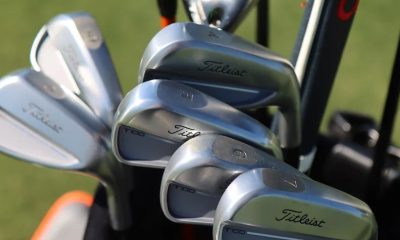
What’s the story behind Webb Simpson’s custom-stamped irons?
-
 Equipment2 weeks ago
Cadillac Championship Tour Report: Spieth’s sizable changes, McLaren Golf launches, and more
-
 Whats in the Bag1 week ago
Kristoffer Reitan’s winning WITB: 2026 Truist Championship
-
 Whats in the Bag2 weeks ago
Cameron Young’s winning WITB: 2026 Cadillac Championship
-

 Equipment3 weeks ago
Justin Rose on the switch to McLaren Golf, learnings from previous equipment moves
-

 Tour Photo Galleries7 days ago
Photos from the 2026 PGA Championship
-

 Tour Photo Galleries3 weeks ago
Photos from the 2026 Cadillac Championship

