
Equipment
TOUR REPORT: Why is this Tour player using two 5-irons at Bay Hill?

Surely you don’t read the weekly Tour Report for my personal stories, but if by chance you do, you’re in luck with my intro this week.
I have what I deem to be a special connection to the Arnold Palmer Invitational, owing to my one meeting with the legendary Arnold Palmer.
As the story goes, I was diagnosed with mononucleosis the day before the 2008 Somerset (New Jersey) County High School Championships. The prize money was small (there was no prize money), but the stakes were large: The winner was to be awarded the winning trophy by the King.
Against doctors orders, I played, and somehow I won. I beat out second-place finisher Alex Edfort for the title, which was especially satisfying because he spent the summer prior beating me in every junior event and side game that we played in.
Approaching the stage to receive the trophy, I was immediately greeted with a quick-witted remark from Arnie, who delivered a hilarious dig the way only he could. I stood 6-feet 2-inches tall as a 140-pound high school senior. Arnie took one glance at me walking up the steps to the stage and said, “You look like a human 1-iron.”
The crowd erupted in laughter, probably because he was right. I did look like a human 1-iron: an old-school blade 1-iron with a thin topline and no offset. I was rail thin, and Arnie came up with the best school-yard nickname I had ever heard within seconds of seeing me.
What a great memory.
This version of the Tour Report is dedicated to Arnold Palmer. I only met him once, but my feeling is that everyone who ever met him has a memorable Arnie story to tell. He was one of the best golfers of all time, but more importantly, he had an infectious attitude and energy that golf fans and people in general cherish to this day. He is greatly missed.
Below, we talk some gear, but let’s keep Arnie at the top of our minds this week. He deserves our respect.
1) Max Homa’s unique toe grinds
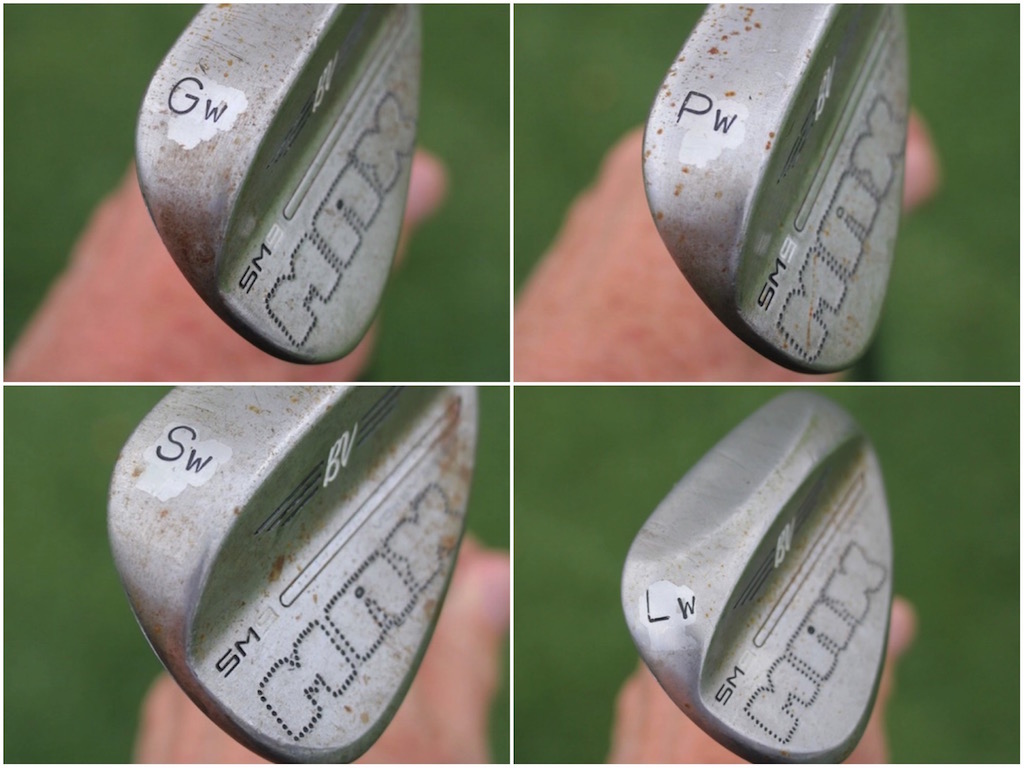
To start off this week’s Tour Report, we enlist Titleist Vokey wedge rep Aaron Dill to explain what exactly is going on with the toe grinds on Max Homa’s Titleist SM9 wedges. There was a bit of speculation going on in our GolfWRX Forums about the build process, so I figured I’d reach out to man who grinded the wedges himself.
As Dill explained to GolfWRX: “We welded out the loft numbers and polished. Then, I stamped in the area with the letters that you see. The numbers were fine, but it was more fun and interesting to have this toe engraving. No additional weight was added and we didn’t weld using any heavier material.”
Homa always does things a little different than the usual, and his wedges are no exception.
2) Rahm’s 4th round putter switch
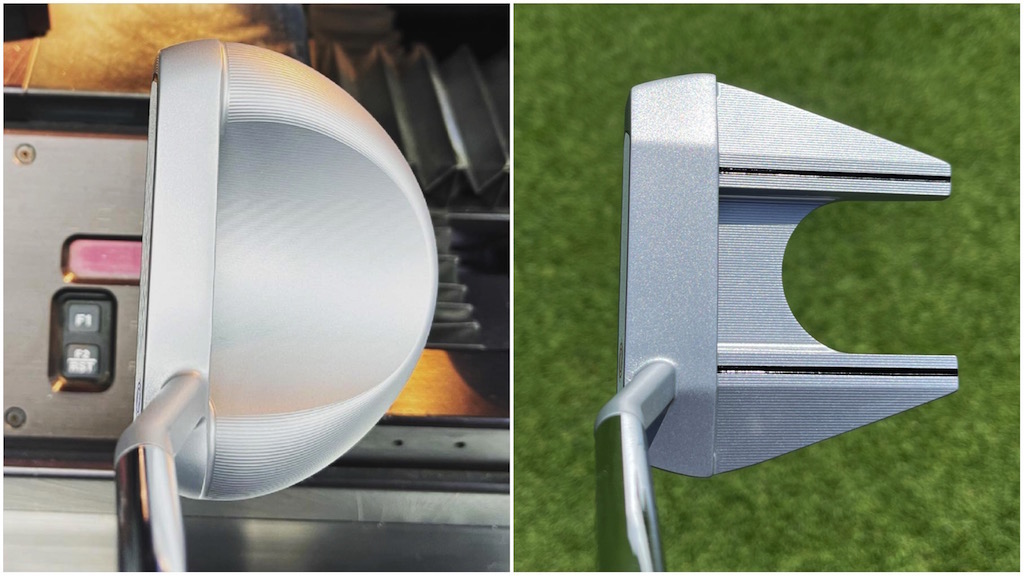
World No.1-ranked Jon Rahm had been using an Odyssey White Hot OG Rossie prototype (pictured on the left) for awhile, and it helped him win the 2021 U.S. Open. Letting go of a winning putter can’t be easy, but Rahm had a stroke issue to fix.
Ahead of the 2022 Genesis Invitational, Rahm worked with Odyssey Tour rep Joe Toulon on finding a different look. The duo settled on the Odyssey White Hot OG #7S with a short slant neck, which helped him keep the putter head closer to the ground and release the head easier through impact.
Rahm switched to the #7S for the final round of the Genesis, shooting a Sunday 65, and he kept the putter in play for the 2022 Arnold Palmer Invitational.
For a deep dive into Rahm’s switch, read the full story here.
3) Scott goes driver-less
Adam Scott hasn’t been driving the ball terribly accurately so far this season; he ranks 183rd in Driving Accuracy on the PGA Tour, hitting just 52.71 percent of fairways.
With driving accuracy being a premium at Bay Hill this year since the rough is up more than usual, Scott decided to leave his driver in his locker for the first round (literally). Scott played the first round of the 2022 Arnold Palmer Invitational without a driver, opting instead for a 13.5-degree TSi2 fairway wood.
Scott explains his decision in-depth over at PGATOUR.com, so check that story out here.
Here’s a brief tidbit from Scott regarding the driver-less first round:
“The basic stats are you hit more fairways with a shorter club than you do a longer club, and a 3-wood you hit more fairways than a driver,” Scott said after his Thursday 68. “I thought it was a premium on hitting fairways here this week. … It’s kind of hard to figure how I’m going to get (the driver) back in the bag for tomorrow. I want to. It’s inspiring to watch Rory (McIlroy) drive it, and I’d like to hit a couple. I’m going to hit a few on the range and see how it feels, but my game plan worked pretty good so far. It’s hard to criticize it.”
4) Annika the GOAT
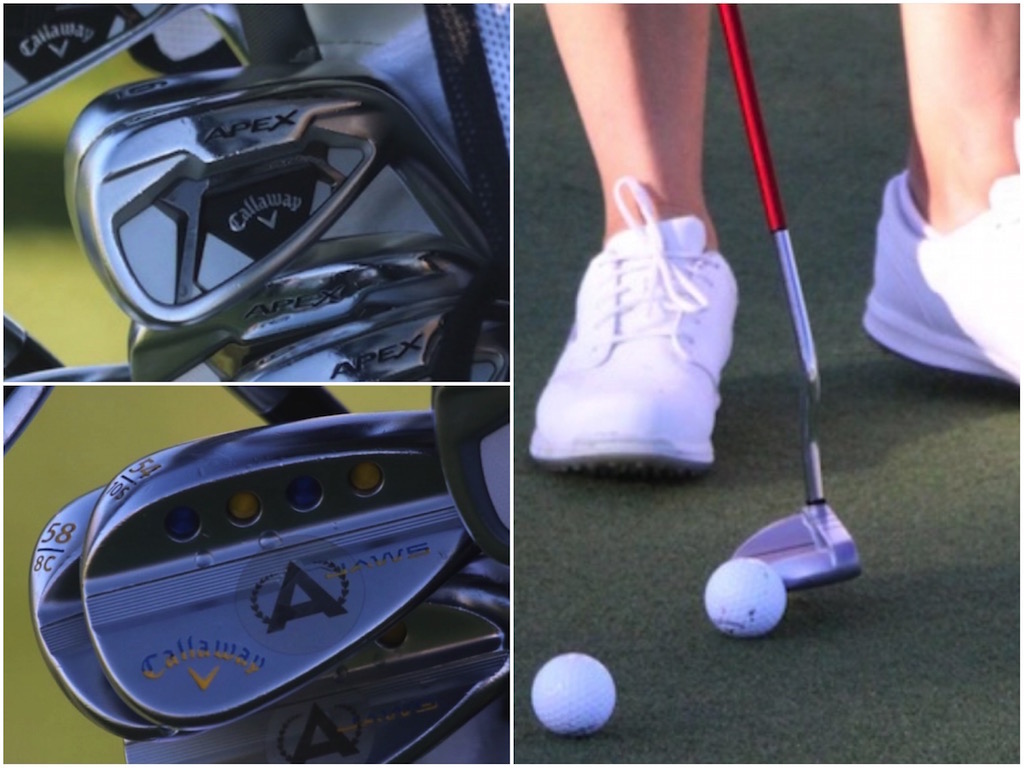
Annika Sorenstam has been a longtime Callaway staffer, and she’s also widely regarded as the greatest women’s golfer to ever tee it up. The 10-time major champion played in the 2022 Arnold Palmer Invitational Pro-Am this week, so were able to get a glimpse at the clubs she has in the bag currently.
The biggest takeaway here is that Sorenstam is using Callaway Apex irons, which are built for more distance and forgiveness than the Callaway irons typically seen in the bags of PGA Tour players. For amateurs, I implore you to answer this question: Should you be using less forgiving irons than the greatest women’s player of all time?
Just food for thought. For more photos of her setup, check out our photos here.
5) Dot’s pretty cool
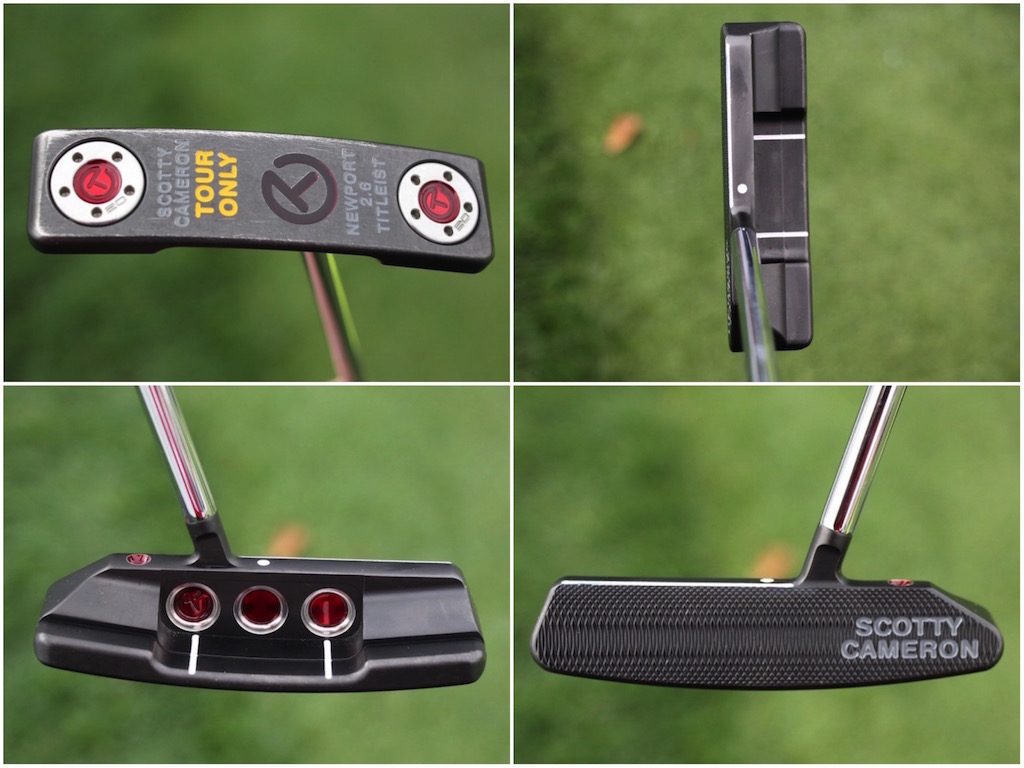
Scott Stallings employs a Scotty Cameron Newport 2.6 Tour Only prototype putter. When you stop looking at how short of a hosel he has on his center-shafted putter, check out the red dot that’s placed below the topline of the putter head below the hosel.
What’s that dot there for? Scotty Cameron Tour rep Drew Page explains: “Scott has a tendency to get too far ahead or behind him with his hands at address. Using a center-shafted putter, [the red dot] helps him return to the same start position every time.”
It’s just a simple dot, but the reminder at address can help immensely with consistency at address. If you want to try this out for yourself, apply a small dot using a Sharpie marker in the same position as Stallings. If you don’t like it, you can always wash it off using some nail polish remover (just be extra careful using nail polish remover on a black finish).
6) Sergio’s settings
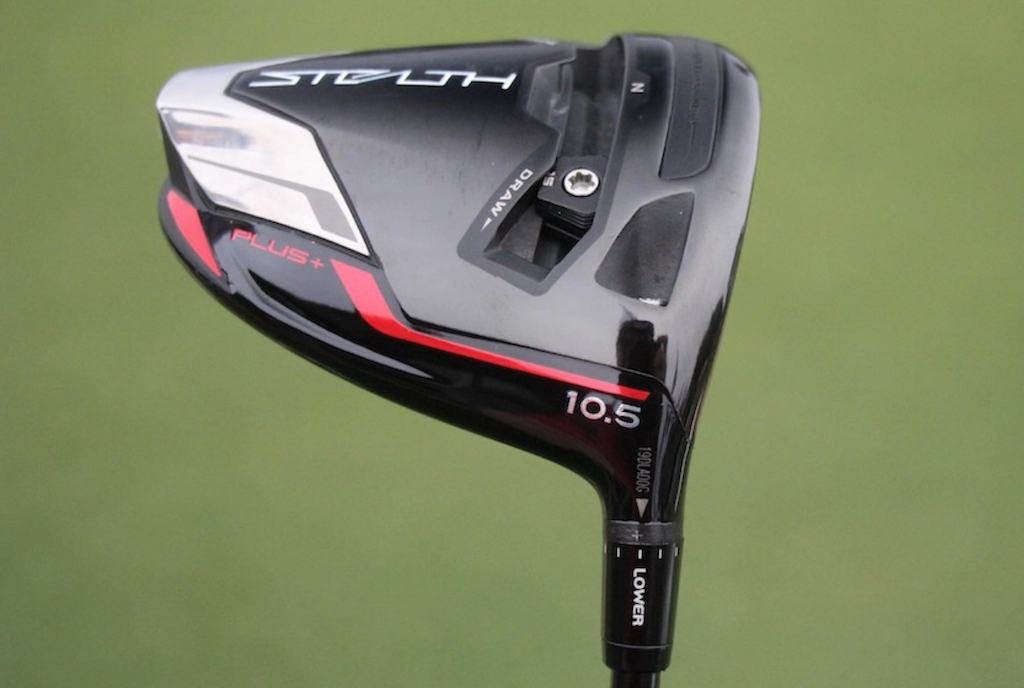
Sergio Garcia has bounced between equipment companies of late, so it’s especially intriguing to see what he has in the bag these days.
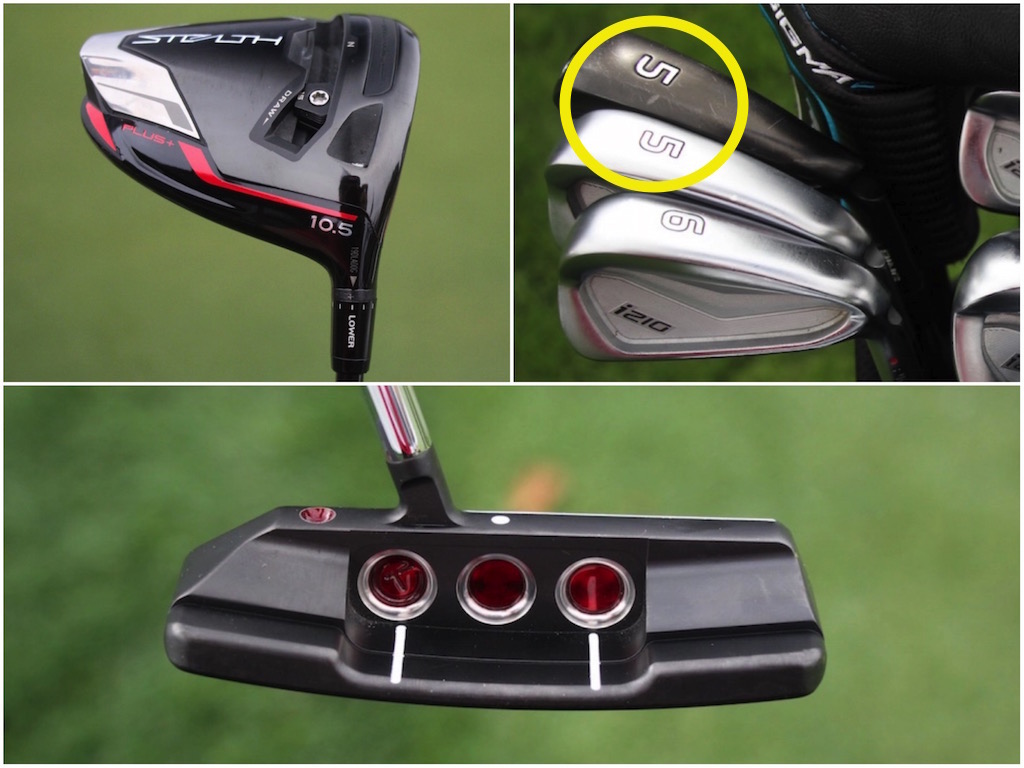
Most interestingly, we got an in-hand look at his driver setup ahead of the 2022 Arnold Palmer Invitational. In 2022, Garcia is opting for a TaylorMade Stealth Plus driver, but he’s taking advantage of both the sole weight adjustability and the hosel adapter.
Garcia plays a 10.5-degree head, but he’s placed the sole weight in the far draw position, and he couples that setup with a hosel that’s cranked down into the “lower” position, meaning he’s reducing loft by 2 degrees. All things considered, Garcia’s driver will play at around 8.5 degrees with a face that’s slightly open, and the bias of the driver will be a draw.
For amateurs, don’t forget to consult with your local fitter or teaching professional to get dialed into the right driver setting for your game. You’d be surprised how much those settings can influence ball flight and overall performance.
View Sergio Garcia’s full 2022 WITB here!
7) Takumi Kanaya has two 5-irons
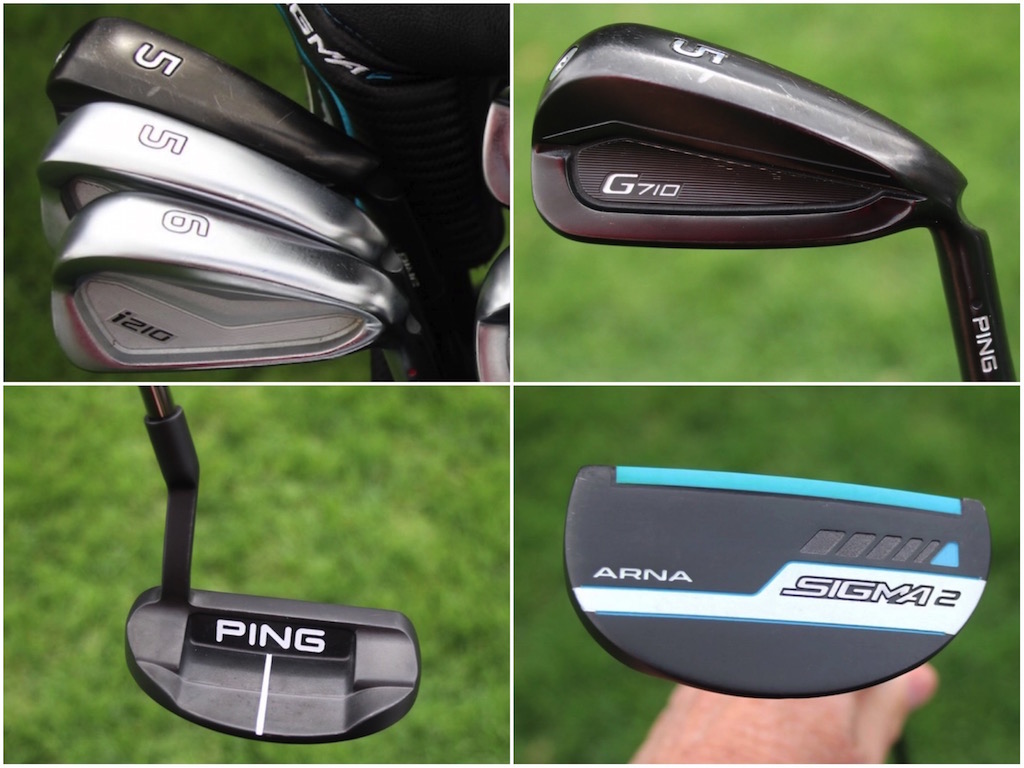
Takumi Kanaya may be a name you’re unfamiliar with, but the 23-year-old Japanese player is currently ranked No. 60 in the Official World Golf Rankings. He’s also in the field this week at the 2022 Arnold Palmer Invitational, so we got an in-hand look at his clubs.
In addition to the photos, I also spoke with Will Yanagisawa, the Collegiate Player Development Manager at Ping who’s worked with Kanaya throughout his amateur and professional days.
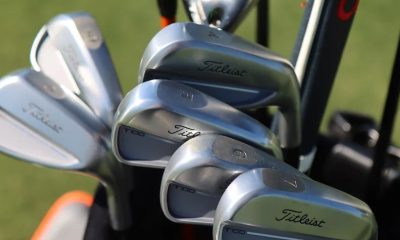
According to Yanagisawa, Kanaya places emphasis on the exact carry yardage that he hits the ball, rather then the number or loft of the club. That being the case, he plays with two 5-irons. One is a Ping G710 iron that’s designed for increased ball speed, height and forgiveness, while the other is a Ping i210 that’s more of a compact player’s iron designed for performance.
He’s also still using a Ping Sigma2 Arna Japan-only putter which he’s had in the bag since his amateur days. Yanagisawa says Kanaya’s short game is his strength, so there’s no reason for him to switch out putters now.
See Takumi Kanaya’s full bag setup here.
8) TaylorMade’s Bay Hill ball
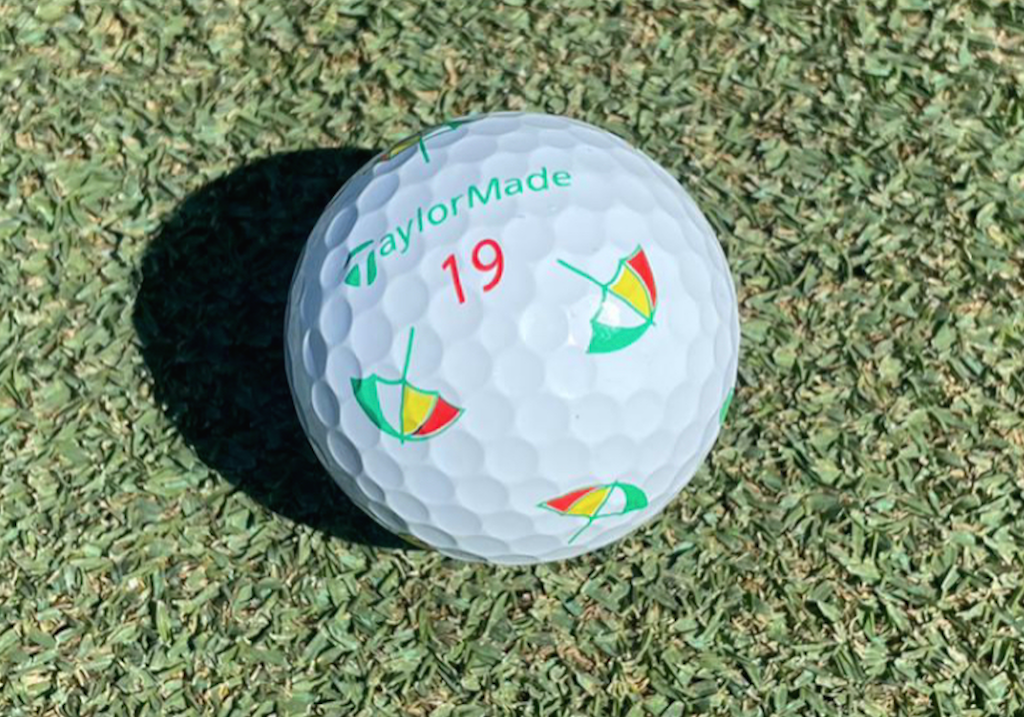
TaylorMade’s Pix golf balls can help with alignment and visibility, but these particular golf balls are special.
Matthew Wolff and Tommy Fleetwood both gamed these custom Arnold Palmer logo’d golf balls during the Wednesday Pro-Am, and word has it that Wolff is using the golf ball during the actual competition this week. In other Wolff news, TaylorMade says that Wolff switched into a Spider GT Black putter with a Single Bend hosel and a short single sight line.
9) A new Rogue shaft on the way?
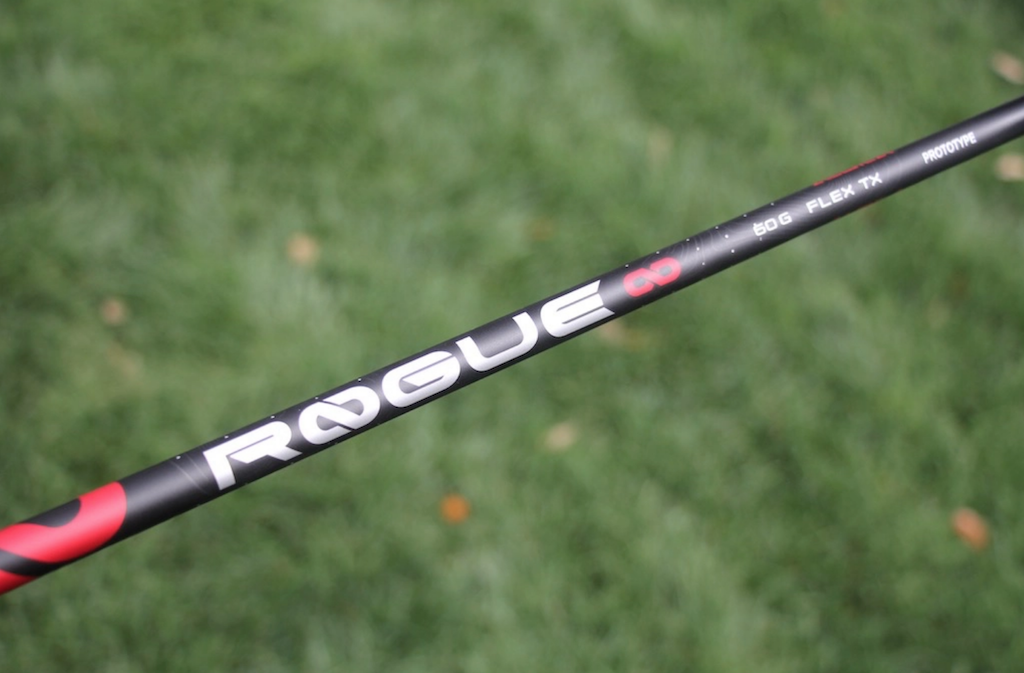
Aldila’s Rogue series has proven to be one of the most popular shafts in golf in recent history, and the shaft series could be getting a new update in the future. When exactly? Well, we can’t be sure, because it seems Aldila isn’t sure itself.
Aldila rep Preston Toulon told GolfWRX what he can say thus far about the new shaft: “It’s a new Rogue part we’re working on with the team in Japan. Nearly none of it is final, just wanted to get some thoughts from some folks out on Tour on cosmetics. Aside from that, I can’t say much about performance or tech because it’s still genuinely TBD.”
As always, we’ll update you with more info when we have it, but until then, join in on the speculation in the GolfWRX forum thread.
10) Paul Casey…disappoints?
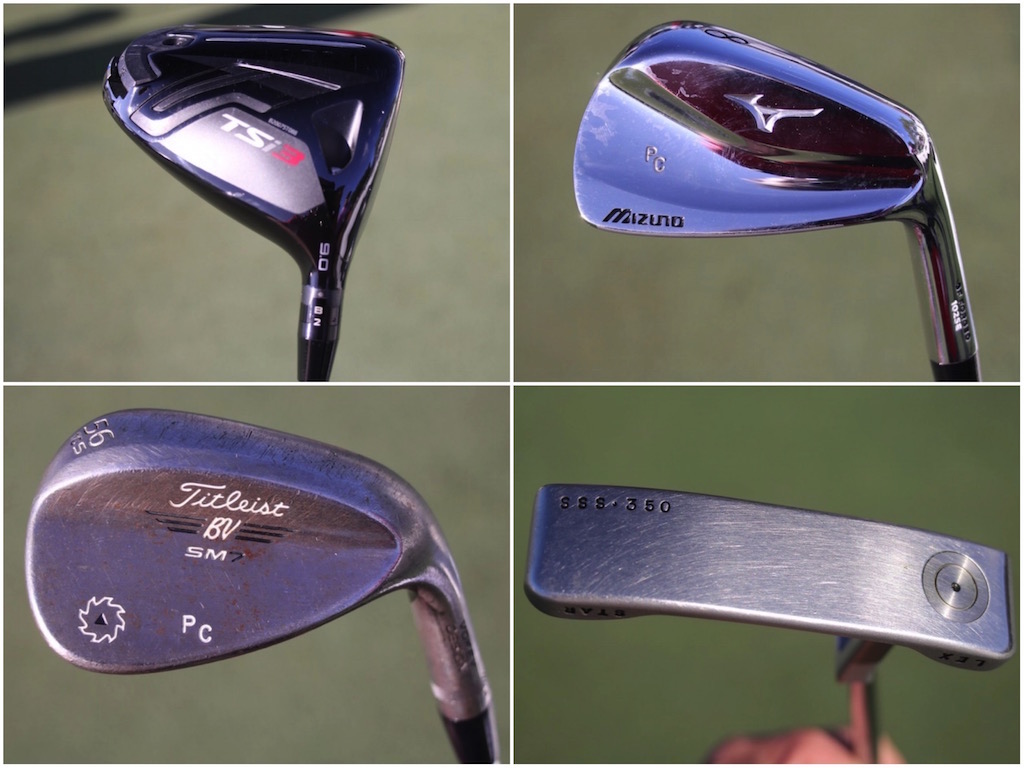
It’s always entertaining, and sometimes informative, to see what golf clubs the equipment free agents on the PGA Tour decide to have in their bag. Being that Paul Casey is one of the top-ranked golfers who remains a free agent, I love to check out his setup to see what new equipment he has.
As it turns out, however, Casey has basically changed nothing since the last time we caught up with him in September 2021. I understand that comfort and performance outweigh changing out clubs for no reason, but c’mon Paul, throw in one new club for us to report!
With Arnold Palmer in our hearts this week, that concludes this version of the weekly Tour Report. We’ll be back next week at The Players Championship for more of the latest gear switches and insight from inside the ropes.
Check out all of our photos from the 2022 Arnold Palmer Invitational here!




In a golf world where players are looking to eke out every yard possible, usually by lengthening their drivers to add clubhead speed, there’s one player at the PGA Championship who’s going in the opposite direction. In fact, for Rickie Fowler, his goal off the tee is not about gaining extra distance or yards north to south, but rather about shrinking the misses from east to west.
Ahead of the PGA Championship and the week prior at the Truist Championship. Fowler mentioned to Cobra Tour Rep Ben Schomin that the driver didn’t quite swing feel the same as everything in the bag. As a result, and with Schomin’s suggestion to try and sync everything up with the big stick, Fowler decided to test out a shorter length shaft.
“He’s been at 45 (inches), and he’d been at 45 for a few weeks, 44 1/8 (inches) is really is where he is been living really for the most part, for the last couple of years, and is where he is been comfortable,” Schomin told GolfWRX. “It just felt like it was a little long and loose on him.”
Interestingly, Fowler ranks 40th in Driving Accuracy this year on the PGA Tour. It’s his most accurate season with the driver since the start of the decade. But sometimes for players, feel is more important than statistics.
“It was really more of a trying to get the swing to feel the fluidness from club to club to club to try to get it to feel the same,” Schomin added. “And so we took it down to 43 and a quarter, and it was a touch of a ball speed loss, just based on that overall club head speed. But honestly, he squared it up probably a little better. The right miss wasn’t nearly as far. So really, overall down-range dispersion tightened up a fair amount, and he felt confident in swinging it.”
The change in length had Fowler’s caddie, Ricky Romano, beaming at how well he had driven during Tuesday’s practice round at Aronimink. So much so, he was asking Schomin not to suggest changes anymore.
Fowler’s shaft-shortening is one of a few driver adjustments he’s made this season, and to Schomin’s credit, it’s thanks to the fact that he and the rest of the Cobra team had Fowler fit very well into three of the four heads in the Cobra OPTM lineup.
“He had three distinct drivers and the biggest decision was trying to decide which worked best at that time,” Schomin told GolfWRX previously. “He’s played the majority of the season with OPTM X, but has also played a couple of tournaments with OPTM LS. His overall driving stats have been good.”
At the RBC Heritage earlier this spring, Fowler switched drivers, changing from his Cobra OPTM X and into the Tour, low-loft Max K model that Gary Woodland used to win just a few weeks prior.
Now for the PGA Championship, Fowler’s back in the X head, but still using the UST Mamiya LIN-Q PowerCore White 6TX shaft, just a little bit shorter.
“Will he stay there? I’m not sure,” Schomin added. “Could we end up say at like 43 and 7.5 (of an inch). If it’s giving him the same feel of consistency through the bag, then I think we might end up just a touch longer. But if he likes where he is at, he’s confident where he is at, that’s really all that matters.”
If there’s more testing, though, just don’t tell his caddie.

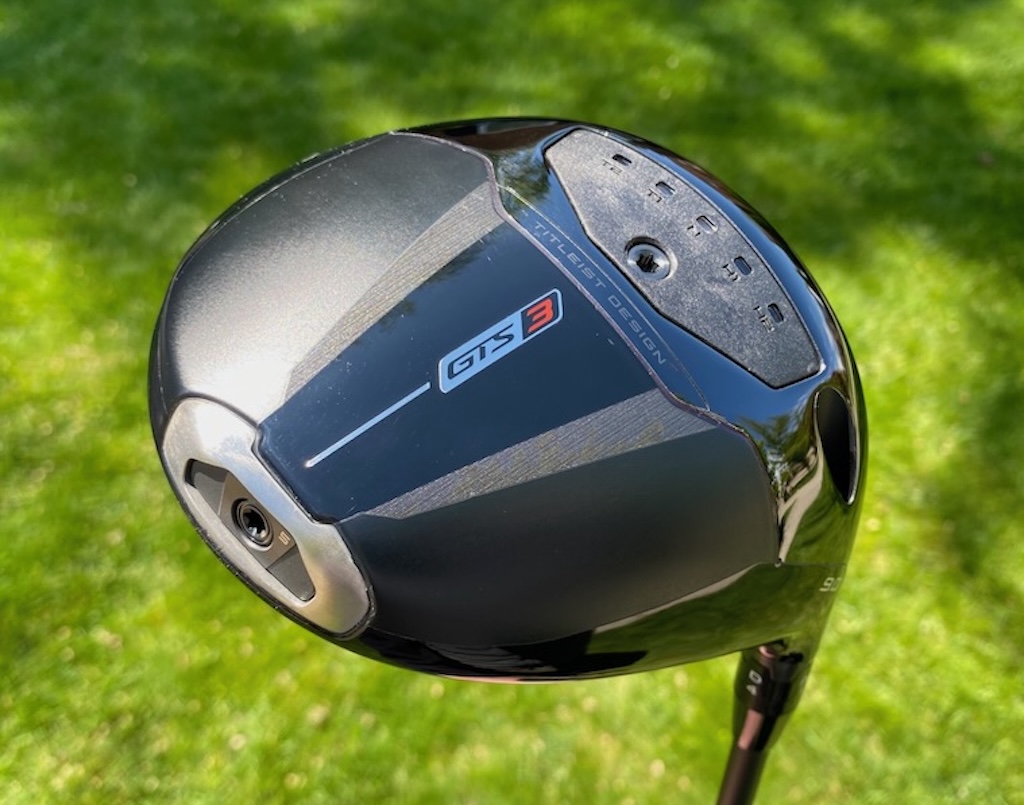
What you need to know: As is customary for the Fairhaven-based company, Titleist officially announced today that its GTS drivers are headed to retail, following a successful tour release. The GTS2, GTS3, and GTS4 drivers will be available in golf shops June 11.
Since debuting at the Texas Children’s Houston Open, the new GTS lineup has quickly gained traction on the PGA Tour, with more than 50 players already making the switch to a GTS2, GTS3, or GTS4 driver. Among them are Justin Thomas and Jordan Spieth.

Justin Thomas’ Titleist GTS2 driver (Greg Moore, GolfWRX)
According to Titleist, the GTS series builds upon the performance foundation established by the GT Series, while introducing several major technological advancements, including a new Split Mass Frame construction, refined aerodynamics, and an updated Speed Sync face design.

2026 Titleist GTS drivers: What’s new, key technology
Split Mass Frame and thermoform body
At the center of the new GTS lineup is a redesigned internal structure: the Split Mass Frame. This technology works with a full-thermoform body made from Titleist’s Proprietary Matrix Polymer (PMP), a lightweight composite that enables engineers to reposition mass more efficiently throughout the head. Compared to the previous GT generation, GTS drivers feature nearly double the PMP material, increasing from 13 grams to 26 grams, while maintaining the sound and feel preferred by better players.
The weight savings from the thermoform construction allowed Titleist engineers to strategically separate mass placement inside the head. Specifically, more weight is pushed rearward to improve stability and forgiveness, while additional mass is positioned low and forward to optimize speed, launch, and spin.
In short, golfers are able to maintain ball speed and consistency across both centered and off-center strikes.

Faster aerodynamics
Titleist also refined the aerodynamic shaping of the GTS heads to help players generate more clubhead speed.
The tails of the new GTS2 and GTS3 heads have been raised compared to previous models, helping airflow stay attached to the crown and sole longer during the swing. According to Titleist, the improved airflow reduces drag and increases speed without affecting launch conditions or center of gravity placement.
Typically, aerodynamic gains can compromise forgiveness or launch characteristics, but the weight savings from the Split Mass Frame allowed engineers to preserve preferred CG locations.

New Speed Sync face
The new Speed Sync Face design is engineered to improve ball speed retention across a larger portion of the face. A reinforced perimeter structure helps maximize face deflection and COR on centered strikes, while the upper portion of the support ring is opened up to increase speed on high-face impacts, a common strike location for many golfers. The face also features a variable thickness design to preserve speed and performance across a wider impact area.
Expanded adjustability
Each GTS model includes a dual-weighting system to fine-tune launch, spin, and shot shape more precisely than previous generations. GTS2 uses interchangeable forward and aft weights, while GTS3 and GTS4 combine a rear weight with an adjustable forward track weight system.
Tour-inspired face graphics
The new lineup features redesigned high-contrast face graphics to improve alignment and framing at address, according to Titleist. Sharp visual lines are designed to make it easier to center the golf ball and to perceive loft more easily at setup.

Additional model details
GTS2

- The GTS2 is the most forgiving model, designed for golfers seeking maximum stability and consistent speed across the face.
- It produces high launch with mid spin and features a larger, confidence-inspiring profile behind the ball.
- Standard weighting includes an 11-gram forward weight and a 5-gram rear weight, with additional fitting configurations available.
GTS3

- The GTS3 is aimed at players who want more control over launch, spin, and shot shaping.
- Compared to GTS2, the GTS3 offers lower launch and spin while featuring a more compact profile and deeper face design preferred by many stronger players.
- The head features an adjustable forward-track weight system to further fine-tune center of gravity placement.
GTS4

- The lowest-spinning option in the lineup, GTS4 is built for golfers looking to reduce excessive spin and maximize total distance.
- Unlike previous “4” models from Titleist, the new GTS4 features a full 460cc profile that improves forgiveness and stability while retaining its low-spin DNA.
- Like GTS3, it includes a forward track weighting system for precise fitting adjustments.

What Titleist says
“When we talk about driver design, it’s never about the one feature or benefit — it’s about all of them,” said Stephanie Luttrell, Titleist’s Senior Director of Metalwood R&D. “Ball speed, forgiveness, spin stability, adjustability, exceptional sound and feel… these are all attributes that golfers care about. It’s our job to design a lineup that elevates performance across the board without sacrificing in key areas, and we feel we’ve done that with GTS.”
“We know that forward CGs drive speed with great launch and spin characteristics, but you need to be able to do that with an inertial stability that still preserves ball speed, launch and spin consistency on off-center hits,” Luttrell said. “We’ve never before been able to hit these CG positions and inertia properties at the same time, and we’re achieving that because of GTS’ construction.”
Club Junkie’s take
I feel like every time there is a new Titleist wood release, I figure they can’t outdo their previous driver. And every year, I am wrong and impressed with the performance. The GTS fits right into that narrative again, as I didn’t know where Titleist could go from GT, but they pushed the limits again, and my fitting proved the smart people there found ways to improve.
My past four Titleist drivers have been a 2 series as my swing typically requires a little height, spin, and forgiveness so I figured I would just get a new GTS2 and be on my way. During the fitting, I was impressed by the new GTS construction, its added PMP material, and the advanced adjustability on each model. My fitter, Joey, got to work putting together a GTS2 and we started there. The launch and spin were great, and the consistency on misses was very tight. My average ball speed with the GTS went up a little bit as the new Speed Sync face creates more speed away from the center.
Joey then built up a GTS3 in 11 degrees, but I figured this wouldn’t have the stability I needed for tight dispersion on my miss hits. That thought was quickly erased after a few shots, and I really liked the more center start line and reduced draw on the misses I was seeing. We tried a few different settings and shafts to dial in the details in order to get the best fit. Having a forward and rear weight in the head allowed Joey to set up the GTS3 with a heavier rear weight to keep the launch and spin up, while the Sure Fit hosel set flat created a more center start line for me. My misses were not nearly as far left, and I was really impressed with the consistency on the spin and launch when I didn’t hit it in the center.
Titleist again created a wood line in GTS that delivers improvements over previous drivers while keeping the traditional look and feel you expect. More adjustability, better off-center speed, and 3 drivers that are playable over a wider range of players should make these extremely successful in fittings.
Pricing, specs, availability
GTS2 lofts: 8, 9, 10, 11 degrees (RH/LH)
GTS3 lofts: 8, 9, 10, 11 degrees (RH/LH)
GTS4 lofts: 8, 9, 10 (RH/LH)
Featured shafts
- Project X Titan Black
- Mitsubishi Tensei 1K White
- Mitsubishi Tensei 1K Blue
- Mitsubishi Tensei 1K Red
Premium shafts
- Graphite Design Tour AD DI
- Graphite Design Tour AD VF
- Graphite Design Tour AD FI
Available for fittings and pre-sale now.
In golf shops worldwide beginning June 11.
Price: $699 (standard), $899 (premium)


Titleist has today introduced its new GTS2 and GTS3 fairways.
Lower and deeper center of gravity (CG) positions, new adjustable heel-toe weights and advanced clubface innovations drive total performance in the two tour-proven models.
- Tour-inspired polished clubfaces: To help players see more of the clubface at address.
GTS2 Fairway


The new GTS2 fairway is designed with a shallower face and a larger profile than GTS3, ideal for players with more sweeping deliveries with their fairway metals.


GTS2’s new face height, inspired by tour feedback, was designed shallower than the prior generation GT2 model and more in line with the GT1 fairway. Each loft in GTS2 leverages a shallower profile except for the 13.5-degree, which maintains a slightly taller face.

With its new dual-weighting system, the ‘2’ model now has heel-toe CG adjustability.
Lofts: 13.5, 15.0, 16.5, 18.0, 21.0
Dual-weight system: 11-gram weight in heel, 5-gram weight in toe (standard)
GTS3 Fairway


The new GTS3 fairway is designed with a deeper face and a more compact profile, ideal for players who hit down on the golf ball more with their fairway metals.

New to the GTS3 family is a 21-degree offering, giving players two distinct profiles in Titleist’s 7-wood loft.


RBC Heritage Tour Report: More minis, course-specific setups, Spider & GTS launches

Justin Rose WITB 2026 (April): Full WITB breakdown with new McLaren irons

Best fairway woods of 2026: The most versatile fairway woods + the most forgiving fairway woods

What’s the story behind Webb Simpson’s custom-stamped irons?

Cadillac Championship Tour Report: Spieth’s sizable changes, McLaren Golf launches, and more

The 24 players who can win the Masters

Rory McIlroy’s winning WITB: 2026 Masters

Kristoffer Reitan’s winning WITB: 2026 Truist Championship

J.J. Spaun’s winning WITB: 2026 Valero Texas Open

Cameron Young’s winning WITB: 2026 Cadillac Championship


Alex Fitzpatrick WITB 2026 (May)
Driver: Ping G440 LST (9 degrees) Shaft: Fujikura Ventus Black 6 X 3-wood: TaylorMade Qi4D (15 degrees) Shaft: Fujikura Ventus...

Kristoffer Reitan’s winning WITB: 2026 Truist Championship
Driver: Ping G440 Max (9 degrees) Shaft: Mitsubishi Tensei 1K White 60 TX 3-wood: Ping G440 Max (15 degrees) Shaft:...


WITB Time Machine: Rory McIlroy’s winning WITB, 2021 Truist Championship
Rory McIlroy’s victory at the 2021 Wells Fargo Championship 2021 (now the Truist Championship) marked a significant return to form,...


Collin Morikawa WITB 2026 (May)
Driver: TaylorMade Qi4D LS (8 degrees) Shaft: Mitsubishi Diamana D+ Limited 60 TX 3-wood: TaylorMade SIM Tour (14 degrees) Shaft:...
-
 Equipment2 weeks ago
Justin Rose WITB 2026 (April): Full WITB breakdown with new McLaren irons
-
 Equipment1 week ago
What’s the story behind Webb Simpson’s custom-stamped irons?
-
 Equipment2 weeks ago
Cadillac Championship Tour Report: Spieth’s sizable changes, McLaren Golf launches, and more
-
Whats in the Bag4 days ago
Kristoffer Reitan’s winning WITB: 2026 Truist Championship
-
 Whats in the Bag2 weeks ago
Cameron Young’s winning WITB: 2026 Cadillac Championship
-

 Whats in the Bag3 weeks ago
Nelly Korda WITB 2026 (April)
-

 Equipment2 weeks ago
Justin Rose on the switch to McLaren Golf, learnings from previous equipment moves
-

 Tour Photo Galleries2 weeks ago
Photos from the 2026 Cadillac Championship


jgpl001
Mar 8, 2022 at 6:11 am
Wow, Max’s Vokeys look cool, very cool
Rich Lerner is a Tool
Mar 7, 2022 at 9:17 pm
What happened to the Golf Channel? They really blow!
They talk more about social BS than golf.
Don T Facsimile
Mar 5, 2022 at 8:13 pm
A SeeMore Cameron? Don T, oh brother….Irrelevant!
Peace out FIGJAM
Mar 4, 2022 at 11:34 pm
With the cancellation of Phil, who do we go after next WRX bros?
Chris
Mar 6, 2022 at 9:13 am
The Chinese sponsorship $
Kt
Mar 4, 2022 at 9:06 pm
G710 4 iron loft is 20.
If they bent his i210 5 iron to power spec or more, it’s probably playing at 24 degrees of loft.
NOT a big deal!
Sheesh you guys just are horrible at explaining things aren’t you?
Bob
Mar 5, 2022 at 5:34 pm
The g710 isn’t a 4 iron though. It’s the 5.
You tried to call them out for poor explanations yet immediately got your own 1st sentence wrong. Fool.
Jeff
Mar 7, 2022 at 2:32 pm
The point still stands. The G710 5 iron loft is 23. The G210 5 iron loft is 26. The G210 4 iron loft is 22.5. He’s effectively playing a 4 iron with the number 5 stamped on it.