
Equipment
Ben Hogan, the scientist: Our Q&A with Ben Hogan Foundation CEO Robert Stennett

In case you missed it, GolfWRX posted photos of Ben Hogan’s old experimental prototype clubs in our forums during the 2022 Charles Schwab Challenge. We also took a deep dive into the innovative clubs over on PGATOUR.com’s Equipment Report.
Hogan’s experimental clubs were previously locked away in a safe, but thanks to Robert Stennett (CEO of the Ben Hogan Foundation), GolfWRX got a rare in-hand look. Stennett also took the time to explain what makes the clubs so special, how he got a hold of the clubs, and more about the Ben Hogan Foundation itself.
For those who wanted a more extensive dive into our conversation with Stennett, we wanted to release the full written portion of the Q&A (we’ve slightly edited the conversation for brevity and grammar).
Enjoy the interview below, and click here to learn more about the Ben Hogan Foundation.
GolfWRX: First things first, how did you get your hands on these clubs? Did someone donate them? Did they come directly from Mr. Hogan?
Robert Stennett: In the office we probably have maybe 300-400 of Mr. Hogan’s drivers, 3 woods and 4 woods, sets, and iron sets. When Mr. Hogan passed, the family left all the clubs in his home, which were substantial, to the Director of Golf at Shady Oaks Country Club, Mike Wright, who subsequently donated them to the Ben Hogan Foundation when it was established in 2007. They donated all the clubs to the Ben Hogan Foundation. Similarly, when Spalding closed the Hogan Company, all of the clubs that were in Mr. Hogan’s office were donated back to Mike Wright and Shady Oaks, and we’ve taken possession of those, as well. Basically, these were all the clubs that were either in his home, or all the clubs that were in his private office at the Hogan Company.
You know, Mr. Hogan was the Iron Byron. He didn’t have a hitting machine in his day [to test equipment]. He would go into the factory, he would go invent, he would go tinker with a club, and he would bring it out to Shady Oaks and he would be the Iron Byron. He would test it, take it back to the factory, tweak it, and these are some of the experimental clubs Mr. Hogan was tinkering with. Most of them subsequently became very famous clubs.
That’s why we try to say people don’t realize how innovative Mr. Hogan was. Mr. Hogan the scientist. How innovative he was in golf club design. And a lot of people know Mr. Hogan’s dad was a blacksmith. Even though he lost his dad at a very very early age, a lot of folks can make a pretty compelling argument that Mr. Hogan’s love of tinkering with things and bending irons and stuff like that came from his early childhood days of his father being a blacksmith there in Dublin, Texas.
How were these clubs getting made? How were they going from idea to product?
He created his own company, and my own substantiated belief is he did that because his previous company couldn’t stay up with how rapidly he was making design changes in equipment. So he created his own company in 1953. He had his own scientist. I’m sure he would draw something out on paper, send it in, they would bring a mockup to him, and then they would go back and forth as they were creating new equipment designs.
Gene Sheeley was one of his early scientists. He was there for a long time. Then after Gene, a guy that’s still around and a good friend, Tom Stites, was his chief scientist. Tom’s stories are really fun, talking about Mr. Hogan’s ability to see and feel things in a golf club that no human could do. He could pick up a golf club and say, “Well this is wrong…this is too heavy.” And Tom would say, “No sir, we just put it on a machine.” They’d put it back on a loft machine and they found out Hogan could identify something no one else could.
How would you say Hogan’s clubs stand out? How are they different, and what makes them unique?
That’s a good question. What probably makes Hogan’s clubs unique was Mr. Hogan was a perfectionist in everything that he did. That was his commitment in his letter that he sent out to his friends that he was going to create the best golf club known to man, and that his quality control was going to be such that he was going to measure a golf club that was better than anyone else’s. His tolerance for imperfection was very small.
You know with Hogan, everything Mr. Hogan did was with purpose, from the extra spike in his shoe, to the way he dressed, to the way he practiced. It carried forth into his business, and the equipment design. A lot of people know the first batch of irons that he made…he had them all destroyed. And he lost a business partner. They spent, back in the day, $100K on making those irons, and they were not to his standard. He made them destroy all of them and start over again because they weren’t perfect. My understanding is they were chopped up. He said, “These are not acceptable.”
Now that sets a pretty good tone when you’re starting a company and you have a certain amount of seed money, and you take that seed money and make your first sets of irons, and you say these are not acceptable to be sold to the public, and you chop ’em all up and start over. That sends a pretty good message to your staff of what you’d expect as a leader.
Can you go through some of these clubs, and tell me what you know about them, whether it’s materials or the idea behind them?
What I did was I just brought 5 examples here. It’s one thing to hear my words how creative and how innovative Mr. Hogan was. It’s another thing to show you a club that no one knows about that was perhaps invented 20-30 years before you’ve heard of the club.
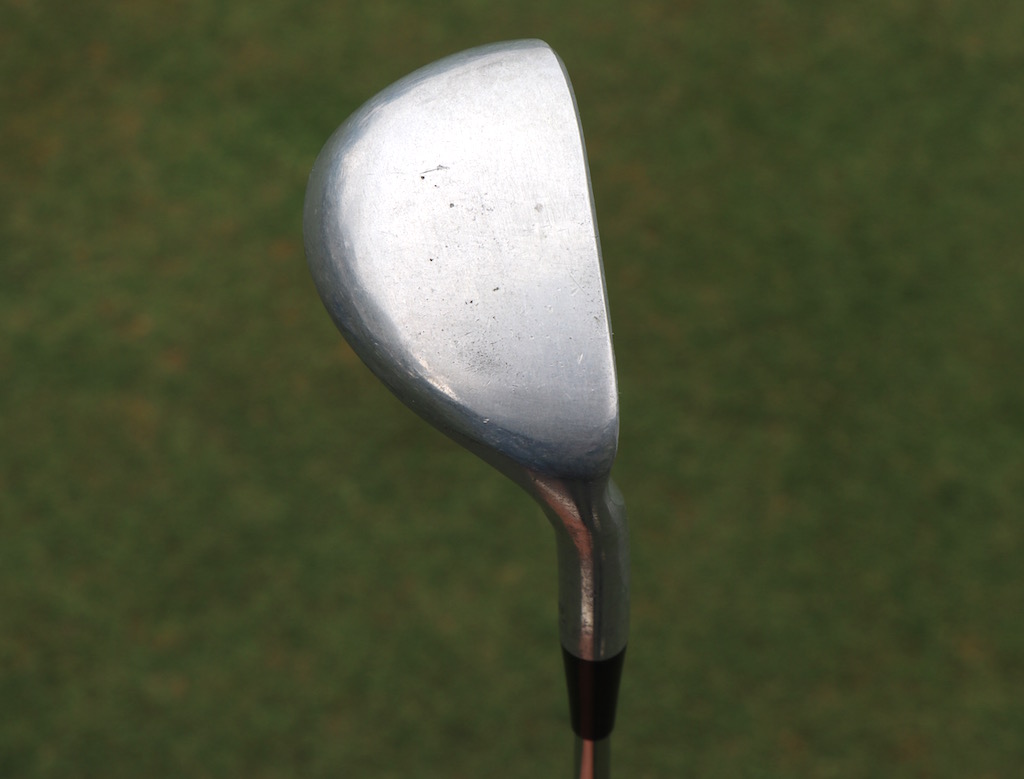
I’ll take this [hybrid] for example. You can see there’s no number on it. He never made this. He just built this experimental club, took it out to Shady Oaks, hit it, tinkered with it, but here is what I believe to be the first hybrid ever known to man. This was made probably 20-25 years before you ever heard of a hybrid.
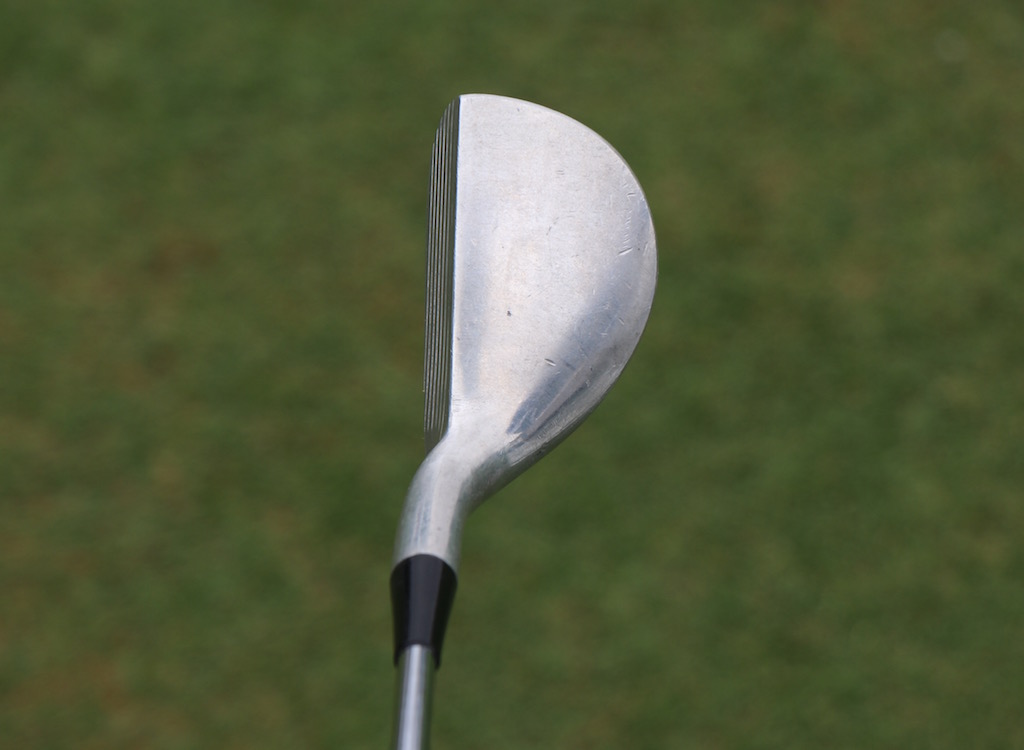
If you look at it, and look at the shaft and set it down, it’s a hybrid. There’s no doubt. They didn’t have that name at that time, that’s just what he was inventing. He was experimenting and creating a hybrid 30 years before you heard the word hybrid. I think this was in the early 1960’s. Most of these clubs were from the early 1960’s.
When did you first hear the word hybrid? Mid 80’s? Late 80’s? So, 25-30 years before you heard of a hybrid, here’s Mr. Hogan inventing a hybrid.

Here’s another example that we brought. You see again, there’s no number on this. It was an experimental club. I believe that this was perhaps the first metalwood ever made about 20-25 years before people started creating metalwoods.
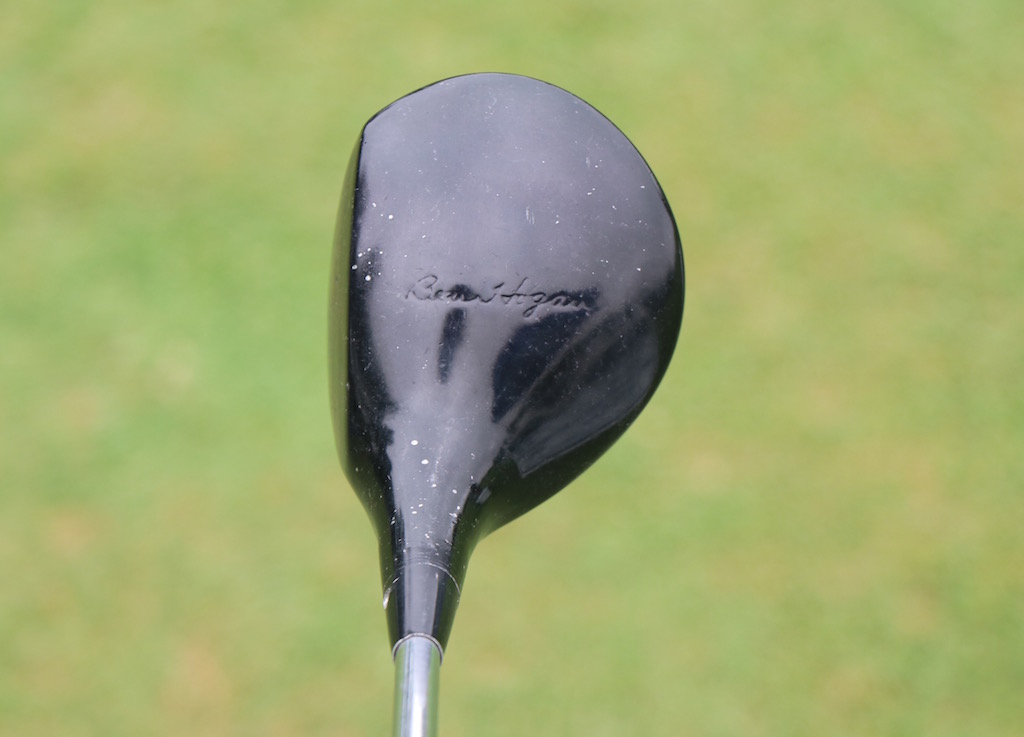
You can kind of see the reflection, it does actually have Hogan’s signature on top of it. It doesn’t have a number on it. He never produced it for the public’s consumption, but he was experimenting with different metals on woods.
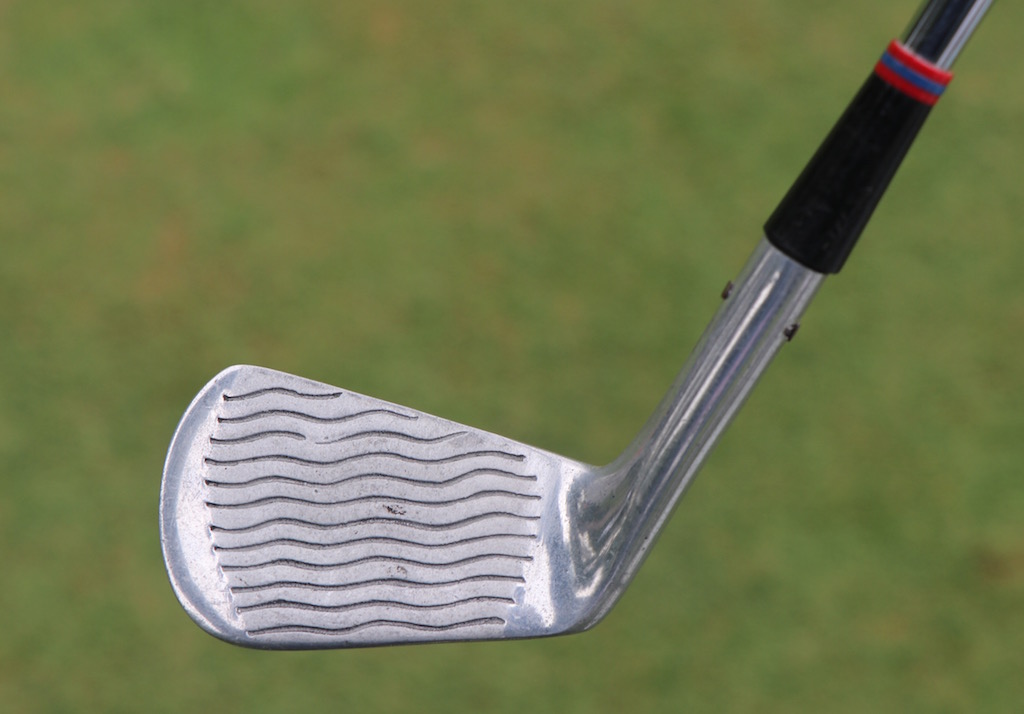
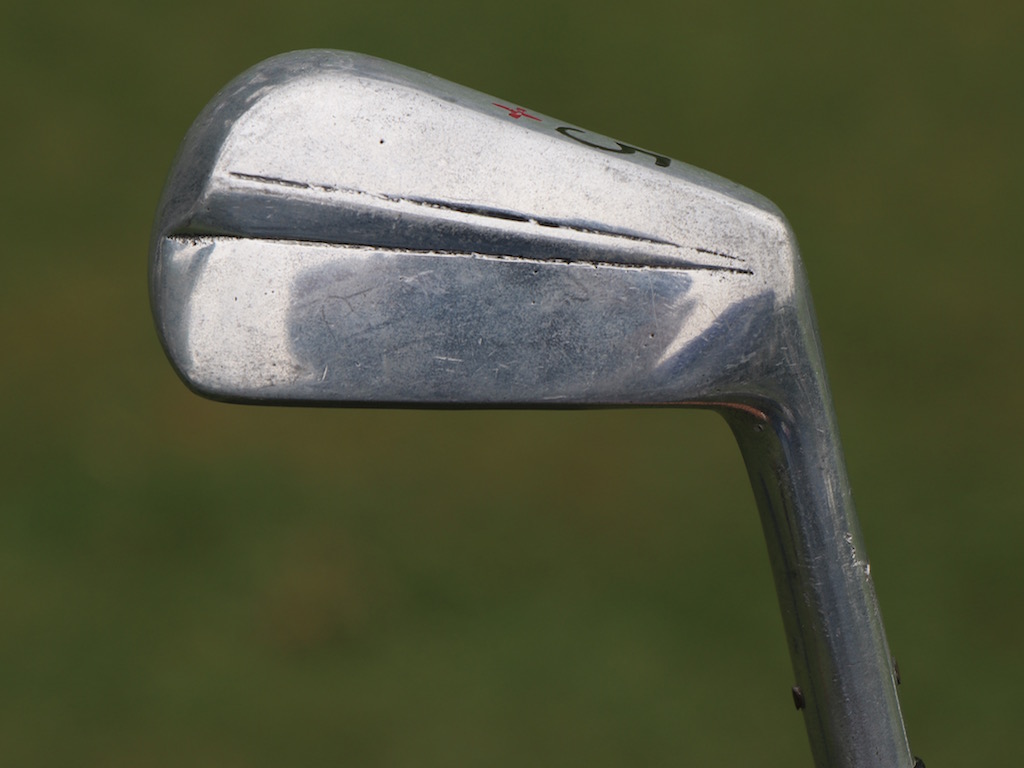
Similarly, here’s an iron. He never made it. It’s made out of, I think, aluminum. It’s about half the weight of a normal iron.
I’m sure he was experimenting with swing speeds. I don’t know what the 5+ means on there, but this set of aluminum irons that we have, each one of them has a different groove design on it. He was trying to see if that could somehow effect spin and club head speed with different metals.

Here’s what I believe to be the first bore-thru shaft that Callaway made famous with the Big Bertha in the early 90’s or so. Here’s a bore-thru shaft that Hogan was making in the 1960’s before you heard of the Big Bertha.
It’s the most widely sold club, maybe to date, and part of their design was the bore-thru shaft.

And we have a…this was a different kind of putter. I could also bring you a counterbalanced putter that Mr. Hogan made 30 years before you heard of counterbalance. He filled this whole top part of the club with lead. It’s so heavy you can’t believe it. He was experimenting with counterbalance on putter 40-50 years before you started thinking about distributing the weight differently in a putter.
I feel like Hogan was basically Bryson DeChambeau before Bryson came along, except he had his own company to build designs, try things out, and chase perfection.
All pros today build a golf club around their swing…they have all the technology. You think about 70 years ago, they didn’t do that. Mr. Hogan built golf clubs he couldn’t hook. He put a Apex 5 shaft in, he tipped it, he set the grip on it, he put a reminder in it, he set the grip in it where the club was sitting 4.5 degrees open. He built a golf club that no human could hook. He started building a golf club around his swing in the 1950’s. Now, everybody does that. But 70 years ago, nobody did that. That was part of his scientific approach to golf.
What was Hogan’s background like? Did he have any engineering or science background? I know his dad was a blacksmith, but did he have any qualifications other than curiosity and knowing the golf swing better than anyone else in the world?
I think you probably hit it. Mr. Hogan did not have the opportunity to pursue his education. He was obviously a brilliant man, but he had to drop out of school in 10th grade to sell newspapers and to go loop at Glen Garden Country Club to get that 65 cents to give his mother so they could eat. And Mr. Hogan always believed in education. That’s why the foundation gives out scholarships, because he always believed in an education…but he did not have that privilege. He always respected it. He was a brilliant guy, but he did not have the opportunity to pursue a formal education.
His attention to detail was so amazing and he was so meticulous, and he spent so much time investigating and learning the golf swing that equipment design naturally flowed to his love of golf and his interest in pursing perfection.
Can you tell me a little about what the Ben Hogan Foundation does?
Thank you for asking. We created the Ben Hogan Foundation in 2007, so we’re relatively young. I was fortunate to know Mr. Hogan. I guess I first met Mr. Hogan when I was 14, as a teenager. Then I knew Mr. Hogan until he passed, when I was in my mid thirties or so. So forbout the last 20 years of his life. I didn’t know the great golfer. He was more in his grandfatherly stages.
I had the opportunity to see Mr. Hogan hit golf balls later in life and it was astounding how well he could hit it as an old man. But I knew Mr. Hogan more as a gentleman. The stories that you hear Mr. Hogan being aloof and difficult etc., I didn’t see that. Mr. Hogan would walk into the 19th hole and he would always be the first to speak. He’d pat you on the back and he’d say, “Hi, fellas!”
When you were touched by the hawk, you’d say, “I’m going low today, boy. I’d been touched by the Hawk.”
But I knew Mr. Hogan later in life, and I knew him as a very kind man. And that’s what we do with his foundation. Mr. Hogan’s word was his name and his words were so important. Hence, our interest is in working with the First Tee organizations across the country and building Ben Hogan Learning Centers. People think the First Tee teaches kids golf, and it does, but more importantly, it teaches kids about core values, the importance of honesty and integrity, and perseverance and hard work. We think that’s something Mr. Hogan would want us to do.
Then we have about five different scholarship programs that we do. As I said, Mr. Hogan wasn’t able to pursue his education, but we have scholarships to help young people pursue their education, because he didn’t have that opportunity.
The final element that we do is when Mr. Hogan was winning about a third of the tournaments he was entering, he left the PGA Tour and joined the Army Air Crops and he proudly served his country in World War II for three years. I knew how patriotic Mr. Hogan was, so we do a military appreciation event each spring at Fort Hood to thank our soldiers for their service. Everything we do, we do because we think it’s something Mr. Hogan would want us to do. Teaching young people core values, helping young people pursue their education, and thanking our military for their service to our country. That’s what we do with Mr. Hogan’s foundation.
Just for a general consumer, if they’re interested in seeing these clubs in person, do you have a facility where people can go and look at his old clubs and merchandise?
These, they can’t. These are special. They go into a locked safe. These are irreplaceable. We’ll bring them out here like we do at Colonial when we have friends contact us. We want people to know the Hogan story. We want them to understand all the interesting elements that made Mr. Hogan so special. We have a small museum that we support in his hometown of Dublin, and we have some clubs on display there. We do some displays at Shady Oaks Country Club, or if somebody wants to contact me, they can come by the office and we can show them Mr. Hogan’s collection. A little private tour.
Any final words you may want golf fans to know about the Ben Hogan Foundation?
Thank you for giving the foundation a platform. That’s important. If you’re not actively, especially as fewer and fewer people know Mr. Hogan, if you’re not actively trying to maintain that legacy, people can forget. Byron Nelson is a good example. I can’t believe how fast his legacy is going away for being one of the absolute greats of the game. I don’t think Jack’s or Arnie’s legacies will diminish because of their Children’s Hospitals, that will really keep their legacies there. But it’s important, and it’s important for these young pros out here to learn about Mr. Hogan.
We just signed an agreement with one of the biggest collegiate golf tournaments to move here to Colonial every year. We just signed an agreement to put that tournament in Mr. Hogan’s name. It will be called the Ben Hogan Collegiate Invitational. It will have the 15 best golf teams in the country here, and as a part of that, as I was visiting with our friends here at Colonial, one thing is to put Mr. Hogan’s name on it and create a Hogan-esque trophy, but the other element of that is these kids are in college to get an education. Every time they come here, they are going to get and education on Mr. Hogan. It won’t be painful. We’ll have Bruce Devlin or one of his friends tell fun Hogan stories, or the guys that were around and shagged range balls for Mr. Hogan. It’ll be a fun thing for them. It’s important they learn about Hogan and learn about the history of the game.




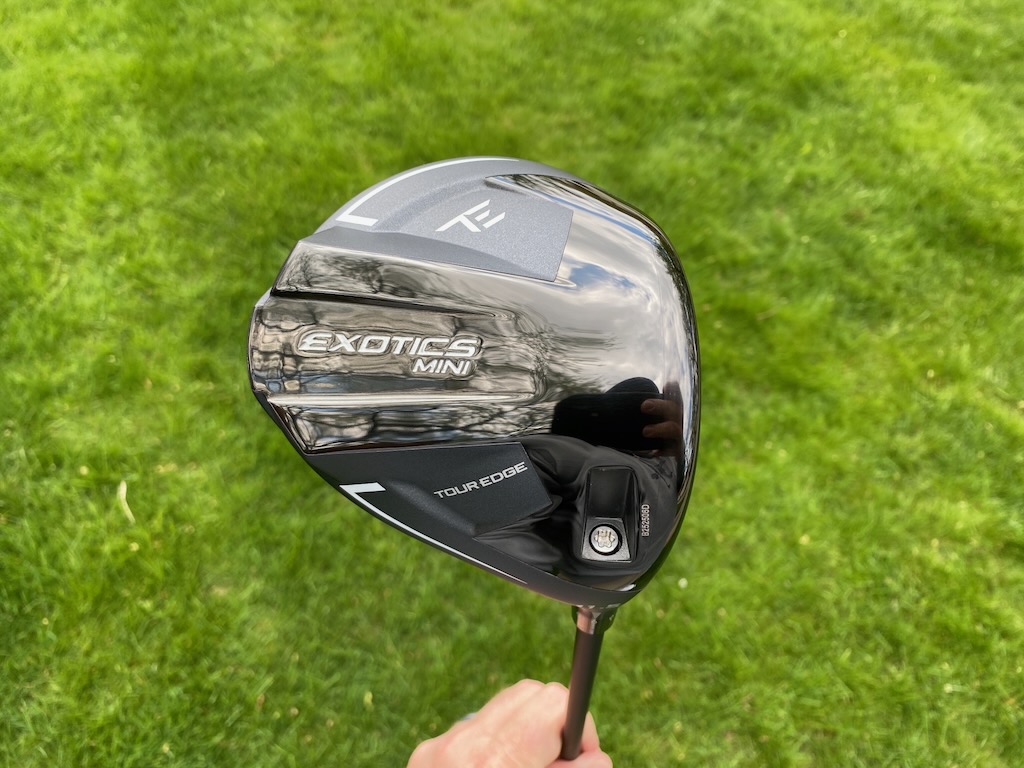
Tour Edge Golf has today introduced the all-new Exotics mini driver, engineered to deliver a powerful combination of speed, control, and versatility in the long game.
The Exotics Mini combines a titanium face with a stainless-steel body in design to balance ball speed with stability and control, creating a versatile option at the top end of the bag.

At the core of the design is Tour Edge’s proprietary Combo Brazing technology, a high-precision thermal bonding process that seamlessly fuses a titanium cup face to a stainless-steel body into a single, continuous structure. By eliminating energy loss found in traditional multi-piece constructions, Combo Brazing is designed to deliver faster face response, more efficient energy transfer, and a uniquely powerful yet controlled feel.

The multi-material construction also allows mass to be positioned lower and deeper in the head in a bid to increase stability, while the thin titanium face is engineered to maintain ball speed across a wider impact area.

“While the initial goal was to enhance control and versatility in the long game, Combo Brazing ultimately drove measurable gains in ball speed and distance within the mini driver category. In robot testing, we’ve documented higher ball speeds, higher launch, reduced spin, and increased carry and total distance compared to leading models.” – Vice President of R&D Matt Neeley

In addition to distance performance, the Exotics mini emphasizes forgiveness through a heavier stainless-steel body that shifts mass toward the perimeter. This configuration increases MOI relative to traditional all-titanium mini drivers, helping preserve ball speed and directional stability on off-center strikes. Paired with Pyramid Face Technology from the Exotics metalwood line, the design is intended to support consistent speed across the face.

To further enhance MOI, a lightweight carbon fiber crown frees additional mass that is strategically repositioned low and deep in the head in design to improve stability and promote optimal launch with controlled spin.

“We designed the Mini to be about five millimeters shallower than other mini drivers on the market. That change improves playability off the deck. From a clean fairway lie, it can function as a strong 3-wood alternative while still providing control off the tee.” – Tour Edge CEO David Glod
An adjustable hosel system allows for loft and lie tuning to dial in trajectory and shot shape, while a fixed 13-gram rear weight helps stabilize the head through impact to improve dispersion consistency. The Exotics Mini Driver is available in 11.5 and 13.5-degree lofts in right-handed models.

Pricing & Availability
The Exotics Mini Driver is available for pre-order beginning today for $399.99 USD at touredge.com, and will be available for purchase at retail outlets worldwide on May 22, 2026.

In our forums, our members have been pitting a Srixon ZXi combo against a TaylorMade P7CB/770 combo. WRXer ‘edutch22’ is on the hunt for a new set of irons and kicks off the thread saying:
“Looking at picking up a new set of irons and think I’ve narrowed it down to Srixon ZXi combo or Taylormade P7CB/770 combo. I am currently a 5 cap and allbeit I feel irons are my weakness. My miss is a little to the toe side. I am decently steep at 4-5 down. Always thought I am high spin but recently on trackman my 7 was spinning at 5800 roughly.
My question or looking for thoughts on which one would benefit me more from a forgiveness standpoint? Or is there another iron is should be looking at entirely? I only get to play about once or twice a week, if I am not playing a 2-3 day event. Thanks in advance.”
And our members have been sharing their thoughts and suggestions in response.
Here are a few posts from the thread, but make sure to check out the entire discussion and have your say at the link below.
- manima1: “You just can’t go wrong with Srixon ZXi7.”
- MattM97: “You have to hit them to know, the V-Sole on the Srixon can be make or break for many.”
- dmeeksDC: “P7CB is more forgiving for me than ZXi7 because my main miss is low middle and the P7CB still flies and spins great on that miss. These are both really nice irons but I like the P7CB more than the Zxi7 and the P770 (or P790) more than the Zxi5. The Srixons are larger so if that gives you confidence that is the way to go. I don’t feel like I get any benefit from the V-sole and the P7CBs live up to their high Maltby forgiveness rating so the TaylorMades have been great for me.”
Entire Thread: “Srixon ZXi combo or TaylorMade P7CB/770 combo? – GolfWRXers discuss”

At GolfWRX, we are a community of like-minded individuals who all experience and express our enjoyment of the game in many ways.
It’s that sense of community that drives day-to-day interactions in the forums on topics that range from best driver to what marker you use to mark your ball. It even allows us to share another thing we all love – buying and selling equipment.
Currently, in our GolfWRX buy/sell/trade (BST) forum, @pianoman0123 has a 2024 Wilson Staff CB/Blade combo up for grabs.

From the listing: “2024 Wilson Staff CB/Blade Combo. 4-8 irons are CB’s and the 9,PW are Blades. 5-PW have Project X 6.0 Shafts and the 4 Iron has a Steelfiber CW110 Stiff Shaft. Standard Length, Lie and Lofts. These are in very good condition the shafts just don’t work for me. Like new Lamkin Grips on the 5-PW and a stock Golf Pride on the 4 Iron. $525 OBO.”
To check out the full listing in our BST forum, head through the link. If you are curious about the rules to participate in the BST Forum, you can learn more here: GolfWRX BST Rules

RBC Heritage Tour Report: More minis, course-specific setups, Spider & GTS launches

Justin Rose WITB 2026 (April): Full WITB breakdown with new McLaren irons

Best fairway woods of 2026: The most versatile fairway woods + the most forgiving fairway woods

What’s the story behind Webb Simpson’s custom-stamped irons?

Cadillac Championship Tour Report: Spieth’s sizable changes, McLaren Golf launches, and more

The 24 players who can win the Masters

Rory McIlroy’s winning WITB: 2026 Masters

Kristoffer Reitan’s winning WITB: 2026 Truist Championship

J.J. Spaun’s winning WITB: 2026 Valero Texas Open

Cameron Young’s winning WITB: 2026 Cadillac Championship


Alex Fitzpatrick WITB 2026 (May)
Driver: Ping G440 LST (9 degrees) Shaft: Fujikura Ventus Black 6 X 3-wood: TaylorMade Qi4D (15 degrees) Shaft: Fujikura Ventus...

Kristoffer Reitan’s winning WITB: 2026 Truist Championship
Driver: Ping G440 Max (9 degrees) Shaft: Mitsubishi Tensei 1K White 60 TX 3-wood: Ping G440 Max (15 degrees) Shaft:...


WITB Time Machine: Rory McIlroy’s winning WITB, 2021 Truist Championship
Rory McIlroy’s victory at the 2021 Wells Fargo Championship 2021 (now the Truist Championship) marked a significant return to form,...


Collin Morikawa WITB 2026 (May)
Driver: TaylorMade Qi4D LS (8 degrees) Shaft: Mitsubishi Diamana D+ Limited 60 TX 3-wood: TaylorMade SIM Tour (14 degrees) Shaft:...
-
 Equipment2 weeks ago
Justin Rose WITB 2026 (April): Full WITB breakdown with new McLaren irons
-
 Equipment1 week ago
What’s the story behind Webb Simpson’s custom-stamped irons?
-
 Equipment2 weeks ago
Cadillac Championship Tour Report: Spieth’s sizable changes, McLaren Golf launches, and more
-
Whats in the Bag3 days ago
Kristoffer Reitan’s winning WITB: 2026 Truist Championship
-
 Whats in the Bag1 week ago
Cameron Young’s winning WITB: 2026 Cadillac Championship
-

 Whats in the Bag3 weeks ago
Nelly Korda WITB 2026 (April)
-

 Equipment2 weeks ago
Justin Rose on the switch to McLaren Golf, learnings from previous equipment moves
-

 Tour Photo Galleries2 weeks ago
Photos from the 2026 Cadillac Championship


Jeff
Aug 13, 2023 at 11:17 am
Byron Nelson’s legacy is not going away! Byron Nelson/Salesmenship golf tournament..one of the largest, if not, the largest contribution to local charities.
Pingback: Ben Hogan's prototype and personal clubs were spotted at the Charles Schwab Challenge - Fly Pin High
Pingback: Spotted: Ben Hogan’s prototype clubs at the Charles Schwab Challenge – GolfWRX
Pingback: GolfWRX Top 5 Picks: Our top five golf articles starting in 2022 - Fly Pin High
Pingback: GolfWRX Top-5 Picks: Our favorite golf articles from 2022 – GolfWRX
Lyle Lingenfelter
Jun 14, 2022 at 2:57 pm
I went to Shady Oaks and played a round with Robert’s father, Clarence Stennett, in the late 1990’s. He told me several Hogan stories over the years and was a great gentleman that day. Especially considering I was stuck in traffic and only made it into the parking lot as our group was teeing off. Best wishes with the Hogan Foundation. I’m a huge club tinkerer and love trying to create my own designs. The article was very enlightening.
Howard Hayden
Jun 9, 2022 at 11:11 am
Nice story. Never get tired of reading about Mr. Hogan.
MrHogan
Jun 10, 2022 at 7:17 pm
Couldn’t agree with you more..