
Equipment
Korea’s FreeFlex shaft proves that lightning strikes twice


The biggest obstacle to success is said to be a closed mind. If past innovators had not been bold in trying new things and testing conventions, we may still be playing with featheries and hickory shafts. Thanks to their pioneering ways, the game was able to evolve into the wonder that it is today and I am grateful for all the advantages I have enjoyed.
According to a recent YouTube video uploaded on TXG, one such innovative product they have tested in recent years is the Autoflex shaft. Despite the shocking pink color and a high price tag, the whippy shaft from a relatively unknown Korean manufacturer has won over a significant number of golfers with its promise of distance and accuracy while going easy on the body. The shaft opened up a whole new shaft category by itself, and after almost three years it is still pretty much the only fighter in the ring.
So why haven’t more companies been entering this niche pioneered by Dumina? The market is clearly there. Surely, there must be other manufacturers capable of putting out their own versions? Is KHT really something that no one else can figure out? Whatever the reason, there hasn’t been any serious contenders making a run at the champ. Until now, that is.
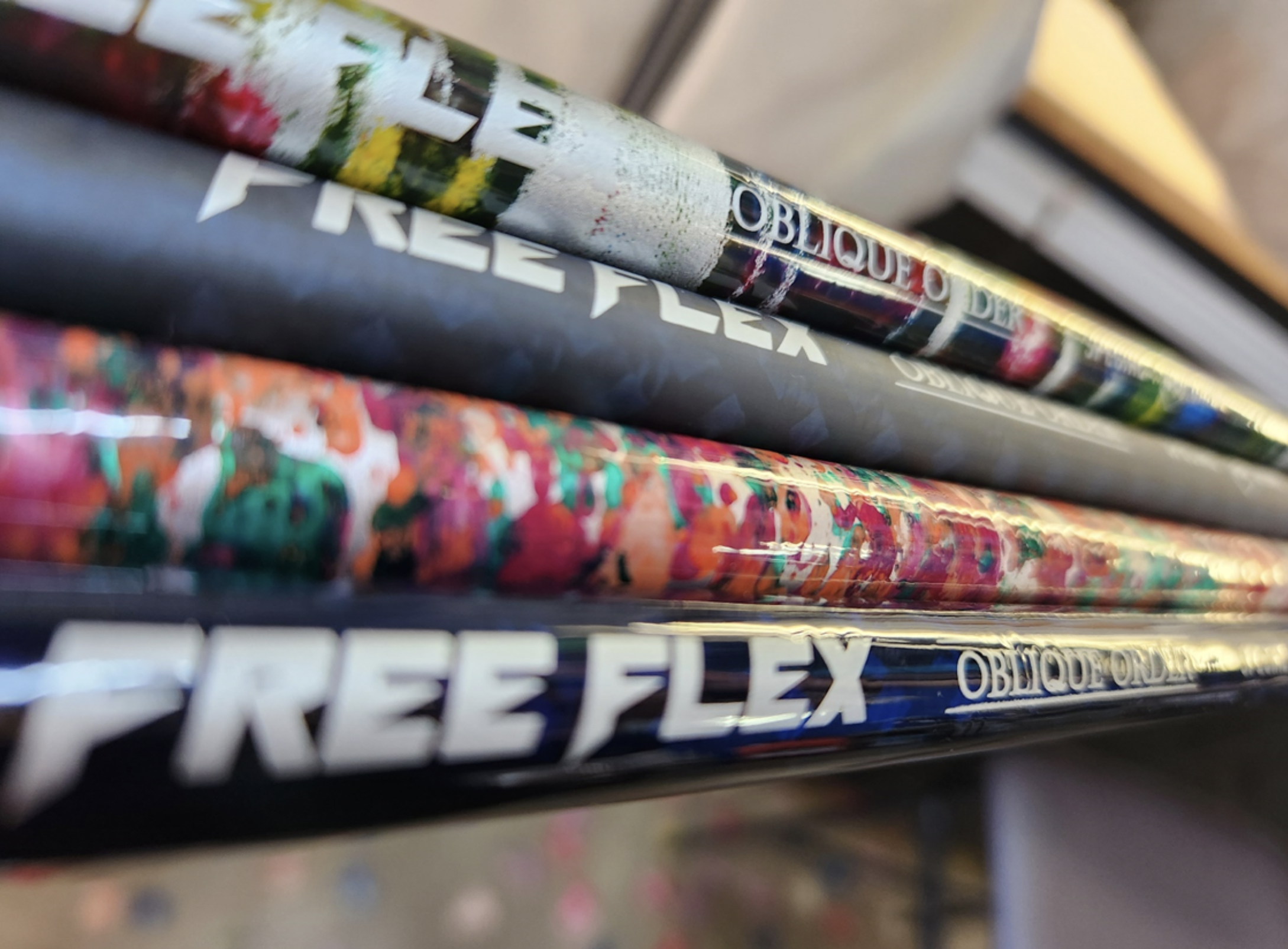
The premium ultralight shaft category has a new entrant in FreeFlex shaft… from South Korea, where else?
Ottophlex?
In the absence of established shaft makers, I did see a lot of individuals on various online forums trying to find their own version of a cheaper Autoflex. Affectionately dubbed as OttoPhlex, I have come across several impassioned posts where golfers have detailed their endeavors to find an effective replacement. To their delight, many have said their bargain shafts also produced noticeable distance gains while retaining accuracy.
That’s just awesome. I think it’s great that Autoflex generated such an interest in golfers to turn over every stone in our search for all the advantages we can get. One caveat, however, seems that an OttoFlex shaft that worked wonders for one guy sprayed the ball all over the place for another. Of the various OttoPhlex shafts I have seen online, I have yet to see a true contender that worked for a wider group of golfers like Autoflex.
In a way, Autoflex reminds me of Floyd Mayweather, Jr., the unbeaten boxing champ. Love him or hate him, one can’t deny that his boxing skills are effective. Similarly, whatever Korea Hidden Technology may be, it simply works and deserves its just dues.
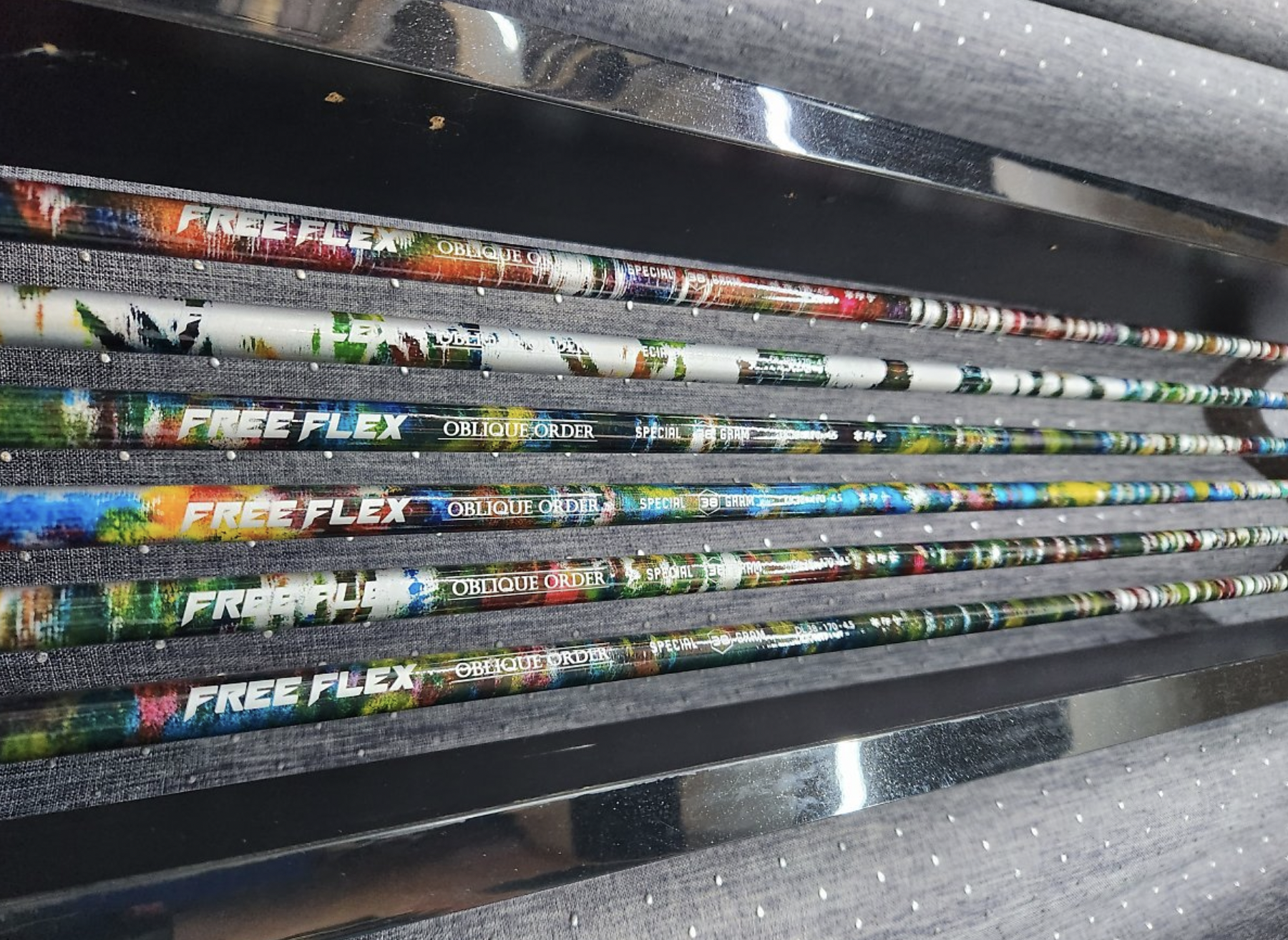
One unique attribute to FF’s water color shaft is that no two shafts are the same.
A Korean Lightning Strikes Again
Now a promising new challenger has entered the ring to contend for the title of the ultra-light premium shaft. The contender, also hailing from South Korea, goes by the name of FreeFLexx (OttoPhlex was taken, obviously) and comes with an extraordinary spec sheet. And to save you readers some time, the shaft is nothing short of amazing.
Dr Seung-jin Choi, founder and CEO of SJ (Special Joy) Golf Engineering Lab, is a lifelong golfer/entrepreneur with an impressive resume and some pretty unconventional ways of thinking. With a PhD in materials engineering, he has over 30 patents in various fields, including materials engineering, architecture, and industrial design and 12 patents (and growing) in golf clubs and shaft design. His appetite for knowledge is only rivaled by his keen ability to adapt and apply them effectively to his research and inventions.
Ever since AF came on the scene, I’ve been waiting for other OEMs to offer similar tech and performance to the AF at a lower price tag so that it can be more accessible to a wider audience. Err… let me return to that idea later.
When I first met Dr Choi, I thought I’d stepped into a golfer’s version of Dr Frankenstein’s laboratory. I’d love to mention some of the jaw-dropping golf innovations he is working on, but an embargo dictates otherwise. But I guarantee you will hear more of his mind-blowing creations soon. Just remember I said it here first.
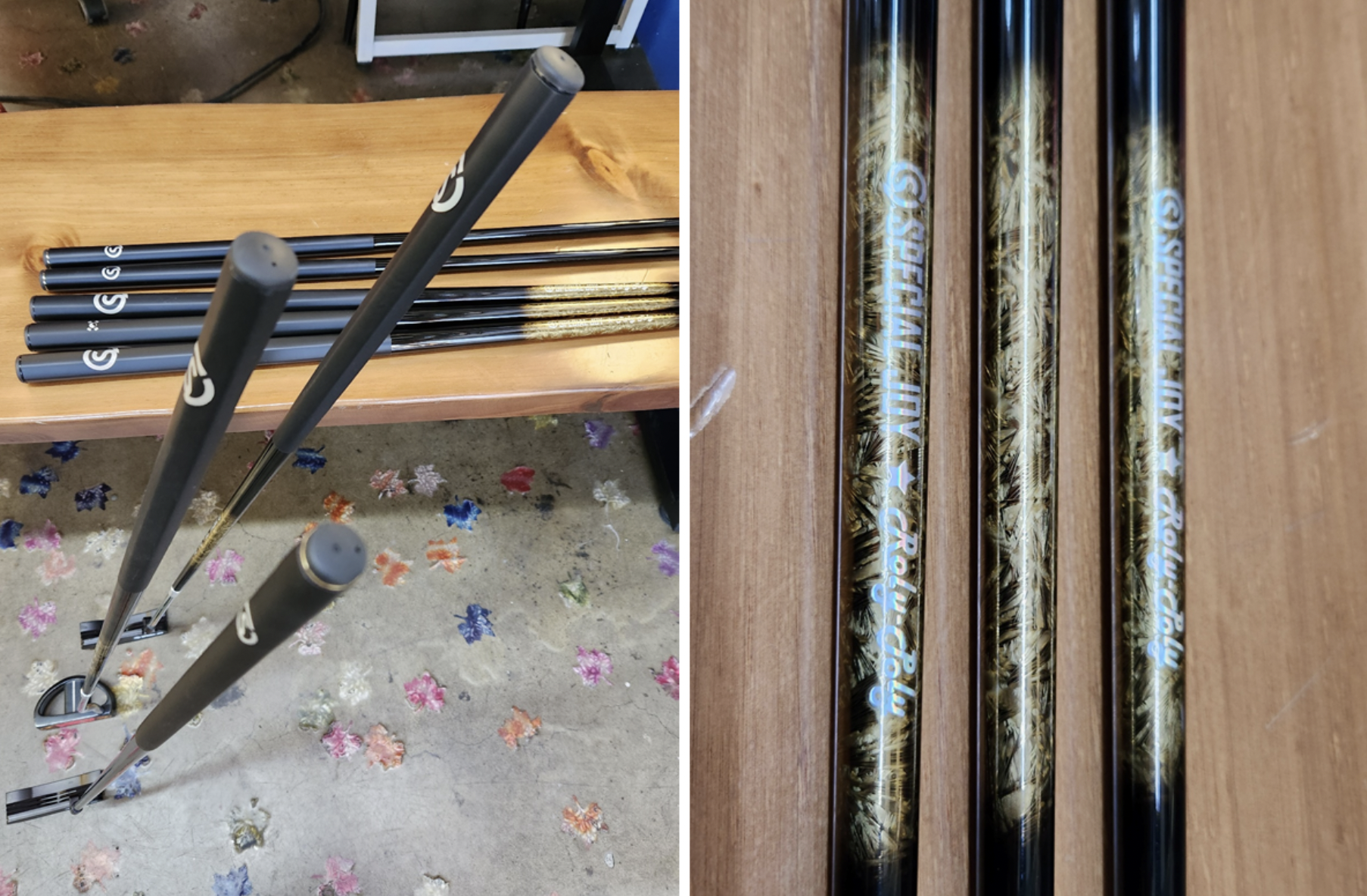
Care for some ultra-light carbon putter shafts that can make any putter stand upright on its own? Then RolyPoly is for you. Just one of many zany things in the works at SJ Golf Lab.
Opening the box, I half-expected to see the color pink and breathed a sigh of relief at the sleek matte black carbon weave design. But aesthetics aside, the shaft had to first check all the requisite boxes for me to even consider it a true contender to the AF. After all, this weight class is not for just any AF wannabes or conventional senior-flex shafts.
To be clear, I am a big fan and user of AutoFlex shafts. But seeing the FreeFlex shaft check all the same WOW factor boxes gave me goosebumps. “Has AF finally found a match in the FF?“
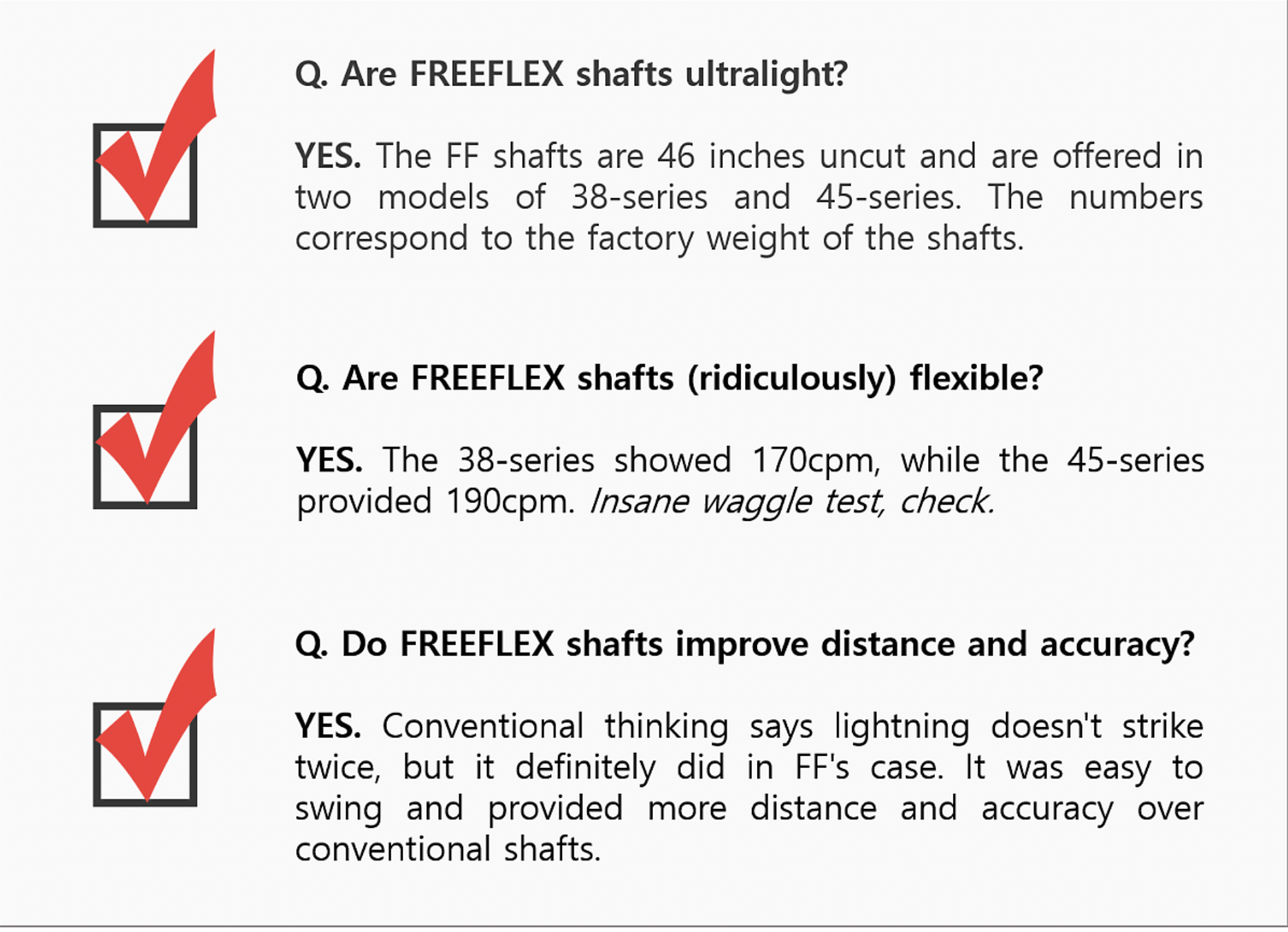
From Theory To Reality
According to Dr. Choi, FF technology is a totally different animal from KHT in concept and manufacturing method and is solidly rooted in measurable and verifiable science. It all began over two years ago with a single question, “Which part of the swing most determines the performance of a golf shot?”
After consulting hundreds of top amateurs and pros along with top professors in sports sciences, he determined that an effective downswing transition was key to long and accurate shots. This led to his next question, “Can a shaft be made to provide golfers with a repeatable and effective downswing transition for better impact and ball control?” With this specific goal in mind, Dr Choi embarked on his research, drawing on his 30+ years of golf experience and scientific background. To many people’s surprise, he was able to prove some pretty eye-opening facts along the way.
I’ve often said that some of golf’s commonly-held conventions should be re-examined lest we may have overlooked anything. With new materials and applications for its use being discovered each year, I definitely think new ‘breakthrough’ discoveries are possible. AF and FF are just the tip of the iceberg.
Before I begin, let me also state that I am an absolute novice when it comes to shaft engineering and manufacturing. I still don’t know what KHT is about, and I am just as ignorant about FreeFlex technology (FFT) as it, too, is veiled in secret and awaiting a patent. So bear with me as I try to explain the idea and innovation of FFT, as translated from speaking with the inventor.
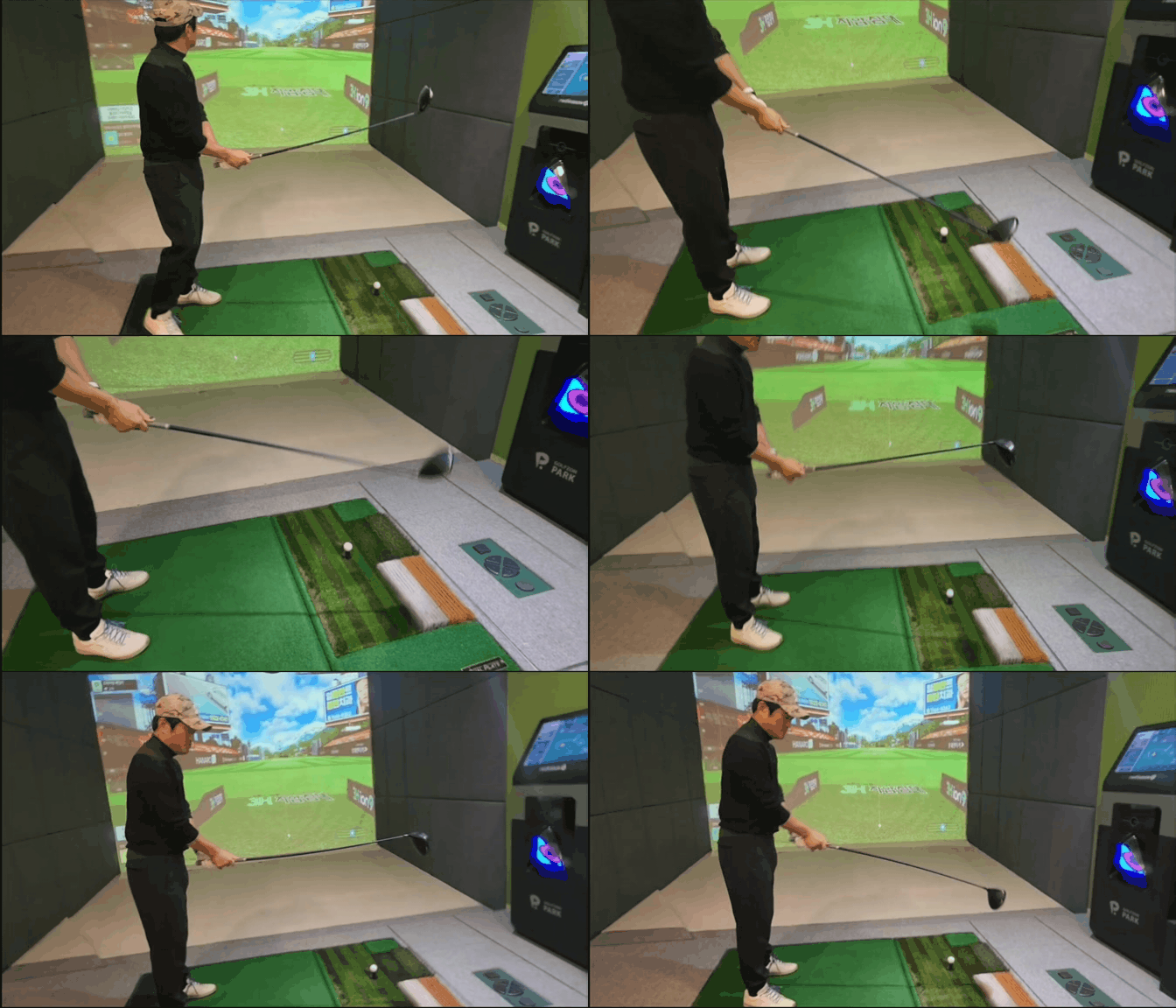
The waggle test that put AF on the map can be seen in the FF as well
FreeFlex Tech – The New Secret Sauce?
Prototypes of the FreeFlex shafts were first launched in April 2022 exclusively in Korea and were tested extensively among the pros and the club fitting community. Soon, word of mouth began to spread among the pros, who were taken aback by the performance benefits of FF. More interestingly, the FF also came under scrutiny from the sports academia as well as the club fitters, most of whom were absolutely skeptical that the shaft can do what it claimed. And Dr Choi was more than happy to show the science and the research to back up his work with FreeFlex.
Having listened to the inventor, however, I can’t really fault them for being doubtful. After all, Dr Choi’s questions and unconventional thinking challenged many of the established notions that I also thought were rock solid. For example, can a single shaft exhibit two different flexes? That is, can one side can be stiff to promote accuracy while the other side is flexible to add an extra kick for more distance?
When everyone said that’s impossible, Dr Choi said “I’ll show you. Let me boot up my computer.”
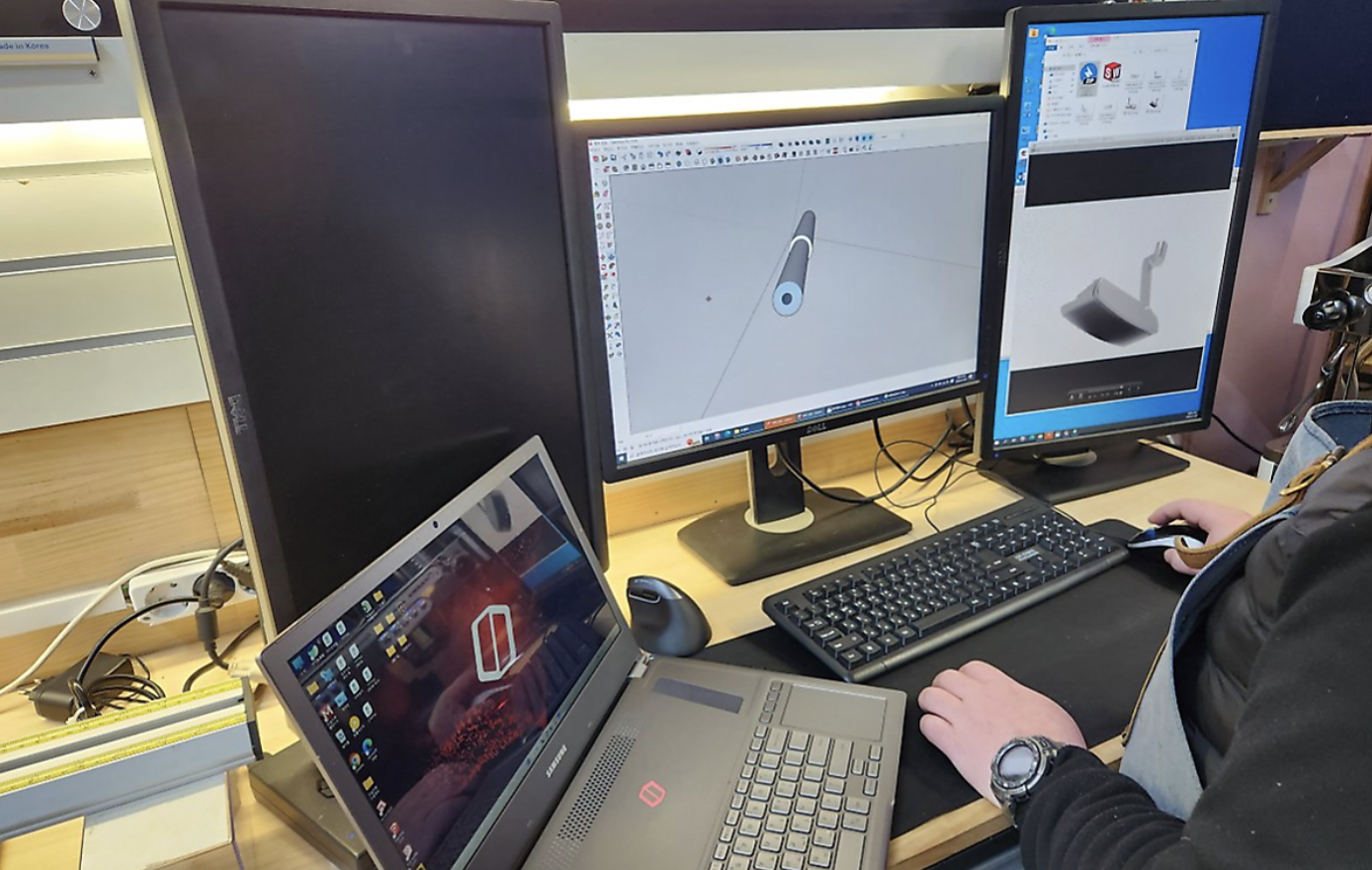
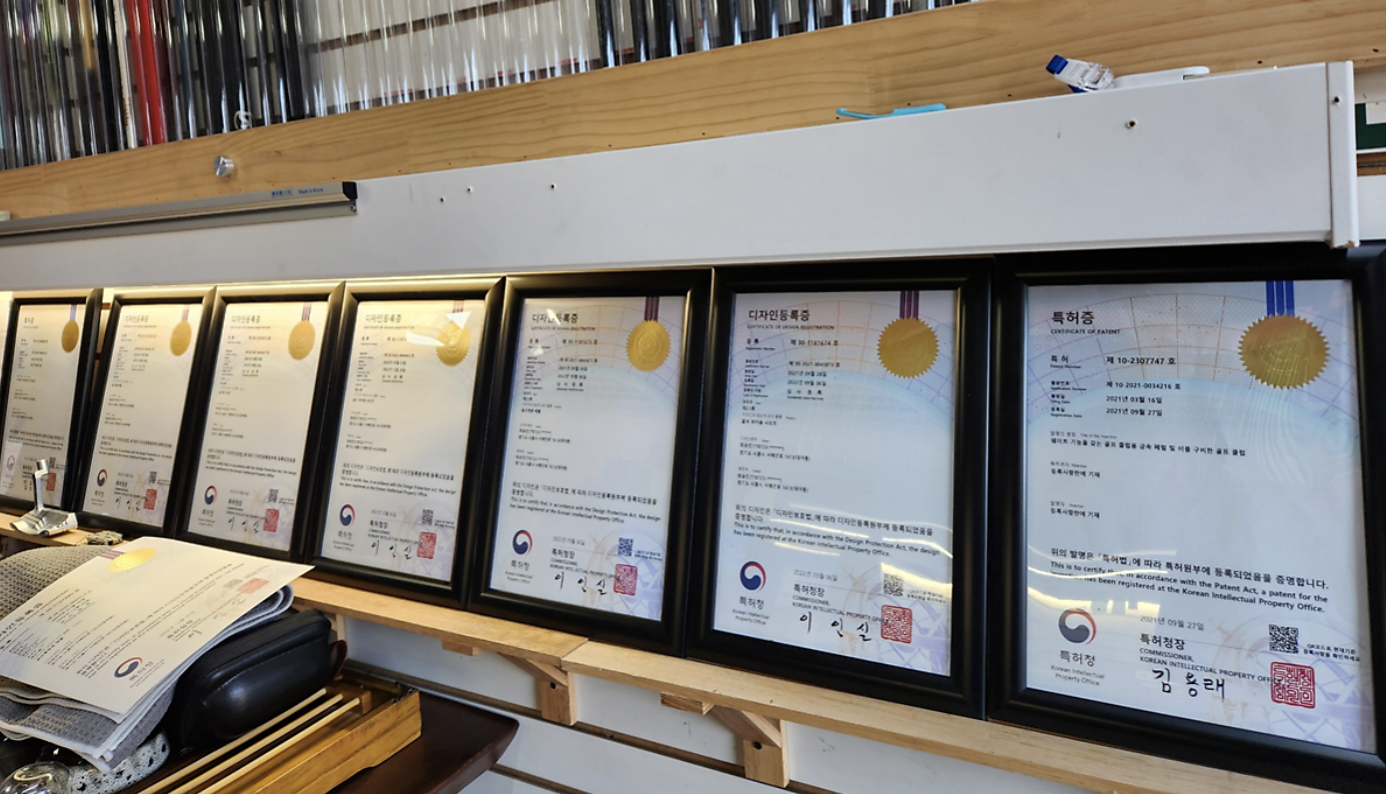
“We have developed a unique shaft to which the pronate and supinate principles have been applied by considering not only the swing toque acting upon the shaft; but also in considering the warping moment and bending torsional moment to optimize Impact and MOI.” – Dr. Seung-jin Choi, inventor of FreeFlex Technology
Before all this, I thought I knew the relationship between a shaft’s flex and torque. Namely, a low torque corresponds to a stiff flex and vice-versa, and more flex may lend itself to more distance, but at the risk of less accuracy. Despite what I thought I knew, Dr. Choi informed me that this was not always the case. In fact, he found that torque and flex (CPM) can be independent of each other and that a 35g shaft with 170cpm can have a torque as low as 2.0. That’s even lower (and firmer feeling) than an extra stiff tour shaft!
In explaining how he can manipulate torque and flex in any combination desired, the actual math and science went straight over my head but I was offered a simpler explanation. Imagine that one side of the shaft has a limiter on it, while the other side has an accelerator. The limiter prevents the shaft from twisting and bending past a certain threshold to increase the chances of the shaft returning back to its original position for accuracy. In turn, the accelerator would activate on the downswing to increase club speed for added distance. As improbable as it sounds, this is the basis for FreeFlex.
But hey, we all know that anyone can talk the talk and all is for naught if it can’t perform. So can FF really put its money where its flex is?
Battle Of The Flexes
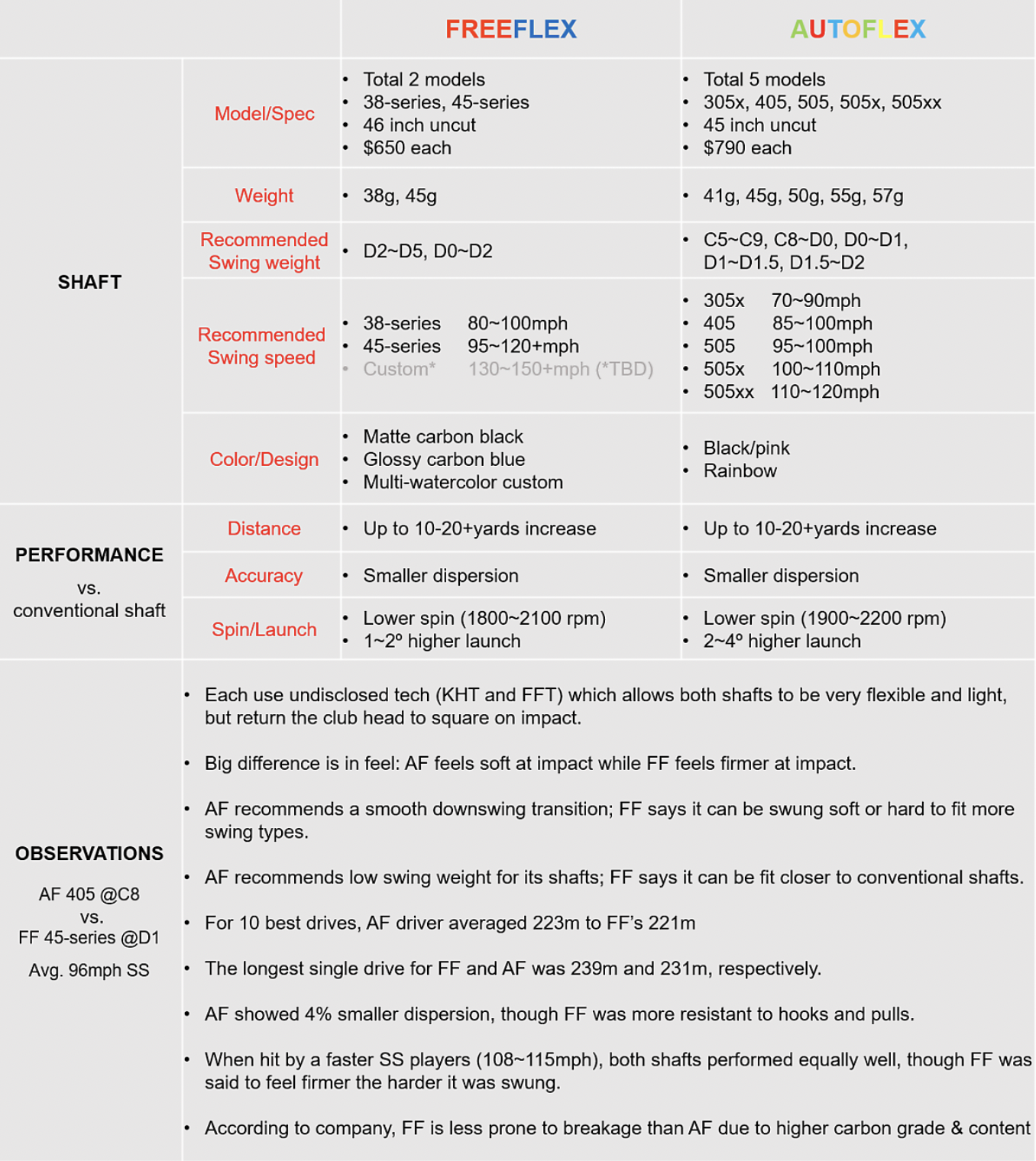
Over the past three years, many golfers have given testimony to the effectiveness of AF and I have also enjoyed my own AF to mostly good ends. While I’m not the foremost expert by any means, below is my own assessment of the similarities and differences that I have observed between AF and FF.
Overall, I found that FF not only was comparable to AF in both distance and accuracy, but it also offered three key differences which may be welcomed by golfers hesitating to pull the trigger on the pink bomber.
Observations
The first difference was the swing weight recommendation for both shafts. The AF 405 and FF 405 had similar weights (45g raw) and flex (190cpm), but the swing weight was totally different at C8 and D1.5, respectively.
From the beginning, AF shafts have frustrated many a golfer trying to get the swing weight down, since the average driver heads were too heavy. As a result, it required switching to lighter head weights or removing them altogether. In addition, certain brand club heads were not suitable for AF, and sometimes the overall driver build length had to become shorter as well. Needless to say, this irked a lot of players and golf fitters who had never encountered such hurdles in their drivers. It is a testament to AF’s performance that so many golfers have put up with it at all.
In comparison, the FF shafts seem more accommodating in this department. The recommended SW for the 38-series is at D2~D5, which should make club fitting all that much easier for a wider variety of driver heads.
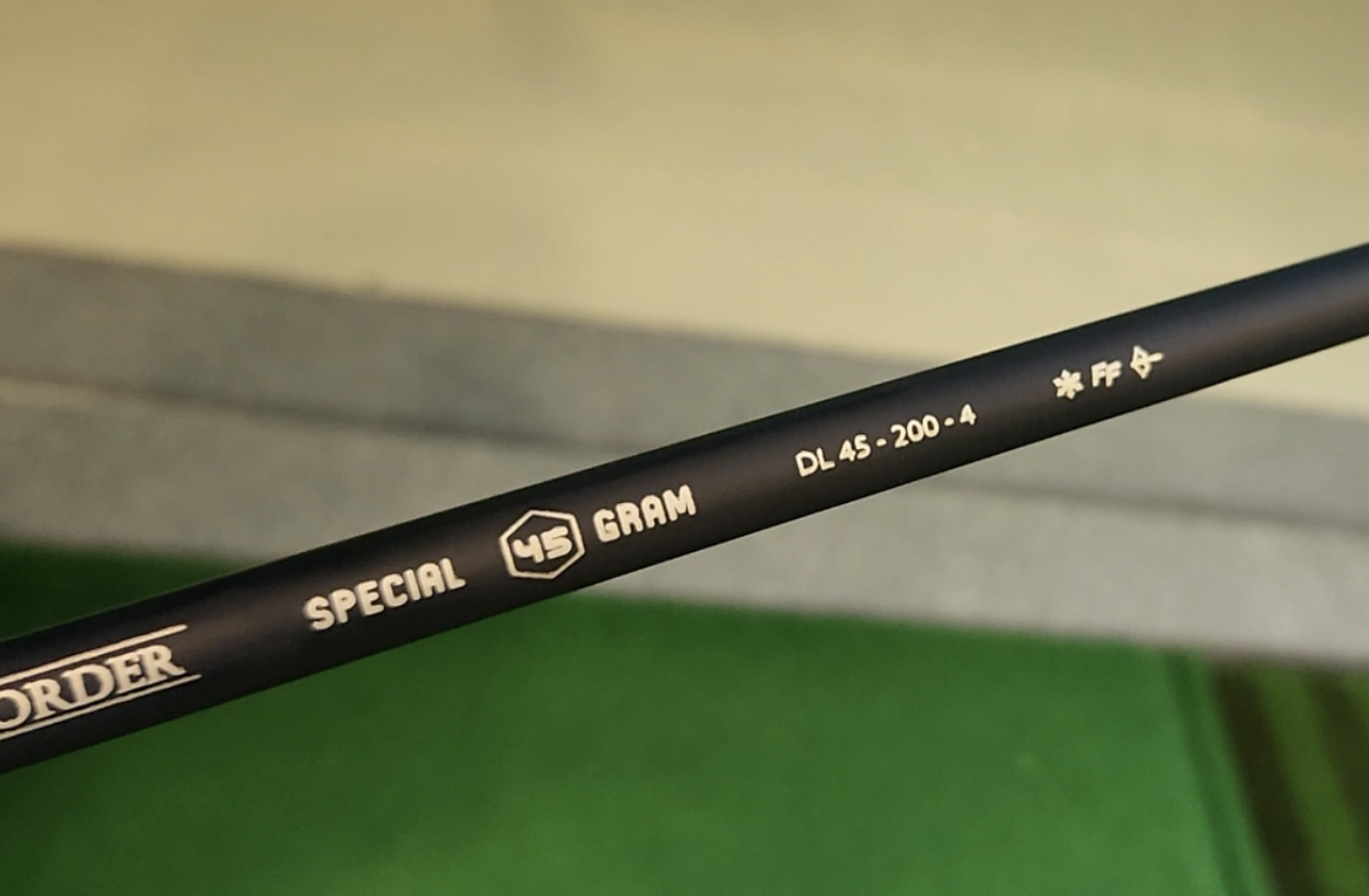
FF shafts feature the weight, CPM, and torque. The bow and arrow symbolizes the idea of FreeFlex Tech, as the shaft reacts to even a small amount of energyacted upon it, much like a bow.
The second key differentiator between the two is swing mechanics. By nature, I am more of a swinger than a hitter, and AF suits my swing super well. With a slow and measured backswing and a smooth downswing transition, I have gained nearly 20 yards over my past conventional shaft. As such, many golfers have testified to benefit from slowing down and smoothing their transitions to unlock AF’s performance. However, for golfers with an aggressive or quick transition, the AF proved difficult to tame, which has led many to believe that AF is only suitable for smooth swingers.
FreeFlex, on the other hand, claims that its shafts can be swung effectively regardless of the type of downswing transitions. From my own limited testing with three friends in this regard, I can say that FF did fare better than AF for hitters with a more aggressive swing. More specifically, FF shafts were noticeably more resistant to the left side and kept hard hooks to manageable draws to keep the ball in play more often. Dr. Choi also added that the shaft is less prone to break, as it uses higher grade carbon content over its counterpart.The third big difference noted by most testers is that the FF shaft feels more stable throughout the swing. Keep in mind that feel is subjective, and “stable” here is only referring to the feel and not the actual shot result. From my experience, the AF shaft is soft and malleable on both the backswing and the downswing, which took me a few weeks to get used to and trust that the head will return to square.
In contrast, FF has the same low CPM but the shaft is noticeably firmer especially on the downswing, giving a feeling of stability. I was better able to feel where the club head was at all points of the swing, and that gave me a slight edge in confidence on the money shots.
The three aspects were the biggest differences that were reported by FF users, and I can also agree on the observations. On a Trackman, my current AF was on average longer by 2m with a 4% smaller dispersion, while the longest single drive by each shaft favored the FF at 239m to 231m.
What gave me pause was that while AF has been my trusted gamer for the past 2+ years, I only hit the FF a couple of times since receiving it. And despite the short duration and novelty, FF performed just as well for me as AF, with the alluring promise of further fine-tuning and additional improvements to be had. Welcome to the weight division, FF.
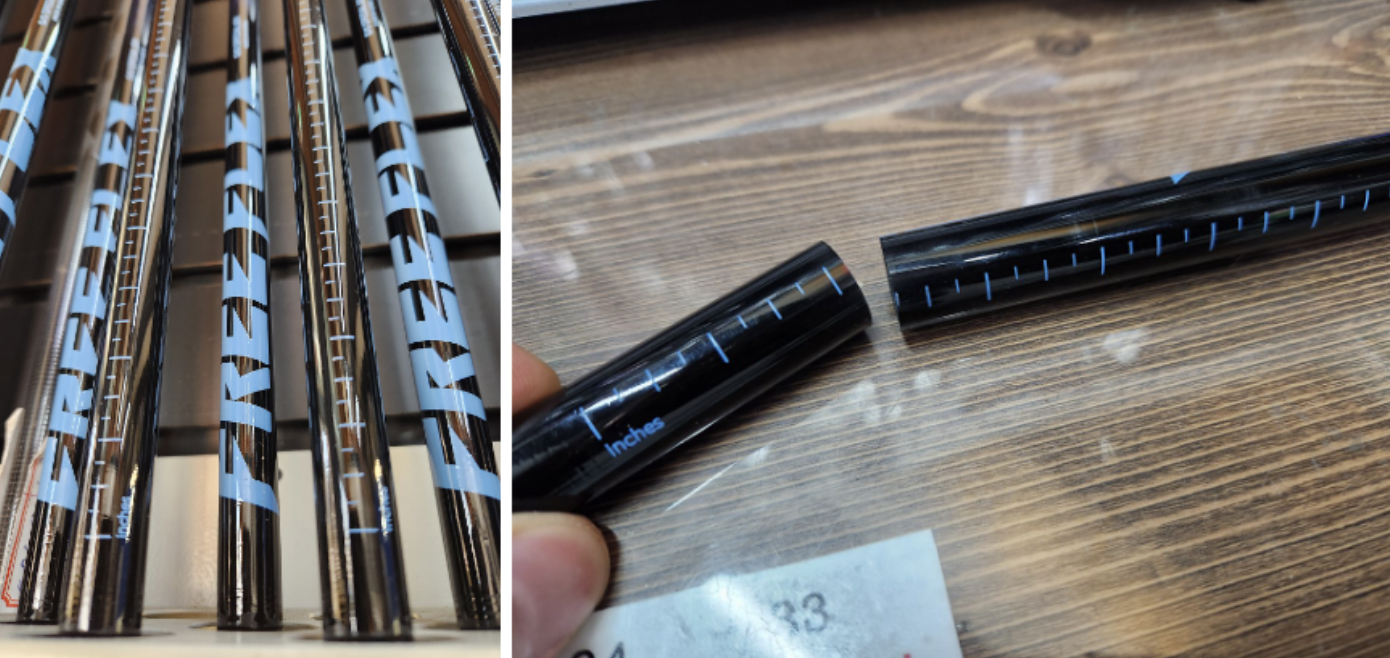
Measurements on the butt end makes it convenient to trim the shaft to desired length.
Price And Availability
Unfortunately, FreeFlex tech shafts are currently available in Korea for the time being, though an English website is in the works at www.freeflexshaft.com for February. According to the company, offline retailers and custom fitters will soon be available to offer FreeFlex in three color options; matte carbon black, glossy carbon blue, and a one-of-a-kind custom watercolor design.
All these ultralight and performance-enhancing factors do not lend themselves to low pricing either. The retail price of the FF driver shaft is set at $650, and while it is much higher than most premium shaft offerings on the market, it is nearly 20-percent less in comparison to the Autoflex at $790.
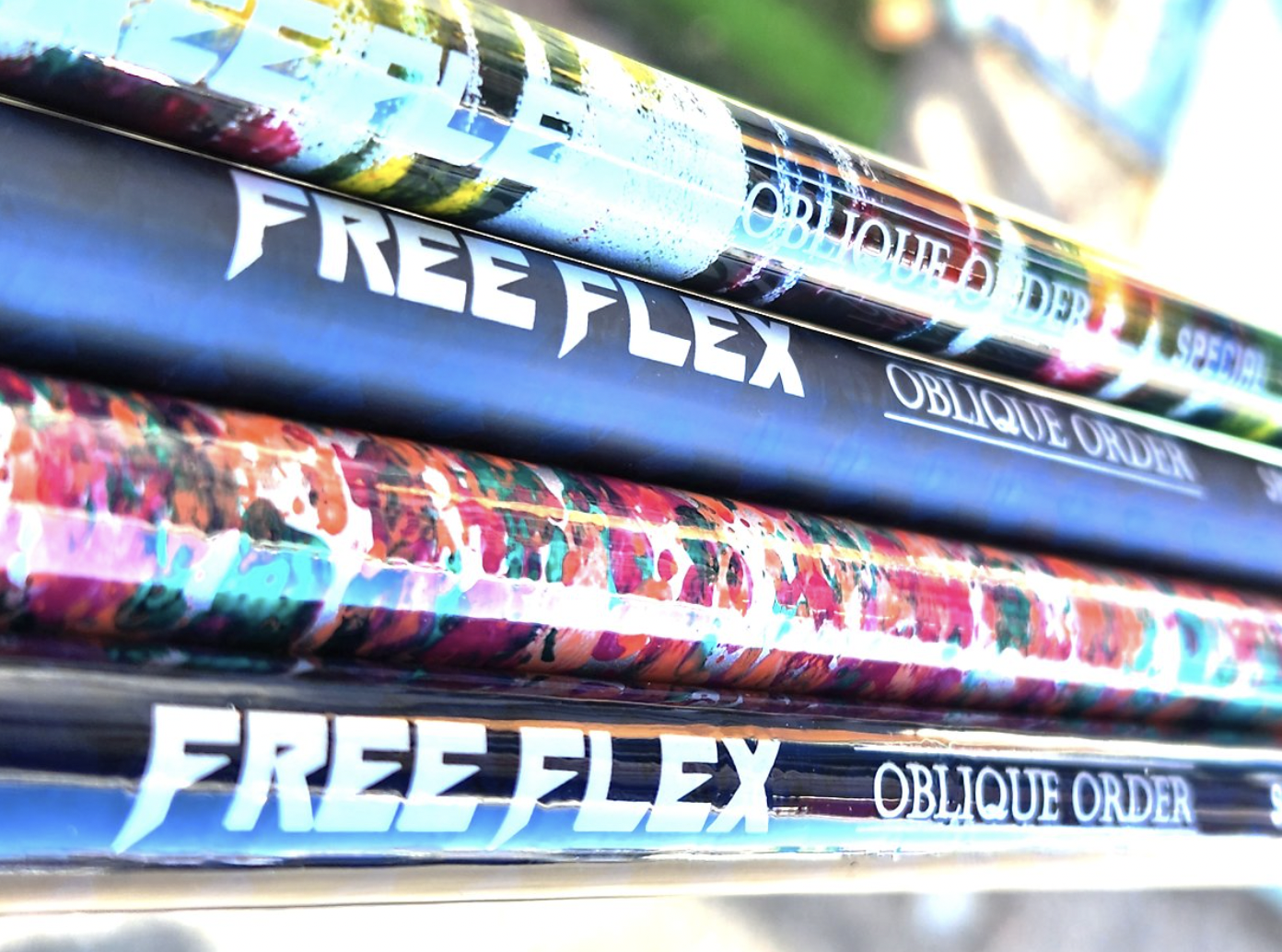
Aside from multi watercolor, FF comes in matte and glossy carbon weave tinged in blue color that looks amazing outdoors
For a limited time starting in February, SJ Golf is also taking applications from professional golfers and reviewers to test the FreeFlex demo shafts. Applications and inquiries can be sent to freeflexshaft@gmail.com and the company will notify the results individually.
And there you have it. The FreeFlex shafts have arrived to join the party and I can’t wait to see who else joins this exclusive club. It would be great to see who rules this ultra-lightweight division, but no matter who is crowned champion, it will be us golfers who will be the ultimate winners.


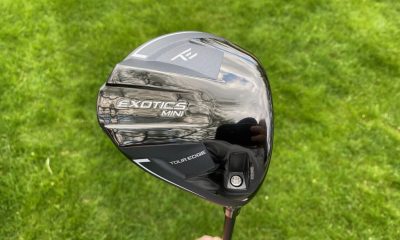


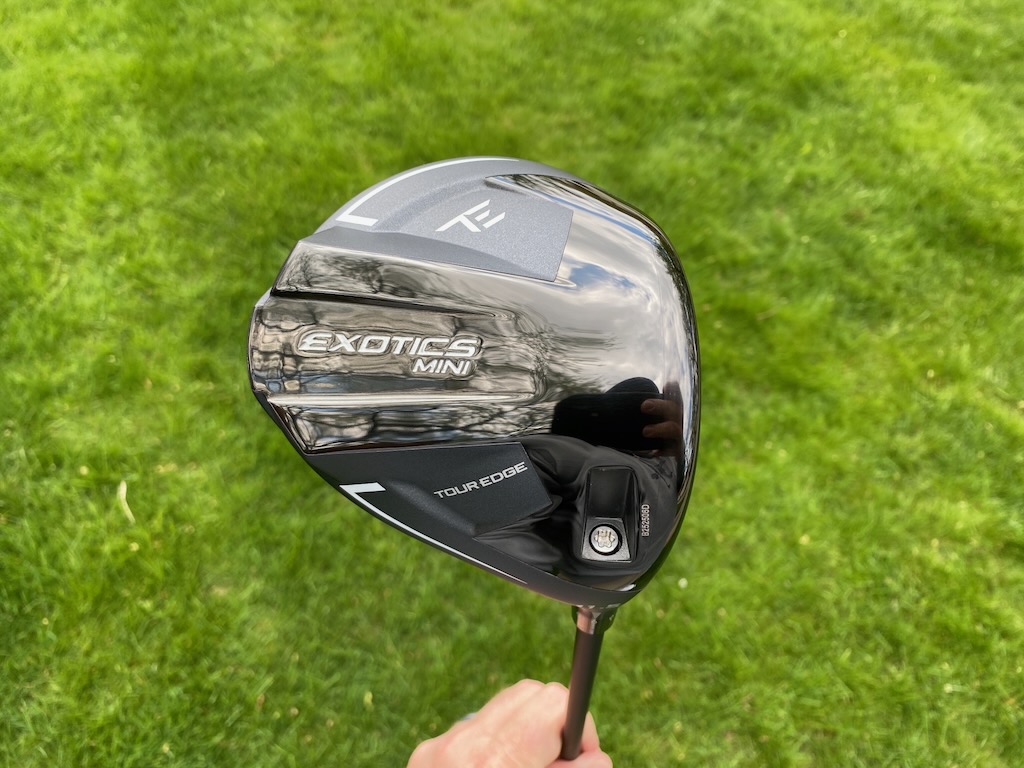
Tour Edge Golf has today introduced the all-new Exotics mini driver, engineered to deliver a powerful combination of speed, control, and versatility in the long game.
The Exotics Mini combines a titanium face with a stainless-steel body in design to balance ball speed with stability and control, creating a versatile option at the top end of the bag.

At the core of the design is Tour Edge’s proprietary Combo Brazing technology, a high-precision thermal bonding process that seamlessly fuses a titanium cup face to a stainless-steel body into a single, continuous structure. By eliminating energy loss found in traditional multi-piece constructions, Combo Brazing is designed to deliver faster face response, more efficient energy transfer, and a uniquely powerful yet controlled feel.

The multi-material construction also allows mass to be positioned lower and deeper in the head in a bid to increase stability, while the thin titanium face is engineered to maintain ball speed across a wider impact area.

“While the initial goal was to enhance control and versatility in the long game, Combo Brazing ultimately drove measurable gains in ball speed and distance within the mini driver category. In robot testing, we’ve documented higher ball speeds, higher launch, reduced spin, and increased carry and total distance compared to leading models.” – Vice President of R&D Matt Neeley

In addition to distance performance, the Exotics mini emphasizes forgiveness through a heavier stainless-steel body that shifts mass toward the perimeter. This configuration increases MOI relative to traditional all-titanium mini drivers, helping preserve ball speed and directional stability on off-center strikes. Paired with Pyramid Face Technology from the Exotics metalwood line, the design is intended to support consistent speed across the face.

To further enhance MOI, a lightweight carbon fiber crown frees additional mass that is strategically repositioned low and deep in the head in design to improve stability and promote optimal launch with controlled spin.

“We designed the Mini to be about five millimeters shallower than other mini drivers on the market. That change improves playability off the deck. From a clean fairway lie, it can function as a strong 3-wood alternative while still providing control off the tee.” – Tour Edge CEO David Glod
An adjustable hosel system allows for loft and lie tuning to dial in trajectory and shot shape, while a fixed 13-gram rear weight helps stabilize the head through impact to improve dispersion consistency. The Exotics Mini Driver is available in 11.5 and 13.5-degree lofts in right-handed models.

Pricing & Availability
The Exotics Mini Driver is available for pre-order beginning today for $399.99 USD at touredge.com, and will be available for purchase at retail outlets worldwide on May 22, 2026.

In our forums, our members have been pitting a Srixon ZXi combo against a TaylorMade P7CB/770 combo. WRXer ‘edutch22’ is on the hunt for a new set of irons and kicks off the thread saying:
“Looking at picking up a new set of irons and think I’ve narrowed it down to Srixon ZXi combo or Taylormade P7CB/770 combo. I am currently a 5 cap and allbeit I feel irons are my weakness. My miss is a little to the toe side. I am decently steep at 4-5 down. Always thought I am high spin but recently on trackman my 7 was spinning at 5800 roughly.
My question or looking for thoughts on which one would benefit me more from a forgiveness standpoint? Or is there another iron is should be looking at entirely? I only get to play about once or twice a week, if I am not playing a 2-3 day event. Thanks in advance.”
And our members have been sharing their thoughts and suggestions in response.
Here are a few posts from the thread, but make sure to check out the entire discussion and have your say at the link below.
- manima1: “You just can’t go wrong with Srixon ZXi7.”
- MattM97: “You have to hit them to know, the V-Sole on the Srixon can be make or break for many.”
- dmeeksDC: “P7CB is more forgiving for me than ZXi7 because my main miss is low middle and the P7CB still flies and spins great on that miss. These are both really nice irons but I like the P7CB more than the Zxi7 and the P770 (or P790) more than the Zxi5. The Srixons are larger so if that gives you confidence that is the way to go. I don’t feel like I get any benefit from the V-sole and the P7CBs live up to their high Maltby forgiveness rating so the TaylorMades have been great for me.”
Entire Thread: “Srixon ZXi combo or TaylorMade P7CB/770 combo? – GolfWRXers discuss”

At GolfWRX, we are a community of like-minded individuals who all experience and express our enjoyment of the game in many ways.
It’s that sense of community that drives day-to-day interactions in the forums on topics that range from best driver to what marker you use to mark your ball. It even allows us to share another thing we all love – buying and selling equipment.
Currently, in our GolfWRX buy/sell/trade (BST) forum, @pianoman0123 has a 2024 Wilson Staff CB/Blade combo up for grabs.

From the listing: “2024 Wilson Staff CB/Blade Combo. 4-8 irons are CB’s and the 9,PW are Blades. 5-PW have Project X 6.0 Shafts and the 4 Iron has a Steelfiber CW110 Stiff Shaft. Standard Length, Lie and Lofts. These are in very good condition the shafts just don’t work for me. Like new Lamkin Grips on the 5-PW and a stock Golf Pride on the 4 Iron. $525 OBO.”
To check out the full listing in our BST forum, head through the link. If you are curious about the rules to participate in the BST Forum, you can learn more here: GolfWRX BST Rules

RBC Heritage Tour Report: More minis, course-specific setups, Spider & GTS launches

Justin Rose WITB 2026 (April): Full WITB breakdown with new McLaren irons

Best fairway woods of 2026: The most versatile fairway woods + the most forgiving fairway woods

What’s the story behind Webb Simpson’s custom-stamped irons?

Cadillac Championship Tour Report: Spieth’s sizable changes, McLaren Golf launches, and more

The 24 players who can win the Masters

Rory McIlroy’s winning WITB: 2026 Masters

Kristoffer Reitan’s winning WITB: 2026 Truist Championship

J.J. Spaun’s winning WITB: 2026 Valero Texas Open

Cameron Young’s winning WITB: 2026 Cadillac Championship


Alex Fitzpatrick WITB 2026 (May)
Driver: Ping G440 LST (9 degrees) Shaft: Fujikura Ventus Black 6 X 3-wood: TaylorMade Qi4D (15 degrees) Shaft: Fujikura Ventus...

Kristoffer Reitan’s winning WITB: 2026 Truist Championship
Driver: Ping G440 Max (9 degrees) Shaft: Mitsubishi Tensei 1K White 60 TX 3-wood: Ping G440 Max (15 degrees) Shaft:...


WITB Time Machine: Rory McIlroy’s winning WITB, 2021 Truist Championship
Rory McIlroy’s victory at the 2021 Wells Fargo Championship 2021 (now the Truist Championship) marked a significant return to form,...


Collin Morikawa WITB 2026 (May)
Driver: TaylorMade Qi4D LS (8 degrees) Shaft: Mitsubishi Diamana D+ Limited 60 TX 3-wood: TaylorMade SIM Tour (14 degrees) Shaft:...
-
 Equipment2 weeks ago
Justin Rose WITB 2026 (April): Full WITB breakdown with new McLaren irons
-
 Equipment1 week ago
What’s the story behind Webb Simpson’s custom-stamped irons?
-
 Equipment2 weeks ago
Cadillac Championship Tour Report: Spieth’s sizable changes, McLaren Golf launches, and more
-
Whats in the Bag3 days ago
Kristoffer Reitan’s winning WITB: 2026 Truist Championship
-
 Whats in the Bag1 week ago
Cameron Young’s winning WITB: 2026 Cadillac Championship
-

 Whats in the Bag3 weeks ago
Nelly Korda WITB 2026 (April)
-

 Equipment2 weeks ago
Justin Rose on the switch to McLaren Golf, learnings from previous equipment moves
-

 Tour Photo Galleries2 weeks ago
Photos from the 2026 Cadillac Championship


Skip
Mar 10, 2023 at 9:44 am
Why is this article written like Free Flex and Autoflex are different companies?
Tai
Feb 23, 2023 at 10:22 pm
Some body need to test out AF, FF, and the Brava. They all claim they are the new AF…
DaveD
Feb 1, 2023 at 11:02 am
After watching TXG test the new Mitsubishi Vanquish lightweight shaft, it appears there is another option to Autoflex and FreeFlex.
Nick Vorbeck
Apr 23, 2023 at 11:25 am
I own a 38 free flex shaft, it’s not 38 grams raw it’s 50. I hit it 50 times and it spiraled apart about 18 inches up the shaft
jccrmr
Feb 1, 2023 at 7:45 am
To each their own, I found the BGT brava exceeded the performance of KHT
F
Feb 1, 2023 at 2:17 am
Can we quit with these biased ads
SKip
Mar 10, 2023 at 2:17 pm
100% paid Ad. Free Flex is literally the same people behind AutoFlex.
Azstu324
Jan 31, 2023 at 5:24 pm
When you reference the “OttoPhlex” and stated that it either works great for some but others are spraying it all over, isn’t that also the general consensus of the original Autoflex and I’d presume the Freeflex as well.
The other forum where there is a very healthy discussion about the concept behind these shaft profiles, many different shafts have been presented BUT there is a shaft that could be considered a standard representation of an Autoflex replica. That’s been the Garafalloy Pro Launch Blue 45g. Many of us have transitioned from test shaft to game shaft with amazingly successful and repeatable results.
derek gzaskow
Feb 2, 2023 at 1:14 am
Yep working for me the GPLB at 45 grams and for 55 shipped I can get it for ALL my drivers 8)
Azstu324
Feb 4, 2023 at 6:42 pm
And for less than the price of 1 Korean magic wand.
H
Jan 31, 2023 at 5:08 pm
Just seek out the Skitter shaft. The original. Way better
C
Jan 31, 2023 at 11:21 am
Can Korea quit making junk cars though
TonyK
Feb 1, 2023 at 1:00 am
Are you from 1990?
B
Feb 1, 2023 at 8:19 pm
Did you not see the car news ?
E
Feb 2, 2023 at 2:25 am
Read the news