
Opinion & Analysis
Ryder Cup 2025: Crossing to Bethpage – NY state park golf, part 4


The two teams that will clash in the 2025 Ryder Cup at Bethpage State Park’s Black course still await roster selection. We might even have a player-captain, for the first time since the 1960s. For me, my two-year journey across New York State came to a fitting and enjoyable close the third week of June. As a life-long New York resident (with a few collegiate stints in Ohio, Vermont, and North Carolina), I was justifiably proud of our state park system, especially its golf courses. Friends in other states boast of two or three state-run facilities in their commonwealths; New York boasts over twenty courses. As an adult, living near the flattest of all the state park courses, I knew that other terrains and topographies existed around the state, and I took great delight in visiting them.
In addition to our hometown course, Beaver Island, I had played the five courses at Bethpage, the one at Green Lakes near Syracuse, and the James Baird course near Poughkeepsie. I was able to visit four courses in central New York in 2024, and another four on Long Island this June. A planned trip to the north country, to visit courses along Lake Ontario and the St. Lawrence Seaway, was scuttled last fall by cold weather’s early arrival. Fortunately for me, I was able to collaborate with the superintendents and managers at a number of courses. They provided me with images and intel required to fill that gap in my travels.
On a cheery Sunday morning, we drove south and east toward Binghamton, New York. As we approached the region, a powerful storm blew through, leaving standing water across parts of the course. We were able to play Chenango Valley that day, and we continued on to the Moses Pitch and Putt, Sunken Meadow, Montauk Downs, and Sag Harbor, all on Long Island. When we holed our final putts on the ninth green at Sag Harbor, I took a long breath and thought those bittersweet thoughts of achievement and completion. Achieving the goal was the target, but the completion meant that another task had come to a close. Don’t let me be a downer. Let’s have a nice look at the final four courses in our Crossing to Bethpage series. At the end, I’ll link the other three installments, in case you haven’t yet read them.
Moses Pitch and Putt
Out on Fire Island (a large island if ever there was one) sit the 18 wee holes that make up the Robert Moses Pitch and Putt golf course. The holes extend from around 60 yards to nearly 115 yards. Brilliantly, there is one blind hole, around 13 or 14, that plays around a dogleg if you let it. The heroic play is to go over the trees and at the green. Send a scouting party ahead, to the corner, to ensure that the green is clear.
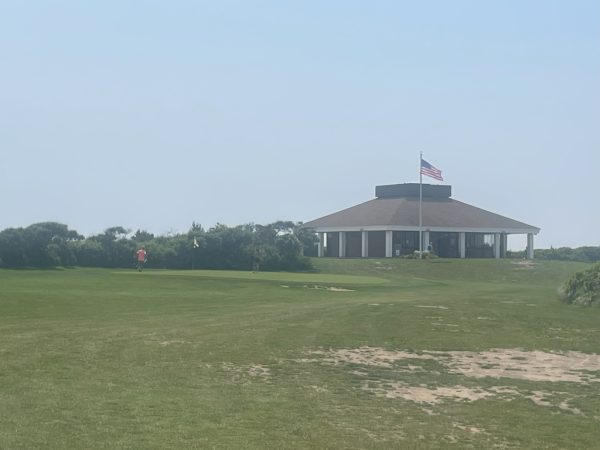
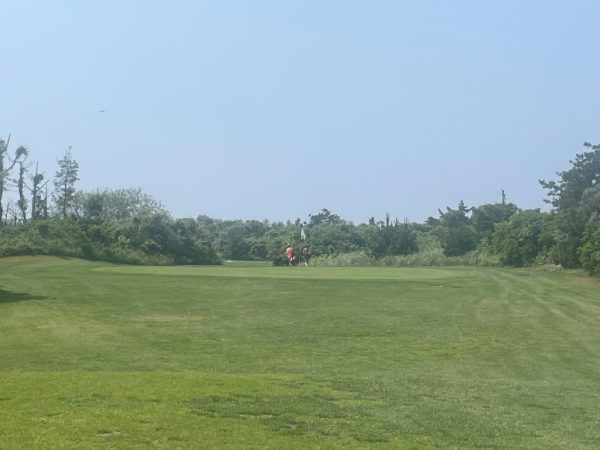
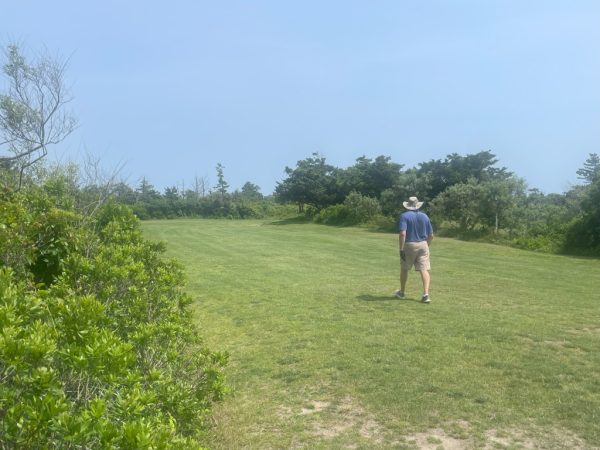
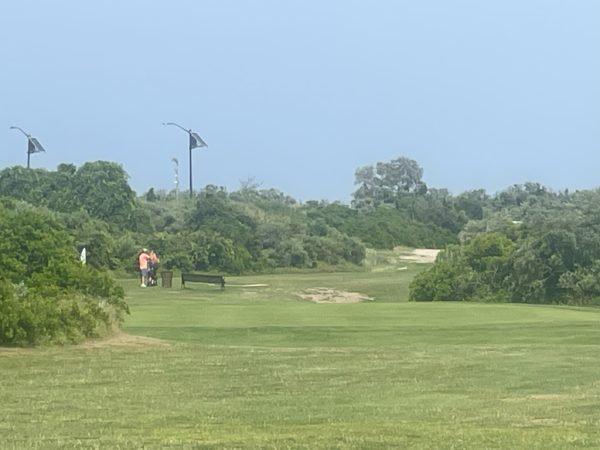
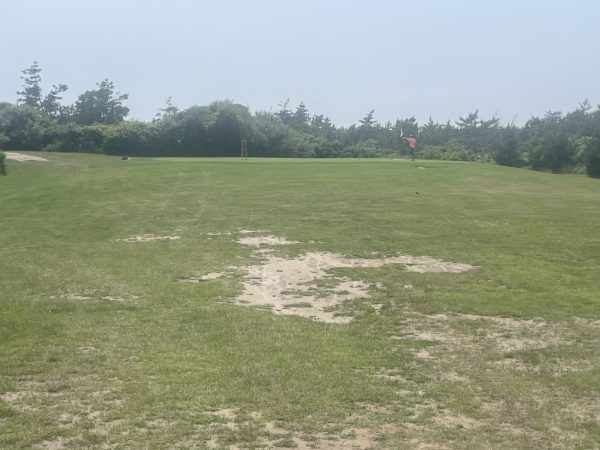
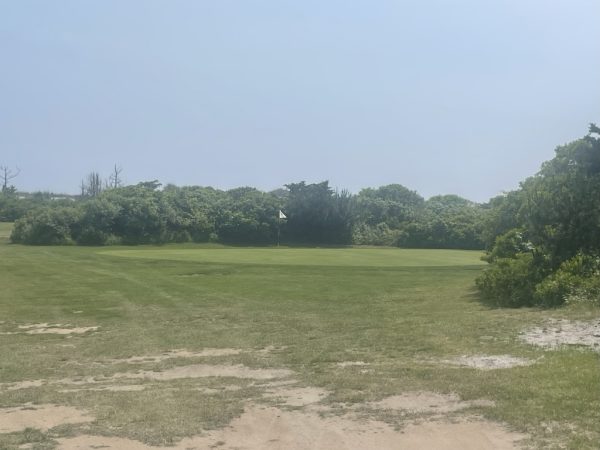
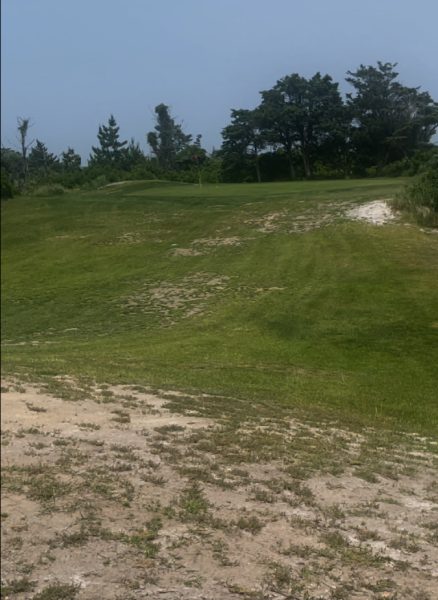
The Moses utilizes turf mats for its teeing grounds. This is quite logical. Great players are not at the Moses to prep for US Open qualifying, nor to diminish their handicap. If you left the Moses to grass teeing grounds, you’d have basepaths all around, minus the white powder lining. Situated in the dunes of Fire Island, the Moses plays as unlike a links course as you’ll find. Greens receive shots with a hug, not with a kick in the rear as the ball bounds over the green. You can play run-up shots to the flag, but it will take a few holes to acclimate yourself to the amount of bounce.
I’m not 100% certain how large a footprint the Moses takes up, but I am convinced that dozens of communities around New York state would benefit from just such a course. State Park golf is all about the public player, the municipal smacker, and the game grows when the youth have a place like the Moses to play.
Sunken Meadow
Sunken Meadow is due north of Bethpage, on the sound side of Long Island. It compares favorably with the Blue course at the big park. Sunken Meadow is filled with turbulence on its Red and Blue nines. Rises and falls of terrain make the walk a hike. If it’s during the famous heat wave of 2025, as our round was, it’s a bear of a hike. Like the Blue course at Bethpage, Sunken Meadow places sizable emphasis on accurate driving. If you have a case of the lateral slides, you will be in for a long day of pitching sideways and praying for par and bogey saves.
Knowing that we had a 27-hole day ahead, we opted to take our walk at Sunken Meadow. As suggested above, hot days are better for riding, unless you remove half the club in your bag to lighten the load. It wasn’t as taxing as the day we spent at Chambers Bay, but it was reminiscent of the fabled summits at the municipal SeaTac course.




Alfred Tull, architect of the Bethpage Yellow course, put his signature on each of the nines at Sunken Meadow. Tull also made updates to the Blue layout, which explains the similarity of styles between those courses and Sunken Meadow. Tull apparently felt the need to test the golfer with tee balls into upslopes, and well-bunkered greens. Length of holes means nothing on a Tull tract. Tull did provide opportunities for players to learn a course. At Sunken Meadow, for example, tee balls up the left on the 1st holes of Blue and Red nines, find a speed slot that adds 30-40 yards to the drive. Flare your ball to the right, and you’ll approach with 3 more clubs.
Sunken Meadow is as solid a training ground for golfers as one might find. It demands accuracy and length, an ability to recover around the greens, and a keen eye for reading basic, not turbulent, spines and splines across the putting surfaces.
Montauk Downs
The Downs sit soooo far out on Long Island that the layout holds a mythical place in state golf lore. When I was a youth, in the 1980s, the course featured regularly in the early listings of America’s top 100 public golf courses. The Downs holds a place in NYS park golf lore that is matched by one other park: Bethpage. When you play the Downs and Bethpage, you cannot help but not that there is an extra level of staffing, an extra level of course care, that the other park courses must envy. It’s a tricky point to make, so let’s leave it at this: it’s ok to have crown jewels among a collection. The reason for this elevation of Montauk Downs merits investigation.
Robert Trent Jones, senior, is recognized as one of the most prolific golf course architects of the 20th century. He hung a shingle for business and worked in 45 states and 35 countries. 500 layouts are attributed to him and his staff. Incredibly, he was not the original designer of the golf course. The original tract of land was developed by a 1920s investor, who opened the course as a private club. The bones of the Downs lie in prestige and exclusivity. When the investor lost his fortune in the 1929 stock market crash, his hopes to turn Montauk into something else simply vanished. The club remained private into the 1960s, when it retained Trent Jones to redesign the layout.
In 1978, the private club was sold to New York State, which gladly added the Downs to its stable of state park courses. The Parks and Rec department recognized the value of the downs, and reserved for it the amount of attention and upkeep that it merits. The Downs immediately took a place among America’s finest, public-access layouts. As late as 2009, it was ranked second (behind Bethpage Black) in a Golf World Readers’ Choice ballot.
The Downs features many of RTJsr’s favorite touches. The majority of fairways, whether straight or bent, feature drive-zone bunkers on each side. The greens are often pushed up, guarded by sand left and right, and demand an aerial approach shot. At some early point in his architectural career, Trent Jones abandoned the traditional golf links principle of the run-up golf shot as an option, and compelled golfers to hoist their approach shots toward the clouds. The Downs also features twisting, nearly-unreachable par five holes, and greens located at the end of a 270-degree turn around a pond.
With no traffic, Montauk Downs is 48 minutes beyond Southampton. That is, it’s 60-90 minute drive from Shinnecock Hills, depending on the time of day. We paired an early-morning tee time with lunch in Montauk; you could do worse than the Shagwong Tavern, and nine holes at Sag Harbor. After a loop around the Downs, you’ll be glad that you made the trek, but a bit saddened that it’s not the five-course park that is Bethpage. The land is inspiring, confrontational, and ever-changing. It’s no wonder that folks used to emulate the Bethpage sleep-in-your-car method of securing a tee time.


Sag Harbor
It was appropriate that we finished our 700-day pilgrimage over nine holes described by the manager as a People’s course. Sag Harbor sits in a well-to-do section of eastern Long Island; it is anything but a posh retreat. Its architectural history remains a mystery, but it’s clear that the person who laid out the course knew something about strategic golf. No two consecutive holes run in the same direction. For every hole that moves left to right, a counterpart moves right to left. As a result, Sag Harbor offers a solid test of your game while not stressing you out too much.
Sag Harbor is a hand-watered layout. It was kept up by a dedicated group of local volunteers and boasted sand greens for a fair number of years. The property was purchased by the state in the late 1980s, and the Parks and Recreation department officially took over operations a decade later. As a hand-watered layout, Sag Harbor is as fast and firm as nature allows. On the day we played, I eschewed aerial assaults for the ground game. It’s way more fun to play bouncers and rollers, to determine just how accurate my sixth sense is.
You won’t come away from Sag Harbor with photos for the ages, or tales of the most daunting, 2700-yard course around, but you will enjoy every moment that you spend on its fairways. This is a course made for walking, so do your best to duck the cart fee and sling your bag. You’ll go back a century or two, and be the better golfer for it.
That’s a wrap
There’s no better place to finish a series than a locals-mainly place like Sag Harbor. It’s a joint of which the regulars are equal parts proud and possessive. They are glad that you came, but don’t want too many people to know. No sense in overcrowding, after all.
As a lifelong muni-golf kid, I have still had the great fortune to play some of the world’s top ten courses. I appreciated my time there, but my heart always hearkens back to my days at Grover Cleveland and Audubon, near Buffalo, NY. The clacking of metal spikes across parking lots and walkways from my youth still resounds in my auditory memory. I changed my shoes in those same lots and put my golf ball in the sleeve to reserve a spot. Municipal golf is different from club golf, and I appreciate the differences.
There certainly are many muni golfers who could avail themselves of a private club. They prefer the diversity and the unpredictability of a public-access course. I know that I did. As a young man, I walked into untold twosomes and threesomes, happy to fill out the merry band of sojourners who would spend a few hours together, chasing the white ball and the perfect shot. To those lasses and lads, any of the aforementioned state park courses is THEIR country club. It is their home for golf, and it is their safe space.
I wish to thank Kevin Cassidy for assisting in securing tee times. Unlike many other stories and series that I’ve written, that was the extent of the beneficence of New York State. Parks and Rec bows to no one, and everyone pays their way. As a state resident, I’m honored to have this many accessible municipal courses from Niagara to Malone, from Montak to Elmira. In September, the finest of them all will host the Ryder Cup, and I’ll be there to report, one last time.
Crossing to Bethpage Part One: Green Lakes, Beaver Island, James Baird, the Bethpage Five
Crossing to Bethpage Part Two: Soaring Eagles, Chenango Valley, Indian Hills, Bonavista
Crossing to Bethpage Part Four: You just read it!



Aronimink is not a storied club, but when Donald Ross himself proclaimed it to be as good as he can design and build, one had to take notice. Jay Sigel was the pre-eminent male amateur golfer from the mid-1970s to the mid-1990s. He might have called any number of Philadelphia clubs home, but he chose Aronimink. It served him well. Gary Player won a PGA Championship here in 1962, and was followed by the 1993 winner … nobody. Aronimink gave that event away to Inverness, for reasons of which it is certainly not proud. So be it. We had to wait sixty-four years for the PGA to return to Newtown Square, but here we are. Aronimink has been neo-restored by Gil Hanse and team, to return Ross features with an eye toward defense against the dark arts, errrr, high-tech equipment.
Day one saw Rory McIlroy and Bryson DeChambeau dig big holes, to the tune of plus-four and plus-six, respectively. Since the first-round lead will be minus-three at worst, many shots will need to be made up for the power couple to reach contention. By nightfall, seven golfers held the day-one lead at three-under par 67. Shots and sticks caught our attention, and we are proud to present Five Things We Learned on Tech Thursday at the 2026 PGA Championship. Thanks to InsideTourGolfer, Today’s Golfer, and GolfWRX for initial equipment research.
First, meet Min Woo Lee
Min Woo Lee, aka Dr. Chipinski, has once again thrust himself into the conversation of Can he, will he, when will he? Lee has so much talent, wins not nearly as often as we believe that he should, and has no major near-misses (much less titles) on his wiki. The young Aussie is getting older and wiser, but is he able to avoid the scarring that holds the older and wiser back from breaking through? Philadelphia offers another opportunity. Min Woo signed for five birdies and two bogeys on day one, and grabbed a share of the opening-day lead at Aronimink. Winners transcend history and the moment, and Lee will need that sort of ascent to lift the Wannamaker on Sunday.
Second, meet Aldrich Potgeiter
The young South African golfer can rip driver with the best of them. Aronimink tips out at nearly 7400 yards, but beyond the fairway bunkers that ensnare only the mortals, Potgeiter can take his chances with wedge from the rough. On Thursday, he spent plenty of time in the spinach. Like Popeye, he used his muscles to gouge and thrash and dig his way out. Six birdies against three bogeys on the card brought AP in a three deep.
Third, meet Martin Kaymer
Not a major event takes place without a where’s he been throwback moment. We know that Martin Kaymer left the PGA and DP World tours for LIV golf, but the two-time (US Open and PGA) major winner has a lifetime exemption into at least one major event, and he seizes the opportunity each May. Kaymer joined the six-seven brigade with four birdies and a solitary bogey on day one. Kaymer was never a long hitter, and the years are kind to no golfer. The German champion will need to uncork every bottle of guile and strategy in his cabinet to remain in contention. For today, though, he occupies a rung on the ladder of Tour Tech.
Fourth, meet Scottie Scheffler
Let’s see, he’s the defending champion at the PGA, and he found his way back to the top tier with five birdies against two bogeys. To be a favorite and then play up to that stature and expectation is quite difficult. Just ask Rory, Bryson, and some of the other pre-tournament heartthrobs. Scheffler’s game is complete, and to knock him off the OWGR #1 pedestal, one needs to defeat him at the majors. Aronimink is the sort of course that fits Scheffler’s game. Better yet, it unfits the game of many of his challengers. Don’t expect Scheffler to go away anytime soon. Come Sunday, he’ll be around.
Fifth, meet Stephan Jaeger
Clocking in for the unheralded players shift are Ryo Hisatsune and Stephan Jaeger. Hisatsune logged seven birdies on day one, but gave most of them back with four bogeys. Still, he’s tied at the top for a time. Jaeger pitched five birdies against two bogeys, including a run of three consecutive, from holes four through six. Odds are that one of the two will hang around through 36 holes. Odds also suggest that both will be gone by Saturday evening. Still, the PGA Championship has historically been the major most likely to be won by an under-known. Both Hisatsune and Jaeger feature on that list, so good luck, lads!


On this episode of the Club Junkie Podcast, I head to the Titleist Performance Institute for a full driver fitting with the new Titleist GTS lineup. We dive into the fitting process, talk about what made the biggest difference in performance, and break down how the different GTS heads and shaft combinations compare on the launch monitor. If you are thinking about a new driver setup for this season, there is a lot to take away from this one.
I also get into Brooks Koepka and the gear setup he brought to the PGA Championship, including the putters that caught my eye during the week. There are some interesting equipment trends showing up at the highest level right now and we break down what stands out.
To wrap things up, I talk about reshafting a few wedges, what I learned during the process, and swapping an adaptor onto a new shaft for another build project in the shop. A gear packed episode from start to finish for anyone who loves golf equipment and club building.
Follow Club Junkie everywhere:
Instagram: https://www.instagram.com/clubjunkiepod/
X: https://x.com/ClubJunkiePod
TikTok: https://www.tiktok.com/@clubjunkiepod
Threads: https://www.threads.com/@clubjunkiepod

Excited for this week’s WITB as we get to add the new Titleist GTS woods to the bag! I was fit at Titleist’s TPI facility in Oceanside California a few weeks ago and my new clubs just showed up. I am also adding a cool set of irons that I built last year some wild custom wedges into a new golf bag. Speaking of the bag I have a new Ghost Anyday Black Ops stand bag that I will be using on my Motocaddy Remote M7 electric cart.
Driver: Titleist GTS3 (11 degrees @ 10.25)
Shaft: Fujikura Ventus Red 6s
3-wood: Titleist GT1 3Tour (14.5 degrees)
Shaft: Graphite Design Tour AD CQ-7s
5-wood: Titleist GTS (18 degrees)
Shaft: Fujikura Ventus Red 7s
9-wood: Titleist GT1 (24 degress)
Shaft: Fujikura Ventus Red 7s
Irons: Bettinardi CB24 (5-PW)
Shafts: KBS C-Taper Lite 110 stiff
Wedge: TaylorMade MG5 (50-09 SB)
Shaft: Mitsubishi MMT 125 Stiff
Wedge: TaylorMade MG5 (56-12 SB)
Shaft: Mitsubishi MMT 125 Stiff
Wedge: TaylorMade MG5 (60-08 LB)
Shaft: Mitsubishi MMT 125 Stiff
Putter: Dan Carraher ZT Proto
Ball: Callaway Chrome Tour
Bag: Ghost Anyday Black Ops Stand Bag

Justin Rose WITB 2026 (April): Full WITB breakdown with new McLaren irons

RBC Heritage Tour Report: More minis, course-specific setups, Spider & GTS launches

What’s the story behind Webb Simpson’s custom-stamped irons?

Cadillac Championship Tour Report: Spieth’s sizable changes, McLaren Golf launches, and more

Kristoffer Reitan’s winning WITB: 2026 Truist Championship

Cameron Young’s winning WITB: 2026 Cadillac Championship

Aaron Rai’s winning WITB: 2026 PGA Championship

Nelly Korda WITB 2026 (April)

Justin Rose on the switch to McLaren Golf, learnings from previous equipment moves

Photos from the 2026 PGA Championship


Patrick Reed WITB 2026 (May)
Driver: Titleist GT3 (9 degrees) Buy here. Shaft: Aldila Rogue Silver 130 M.S.I. 70 TX 3-wood: TaylorMade Qi35 (15 degrees)...

Aaron Rai’s winning WITB: 2026 PGA Championship
Driver: TaylorMade M6 (9 degrees) Shaft: Aldilda Synergy Blue 70 TX 3-wood: TaylorMade Qi10 (15 degrees) Shaft: Fujikura Ventus Blue...


Michael Block WITB 2026 (May)
Driver: TaylorMade Qi4D (9 degrees) Shaft: Fujikura Ventus Black VeloCore+ 5 X 3-wood: TaylorMade Qi4D (15 degrees @14.25) Shaft: Mitsubishi...


Bryson DeChambeau WITB 2026 (May)
Driver: Krank Formula Fire Pro (6 degrees) Shaft: Project X Prototype 3-wood: Krank Formula Fire (10 degrees) Shaft: LA Golf BAD...
-
 Whats in the Bag3 weeks ago
Kristoffer Reitan’s winning WITB: 2026 Truist Championship
-
Whats in the Bag2 weeks ago
Aaron Rai’s winning WITB: 2026 PGA Championship
-
 Tour Photo Galleries3 weeks ago
Photos from the 2026 PGA Championship
-
 Equipment2 weeks ago
GolfWRX Launch Report: 2026 Titleist GTS drivers
-

 Equipment2 weeks ago
PGA Championship Tour Report: Fitzpatrick, Koepka among big-name putter switches for Aronimink
-

 News2 weeks ago
WITB Time Machine: Phil Mickelson’s winning WITB, 2021 PGA Championship
-

 Equipment2 weeks ago
Which of Tiger’s major winning irons are your favorite? – GolfWRXers discuss
-

 Equipment2 weeks ago
Lead Tape Report: Adjusting the swingweight of the Wanamaker Trophy


Sistem Informasi
Jul 22, 2025 at 10:25 pm
Why do some golfers prefer public-access courses over private clubs, seeing them as their own “country club” and a space for connection and community?
Regard Sistem Informasi