
Equipment
Inside rangex: A Korean Launch Monitor For Serious Golfers


I’ve run into a wall in my golf game again lately. I knew it was foolish to tempt the wrath of the Golf gods, but I got cocky. It all started last summer when I broke par for the first time in over 10 years, reminding me of the good ol’ days when I was young and carefree.
I had just started experimenting with the single-plane swing and had been binge-watching YouTube videos on Moe Norman and Count Yogi. I wanted to be more consistent in my iron play, and their method sounded quite logical for maintaining a repetitive golf swing. Lo and behold, I was striking the ball pure only after about a week.
And like a fickle lover, I jilted my decades-long vertical arm-swing style for the new horizontal body-turn swing just like that. Like all new relationships tend to be, the next several months were heavenly. My shots stayed on or near the fairway, my irons found the green more often than not, and my putter got a lot more looks at birdie than ever in recent memory. Despite a lack of any structured practice whatsoever, the speed with which I adapted to the new swing convinced me that I was special.
The Golf Gods Strike Back
The rude awakening came this past December during a golf trip to Southern China. I was chomping at the bit to take my friends’ money, since I had it all “figured out” with my new improved swing. You know the story. Under pressure, I suddenly couldn’t buy a swing. I was topping, pulling, pushing, shanking, and duffing more times than I can count. What seemed natural just days before became strained and laborious. It was as if my ex-swing and current swing were having a catfight to see who’d control my body, and the more I tried to recreate the swing images I thought I had mastered, the more confused I got.
Returning from the trip a little poorer and a lot more humble, I sought professional relationship counseling in the form of golf lessons and practice.

In a highly competitive Korean golf simulator market, one is making a name for itself as a serious instrument for serious golfers.
My initial goal was to find a clean, spacious practice facility that was close by. I would’ve preferred to see my ball in the air, but outdoor driving ranges are few and far between in the city. The cold winter weather also forced me to look for something indoors. Luckily, Korea has one of the world’s most mature indoor golf markets, and I had my pick of various places to choose from.
Why Practice in Korea Is Different
It is also important to understand that golf practice in Korea is rarely a casual activity. Unlike Topgolf, where beginners and seasoned players gather to hit balls, laugh at each other’s swings, and enjoy a few drinks, practice here tends to be far more intense. It is structured, frequent, and often centered around premium indoor studios that combine coaching with advanced technology. It is common to see young professionals stop by after work for short, focused sessions where efficiency matters just as much as repetition.
Lastly, as golf lessons tend to be expensive here, I was hoping to self-diagnose my flaws as much as possible with a performance-based simulator or launch monitor to track my progress. After searching and being recommended a few options by my friends, I decided upon a relatively new player in the simulator space in Korea.

The large, phone-like touchscreen interface organizes data in an intuitive format, allowing golfers to analyze each shot instantly.
Discovering rangex
According to its website, rangex (pronounced Range-X) is an all-in-one simulator and launch monitor system built for serious golfers who expect technology to support long-term development. Instead of chasing the casual simulator market, most of the positive reviews pointed to how well the system serves practice-oriented players. That caught my attention, as my goal (for the umpteenth time in my life) was to become more focused on tracking my progress and diagnosing my swing habits.
The biggest visual difference from other golf simulators was the interactive kiosk, which resembled a gigantic six-foot-tall mobile phone loaded with apps. As expected from a premium launch monitor, rangex was chock full of features and collected more than enough data to satisfy even the most discerning gearheads.
To begin, I simply logged in, selected my profile with all my past sessions stored, and started hitting balls. At impact, the huge screen immediately displayed every ball and club data point I could want, including swing videos from the front and side.

rangex provides swing video alongside launch data, which helped me to immediately connect my swing mechanics with the ball flight.
What stood out, though, was not the volume of data but how accessible it felt. There was no need for a certification course or a lengthy walkthrough, as each metric was readily explained upon touch. Like a familiar smartphone, the intuitive interface allowed me to drag and customize the data tiles to show only what mattered to me. Despite having a mountain of information at my fingertips, I never felt buried in it. For someone trying to rebuild confidence rather than operate machinery, this simplicity made a difference.
It may sound strange, but I also felt a sense of satisfaction in being able to explore the system freely. In many studios, instructors tended to protect the controls and steer you toward only the numbers they wanted you to see. It’s understandable since hardware is expensive, but sometimes it felt like I was a child being told not to touch adult stuff.
With rangex, I was free to navigate, explore the data, challenge my own assumptions, and take ownership of the session. That sense of control made practice feel more personal and more intentional.

For the first time ever, I could actually see where my shot performance stood in comparison to others
Data That Actually Mean Something
After a couple of days practicing with the simulators, I began to notice a key difference from other systems I had used. One of the quiet frustrations of practice is not really knowing what the “right” numbers should be. For instance, are my approach shots launching in the proper window? Is there enough backspin, or am I just sending low, hopeful bullets toward the green?
Without a reference point, most golfers are left guessing. I know, because I also used to nod thoughtfully at the screen, pretending to know what the numbers meant. The result is practice that can feel busy but not necessarily productive, sometimes reinforcing habits that only made things worse.
The system addressed the problem in a simple but surprisingly effective way. Instead of just flooding the screen with data, it shows benchmark averages across key metrics for male and female amateurs, as well as PGA and LPGA Tour players. Seeing how my numbers stacked up against these instantly gave my practice some structure. It turned vague curiosity into something closer to a plan and, perhaps more importantly, kept my expectations grounded in reality.
I’ve now become much more humble about my driving distance. More importantly, it helped me set concrete goals by showing where I needed to improve (launch, spin, AoA, CHS, etc.) while tracking my performance over weeks, months, and, if I grind it out, perhaps even years.

A system within a system, the new short game practice feature is highly intuitive and effective.
Practicing the Shots That Matter
Another aspect I found particularly helpful was the way this system approached short-game practice (see what I did there?). The recently added feature allowed me to select distances anywhere between 20 and 130 meters, and even choose specific areas of the green to target. The idea is to recreate the experience of standing on a real practice tee with a bucket of balls, working to different pins at varying yardages.
It may not sound revolutionary on paper, but it was remarkably effective in practice. Instead of mindlessly repeating the same distance, I was forced to adjust feel, trajectory, and spin just as I would on the actual practice green or golf course. As a result, the focused sessions helped me not only sharpen my distance control, but also better predict and adapt to various conditions.
Over time, patterns began to emerge that pointed out my weaknesses and where I needed to improve. In turn, this allowed me to turn a simple wedge session into something more objective and focused. Now I didn’t have to guess whether a shot that “felt” good was actually effective in real situations.
“We didn’t design rangex around handicap or status. We designed it around intent, as commitment to improvement is what matters. It’s built for golfers who truly want to get better and for the instructors who guide them.” – Jin-kyu Park, rangex CEO
Built Around Improvement
For Jin-gyu Park, CEO of rangex, the decision to build a simulator did not begin as a technology venture, but rather from frustration. What began as a personal question about better practice has since grown into a system he believes can help not only Korean golfers, but instructors and players everywhere make better sense of their swings.
Years ago, while participating in an elite training program alongside aspiring professionals, Park experienced firsthand how powerful launch monitor data could be. However, he was also annoyed by how inaccessible it often felt. The expensive equipment was closely guarded and operated almost exclusively by instructors. But why should technology designed to improve golfers feel distant from the golfer?

rangex uses a triple-camera optical system to capture impact data with precision, while costing roughly one-third as much as many competing launch monitor systems.
From the outset, Park believed there was room for a system that preserved professional-level measurement while removing unnecessary barriers in operation and access. His objective was in meaningful accuracy, simplify usability, and ensuring that indoor carry numbers and ball flight behavior aligned with what golfers experienced on the course. That focus led rangex to emphasize club path and spin measurement, in order to build trust through consistency.
When asked why rangex matters in an already crowded market, Park described his system as a means of understanding. Golf improvement, in his view, begins when a player clearly sees why a shot behaves the way it does, and launch monitors are important only insofar as they help make that connection clearer. The real story is whether the golfer improves.

Golf simulators and launch monitors have changed the way we golf. Why practice harder, when one can practice smarter?
Last summer, when I broke par for the first time in more than a decade, I thought I had the game figured out. The Golf gods quickly reminded me otherwise.
rangex didn’t magically reconcile my old arm swing with my brief single-plane romance, but it did something far more useful. It replaced speculation with feedback and turned practice into something purposeful. And when things fall apart again, I now have a better way to understand why.
And in golf, that may be the closest thing we ever get to progress.


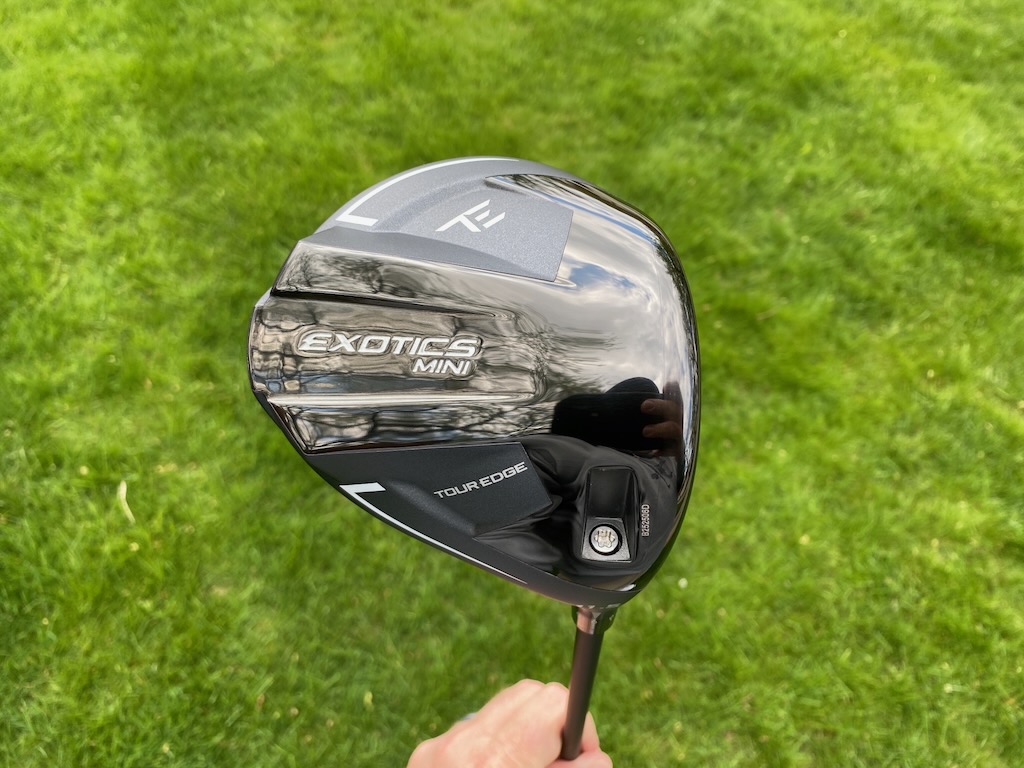
Tour Edge Golf has today introduced the all-new Exotics mini driver, engineered to deliver a powerful combination of speed, control, and versatility in the long game.
The Exotics Mini combines a titanium face with a stainless-steel body in design to balance ball speed with stability and control, creating a versatile option at the top end of the bag.

At the core of the design is Tour Edge’s proprietary Combo Brazing technology, a high-precision thermal bonding process that seamlessly fuses a titanium cup face to a stainless-steel body into a single, continuous structure. By eliminating energy loss found in traditional multi-piece constructions, Combo Brazing is designed to deliver faster face response, more efficient energy transfer, and a uniquely powerful yet controlled feel.

The multi-material construction also allows mass to be positioned lower and deeper in the head in a bid to increase stability, while the thin titanium face is engineered to maintain ball speed across a wider impact area.

“While the initial goal was to enhance control and versatility in the long game, Combo Brazing ultimately drove measurable gains in ball speed and distance within the mini driver category. In robot testing, we’ve documented higher ball speeds, higher launch, reduced spin, and increased carry and total distance compared to leading models.” – Vice President of R&D Matt Neeley

In addition to distance performance, the Exotics mini emphasizes forgiveness through a heavier stainless-steel body that shifts mass toward the perimeter. This configuration increases MOI relative to traditional all-titanium mini drivers, helping preserve ball speed and directional stability on off-center strikes. Paired with Pyramid Face Technology from the Exotics metalwood line, the design is intended to support consistent speed across the face.

To further enhance MOI, a lightweight carbon fiber crown frees additional mass that is strategically repositioned low and deep in the head in design to improve stability and promote optimal launch with controlled spin.

“We designed the Mini to be about five millimeters shallower than other mini drivers on the market. That change improves playability off the deck. From a clean fairway lie, it can function as a strong 3-wood alternative while still providing control off the tee.” – Tour Edge CEO David Glod
An adjustable hosel system allows for loft and lie tuning to dial in trajectory and shot shape, while a fixed 13-gram rear weight helps stabilize the head through impact to improve dispersion consistency. The Exotics Mini Driver is available in 11.5 and 13.5-degree lofts in right-handed models.

Pricing & Availability
The Exotics Mini Driver is available for pre-order beginning today for $399.99 USD at touredge.com, and will be available for purchase at retail outlets worldwide on May 22, 2026.

In our forums, our members have been pitting a Srixon ZXi combo against a TaylorMade P7CB/770 combo. WRXer ‘edutch22’ is on the hunt for a new set of irons and kicks off the thread saying:
“Looking at picking up a new set of irons and think I’ve narrowed it down to Srixon ZXi combo or Taylormade P7CB/770 combo. I am currently a 5 cap and allbeit I feel irons are my weakness. My miss is a little to the toe side. I am decently steep at 4-5 down. Always thought I am high spin but recently on trackman my 7 was spinning at 5800 roughly.
My question or looking for thoughts on which one would benefit me more from a forgiveness standpoint? Or is there another iron is should be looking at entirely? I only get to play about once or twice a week, if I am not playing a 2-3 day event. Thanks in advance.”
And our members have been sharing their thoughts and suggestions in response.
Here are a few posts from the thread, but make sure to check out the entire discussion and have your say at the link below.
- manima1: “You just can’t go wrong with Srixon ZXi7.”
- MattM97: “You have to hit them to know, the V-Sole on the Srixon can be make or break for many.”
- dmeeksDC: “P7CB is more forgiving for me than ZXi7 because my main miss is low middle and the P7CB still flies and spins great on that miss. These are both really nice irons but I like the P7CB more than the Zxi7 and the P770 (or P790) more than the Zxi5. The Srixons are larger so if that gives you confidence that is the way to go. I don’t feel like I get any benefit from the V-sole and the P7CBs live up to their high Maltby forgiveness rating so the TaylorMades have been great for me.”
Entire Thread: “Srixon ZXi combo or TaylorMade P7CB/770 combo? – GolfWRXers discuss”

At GolfWRX, we are a community of like-minded individuals who all experience and express our enjoyment of the game in many ways.
It’s that sense of community that drives day-to-day interactions in the forums on topics that range from best driver to what marker you use to mark your ball. It even allows us to share another thing we all love – buying and selling equipment.
Currently, in our GolfWRX buy/sell/trade (BST) forum, @pianoman0123 has a 2024 Wilson Staff CB/Blade combo up for grabs.

From the listing: “2024 Wilson Staff CB/Blade Combo. 4-8 irons are CB’s and the 9,PW are Blades. 5-PW have Project X 6.0 Shafts and the 4 Iron has a Steelfiber CW110 Stiff Shaft. Standard Length, Lie and Lofts. These are in very good condition the shafts just don’t work for me. Like new Lamkin Grips on the 5-PW and a stock Golf Pride on the 4 Iron. $525 OBO.”
To check out the full listing in our BST forum, head through the link. If you are curious about the rules to participate in the BST Forum, you can learn more here: GolfWRX BST Rules

RBC Heritage Tour Report: More minis, course-specific setups, Spider & GTS launches

Justin Rose WITB 2026 (April): Full WITB breakdown with new McLaren irons

Best fairway woods of 2026: The most versatile fairway woods + the most forgiving fairway woods

Gary Woodland’s winning WITB: 2026 Texas Children’s Houston Open

What’s the story behind Webb Simpson’s custom-stamped irons?

Cadillac Championship Tour Report: Spieth’s sizable changes, McLaren Golf launches, and more

The 24 players who can win the Masters

Rory McIlroy’s winning WITB: 2026 Masters

Kristoffer Reitan’s winning WITB: 2026 Truist Championship

J.J. Spaun’s winning WITB: 2026 Valero Texas Open


Alex Fitzpatrick WITB 2026 (May)
Driver: Ping G440 LST (9 degrees) Shaft: Fujikura Ventus Black 6 X 3-wood: TaylorMade Qi4D (15 degrees) Shaft: Fujikura Ventus...

Kristoffer Reitan’s winning WITB: 2026 Truist Championship
Driver: Ping G440 Max (9 degrees) Shaft: Mitsubishi Tensei 1K White 60 TX 3-wood: Ping G440 Max (15 degrees) Shaft:...


WITB Time Machine: Rory McIlroy’s winning WITB, 2021 Truist Championship
Rory McIlroy’s victory at the 2021 Wells Fargo Championship 2021 (now the Truist Championship) marked a significant return to form,...


Collin Morikawa WITB 2026 (May)
Driver: TaylorMade Qi4D LS (8 degrees) Shaft: Mitsubishi Diamana D+ Limited 60 TX 3-wood: TaylorMade SIM Tour (14 degrees) Shaft:...
-
 Equipment2 weeks ago
Justin Rose WITB 2026 (April): Full WITB breakdown with new McLaren irons
-
 Equipment1 week ago
What’s the story behind Webb Simpson’s custom-stamped irons?
-
 Equipment2 weeks ago
Cadillac Championship Tour Report: Spieth’s sizable changes, McLaren Golf launches, and more
-
Whats in the Bag3 days ago
Kristoffer Reitan’s winning WITB: 2026 Truist Championship
-

 Whats in the Bag1 week ago
Cameron Young’s winning WITB: 2026 Cadillac Championship
-

 Whats in the Bag3 weeks ago
Nelly Korda WITB 2026 (April)
-

 Equipment2 weeks ago
Justin Rose on the switch to McLaren Golf, learnings from previous equipment moves
-

 Tour Photo Galleries2 weeks ago
Photos from the 2026 Cadillac Championship


S
Mar 23, 2026 at 11:23 am
Why not make cars that don’t kill people first? LMAO
Jack
Mar 23, 2026 at 7:46 am
Great article