
Equipment
Kraken Golf Q&A: ‘I’d rather make 50 pieces that matter than 5,000 that don’t’


Kraken Golf was born in a garage in Acushnet, Massachusetts, where founder Marc Cordeira taught himself to machine brass on nights and weekends after a 25-year career in direct marketing.
Eight years later, his CNC-milled ball markers, divot tools and putters sell out in minutes, retired forever after runs of 50 to 100 pieces. In our latest Q&A, Cordeira talks about building a brand by hand, why he refuses to scale into a factory, and the fine line between respecting golf’s traditions and refusing to disappear into them.
Check out the full Q&A below.
Gianni: For those discovering Kraken Golf for the first time, can you tell us how the brand came about?
Kraken Golf: Kraken is the product of a lot of different threads in my life pulling in the same direction. I grew up in Acushnet, Massachusetts, next to the city of New Bedford, a whaling city with real history and real edge, and my dad was a machinist in a factory there. So I grew up around people who made things with their hands for a living.

Kraken’s Caged Peach marker
Art was always part of my life too, the other side of that same coin. Then I went the other direction professionally: got my MBA, spent 25 years in direct marketing, learned how to build brands. What I didn’t have was the shop. So I taught myself machining – nights, weekends, a lot of ruined brass – because I wanted to actually make the thing, not just market it.
“Kraken came out of all of that colliding with a frustration about golf. Every ball marker, every headcover, every accessory in the bag felt like it came off the same conveyor belt. Safe, forgettable, built to blend in.
I wanted to build accessories for the golfer who doesn’t want to look like everyone else on the first tee.”
Who feels the obsession, the hunt, the thing that pulls you back to the course at 6 a.m. on a Saturday, or for me, to the workshop. So I started machining pieces in my shop, ball markers, divot tools, eventually putters, and built the brand around the idea that what you carry in your bag says something about who you are. Eight years later, that’s still the whole thing.
Gianni: Every Kraken product passes through your hands. As the brand grows and demand increases, how do you protect that without burning out? Is there a ceiling to how big Kraken can get before it stops being Kraken?
Kraken Golf: Great question and something I think about often! The ceiling isn’t a revenue number. It’s the moment a customer opens a box and it feels different. That’s the line. Right now every drop is 50 to 100 units, designed once, retired forever. That constraint isn’t a marketing gimmick, it’s the thing that keeps the work honest.
“I’d rather make 50 pieces that matter than 5,000 that don’t.”
As we grow, I’m investing in the capability around me, better machines, better tooling, smarter systems in marketing, shipping and areas that are not product focused. But the design, the finishing, the final inspection, that stays with me. If Kraken ever becomes something a warehouse assembles, it’s dead.
“The goal isn’t to scale into a factory. It’s to scale the myth while keeping my hands on every piece.”
That’s a harder problem than just hiring people, and I’d rather solve it slowly than break the thing that makes this work.
Gianni: How do you decide what to make next? Is it pure creative instinct, or are you listening to what the community is asking for?
Kraken Golf: It’s neither, really. It’s obsession. I make what I can’t stop thinking about. The recent Cloud Nine drop came from looking at fine watchmakers (which is an inspiration for me) and wanting to bring some of that craftsmanship to a ball marker so that it would feel like an object I’d want to hold when I’m not even on the golf course. The Peach Cage drop came out of four failed prototypes, you have to iterate to get to something worth dropping. The community informs some of the energy.

Kraken’s Cloud Nine marker
The Blacklist gives me a real-time read on what resonates with high end collectors, but I’ve learned that if you only build what people ask for, you end up making the same thing everyone else makes. So I like to push boundaries and make things that at first sounds crazy or maybe too out there – those seem to resonate most with people that collect my work. The pieces that sell out in minutes are never the safe ones. They’re the ones where somebody in the community sees it and goes “I didn’t know I needed that until right now.” That’s what I like to make. Not answering demand. Creating it.
Gianni: Golf has traditionally been one of the most conservative sports when it comes to aesthetics and self-expression. You’ve described Kraken as a rebellion against that. Do you feel the culture is shifting, or are you still fighting that battle?
Kraken Golf: The culture is shifting, but the enemy isn’t older, traditional brands (they have their space), it’s the mass-produced middle. I sometimes find companies re-creating my winners at scale which is disappointing. The light pink polo, the mass-produced cast marker you get free at a member-guest, the headcover that looks like every other headcover in the pro shop. That’s what I am against. And yeah, a new generation of golfers are pushing back on all of it. You see it in apparel, in course design, in how people are actually showing up to play. But I’d say we’re still early.
Most of the industry is still built for the golfer who wants to disappear into the tradition.
“Kraken is for the golfer who loves the tradition and wants to stand inside it as himself.”
Those aren’t opposites. The guys wearing a Kraken hoodie on the first tee are usually the ones who can quote Hogan. They just don’t think respecting the game means dressing like a stock photo. They want to have their own identity and nuance, which is what I am like on the putting green as well.
Gianni: You’re based in Acushnet, Massachusetts, the same town as Titleist headquarters. Has that proximity shaped how you think about craft, or is it purely a coincidence?
Kraken Golf: Not a coincidence, but not the way you’d think. Titleist being up the road is a daily reminder that world-class golf manufacturing came out of this part of Massachusetts. That the standard was set here. I don’t compete with them at all, different scale, different game entirely. But there’s something about working in the same zip code as a company that built an empire on getting the small details right. It keeps me honest. You can’t make a half-serious ball marker in Acushnet and feel good about yourself.
View this post on Instagram
The deeper thing, though, is the region itself, New Bedford, the coast, the maritime history. That’s where the Kraken name comes from. Whalers (my high school and significant history in the area), local makers, people who built things by hand, my dad was a machinist in a local factory in New Bedford. That’s the lineage I’m actually pulling from. Titleist is the neighbor. The whaling port is the blood.
Gianni: What’s next for Kraken Golf? Are there product categories or collaborations you haven’t explored yet that excite you?
Kraken Golf: Apparel is the big one. Right now it’s a small percentage of revenue, however its a focus area moving forward, hoodies and tees, headwear, etc. perhaps with the same one-design-one-drop philosophy plus stock offerings as well. Some pieces retired. I’m also deep in putters as art work as well as other forms of golf art that might break some moulds in the industry, opening some new aesthetic language for collectors.
“Beyond product, the real frontier is the community.”
The Blacklist is 200 members right now; I want to build that into something closer to a private club: app-based, gamified, concierge-level. Not only early access and members-only drops, but experiences. Collaborations I’ll say less about, but I’ll give you the filter: I will only partner with people and brands whose work I respect. I am picky. The brand took eight years to build. I’m not trading that for a check.


Equipment
Spotted at the PGA Championship: Koepka’s new putter, L.A.B. Golf’s latest prototype and custom Philly gear

Aronimink Golf Club takes center stage for the 2026 PGA Championship, as the world’s best, along with America’s top club pros, take on the Donald Ross classic, just outside Philadelphia in Newtown Square, Pennsylvania.
Even on the first official practice day of the championship, there was plenty of gear news and storylines to dive into, with a three-time champion going through an extensive putter testing, as well as new prototype putters spotted and custom gear galore. Let’s dive into it.
Brooks Koepka’s putter testing
Three-time PGA Championship winner Brooks Koepka spent plenty of time Monday morning and into the afternoon on the practice putting green in front of the Aronimink clubhouse, working with coaches and Tour reps and putting plenty of different flasticks through their paces, after apparently recently breaking his new TaylorMade Spider Tour X last time out at the Myrtle Beach Classic.
Koepka tested out a couple of Scotty Cameron heads, similar to that of Cameron Young’s Phantom 9.5R with a full sightline. It’s not the first time a Tour pro has asked to follow in Young’s footsteps. Justin Thomas had the same request last week at the Truist Championship. Why not follow the hot hand?
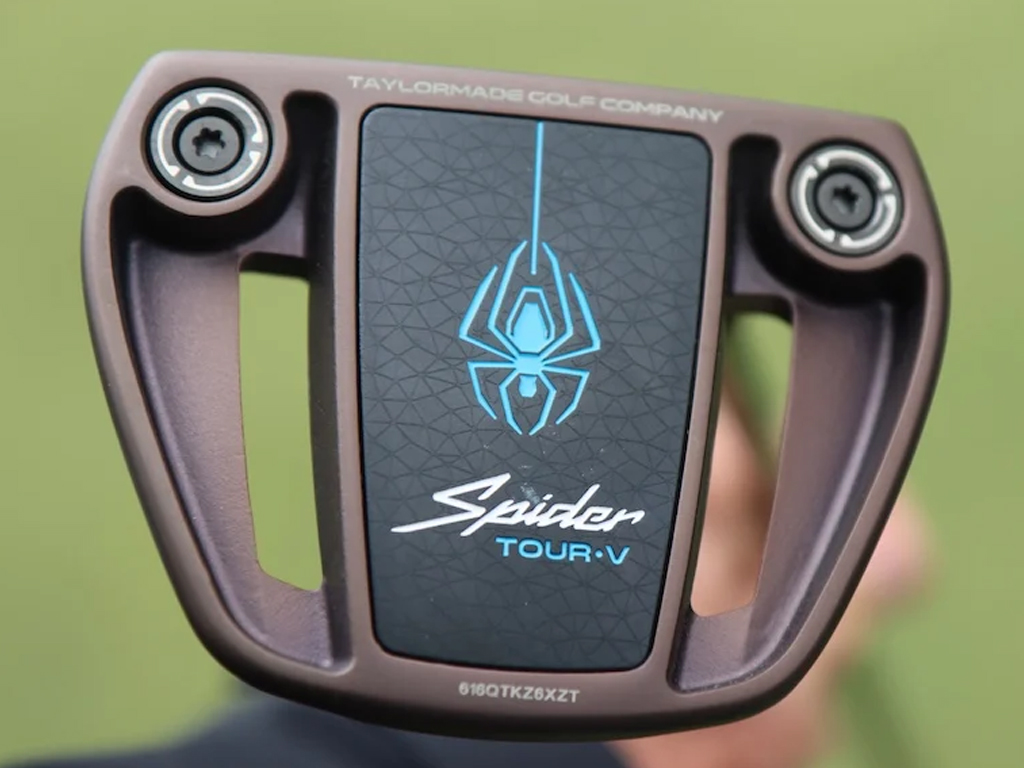
Koepka’s custom Cameron featured the same style Teryllium insert that he has used previously, most notably during his PGA Championship wins in a Newport-style blade. The putter, however, that looks to have the best chance of making its way into the bag come Thursday is a TaylorMade Spider Tour V, the model of head recently launched on Tour at the RBC Heritage.

What’s unique about Koepka’s new Tour V putter is the custom length L-Neck (plumbers) hosel that he has equipped. The extended version looks ot reduce the toe-hang of the putter along with adding stability to the stroke.

The putter change comes with a plethora of additions to Keopka’s bag after his split with Srixon/Cleveland. Along with already playing a Titleist ist Pro V1x golf ball, Koepka added Vokey wedges to his Grove XXIII staff bag last week in South Carolina. The 36-year-old is using SM11s in 48.10F, 52.12F and 56.10, along with the WedgeWorks 60B, a special grind with an interesting letter choice.
Look at Koepka’s full bag here.
L.A.B. Golf’s new vision
As GolfWRX continued the long tradition of capturing players’ bags and equipment, we got a glimpse of the latest L.A.B. Golf putter in the bag of Adrian Saddier. The Frenchman, who’s making his PGA Championship debut at Aronimink, is rolling with the newly added VZN.1i putter, which features a closed-back, winged-mallet design, resulting in a square cutout in the middle of the mallet.
Saddier’s new stick is center-shafted with two thick white alignment lines. The VZN.1 is the latest L.A.B. putter to be spotted. It comes after the traditional blade-style LINK.2.1 & LINK.2.2 were released on Tour, featuring a heel-shaft.

Take a look at the full gallery here.
Custom Philly-themed gear
As with every major championship, the PGA sees a bevy of custom gear from equipment manufacturers to highlight the theme of the week. With Aronimink sitting just west of Philadelphia, the City of Brotherly Love takes full focus.
Callaway is ringing the Liberty Bell with its Philly special-edition staff bag that tour players will be rocking at Aronimink. The bag features a pin-striped design, embossed with the Liberty Bell itself and a special green-fluff strap for the Philadelphia Phillies’ mascot, the Phillie Phanatic.

TaylorMade is also theming the staff bag around the birth of a nation, with a specially crafted staff back to celebrate the city where American independence was born. The bag features Philadelphia’s fingerprints with Independence Hall lives on the ball pocket, the Liberty Bell graces the valuables pocket, and Benjamin Franklin holds court on the back. The bottom collar reads – City of Brotherly Love – and custom “LOVE” zipper pulls pay tribute to the iconic Robert Indiana’s sculpture situated in the city center.
Tileist has adopted a different design for its GTS headcovers, going with Kelly Green, for the 2025 Super Bowl-winning Philadelphia Eagles.
Check out more custom gear in the forums.


Driver: Ping G440 LST (9 degrees)
Shaft: Fujikura Ventus Black 6 X

3-wood: TaylorMade Qi4D (15 degrees)
Shaft: Fujikura Ventus TR Black 7 X

7-wood: TaylorMade Qi4D (21 degrees)
Shaft: Fujikura Ventus Black 9 TX

9-wood: TaylorMade Qi4D (21 degrees)
Shaft: Fujikura Ventus Black 9 TX

Irons: Titleist T100 (5-9)
Shafts: Nippon N.S. Pro Modus 3 Tour 120 X (5-9)

Wedges: Titleist Vokey Design SM11 (46-10F, 50-12F, 56-14F), WedgeWorks (60-A+)
Shafts: Nippon N.S. Pro Modus 3 Tour 120 X (46, 50), True Temper Dynamic Gold Tour Issue S400 (56, 60)

Putter: Odyssey Ai-One #7S

Grips: Golf Pride MCC
Ball: Titleist Pro V1x

Today is a very special day for the Lead Tape Hall of Fame. Our second inductee is announced, and with great honor, we welcome Hideki Matsuyama to the Silver Jacket ceremony. Hideki’s meticulous attention to detail and precision have earned him his place in the Lead Tape Hall of Fame.

Hideki turned professional in 2013 and began his career on the Japan Tour. He was the first rookie on the Japan Tour to lead the money list, highlighted by five wins in his first season. His first appearance on the PGA Tour was the 2013 U.S. Open at Merion, where he came in 10th place in his debut. In 2014, he won his first PGA Tour event at Memorial. Hideki is currently at 11 PGA Tour wins, including a scoring record at The Sentry in January 2025 at 35 under par. In 2021, he won The Masters. An incredible career and still full of momentum, what kind of tools does Hideki use to get in the mix week in and week out?
Matsuyama has been a career Srixon and Cleveland staff player. Typically with Graphite Design shafts in his woods and True Temper Dynamic Gold S400 shafts in his irons. A unique trait is that in his wedges, he will play X100 shafts that suit his launch preferences. Rarely do you see a stiffer profile in wedges compared to irons.


Speaking of wedges, Hideki plays the Cleveland RTX4 Forged wedges. These debuted in 2018, but due to his level of detail, this is what he plays today. You can see the lead tape placed on the wedges in different places on the back flange. Usually erring towards the heel promoting certain launch characteristics and if anything a slight draw ball flight. In a 2021 GolfWRX interview, we found Hideki does not want to see the ball fall to the right. He wants the ball to fall to the left.

We see the use of lead tape on clubs like his fairway metal, where we see a small strip near the ferrule and even at the base of the grip. Looking at the details, Hideki operates; everything is done with purpose and measured for his stats. Not the type of feel player that doesn’t know how much weight is where and says, “That’s fine.”

Srixon told us, “We also travel with pre-cut lead tape in half-gram and one-gram increments, and Hideki will apply the tape to different areas of the club (muscle, flange, hosel, shaft), depending on how the club feels while testing.”
Hideki and his team have his club spec’d to the half gram for what to add or subtract from his set. This is Hall of Fame level here, nearly alone, but with Hideki’s meticulous attention to detail for each club is amazing to see.
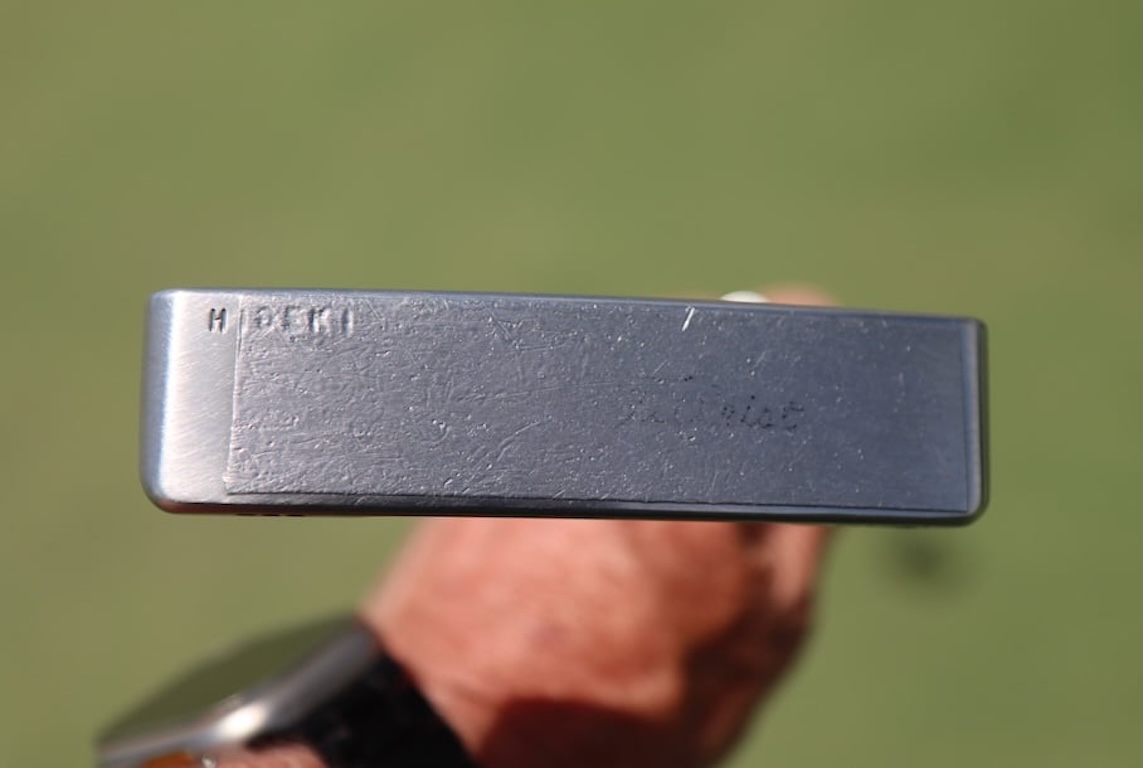
This attention to detail carries down to the putting green as well. Hideki rotates through a series of Scotty Cameron Newport putters with subtle changes on sightlines, bumpers, and welded plumber’s necks. Sometimes on the bottom of the putter? A strip of one-inch lead tape. The tape has been on there so long that you can see the hand-stamped logo underneath. That is absolutely Hall of Fame grade!


It is incredible to see through the lens of the level of detail that Hideki operates in. We see lead tape anywhere from the shaft, above the hosel, in different positions on the back flange of wedges, and on the bottom of the putter. The precision he brings to the course has translated into a record of winning results from the beginning. We will have to stay tuned if his new Silver Jacker accompanies his Green Jacket in the trophy room!
RELATED: Lead Tape Hall of Fame: Why Scott Piercy is a first ballot inductee

RBC Heritage Tour Report: More minis, course-specific setups, Spider & GTS launches

Justin Rose WITB 2026 (April): Full WITB breakdown with new McLaren irons

Best fairway woods of 2026: The most versatile fairway woods + the most forgiving fairway woods

Gary Woodland’s winning WITB: 2026 Texas Children’s Houston Open

What’s the story behind Webb Simpson’s custom-stamped irons?

Cadillac Championship Tour Report: Spieth’s sizable changes, McLaren Golf launches, and more

The 24 players who can win the Masters

Rory McIlroy’s winning WITB: 2026 Masters

J.J. Spaun’s winning WITB: 2026 Valero Texas Open

Cameron Young’s winning WITB: 2026 Cadillac Championship


Alex Fitzpatrick WITB 2026 (May)
Driver: Ping G440 LST (9 degrees) Shaft: Fujikura Ventus Black 6 X 3-wood: TaylorMade Qi4D (15 degrees) Shaft: Fujikura Ventus...


Kristoffer Reitan’s winning WITB: 2026 Truist Championship
Driver: Ping G440 Max (9 degrees) Shaft: Mitsubishi Tensei 1K White 60 TX 3-wood: Ping G440 Max (15 degrees) Shaft:...


WITB Time Machine: Rory McIlroy’s winning WITB, 2021 Truist Championship
Rory McIlroy’s victory at the 2021 Wells Fargo Championship 2021 (now the Truist Championship) marked a significant return to form,...


Collin Morikawa WITB 2026 (May)
Driver: TaylorMade Qi4D LS (8 degrees) Shaft: Mitsubishi Diamana D+ Limited 60 TX 3-wood: TaylorMade SIM Tour (14 degrees) Shaft:...
-
 Equipment2 weeks ago
Justin Rose WITB 2026 (April): Full WITB breakdown with new McLaren irons
-
 Equipment7 days ago
What’s the story behind Webb Simpson’s custom-stamped irons?
-
 Equipment2 weeks ago
Cadillac Championship Tour Report: Spieth’s sizable changes, McLaren Golf launches, and more
-
 Whats in the Bag1 week ago
Cameron Young’s winning WITB: 2026 Cadillac Championship
-
Whats in the Bag3 days ago
Kristoffer Reitan’s winning WITB: 2026 Truist Championship
-

 Whats in the Bag3 weeks ago
Nelly Korda WITB 2026 (April)
-

 Equipment2 weeks ago
Justin Rose on the switch to McLaren Golf, learnings from previous equipment moves
-

 Tour Photo Galleries2 weeks ago
Photos from the 2026 Cadillac Championship


MrHogan
Apr 29, 2026 at 6:14 am
That’s not a ball marker, it’s a man hole cover.
woody
Apr 27, 2026 at 11:26 pm
I’d be pissed if my chip from off the green didn’t go into the hole because it hit one of these obnoxious Kraken Golf markers that sit above the surface of the green
James Cormack
Apr 28, 2026 at 11:47 am
I agree, although these are great work and great designs I think the poker chip style marker should be banned from golf, I have seen it on the LPGA where a ball hits one of these and diverts away from the hole. Make markers markers again, you can still have these designs on something more flush with the ground. Poker chips are just a brah thing, pointless accessory.