
Opinion & Analysis
Using statistics and launch monitor data to shoot lower scores

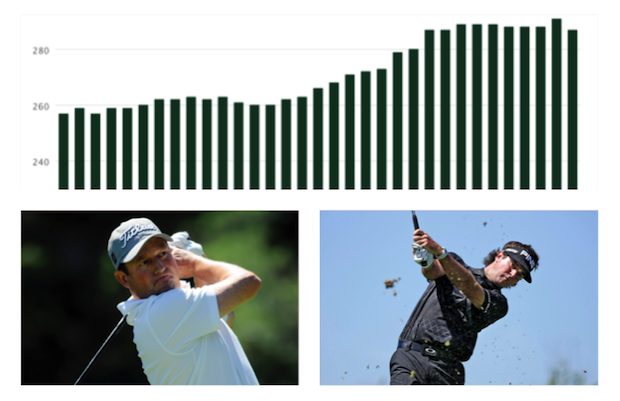
As a statistician who works with PGA Tour players, I’m frequently asked by aspiring Tour players and their coaches what statistics they can use to measure themselves against Tour players.
The mistake with this question is that the playing grounds for aspiring Tour players and actual PGA Tour players are often different. In fact, metrics on the PGA Tour can change drastically from one event to another. For instance, the average make percentage of putts from 3-to-5 feet for the year is roughly 87 percent. At the AT&T Pebble Beach National Pro-Am, however, the average make percentage for professionals from 3-to-5 feet was only 76 percent. Thus, a golfer that made 80 percent of their putts from 3-to-5 feet would be putting poorly on many Tour courses, but doing better than average at Pebble Beach. And the same applies for shot proximity to the cup. Some courses are easier than others and for aspiring Tour players. It is not easy to gauge their performance versus the PGA Tour players performance since it depends on the degree of difficulty of the course.
Don’t get me wrong. I do think that using PGA Tour benchmarks can be useful, but expecting that they will provide golfers with an accurate depiction of how the average Tour player would perform on a course is misleading at best. Instead, I advise golfers to focus on what I call their “game profile.” A game profile is various strengths and weaknesses of a golfer’s game. It’s how well they putt, drive the ball, what happens when they drive it effectively or ineffectively, how well they hit their short approach shots, mid-length approach shots and long approach shots and how well they perform with their short game around the green.
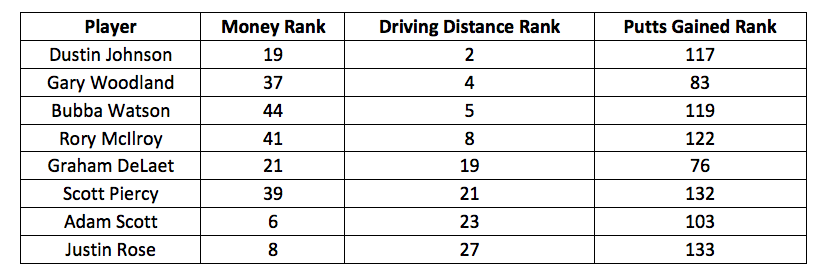
The game profile starts with power and how far a golfer hits the ball off the tee. How far a golfer hits the ball dictates what the rest of their game will generally have to look like in order to achieve success. But first, what we should understand is that the biggest advantage to hitting the ball far is that it affects how well golfers will have to putt the ball. And the farther a golfer hits the ball, the more likely he or she can get away with poor putting. Here is a chart showing many of the super-long hitters on Tour and their 2013 PGA Tour performance in money, driving distance and the strokes gained – putting categories.
Conversely, here’s a look at the shorter hitters on Tour that were successful and their rankings.
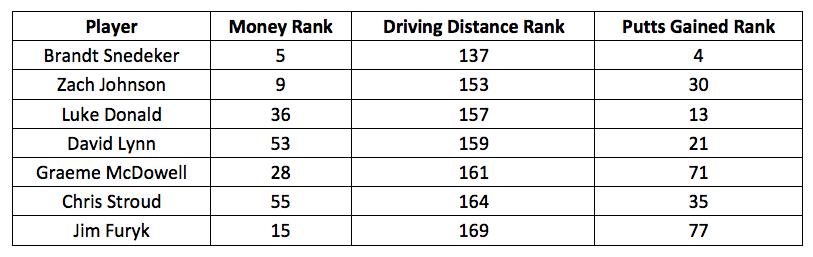
The biggest reason why the long hitters can get away with weaker putting is that they often have the distance to play the par-5’s in two shots like they are par-4’s. And they are getting more birdie opportunities on those holes, because they’re often hitting it closer to the cup.
The problem with using distance for the aspiring Tour player is that virtually every golfer who tells me how far they hit the ball will give me a number of when they hit the ball the best without the weather conditions affecting their distance. Even Tour players do not consistently make great contact with the ball and are far from being overly consistent with how far they hit their driver.
And that is where launch monitors can help. In 2013, the average club head speed on Tour was 113.6 mph. The highest club head speed was 124.5 mph by Charlie Beljan, and the lowest was 104.7 mph by Jin Park. These numbers should give an initial indication of how much power a golfer has compared to the Tour.
Another important factor to consider is the attack angle. I am not trying to advocate any particular attack angle for a golfer. We know that all things being equal, the more golfers hit up on the ball with a well-fit driver the farther the ball will travel. Therefore, if a golfer has a very downward attack angle, but generates 113.6 mph of club head speed, he or she is effectively now as powerful off the tee as a golfer that may have less club head speed, but hits well up on the driver.
Lastly, we need to consider the Apex Height. The average apex height of a Tour player in 2013 was 96.9 feet. The highest was 131.7 feet by Jason Day. And the lowest apex height was 67.5 feet from Scott Langley. There is a statistical correlation between a player’s apex height and success on Tour. While it is not a strong mathematical correlation, it is substantial enough that it warrants attention. Obviously, golfers with higher club head speeds generally will hit the ball higher, but there are many low club head speed players that hit the ball high and have had resounding success like Brandt Snedeker, Ben Crane, Mark Wilson and Luke Donald, to name a few. What my research has uncovered is that there are too many courses on Tour that favor golfers with higher ball trajectories. I attribute this to the modern course designs, which have more forced carries than older courses.
Once a golfer gets their club head speed and attack angle readings, they can start to determine how much power they have off the tee compared to the rest of the Tour. And for any player, I generally recommend a goal of keeping their fairway bunkers hit to under 5 percent (roughly one fairway bunker hit every other round). As far as hitting the fairways goes, it is rather simple. The farther golfers hit the ball, the lower percentage of fairways they have to hit. Here is a chart of the recommended goal of fairway percentage hit based on club head speed in order to be effective off the tee:
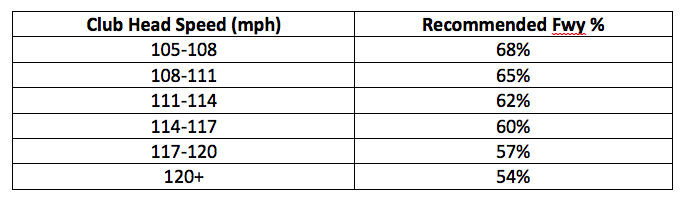
When we examine the table showing the successful lower club head speed players and putting combined with the recommended fairway percentages by club head speed table, we start to see that it becomes virtually impossible to make the PGA Tour if you cannot generate at least 104 mph of club head speed. Once a golfer gets below 104 mph, it requires them to hit such a high percentage of fairways and to putt so incredibly well that they are going to have a hard time keeping their card because golfers can only be so accurate and putt so well.
This leads into power and its influence on the game profile and the player’s ability to hit approach shots. I break down approach shots into three different zones:
- Birdie Zone (shots from 75-to-125 yards)
- Safe Zone (shots from 125-to-175 yards)
- Danger Zone (shots from 175-to-225 yards)
In general, the Danger Zone is the most important zone in golf. In fact, it has the strongest mathematical correlation to success on Tour. Regardless of club head speed, the player’s performance on Tour is largely dictated by how well they play from the Danger Zone. And there is not a substantial correlation between club head speed and Danger Zone play.
My research leads me to believe that this is because the Danger Zone shots requires golfers to have directional and distance control, whereas shots from the Birdie and Safe Zones are more distance-control oriented. The angle for error from the Danger Zone diminishes because it is such a long shot. So while generating more club head speed will have golfers hitting shorter clubs from the Danger Zone, the angle of error diminishes so much that golfers with slower club head speeds like Jim Furyk, Zach Johnson, Luke Donald and Graeme McDowell can get the advantage because of their superior directional control from this zone.
What often happens with the long hitters is that they may not actually be that skillful with their irons, but still rank well from the Danger Zone. This is because most of their Danger Zone shots are coming on the Par-3’s. When the rest of the field is playing a long par-4 and can only manage to leave themselves with 175-to-225 yard shots into the green, the long bombers can hit their drives to 125-to-175 yards. This is one of Bubba Watson’s strengths, because historically he has not been a good iron player. If there was a contest from 200 yards between Bubba and Jim Furyk, I would take Furyk. The difference is that in competition Bubba is hitting his approach shots from a much shorter distance than Furyk the majority of the time and that levels the playing field, or even gives the advantage to the lesser skilled iron player.
As I discussed earlier, the shorter hitters normally have to putt better because they cannot hit their second shots as close to the hole on the par-5’s as the long hitters. This also means that slower club head speed players need to hit it better from 100-to-150 yards in order to catchup to the rest of the field on those par-5’s. Shots from 100-125 yards are generally where the shorter hitter will end up laying up to. Even if their “money yardage” is less than 100 yards, the majority of the time they can only lay up to 100-to-125 yards. And if they hit a weaker tee shot, then their lay-up shot tends to move more towards 125-to-150 yards.
Here is a table showing some notable players’ 2013 ranking on shots from 100-to-125 yards and their club head speed with the driver.
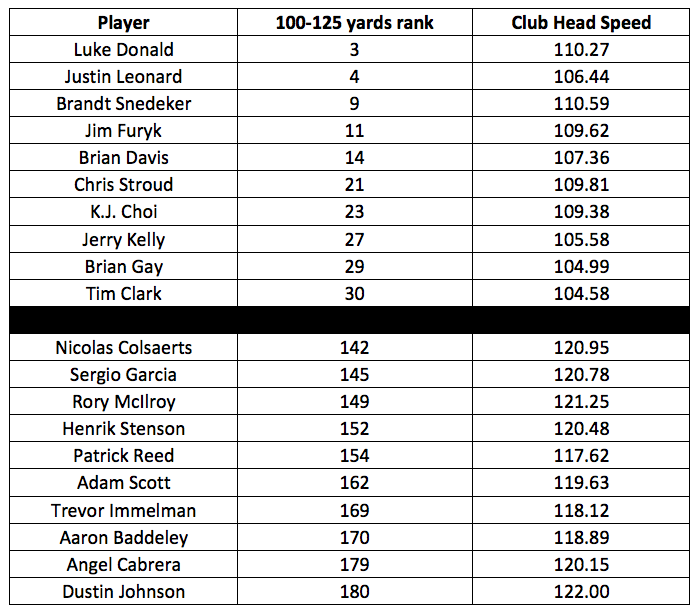
If the higher club head speed players were better from 100-to-125 yards, it would have a positive impact on their performance. However, due to their high club head speed, performing well from 100-to-125 yards is a lower priority than it is for the lower club head speed players.
The game profiles are something that the average amateur can use as well. For example, golfers who play to a 10 handicap but hit the ball short for that handicap level and do not foresee themselves increasing their club head speed substantially in the future may want to follow the example set. There is a warning; the distance of the “Zones” changes for amateurs because they are playing shorter courses. So if golfers are playing courses that are roughly 6,000-to-6,300 yards, their ‘Danger Zone’ will about 150-to-200 yards and the Birdie Zone will be about 50-t0-100 yards. But the same game profile concept will remain the same.
The shorter-than-your-average-10 handicap player may want to work more on his putting, focus more on hitting more fairways and on his wedge play. The longer-than-your-average-10 handicapper may want to focus on keeping his drives in play more often so they can use that length to his advantage. This can help players from all levels take the path needed to shoot better scores.



Aronimink is not a storied club, but when Donald Ross himself proclaimed it to be as good as he can design and build, one had to take notice. Jay Sigel was the pre-eminent male amateur golfer from the mid-1970s to the mid-1990s. He might have called any number of Philadelphia clubs home, but he chose Aronimink. It served him well. Gary Player won a PGA Championship here in 1962, and was followed by the 1993 winner … nobody. Aronimink gave that event away to Inverness, for reasons of which it is certainly not proud. So be it. We had to wait sixty-four years for the PGA to return to Newtown Square, but here we are. Aronimink has been neo-restored by Gil Hanse and team, to return Ross features with an eye toward defense against the dark arts, errrr, high-tech equipment.
Day one saw Rory McIlroy and Bryson DeChambeau dig big holes, to the tune of plus-four and plus-six, respectively. Since the first-round lead will be minus-three at worst, many shots will need to be made up for the power couple to reach contention. By nightfall, seven golfers held the day-one lead at three-under par 67. Shots and sticks caught our attention, and we are proud to present Five Things We Learned on Tech Thursday at the 2026 PGA Championship. Thanks to InsideTourGolfer, Today’s Golfer, and GolfWRX for initial equipment research.
First, meet Min Woo Lee
Min Woo Lee, aka Dr. Chipinski, has once again thrust himself into the conversation of Can he, will he, when will he? Lee has so much talent, wins not nearly as often as we believe that he should, and has no major near-misses (much less titles) on his wiki. The young Aussie is getting older and wiser, but is he able to avoid the scarring that holds the older and wiser back from breaking through? Philadelphia offers another opportunity. Min Woo signed for five birdies and two bogeys on day one, and grabbed a share of the opening-day lead at Aronimink. Winners transcend history and the moment, and Lee will need that sort of ascent to lift the Wannamaker on Sunday.
Second, meet Aldrich Potgeiter
The young South African golfer can rip driver with the best of them. Aronimink tips out at nearly 7400 yards, but beyond the fairway bunkers that ensnare only the mortals, Potgeiter can take his chances with wedge from the rough. On Thursday, he spent plenty of time in the spinach. Like Popeye, he used his muscles to gouge and thrash and dig his way out. Six birdies against three bogeys on the card brought AP in a three deep.
Third, meet Martin Kaymer
Not a major event takes place without a where’s he been throwback moment. We know that Martin Kaymer left the PGA and DP World tours for LIV golf, but the two-time (US Open and PGA) major winner has a lifetime exemption into at least one major event, and he seizes the opportunity each May. Kaymer joined the six-seven brigade with four birdies and a solitary bogey on day one. Kaymer was never a long hitter, and the years are kind to no golfer. The German champion will need to uncork every bottle of guile and strategy in his cabinet to remain in contention. For today, though, he occupies a rung on the ladder of Tour Tech.
Fourth, meet Scottie Scheffler
Let’s see, he’s the defending champion at the PGA, and he found his way back to the top tier with five birdies against two bogeys. To be a favorite and then play up to that stature and expectation is quite difficult. Just ask Rory, Bryson, and some of the other pre-tournament heartthrobs. Scheffler’s game is complete, and to knock him off the OWGR #1 pedestal, one needs to defeat him at the majors. Aronimink is the sort of course that fits Scheffler’s game. Better yet, it unfits the game of many of his challengers. Don’t expect Scheffler to go away anytime soon. Come Sunday, he’ll be around.
Fifth, meet Stephan Jaeger
Clocking in for the unheralded players shift are Ryo Hisatsune and Stephan Jaeger. Hisatsune logged seven birdies on day one, but gave most of them back with four bogeys. Still, he’s tied at the top for a time. Jaeger pitched five birdies against two bogeys, including a run of three consecutive, from holes four through six. Odds are that one of the two will hang around through 36 holes. Odds also suggest that both will be gone by Saturday evening. Still, the PGA Championship has historically been the major most likely to be won by an under-known. Both Hisatsune and Jaeger feature on that list, so good luck, lads!

On this episode of the Club Junkie Podcast, I head to the Titleist Performance Institute for a full driver fitting with the new Titleist GTS lineup. We dive into the fitting process, talk about what made the biggest difference in performance, and break down how the different GTS heads and shaft combinations compare on the launch monitor. If you are thinking about a new driver setup for this season, there is a lot to take away from this one.
I also get into Brooks Koepka and the gear setup he brought to the PGA Championship, including the putters that caught my eye during the week. There are some interesting equipment trends showing up at the highest level right now and we break down what stands out.
To wrap things up, I talk about reshafting a few wedges, what I learned during the process, and swapping an adaptor onto a new shaft for another build project in the shop. A gear packed episode from start to finish for anyone who loves golf equipment and club building.
Follow Club Junkie everywhere:
Instagram: https://www.instagram.com/clubjunkiepod/
X: https://x.com/ClubJunkiePod
TikTok: https://www.tiktok.com/@clubjunkiepod
Threads: https://www.threads.com/@clubjunkiepod
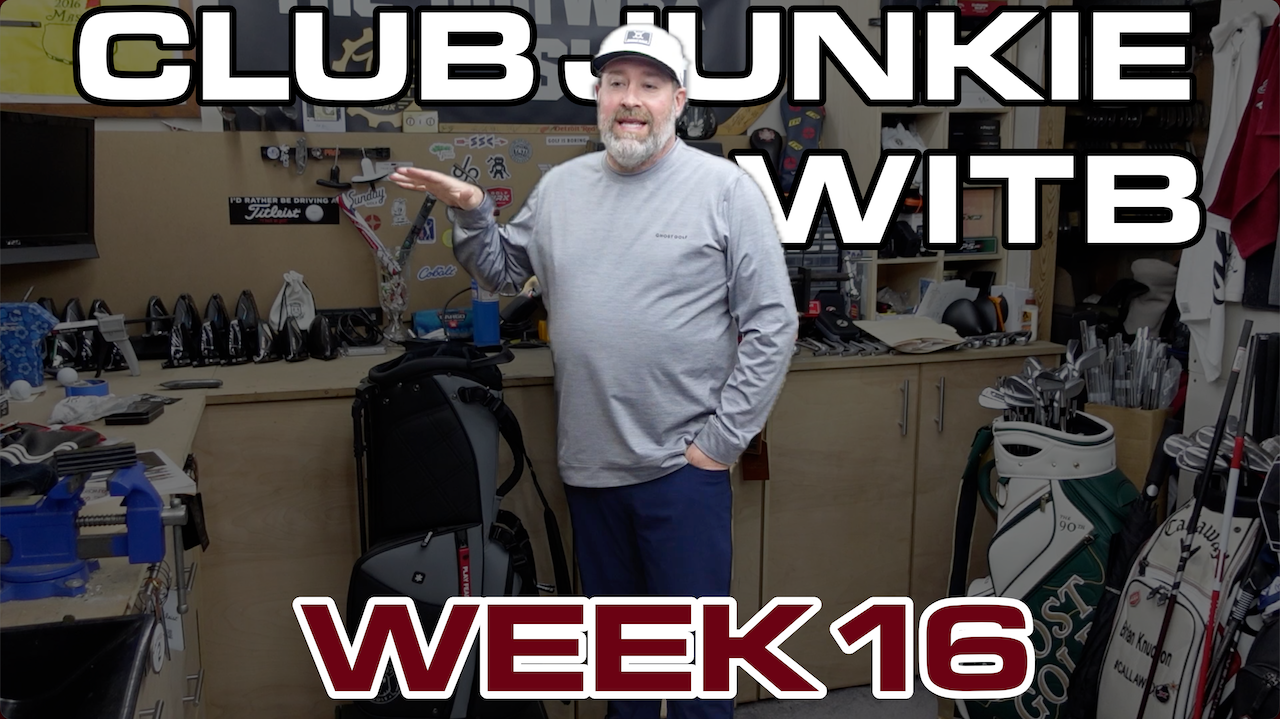
Excited for this week’s WITB as we get to add the new Titleist GTS woods to the bag! I was fit at Titleist’s TPI facility in Oceanside California a few weeks ago and my new clubs just showed up. I am also adding a cool set of irons that I built last year some wild custom wedges into a new golf bag. Speaking of the bag I have a new Ghost Anyday Black Ops stand bag that I will be using on my Motocaddy Remote M7 electric cart.
Driver: Titleist GTS3 (11 degrees @ 10.25)
Shaft: Fujikura Ventus Red 6s
3-wood: Titleist GT1 3Tour (14.5 degrees)
Shaft: Graphite Design Tour AD CQ-7s
5-wood: Titleist GTS (18 degrees)
Shaft: Fujikura Ventus Red 7s
9-wood: Titleist GT1 (24 degress)
Shaft: Fujikura Ventus Red 7s
Irons: Bettinardi CB24 (5-PW)
Shafts: KBS C-Taper Lite 110 stiff
Wedge: TaylorMade MG5 (50-09 SB)
Shaft: Mitsubishi MMT 125 Stiff
Wedge: TaylorMade MG5 (56-12 SB)
Shaft: Mitsubishi MMT 125 Stiff
Wedge: TaylorMade MG5 (60-08 LB)
Shaft: Mitsubishi MMT 125 Stiff
Putter: Dan Carraher ZT Proto
Ball: Callaway Chrome Tour
Bag: Ghost Anyday Black Ops Stand Bag

Justin Rose WITB 2026 (April): Full WITB breakdown with new McLaren irons

RBC Heritage Tour Report: More minis, course-specific setups, Spider & GTS launches

What’s the story behind Webb Simpson’s custom-stamped irons?

Cadillac Championship Tour Report: Spieth’s sizable changes, McLaren Golf launches, and more

Kristoffer Reitan’s winning WITB: 2026 Truist Championship

Cameron Young’s winning WITB: 2026 Cadillac Championship

Aaron Rai’s winning WITB: 2026 PGA Championship

Nelly Korda WITB 2026 (April)

Justin Rose on the switch to McLaren Golf, learnings from previous equipment moves

Photos from the 2026 PGA Championship


Patrick Reed WITB 2026 (May)
Driver: Titleist GT3 (9 degrees) Buy here. Shaft: Aldila Rogue Silver 130 M.S.I. 70 TX 3-wood: TaylorMade Qi35 (15 degrees)...

Aaron Rai’s winning WITB: 2026 PGA Championship
Driver: TaylorMade M6 (9 degrees) Shaft: Aldilda Synergy Blue 70 TX 3-wood: TaylorMade Qi10 (15 degrees) Shaft: Fujikura Ventus Blue...


Michael Block WITB 2026 (May)
Driver: TaylorMade Qi4D (9 degrees) Shaft: Fujikura Ventus Black VeloCore+ 5 X 3-wood: TaylorMade Qi4D (15 degrees @14.25) Shaft: Mitsubishi...


Bryson DeChambeau WITB 2026 (May)
Driver: Krank Formula Fire Pro (6 degrees) Shaft: Project X Prototype 3-wood: Krank Formula Fire (10 degrees) Shaft: LA Golf BAD...
-
 Whats in the Bag3 weeks ago
Kristoffer Reitan’s winning WITB: 2026 Truist Championship
-
Whats in the Bag2 weeks ago
Aaron Rai’s winning WITB: 2026 PGA Championship
-
 Tour Photo Galleries3 weeks ago
Photos from the 2026 PGA Championship
-
 Equipment2 weeks ago
GolfWRX Launch Report: 2026 Titleist GTS drivers
-

 Equipment2 weeks ago
PGA Championship Tour Report: Fitzpatrick, Koepka among big-name putter switches for Aronimink
-

 News2 weeks ago
WITB Time Machine: Phil Mickelson’s winning WITB, 2021 PGA Championship
-

 Equipment2 weeks ago
Which of Tiger’s major winning irons are your favorite? – GolfWRXers discuss
-

 Equipment2 weeks ago
Lead Tape Report: Adjusting the swingweight of the Wanamaker Trophy


Hudson
Apr 2, 2014 at 4:58 pm
I have recently calculated on a full round of 18 holes the gained/lost strokes compared to a PGA pro and based on the “gained stokes concept” implemented by Mr Broadie.
Let me share with you my results that will interest quite a few of you down here 😉
The great advantage of the method is that it quantifies the number of strokes you loose on each part of your game. I found this new concept a revolution ! I for example can now focus on my long game (>165 yards)of my game where I “lost” 6 strokes last week…
See below the complete calculations and explanations I made:
http://golf-made-in-us.blogspot.com/2014/04/golf-stats-revolution-gained-strokes.html
Mike
Mar 14, 2014 at 10:33 am
Great read, thanks for posting it. One question: are those tour statistics readily available for the average person to see?
Peter Maki
Mar 14, 2014 at 1:48 am
Great article. As a mechanical engineer aspiring to play professionally I enjoy reading this technical analysis type stuff. Keep it up!
RollTheRock
Mar 13, 2014 at 10:29 am
Great article, but how do I know if I am a “shorter than average 10-hcp”? Do you have a table with average distance per handicap?
RollTheRock
Mar 13, 2014 at 10:50 am
As a follow up, if you are a shorter than average 10, and you improve upon the other aspects of your game, your handicap will drop, making you a significantly shorter than average 6 or wherever you get to. It almost seems like there is an implied floor to how low your handicap can within reason based on distance off the tee. If you hit the ball 250, which is average for let’s say a 10hcp, and get down to a 5, to improve further assuming you can’t get any more distance off the tee, you would have to become incredibly accurate or an amazing putter. It would be awesome if there was some way to quantify this. A chart or data that says to be a scratch golfer with an average distance of 250yds off the tee, you would typically have to hit x% of fwys, gain y strokes from the danger zone, and gain z strokes putting. And then perhaps be able to play with x, y and z. For instance, I can hit x% of fairways but I don’t gain enough strokes in the danger zone, however I can gain z+ strokes putting.
Sorry for the nerd rant, but that would be cool.
Philip
Mar 13, 2014 at 11:53 am
I second the request for that info, if available. Definitely would be cool to have!
Richie Hunt
Mar 13, 2014 at 1:47 pm
That was one of the parts I struggled with. There were some researchers from Australia that did research and found that handicap and club head speed do have a very strong correlation to each other. They did a regression analysis to come up with a handicap to ball speed analysis, but I could not get the formula to compute correctly. Something I am working on.
anonymous
Mar 14, 2014 at 9:57 am
http://www.nytimes.com/2008/07/21/sports/golf/21pennington.html?pagewanted=all&_r=0
This is a related article on what to work on based on statistical analysis.
Basically, you take your fractional remaining length (distance remaining to target / total distance from original spot). If your FRL is ~5-6% you should be hitting it 297 yards, ~8-9% 248 yards, ~12% 237 yards, 17.3% 216 yards. If you hit it farther, work on your short game, if you hit it shorter work on your long game.
joe sixpack
Mar 13, 2014 at 12:02 am
This is definitely better than your article last August about whether Trackman is ruining golf.
I have 2 beefs with this.
First, the title. “Statistics & Launch Monitor Data”. The only launch monitor data you use in this article is club head speed. All of the rest of the data is from Shotlink. You mention that it’s important to hit up on a driver and it helps to hit a high ball, but you give no analysis or data on these issues. When I clicked on this story, I was expecting something about Trackman and all of the awesome data it provides. I felt teased.
Second, what is your main point? Shorter hitters need to be straighter drivers, better wedge players and better putters to compete with longer hitters? Duh! Do you need to crunch a bunch of data to convince people of that?
The structure of this article is also a bit of a mess.
Here’s an outline of your article:
– Tour averages vary from course to course. (So what? This has nothing to do with the rest of your article.)
– Pros need to look at their individual strengths and weaknesses.
– The longer you hit the ball, the worse you can be at putting and still compete.
– Shorter hitters that succeed on tour are good putters.
– Launch monitors help you maximize distance for a given swing speed.
– Longer hitters don’t have to hit as many fairways to be competitive.
– Longer hitters have shorter and easier approach shots.
Your argument boils down to this: longer hitters have an advantage. No one will argue with that. Tell us something interesting.
Richie Hunt
Mar 13, 2014 at 9:12 am
I used more than just club head speed. I discussed attack angle and also used Apex Height of the ball. I also never discussed ‘launch monitors help you maximize distance for a given club head speed.’ The article does not recommend any particular attack angle, but it discusses power, how to more accurately measure it and understand how this will impact the rest of yoru game.
Lastly, long hitters do not always have easier approach shots. If they are in the fairway bunker or deep rough or the trees, that’s not the case. That’s why long hitters rarely win at Sawgrass (Tiger won last year, but was hitting 3-wood on virtually every hole). As I stated in the article, they are likely to have more easier shots into par-5’s. However, they still have to keep the ball on the grid. A player like Luke List didn’t stand a chance last year despite being the longest player on Tour because he couldn’t keep the ball in play.
Mike
Mar 13, 2014 at 10:38 am
+1 on this. I was expecting some analysis on swing speed vs. ball speed or something…
Richie Hunt
Mar 13, 2014 at 1:45 pm
I tend to avoid using ball speed because there are many factors to ball speed and often times the ball speed measurement is not quite accurate. I also think that the average golfer relates more to club head speed than they do ball speed.
Tom Stickney
Mar 12, 2014 at 10:49 pm
Awesome analysis…big fan of your work.
Dan
Mar 12, 2014 at 10:38 pm
Well written and insightful article Richie. I especially liked the club head speed and recommended fairway percentage. I’ll definitely be able to apply that when looking over my own stats. Keep the great articles coming! Cheers.
marcel
Mar 12, 2014 at 6:49 pm
what a brilliant article. great research and great write up.
Philip
Mar 12, 2014 at 5:42 pm
Awesome! Helps me know what to focus on this spring to maximize my game fast.
joselo
Mar 12, 2014 at 4:55 pm
this is not helping settin down my golf addiction; great article!
Travis
Mar 12, 2014 at 4:50 pm
These types of articles with statistics are more informative for me. It breaks down the stereotype of trying to hit it farther. For a recreational golfer like myself, we constantly read articles and see commercials on how to hit it far just to have bragging rights. This article just proves how hitting it far is not always a good thing to do.
Richie Hunt
Mar 12, 2014 at 5:15 pm
Thanks for the kind words. I think my main point is that there are more than one way to shoot better scores and to understand what power does for a golfer’s game. If you are legitimately able to add 25 yards to your game and still be fairly consistent doing so, I would certainly take it. But if you can’t legitimately add substantial power and you hit it short, you need to look at putting better and hitting your wedges better while finding more fairways.
W
Mar 12, 2014 at 4:29 pm
Love the plethora of information, kudos to the author. Another way to analyze our games and take them to the next level…..
The dude
Mar 12, 2014 at 2:05 pm
Love this stuff !!!!….bring more (on puttin %)
8thehardway
Mar 12, 2014 at 12:01 pm
Fascinating! As a shorter-than-average 8 handicapper, I’ll always lack the go-low potential of longer hitters but as long as my up & downs are roughly equal to the GIRs I’m giving away straight drives and short game focus let me compete with friends 20 years younger and 30 yards longer. And when I can depend on my short game, there is less pressure to attempt a high trajectory, 180 yard approach shot; in effect, I can shrink the danger zone on a hole-by-hole basis by playing to my strengths rather than gambling on my weakness.
jon olson
Mar 12, 2014 at 11:12 am
this is an exceptionally well written article. one of the best i have seen on dictating the correlation between the PGA tour courses, the skill set they demand and the strengths and weaknesses of each individual player on tour. excellent read for coaches and players alike!
Evan
Mar 12, 2014 at 10:36 am
There is obviously a Long game/ Short game teeter-totter effect. Do you think this has something to do with the nature of golf and it’s equipment? I often think that these long hitters would benefit from a balanced approach to their swings and equipment. More 43″/ 100 g shafted drivers in the hands of the high swing speed players would increase their consistency (not as big of difference in feel from driver to irons).
The driver swing is different than the iron/ wedge swing… is it a coincidence that no one does both really well?