
Opinion & Analysis
A Golf Geek’s Dream: Time in the Tour Van

One week ago, I walked up my driveway with a bounce in my stride that I only get at the end of a great day. Watching the sunset from the top of Mount Kilimanjaro was special, but spending the day in a PGA Tour Van at the Valspar Championship was beyond words.
“Honey, I’m home,” I called out to my girlfriend as soon as I walked in the door. “I went to the Valspar and watched a bunch of tour players hitting bullets on the range,” I said. “But then I got to hang out in a tour van and watched Scott build a set with an SST Pure. It was the most amazing thing!”
“Sorry,” she said, looking at me like I was a bit crazy, “but I have no idea what you’re talking about.”
I tried to explain it in plain English.
“Today, a friend took me into a tour van and introduced me to Scott E. Garrison,” I said. “Scott owns and operates a tour van. His van is basically a tractor trailer truck that’s a pro shop on wheels and steroids. Imagine a science lab crossed with a tailor shop crossed with the best stocked pro shop you could imagine.”

Scott E. Garrison (right) and Bob Van Sweden, my hosts for the day.
“Let me see if I get this,” she said. “Your great mood is because you spent the day in a tractor trailer truck?”
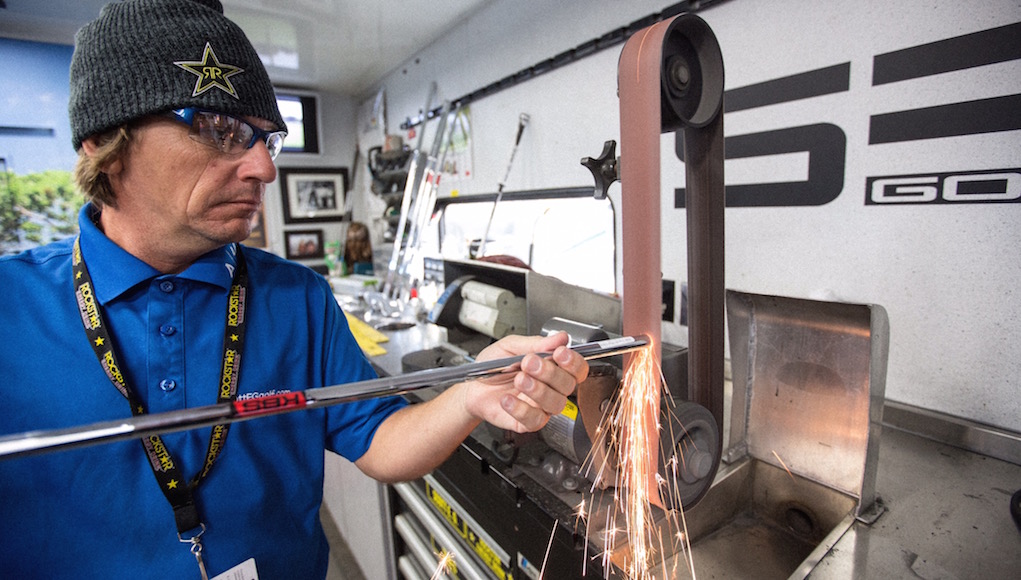
“Not just any… Scott’s,” I said. “He travels to about 32 tour events per year, usually stays from Monday to Wednesday, repairing, fitting and building clubs for tour players. His van is full of the most unbelievable technology, a lot of which you can’t find anywhere other than a van like his. He has a couple of lie and loft machines, a gripping station, a saw, a belt sander and a machine to get shafts PUREd.”
“A PUREd?” she asked. She looked at me like I was crazy and speaking a foreign language.

Scott E.G.’s Tour Van.
“Yes, a PUREd,” I said, barely holding back my excitement. “It’s this machine that analyzes golf shafts and identifies the most stable plane. It’s helped PGA Tour players earn $2 billion around the world.”
“PureD made $2 billion?” she asked. “Sounds like a vitamin or a workout tape.”
“No, it’s better,” I told her. “What you do is load a club shaft into the machine, then the machine spins the shaft around to locate the strongest point in the shaft. When the machine identifies the spot it even marks it! Then, when Scott builds a club, he puts that spot into the 12 o’clock position on the club, which optimizes performance.”

Scott using his SST Pure machine.
Her interest piqued. “Why is that important?” she asked.
“Because even something as well built and precise as the shafts in golf clubs have individual characteristics that can be used to make how you use them more or less effective. In this case, it allows you to position the club so it can be its strongest, most consistent and most effective when you swing.”
“Wow, now I get it,” she said. “So that machine could be the difference between someone winning or losing on tour?”
“Exactly,” I said. “I also got to watch Scott put together a set for a big deal on the PGA Tour while the guy stood there. The process was pure artistry. First, Scott looked at the desired specs for the player. Then he weighed all the heads, all the grips, PUREd the shafts and then set upon building what was literally a perfect set.”
“A true artist at work,” she said.
“You got it,” I said. “As he moved effortlessly, he spoke of the precision required in his work, teaching me about the nuances of the process, as well as the challenges of working with tour players. Many of these guys can tell even one swing weight.”
“At one point he held up two brands of golf grips: an Iomic and a Golf Pride,” I said. “He pointed to the end of a club and said, ‘See here, Iomic has no butt, but Golf Pride has about a quarter-inch butt. When you build, you better account for the difference.'”

A Golf Pride grip (right) and an Iomic model.
I kept chattering.
“He was moving from machine to machine through the process, snipping a little hear, measuring a little there, then some mixing and a little light banging and VOILA!” I said. “The perfect set; all lengths, swing weights and frequencies spot on!”
I had her attention as she sat sipping her water.
“The process continued,” I said. “A hybrid for another household name player. Then a putter grip and then a loft and lie check.”
Scott told me that many PGA Tour players came into his Tour van every week to check their lies as he measured a golf club using his $6,000 digital loft and lie machine. “And then there are some who come less often,” he said. “Depends on the guy. Some are very particular, others are not.”

I continued recounting the events of the day to her.
“Around 11 a.m., the Pro-Am was about to start,” I said. “The players and everyone other than Scott left the van. As he continued to work I asked, ‘Was that stressful?’ He laughed. Just how he looked at me, it was clear that he loves his work as much as any artist or craftsman who needed to be on his game all the time. He made it all look very easy.”
“And then what?” my girlfriend asked.
“I watched him work silently for a long time,” I said. “It really felt like he was the master sword fitter, arming the greatest Samurai in the land, and I was watching him build the swords that would make the difference between life and death.”
“Come on young Skywalker,” she said laughing. She kissed me and led me into the kitchen for for dinner; I could smell the spaghetti bolognese, my favorite.
“It didn’t just seem like it,“ she said. “He probably was.”
“Yup,” I said. A perfect day, as I kissed her lightly on the cheek, a happy, contented man.
—
Scott has one of the most amazing Instagram pages (@scotteggolf). It is AWESOME and a must follow! He also offers “Tour Experiences,” where you can have him build you a set of clubs. To find out more, you can visit his website at ScottEGGolf.com.
Bob Van Sweden is a full-time club fitter in St. Petersburg, Florida. His website is http://www.golfrepaircenter.com/.


Opinion & Analysis
Brandel Chamblee PGA Championship Q&A: Rose’s huge McLaren risk, distracted LIV pros and why Aronimink suits the bombers


PGA Championship week is here, and Brandel Chamblee did not hold back in our latest discussion ahead of the season’s second major.
In our 2026 PGA Championship Q&A, golf’s leading analyst made the case that PIF pulling LIV’s funding has left its players competing in a state of confusion, called Justin Rose’s mid-season equipment switch a huge risk at 45, and explained why Aronimink will be a bombers’ delight this week.
Check out the full Q&A below.
Gianni: With the PIF confirming that they’re pulling funding from LIV at the end of the season, what impact do you expect that to have on the LIV players competing at the PGA Championship?
Brandel: I would imagine that they have all been thrown into a state of confusion, and will be distracted, not knowing where they are going to play next year and not knowing exactly their road back to either the DP World Tour or the PGA Tour. Or in Rahm’s case, being tied to a sinking ship for the next few years, likely playing for pennies on the dollar in events that no one cares about or watches.
I doubt this would put him in the best frame of mind to compete at his highest level. Keeping in mind, however, that majors are the only time that LIV disciples get to play in events that matter, so never disregard the motivation they have to prove to the world they are still relevant.
Gianni: Justin Rose switched to McLaren Golf equipment mid-season while playing some of the best golf of his career. What do you make of the change?
Brandel: I don’t really know what to make of Rose switching equipment. It seems a huge risk on his part, even though it is likely, in my opinion, that the clubs he’s playing are similar, if not the exact grinds, to what he was playing previously, with a McLaren stamp on them.
Having said that, at best, it is a distraction when he seemed to be as dialed in with his game as any 45-year-old could be and trending in the majors to perhaps do something that would definitely put him in the Hall of Fame. At worst, given the possibility that these clubs aren’t just duplicates of his old set stamped with McLaren on them, he’s made an equipment change that would take time, and 45-year-old athletes don’t have the time to do such things.
Gianni: Aronimink has only hosted a handful of professional events since it hosted the 1962 PGA Championship. What kind of test does it present, and does a course with less recent major championship history tend to level the playing field?
Brandel: Even though Aronimink has only hosted a handful of meaningful professional events, it has been fairly discerning in who can win there. When Keegan Bradley won the BMW Championship on the Donald Ross masterpiece in 2018, he was the 2nd best iron player on tour coming into that week. When Nick Watney won the AT&T at Aronimink in 2011, he was 2nd in strokes gained total coming into the week.
In 2020, Aronimink hosted the KPMG Championship, and Sei Young Kim won. On the LPGA that year, she was first in greens in regulation, putts per green in regulation, and scoring average on the way to being the LPGA player of the year. And then there is the 1962 PGA Championship won by Gary Player, who eventually became just one of a few players to win the career grand slam on the way to winning 9 majors. It is a formidable test, and if it’s not softened by rain, it will bring out the best in the upper echelons of the game.
Gianni: Is there a specific hole at Aronimink that you think will do the most to decide the winner?
Brandel: The hardest hole at Aronimink in each of the three tour events that have been played there since 2010 has been the long par-3 8th hole, with the par-4 10th being the second hardest, so most of the carnage will happen around the turn, but with the par-5 16th offering opportunities for bold plays and the tough closing holes at 17 and 18, the finish is likely to be frenetic.
Gianni: The PGA Championship has always sat in the shadow of the other majors. What does the ideal PGA Championship look like in your eyes, and what would it take for it to carve out its own identity?
Brandel: The PGA Championship, to whatever degree it suffers from the comparison to the other three majors, is still counted just as much when adding them up at the end of one’s career. Almost 1/3 of Nicklaus’ major wins were the five PGA Championships he won. Walter Hagen won 11 majors, five of which were PGA Championships.
Tiger Woods twice in his career won back-to-back PGA Championships, and those four majors count just as much as the other 11 he won. The PGA may not have the prestige of the other three, but it carries the same weight. Having said that, I preferred the identity that it had as the last major of the year.
Gianni: You nailed your Masters picks. Rory won, Scottie finished solo second, and Morikawa surged to a tie for seventh. Who are your top 3 picks for the PGA Championship and why?
Brandel: I am not a huge fan of majors played on golf courses that have been shorn of most of the trees, although I understand some of the agronomic reasons for doing so and of course the ease with which it allows members to play after errant drives. However, at the highest level, it all but eliminates any strategy off the tee and turns professional golf into an even bigger slugfest. That means that it will likely be a bomber’s delight this week, but fortunately, Scottie Scheffler is long enough to play that game and straight enough to play it better than anyone else.
The major championships give us very few surprises anymore, going back to the beginning of 2012, so the last 57 majors played, the average world rank of the winners has been better than 15th in the world. So look at the highest ranked and longest drivers who are on form coming into the PGA Championship who also have great short games as the surrounds at Aronimink are very challenging. That’s Scottie Scheffler by a mile and then McIlroy and Cameron Young with a far bigger nod towards DeChambeau than I gave him at the Masters.


In this episode of the Club Junkie Podcast, we dive into one of the most interesting flatstick releases of the year with a full review of the new TaylorMade SYSTM 2 putters. After spending time on the greens, I break down what makes this design stand out, where it performs, and why it has me completely torn between loving it and fighting it. If you are into feel, alignment, and consistency, this is one you will want to hear about.
We also take a look at some of the putters in play on the PGA Tour last week. From familiar favorites to a few surprising setups, there is always something to learn from what the best players in the world are rolling with under pressure.
To wrap things up, I walk through the process of building a set of JP Golf Prime irons paired with Baddazz Gold Series shafts. From component selection to performance goals, this is a deep dive into what goes into creating a unique custom set and why this combo has been so intriguing.


This year my 50th birthday. Gosh, where has the time gone?
As a teenager in rural Missouri, some of my junior high and high school years felt interminable. Graduation seemed light years away. But the older I get, the faster life seems to fly by.
I’m also increasingly aware of my mortality. My dad died recently. Earlier this year, a friend and fellow PGA of America professional and I were texting about our next catch-up. The next message I received was news of his unexpected passing at 48. Shortly after, a woman I dated in college succumbed to cancer at 51.
Certainly, one can share perspective at any age. Seniors help freshmen, veterans guide rookies. But reaching this milestone feels like as good a time as any to do one of those “what would I tell my younger self?” articles.
I’ve had a uniquely varied career in golf. I started as a 27-year-old, average-length-hitting, 14-handicap computer engineer and somehow managed to turn pro before running out of money, constantly bootstrapping my way forward. I’ve won qualifiers and set venue records in the World Long Drive Championships, finished fifth at the Speedgolf World Championships, coached all skill levels as a PGA of America professional, built industry-leading swing speed training programs for Swing Man Golf, helped advance the single-length iron market with Sterling Irons®, caddied on the PGA TOUR and PGA TOUR Champions, and played about 300 courses across 32 countries.
It’s been a ride, and I’ve gone both deep and wide.
So while I can consult and advise from a lot of angles, let me keep it to a few things I’d tell the average golfer who wants to improve.
1. Think About What You Want
Everyone has their own reason for picking up a golf club.
Oddly, as a professional athlete, I’m not internally driven by competition. That can be challenging, as the industry currently prioritizes and incentivizes competition over the love of the game.
For me, I love walking and being outdoors. Nature helps balance my energy. I prefer courses that are integrated into the natural beauty of their surroundings. I’m comfortable practicing alone. I’m a deep thinker, and I genuinely enjoy investigating the game, using data and intuition to unearth unique, often innovative insights. I’m fortunate to be strong and athletic, so I appreciate the chance to engage with my abilities. Traveling feels adventurous. I could go on.
You don’t have to overthink it like I do. For you, it might be as simple as hitting balls to escape work, hanging out with friends, and playing loosely with the rules and the score.
The point is to give yourself permission to play for your own reasons, and let that be enough.
But if improvement is your goal, thinking about your destination—and when you want to get there—is important, because it dictates the steps you need to take. When I set out to go from a 14-handicap to the PGA TOUR as quickly as possible, the steps I needed were very different from those of a working golfer trying to break 90 in six months. That’s also different from someone who just wants a few peaceful hours outside each week, away from work or family.
None of these goals are better than the others, but each requires a different plan that you can work backward from.
2. There Are Lots of Things That Can Work
One of the challenges of golf is that, although there are rules for playing, there aren’t clear, industry-wide standards for how to best play the game. There’s a lot of gray area.
You might hear a top coach or trainer insist that a certain move is the best way to swing or train. Then you dig a bit deeper and, much to your confusion and frustration, another respected coach or trainer says something completely different. I don’t think anyone is trying to confuse you—at least I hope not. It’s just where the industry is right now.
You have to be careful with advice from tournament pros, too. They might be great at scoring, but they’re also human and sometimes just as susceptible as amateurs to believing things that don’t really move the needle. Tour players might describe what they feel, but that’s not always what they’re actually doing when assessed with technology.
I recently ran a test on my YouTube channel (which connects to my GolfWRX article “How to use your hands in the golf swing for power and accuracy”), and, interestingly, two of the most commonly taught hand actions produced the worst results in the test.
Coaches can certainly help. If you find someone you connect with to help navigate, that’s great. But there are many ways to get the ball in the hole. In the current landscape, you may need to seek multiple opinions, think critically, and use your own intuition to discern what seems true and whose advice resonates with you.
I’d recommend seeking someone who is open-minded and always learning, because things constantly change. Absolutes like “correct” or “proper” should raise a red flag. AI can be useful, but it tends to confidently repeat popular advice, so proceed with caution.
3. Get Custom Fit
If you’re serious about becoming a better player, getting custom fit is hugely important. There’s no sense fighting your equipment if you don’t have to. Most better players get fit these days and, if they don’t, they’re usually skilled enough to work around clubs that aren’t ideal.
If you plan to play for a long time, it’s worth spending a little more upfront to get something that truly fits you and your game, rather than continually buying and discarding equipment.
Equipment rules haven’t really changed significantly since the early 2000s. To stay in business, manufacturers keep pushing those limits. If you pull a bunch of clubs and balls off the rack and test them, you’ll find differences. I’ve tested two new drivers and seen a 30-yard total distance gap. Usually, the issue isn’t bad equipment; it’s that the combination of components simply isn’t the best fit.
It’s like wearing a new pair of floppy clown shoes. Sure, they’re shoes—but you won’t sprint your best in them compared to track shoes that fit perfectly.
Be wary of what’s called custom fitting, too. Sometimes the term is used as a marketing strategy rather than an actual fitting. In some retail settings, fitters may be incentivized to steer you toward higher-priced components. That doesn’t automatically mean it’s not the best fit, but you should be aware of potential biases.
I learned a version of this lesson outside of golf. Years ago, I bought a tennis racquet at a big box store from a seemingly knowledgeable employee who thought it would suit me best. The racquet gave me tennis elbow, and I spent months recovering with rest and acupuncture. The next season, I invested more time and money to find what actually fit me, and I walked away with something amazing that I still play with years later.
So if you’re going to get fit, be smart about it.
Find someone you believe has deep knowledge—possibly with certifications, but not necessarily. Make sure there’s a wide inventory across many brands. Check recent reviews for the individual fitter if possible. Make sure you trust that the fitter has your best interests at heart. If they’re wearing a hat or shirt with a specific brand’s logo, proceed with caution. Unless you specifically want a certain brand or look, be wary of upsells, especially if two options perform nearly the same.
Also, while golf is called a sport of integrity, there’s a thread of manipulation in the industry. I once drafted an equipment article for an industry magazine, structured just like one of their previous popular stories, with matching word count and great photos. The assistant editor loved it; it was useful to readers and required little work on his part. But the editor-in-chief nixed the story. When I asked why, I was told it was because I wasn’t an advertiser. It turned out the article I’d modeled mine after was a paid ad cleverly disguised as editorial content.
I really dislike games, clickbait, and fear-based manipulation. I hope this changes, but golfers deserve to know it exists.
4. Distance and Strategy Matter
There’s a real relationship between how far you hit the ball and your scoring average, even at the PGA TOUR level.
I experienced this early in my pro career. I started as a power hitter, swinging in the high 120s and breaking 200 mph ball speed with a stock driver.
Back then, some instructors advised swinging at 80%, so I tried slowing down for more accuracy. That worked fine on shorter, tighter courses. But on longer setups, I was coming into greens with too much club, and par 5s stopped being

RBC Heritage Tour Report: More minis, course-specific setups, Spider & GTS launches

Justin Rose WITB 2026 (April): Full WITB breakdown with new McLaren irons

Best fairway woods of 2026: The most versatile fairway woods + the most forgiving fairway woods

Gary Woodland’s winning WITB: 2026 Texas Children’s Houston Open

What’s the story behind Webb Simpson’s custom-stamped irons?

Cadillac Championship Tour Report: Spieth’s sizable changes, McLaren Golf launches, and more

The 24 players who can win the Masters

Rory McIlroy’s winning WITB: 2026 Masters

Kristoffer Reitan’s winning WITB: 2026 Truist Championship

J.J. Spaun’s winning WITB: 2026 Valero Texas Open


Alex Fitzpatrick WITB 2026 (May)
Driver: Ping G440 LST (9 degrees) Shaft: Fujikura Ventus Black 6 X 3-wood: TaylorMade Qi4D (15 degrees) Shaft: Fujikura Ventus...

Kristoffer Reitan’s winning WITB: 2026 Truist Championship
Driver: Ping G440 Max (9 degrees) Shaft: Mitsubishi Tensei 1K White 60 TX 3-wood: Ping G440 Max (15 degrees) Shaft:...


WITB Time Machine: Rory McIlroy’s winning WITB, 2021 Truist Championship
Rory McIlroy’s victory at the 2021 Wells Fargo Championship 2021 (now the Truist Championship) marked a significant return to form,...


Collin Morikawa WITB 2026 (May)
Driver: TaylorMade Qi4D LS (8 degrees) Shaft: Mitsubishi Diamana D+ Limited 60 TX 3-wood: TaylorMade SIM Tour (14 degrees) Shaft:...
-
 Equipment2 weeks ago
Justin Rose WITB 2026 (April): Full WITB breakdown with new McLaren irons
-
 Equipment1 week ago
What’s the story behind Webb Simpson’s custom-stamped irons?
-
 Equipment2 weeks ago
Cadillac Championship Tour Report: Spieth’s sizable changes, McLaren Golf launches, and more
-
Whats in the Bag3 days ago
Kristoffer Reitan’s winning WITB: 2026 Truist Championship
-

 Whats in the Bag1 week ago
Cameron Young’s winning WITB: 2026 Cadillac Championship
-

 Whats in the Bag3 weeks ago
Nelly Korda WITB 2026 (April)
-

 Equipment2 weeks ago
Justin Rose on the switch to McLaren Golf, learnings from previous equipment moves
-

 Tour Photo Galleries2 weeks ago
Photos from the 2026 Cadillac Championship


Fyearoldgolfer
Mar 16, 2017 at 9:41 pm
People spouting off with out doing the basic research of checking google. SSTPuring
Was developed by engineers interested in making a golf club better and matched
to the end user. I didn’t use it 20 years ago because of the expense, but now every
set of iron shafts I buy are pured. I now also get wood shafts pured to be aligned
in the hosel setup I will use the most in my adjustables, and aligned in my glue in heads
that still out perform whatever current club heads offered now. I see some noticeable
Improvements every 3 – 5 years, and only buy that head if it outperforms all my current
backups. 15 drivers that need to be culled down to 5. 36 fairway clubs, 7 hybrids,
15 sets of irons, I’ve lost count of wedges 60 or 70, 8 – 10 putters, plus another
4 for sentimental reasons. 8 driver shafts for adjustable heads, only 2 fairway shafts
for adjustable heads, more coming out of some of the unneeded drivers. Played this game
more than 47 years, I can feel a one swing weight difference club to club, my club fitter
tested me all the time without telling me what he was doing, I thought I could only
tell if it was 2 or more swing weights, but he taught me better. Go find your old set of irons
and have them fitted. Sure your own is not a current pw/8 iron, but I would bet you the cost of the new shafts that you play them better, and now your upper end iron is a 4 or 3 iron
that outperforms your new off the rack hybrid.
Iliketomoveitmoveit
Mar 16, 2017 at 10:33 am
I thought the article was pretty cool but still left out a lot of details on what really goes on in these vans from stop to stop. I for one would love to hear more about the back-end operations that make these tour events so successful year after year – from the tour van guys, the caddies, the volunteers, photographers, clubhouse chefs, and more! I think it’s a very overlooked aspect of golf operations that people don’t either seem to care about or even know what impact they have on making an event a success. I say more of these kind of articles/insights – the golf fans want to know!!
Tom
Mar 16, 2017 at 1:10 pm
+1… I agree
People's Champ
Mar 16, 2017 at 10:28 am
Great read and obvious the hackers don’t get it. You can’t win them all Brendan. Keep it up.
Hooker T. Washington
Mar 16, 2017 at 9:45 am
I love how everyone’s objective on here is always to find ways to bash the articles and/or the writers. Brendan, I want to say that I thoroughly enjoyed reading this, and the conversation/story style it was written in was somewhat refreshing compared to your typical articles.
To all of you who are speaking so negatively on shaft PUREing, it definitely does make a difference…maybe only a minute one in some circumstances, such as steel iron shafts, but noticeably in graphite shafts. Granted, you will only see or feel this difference if you are swinging very consistently day in and day out. I don’t know if they still offer them when you have the process done, but I had received a full page printout with graphs and explanations of the PUREing process when I had a bi-matrix driver shaft PUREd years ago…the shaft was stabilized by 94% compared to the usual logo-down install position…and yes I saw a significant increase in consistency!
So to all the naysayers…go put some work in on your swing or seek out a PGA professional for help improving your game…then go try a driver with a PUREd shaft
Jim
Mar 16, 2017 at 10:41 am
We don’t build ANYTHING without PURing . No one second guesses us. It’s built into our pricing. Every one of our (hundreds) of demo shafts are PURED and PROFILED. We can replicate the exact feel and performance of the club you used for your fitting because of this.
Puring is for real. It absolutely works. For those who doubt or simply don’t understand, here’s the best analogy:
Remember that set of irons – or maybe your current set where you could just KILL (say) the 4iron, but the 5 or 7 never quite worked or felt as good – as buttery as thar ONE perfect feeling club….
the perfect one had the shaft installed on the optimal plane – simply by chance – because of where the silk screened logo got rolled on….the other ‘evil’ iron – the one that felt ‘harsh’ or couldn’t draw the ball with – whatever – THAT shaft was put in with it’s SEAM on a detrimental axis…
Keep spending $48 a dozen on overpriced BS balls and stick your head in the sand on puring….it’s YOUR loss
carl spackler
Mar 16, 2017 at 9:03 am
Look at the seg golf website. The only reason he has a truck is for advertising purposes, so it makes sense that this article is just another advertisement. I’m just disappointed there are not more pictures of him making the shaka sign. Hang ten bro!
Jeffrey Purtell
Mar 16, 2017 at 3:45 am
I have tried both Pured and non-Pured on the same equipment and found there is no difference. In fact, my handicap is now lower with an un-Pured set of clubs. If you get a kick out of paying lots of money to have an extra sticker on the shaft of your club, then knock yourself out.
Stevegp
Mar 16, 2017 at 12:33 am
Golf is indeed highly mental. I’m curious about the benefits of Pureing shafts. There are some true believers and I respect that. However, many disagree to its worth and value. Like them, I would like to see some facts and proof of the benefits it provides. Sometimes it is difficult separating facts from marketing spin.
The dude
Mar 15, 2017 at 10:02 pm
Fairytale story at best
CCTxGolf
Mar 15, 2017 at 9:46 pm
“Wow, now I get it,” she said.
Very bizarre way to write this article. Sort of a weak advertisement not trying to be an advertisement actually.
Bert
Mar 15, 2017 at 9:18 pm
I’ve identified the spine on graphite shafts, but are you saying KBS steel shafts are so out of round they need to be Pured? Is this process the same as identifying the spine? Seems like these high quality steel shafts would be perfect no matter how aligned in the club head.
Bert
Mar 15, 2017 at 9:20 pm
Or is it frequency matching?
Jim
Mar 16, 2017 at 11:13 am
Once you ‘find the spine’ – all steel shafts have one – even &500 graphite shafts have one….where do you put it? Prior to SST we would manually test each shaft for Freq, have to ‘spine’ it, then dry fit the head to FLO (Flat Line Oscillate) it, then Freq it again…
A set of our clubs come with the factory shaft logos pointed all over the place…it looks like someone just glued them together and didn’t bother to ‘line em up’ for a “nice display”. Nothing could be further from the truth. It’s way more work to build the best, most exacting products….
In house SST system saves time and guarantees every one of your 280-400 per club irons we build you feels perfect…
NO One buying top shelf shafts or custom clubs ever says “don’t” PURE it…
“I tried both Pured and not Pured clubs” – yeah, right…
Bert
Mar 16, 2017 at 7:55 pm
Thanks Jim, I’d like to learn more about the process.
Jim
Mar 17, 2017 at 12:19 am
I went to one of the very first intro seminars and workshops. John Kennedy @ Westchester CC hosted it and it was awesome. Go to their website. It’s all true. Every steel shaft has an internal weld. It produces a ‘spine’ Graphite shafts have several manufacturing process’ but most common is layers rolled on…each sheet has a start and a stop so sometimes they ‘gather’ more to one side than the other, thus producing a ‘ridge’ or stronger side…
Logos are silk screened on or decals applied as the shafts roll down a work surface, so have only a roulette chance of being in concert with this strong side.
IF this spine ends up at say 3 or 4 oclock, it would make the club harder to ‘turn over’ smoothly and produce a gentle draw…if it’s installed @ 4 or 5, draws easily become a larger sweeping hook. Put in at 4,5,6, the shaft feels ‘harsher’ and transmits more vibration. Some ot these may also produce more or less droop at high speed, thus making a single lie angle change number not as accurate with all irons (our high end fittings adjust each clubs lie angle individually as sometimes folks release longer flatter lying clubs different from more upright ones – the ‘human factor’)…
anyway, it works. And the machine was time consuming and manual. There was a high probability of operator error as one had to rotate a large lathe chuck smoothly and stop accurately on cue. There was no way this could be adopted to mass production.
the machine itself was 25k PLUS royalties! No “garage club builder” has one – or is gonna get one.
we waited for 2 years until they made us a ‘better offer’ and did the spining by hand, then freq’d it on 4 planes by hand to make sure we had it right, then dry fit the head and ‘bounced it’ up and down slighty turning the face so that the club would eventually bob up and down on a single plane – “Flat Line Oscillating”….
We got one of the first new fully automated machines (no more painstaking precision – or possible operator error, and we can do ten shafts in the time it took to do 3 before.
We also purchased a dozen asst shafts from Golfsmith ($10 up charge when everyone was charging 30 or 35 for a raw shaft) and 7 of them were totally off from when we retested them, SO, it’s quite probable anyone – not the trolls – who legitimately had it done and was unhappy simply had shafts that were not properly done…
What sold me – one of our regular ‘haunters’ had a Kmart Adams driver with the std Adams $10 graphite shaft and said he wanted to try it….I took his club and hit it a dozen times – all over the place. After we pured it, he and I BOTH hit it remarkably better. The hook became a draw and toe side hits on high speed video showed less than half of the torque that was opening the face which produced better gear-effect. It stopped several ‘toe-pushes’ from becoming further right toe-push-slices’…
BOTTOM LINE. It’s 100% legit
Jeffrey Purtell
Mar 17, 2017 at 3:01 am
Jim, my friend, why would I lie. Im saying I pured my old set of irons (perfectly flo-ed them. Are there different ways to perfectly flat line?????) and now use a set of the same irons that have been reconditioned and the shafts have not been flo-ed/ pured. So yes I have tried both. Maybe if I was a robot I might have felt a difference. Cheers.
Jim
Mar 17, 2017 at 11:37 am
I’m telling you flat out….Your shafts were NOT done properly. Period.
After we got our first machine it took me maybe 30 or 40 attempts to really ‘get it’. My partner and I would check each others shafts we had done…It was a significant investment in time to get it dead on. We bought 10 shafts from Golfsmith to check their work (we needed some for stock anyway, and it was only a $10 up charge)
Only 3 came out dead on when we retested them….and a couple of em hadn’t even been prepped for PURING properly.
The shaft had to be prepped…any mfr stickers removed (pain in the butt – they never just ‘peel off’) and the butt had to be cut PERFECTLY square and the shaft seated by hand in the chuck. The operatot had to roll the chuck smoothly and consitently ‘hand over hand’ and stop perfectly on cue, then roll the opposite direction.
I’M CERTAIN yours were not done properly.
Also, much to MY surprise and dismay, PURED shafts DON’T FLO! …yeah, I was bummed….”cause I know all the work we did manually to find and orient the strong side and then ‘tweek it a little’ from there to get the Flat Line bounce did absolutely produce better feeling and more accurate clubs…I loved the feel as did our customers, making us a Top 25 Custom Shop – before we finally came to a deal w/SST…
Jeffrey Purtell
Mar 17, 2017 at 9:49 pm
Your last paragraph is exactly what I did. Bare original shaft, spine only as a reference, strongest bend toward target, then fine tune flo with head on. I even rigged up a slip pulley so each Twang of the shaft would be consistent. If this is the wrong way, so be it. Perhaps my lower handicap and better play is more mental in the fact that the reconditioned set looks and feels like a 100% brand new set (which I also did the work myself) and I get satisfaction out of that, who knows? Cheers.
Jim
Mar 19, 2017 at 12:11 am
Sounds like you took the time and did it right! I think the issue we have here is terminology.
You weren’t wrong, you were mislead.
PURING is the SST proprietary term for what their machine does. It was hijacked years ago by folks – some out of ignorance, some out of malice, and some who never actually seriously checked out what it was.
A lot of us builders who were all kind of seperately working on this in it’s infancy and spent their time sweat and money figuring out the process (you and I both used) felt ‘challenged’ when this new, very expensive machine came out – as if all the stuff we were doing to make the best clubs we could – when so many other builders/repair guys – and OEMS didn’t bother taking the extra time to do all those extra steps…..
Problem was we were flying blind. We built (same type everything) clubs with the spine in at 9:00, 12:00 etc, but ultimately we were guessing, so we’d hit em over and over and have several of our ‘better stick’ regulars try them and we ended up with the spine up @ 12:00 as it seemed to provide the best ‘feel’ as folks reported, and seemed less likely to hook as opposed to the 9:00 position which ‘seemed’ to feel more harsh, and ‘turn over’ more than 12… again, all soley based on human feedback at the time…we used the Cheetah (pre trackman) on a full length outdoor range 10 years ago for this as it had become standard with our builds….We were well aware of SST, but it was still pretty expensive. Fortunately, they wanted IN to our shop, and after almost 18 months of back n forth and haggling, they made us a better offer…
Prior to getting the unit it’s successes were getting good press, and we never told anyone we ‘pured’ our shafts, we did absolutely promote how we ‘tuned them’ and promoted the manual FLO process with a video we’d run in house, or take the customer into the shop and demonstrate the process first hand.
Whatever you read, or were told about what/how to do what you did (love the slip release!) Simply never should have lead you (and A LOT OF OTHER FOLKS) to believe it was PURING a shaft…
the machine – designed by total NASA engineer types – takes the guess work out, cuts the time and it absolutely works….
If a new driver shaft is in your future, seek a well regarded cat in your area and have them do it for you. I promise you won’t be sorry
Regards & happy motoring. J
Jeffrey Purtell
Mar 19, 2017 at 1:44 am
All good mate, sounds like I was doing similar stuff to what you were doing 20 years ago, lol. I failed to mention I also did this process on my old Fairway woods (910 Titleist with Aldila Rip A shafts) but never my Driver (913 D2 Aldila Rip A). I now have 913 fairways with untouched shafts and the same driver. Funnily enough, I have just this minute done a google search of SST Puring near me, Im in Wollongong south of Sydney NSW Australia, and only found 2 places in Queensland (1000+ Klm away) that does it.
Jeffrey Purtell
Mar 19, 2017 at 2:46 am
All good mate, sounds like I was doing similar stuff to what you were doing 20 years ago, LOL. Happy golfing, cheers.
Jeffrey Purtell
Mar 20, 2017 at 2:43 am
Arghh! Silly double post. I thought the first one didn’t post so I shortened it and they both posted. Doh!
Jim
Mar 17, 2017 at 3:32 pm
FLO / SPINING IS NOT SSTPURING….Folks have been alluding that – mostly silly articles or threads – sometimes worse; the mildy competent club builder. The guy @ big box repait counter who discounts the SST machine – as he will never touch one, the small shop guy or hobbiest – some of which no doubt read some of our work from years ago when we first started “profiling” shafts and figured out one side WAS stronger than the other….We had to see the proof SST PURING was for real, and it is. I can’t defend it enough here.
We balked at the price, and it was an expensive service….It is NOT related to all the manual work and time we spent to “tune” the shaft for the head (high MOI shaped drivers vs pear shaped heads)….that’s where it became – as good as we were – kinda ‘flying blind’ vs the machine….
When clubs are spined – first step to manually FLOing them, what side goes where? We all debated that back n forth – a case can be made for all 4 compass points, and the process, when done right did produce more stable & consistent clubs, but the biggest thing with irons was feel…
The SST machine simply does it better and absolutely provides both quantifiable & kinesthetic improvement….
tbere’s no doubt in my mind, your clubs were not done properly….
Peace
andy
Mar 15, 2017 at 8:53 pm
i wish there was a standard for buttcaps would make life so much easier.
Dave R
Mar 15, 2017 at 8:03 pm
Great article would like more of these very interesting about shafts.
Aaron
Mar 15, 2017 at 4:57 pm
How does Scott E. Garrison make money? Selling ads on his trailer? Invoicing players for his work? It makes sense when OEM staff players visit their respective brand’s trailer each week, but if Scott isn’t affiliated with any one brand, how is it worth his time?
MrBluster
Mar 15, 2017 at 2:33 pm
Forgetting all the “my dog’s bigger than your dog” chatter- At the Tour vans at all levels, do the players pay for any work that is done or is it all free. Do they tip the operators? How about the equipment available on the ranges and putting greens?
Sekim
Mar 15, 2017 at 2:33 pm
Bob “the guy asking the questions” is actually a well versed club-fitter in St Pete. I’ve been going to his shop for years and it’s a bit funny the way the article worded things. Bob knows all of that already. The tour van access is cool nonetheless…
Ummmm
Mar 15, 2017 at 2:46 pm
That’s because this is a fluff piece designed to get you to spend money on SST puring and hopefully from him.
charles lee
Mar 15, 2017 at 1:46 pm
For OEM manufactures to have all irons pured and perfectly built for tour players would force OEM manufactures to increase to price of clubs. Besides most Joes would never feel the difference. Pros are looking, holding, and swinging the golf clubs almost a 3rd of third of their lifetime. It makes a difference to them.
Blake
Mar 15, 2017 at 1:43 pm
More tour van content please
Artie Jenkins
Mar 15, 2017 at 1:39 pm
Good article and from someone who plays PURE’d clubs I can say they are great. I’m not awesome but I can break par once a week. I think the bad comments are from people who haven’t been fit properly and are showing their ignorance. Poor suckers. Bring your wallet to Jupiter and we’ll play!
Chris C
Mar 15, 2017 at 12:13 pm
The problem with this article is that it makes more than insinuations that Pure-ing makes a difference.
Major OEMs have top engineers, testing facilities, and golf experts, that develop and test new materials and technologies in hopes that they can find something demonstrably better, that still confines to the rules set by the usga and R&A.
Some technologies were milestones and have stuck around through time, i.e. Larger clubheads, titanium and then carbon and multi materials, face thickness innovation and every company is using a version of those technologies. Those milestones are few and far between.
Now, Because of how close we are to the limits of technology within the rules, Companies spend many, many millions of dollars and grasp at straws when needed to find anything that they can legally claim is better so they can market that claim and sell more clubs, even if it barely makes a difference to ball flight. The fact that no major OEMs embrace this as a technology that they can even claim makes a difference, should tell anyone with any common sense that Pure-ing makes absolutely no difference to your ball flight.
Will it hurt the golfer, no. And if it makes you more confident to spend money to “Pure” you’re shafts go ahead. But if you need to “Pure” your shafts to have more confidence, you might as well send me a check for whatever half the cost of “Pure-ing” is and I’ll just text you once a week telling you how awesome you are at golf. You’ll get more of your money’s worth…
Joey5Picks
Mar 15, 2017 at 4:16 pm
Manufacturers add a 1/4″ to the shaft, lower the loft 2 degrees and claim their clubs are the longest. People don’t care about Puring, they care about distance.
Chris C
Mar 15, 2017 at 6:38 pm
You’re absolutely right people do care about that more in the market, and for what it’s worth strengthening the loft and increasing shaft length does change ball flight and that’s something they can quantify and sell, unlike pure-ing.
Jim
Mar 16, 2017 at 11:30 am
Sorry….you couldn’t be more wrong. 20 years of PURING and the robot tests to prove it works. Has shaft manufacturing improved in that 20 years? YES! Dramatically too!
Every steel shaft still has a welded seam creating a ‘spine’ even woven ‘asymmetrical’ graphite shafts had a spine – it was on the mandrel they were woven around….
How can anyone ‘accept’ Frequency analysis / matching and not Puring?
WE ROBOT TESTED factory issue irons with small increments of off-center / off plane strikes then took the club apart, pured it and retested it and the results are quantifiable better….PERIOD…It’s a fact the shitworks. PERIOD…. AND, it’s like $ 10 a club now….a fraction of what it was even 10 years ago.
HONESTLY….IF YOU just got a set of APEX with 110gr Tour Recoil shafts and love ’em, you’re good! Why mess with them…..I HAVEN’T TAKEN MINE APART just to PURE them…..BUT if you’re reshafting clubs, or building custom from scratch, frankly, you’d be an idiot not to do it
Jim
Mar 17, 2017 at 12:29 am
….IT IS ILLEGAL to Manufacture a shaft with a spine deliberately to improve performance. It is NOT Illegal to FIND the spine and install it in a certain way….those crazy rules again…
Jim
Mar 17, 2017 at 9:02 pm
….sorry…one more bit to that….It would be illegal to install a shaft that was spined into the club in a position that would affect – or assit in producing a certain ball flight. Say someone wanted to help promote a draw or a fade, the shaft could be installed in a position that would absolutely contribute to that…
adjustable heads / movable weights aside, according to the rules, the shaft can’t be made or installed to help….who’d know? – kinda like wearing a wedge inside your shoe to invert your ankle and help prevent the foot from rolling – also illegal…as is ‘planing down the sole of a shoe to promote same….
lotsa equipment rules no one ever hears about….STPURING is legal, as it’s simply finding the most solid stable plane in the shaft – which is neutral for influencing ball flight – other than to reduce dispersion from imperfections in the shaft.
the consistent feel is just a bonus
Jeffrey Purtell
Mar 18, 2017 at 6:25 am
Hi Jimmy, me again. I found the the most solid (strongest) and stable (perfect flo) in my shafts but apparently I didn’t do it properly. LOL. I really need that extra sticker on the shaft, hey.
Jim
Mar 19, 2017 at 12:48 am
…Hey Man they’re like the weights for balancing tires absolutely KEY components….lol
Funny, but for the first few years (flo or SST) the biggest beef people had was the shaft logos were all over the place…a couple folks reeeaally bummed out! “I need that for alignment” (?)… we never got into the trend that started a few years ago where dudes were “too cool” to have any logo visible – even asking for the grip to be installed upside down….If people want the stickers, we’ll give them to them. We don’t put em on anymore as part of the build…
too funny! 🙂
Jeffrey Purtell
Mar 20, 2017 at 2:50 am
All good, I slipped that one in there as a bit of cheek. lol. When I did my 910 fairways with the aldila shafts the graphics were all over the place with the factory A1 setting. Now my 913’s are untouched straight up graphics.
Chuck S.
Mar 15, 2017 at 11:40 am
This OPINION piece is nothing more than a dressed up ad for PURE Shaft Technology. If this tech is so great then why don’t all the other OEM trucks have them as well? Also, the style in which this is written is totally bogus. Who talks like that? Especially to their girlfriend…
The dude
Mar 15, 2017 at 9:58 pm
Spot on….
Daniel
Mar 15, 2017 at 11:01 am
The Pros all Pure their shafts because guys are willing to do it for them for free, then claim it was that process that helped them win however much money they won that week. The pros probably don’t even know the difference, and just say “sure” when one of these guys asks them if they want their shafts Pured. Then that same guy goes and tells all his retail clients “(Insert big name) has all of his shafts Pured, you are missing out if you don’t”
The difference is the retail buyer pays $30 per club and gets no value.
John O
Mar 15, 2017 at 10:57 am
Been wondering why my scores are still around 100. Need my shafts pure’d.
Miramar
Mar 15, 2017 at 10:48 am
The bonsai tree in the background is much more real than the PUREd shafts…
GolfnRide
Mar 15, 2017 at 10:41 am
An awkward, uncomfortable read…
Pete S
Mar 15, 2017 at 11:32 am
There’s a 0% chance that conversation went that way.
ken
Mar 15, 2017 at 10:38 am
Wow..The curmudgeon is strong in you three people.
Get this straight…You WISH you could be building clubs for the best players in the world.
Hell you’d all be happy just to be the guy that removed the grips prior to regripping the shafts.
Matt Abramson
Mar 15, 2017 at 10:07 am
Why did you have to write the article in story form? And then, to write the plot as you did, in such a weird fantastical form involving a women you claim to be you girlfriend? Confusing and awkward. When trying to scam people on a bogus technology, the use of logos (an appeal to logic/reason) is much more effective than the use of pathos. Trying to appeal to the emotions of the reader is very ineffective, ESPECIALLY when you write it the way you did – in fictional story form.
PapaBear
Mar 16, 2017 at 9:02 am
I loved it!
Chris
Mar 15, 2017 at 9:40 am
Lol. Pure-ing is still a thing? Making a living off of nonsense. Must be nice.
cc ryder
Mar 15, 2017 at 10:46 am
pure-ing is real and I feel as if it helped my game and tournament play.
Ummmm
Mar 15, 2017 at 9:35 am
lol@pured
The scam is still alive!
cc ryder
Mar 15, 2017 at 10:47 am
Scam? LOL… troll I say. Pured shafts work. Work for me and for many of the best in the world.
McPickens
Mar 15, 2017 at 1:17 pm
the technology and science is sound, the actual benefit or increase in performance is what is questionable and any gains are likely in your mind
Ummmm
Mar 15, 2017 at 2:42 pm
It took you two posts saying the same thing?
There is literally 0 scientific proof it helps. It was invented by garage club makers as a means to help revenue and be yet another thing those evil oem and big box stores don’t do.
It’s a scam pure and simple.
If you think it helped, since golf is very mental, great. But it didn’t actually do anything for you. This isn’t 1965 and shaft quality and consistency is such that it’s not something that is the concern these snake oil people want you think it is.
Jim
Mar 17, 2017 at 1:30 pm
You know nothing of which you speak.
spoken like a true troll