
Equipment
Nippon expands Modus line with Tour 105 and 125 iron shafts


Nippon iron shafts have gained the attention of many PGA Tour players in recent years. Proof can be found in our Tour/Pre-Release forum, where a thread published in November 2014 — “Is it just me or are a lot of pros switching to Nippon iron shafts” — has amassed nearly 2,000 replies and 165,000 views.
Most of the conversation in the thread has revolved around Nippon’s N.S. Pro Modus3 Tour 120 and Tour 130 shafts. Expect the conversation to continue now that the company has released two new Modus shaft models: the Tour 105 and Tour 125.
Both the Tour 105 and Tour 125 are mid-launching, mid-spinning shafts, but as their names imply they use different weights to target two distinct audiences.
N.S. Pro Modus3 Tour 105

The Tour 105 is the company’s lightest N.S. Pro Modus3 iron shaft, and was known as the “Proto ST” during its 48-month testing phase on the PGA Tour that saw as many as 25 players using the shaft at one point. It weighs approximately 106 grams in stiff flex, and 112 grams in x-stiff flex, making it a fit for golfers who prefer the lightweight steel and composite/graphite shaft models that have increased in popularity in recent years.
[quote_box_center]”The Tour 105 really caught us by surprise,” said Hiro Fukuda, sales and marketing for Nippon Shaft in the Americas. “We didn’t expect this shaft to do so well on Tour. We brought it out based on the recommendation of our tour reps, and the feedback was that its spin rate and trajectory was more consistent than other shafts in the 115-gram category.”[/quote_box_center]
OEMs have taken notice. Ping chose the N.S. Pro Modus3 Tour 105 as a stock shaft option for its new “i” and GMax irons.
N.S. Pro Modus3 Tour 125

The Tour 125 shaft weighs roughly 125 grams, and first gained traction on the Japan Golf Tour. It will launch higher than the company’s Tour 120 shaft, yet lower than the company’s Tour 130 shaft. According to Fukuda, the Tour 125 has been most popular with former Dynamic Gold players.
The Tour 125 uses Nippon’s MHT or “Multi-Heat Treatment” Technology, which allows the company to use different heat treatments on different areas of the shaft to fine tune feel and performance. The technology was also used on the company’s N.S. Pro Modus3 wedge shafts, which were released in April. In the Tour 125’s case, the heat treatment gave the shaft a slightly softer tip section and a slightly stiffer butt section.
Both shafts are currently available through Nippon’s network of retailers and fitters for $37 each.


Equipment
Putters that never made it: Check out some of the best tour builds that didn’t make the cut

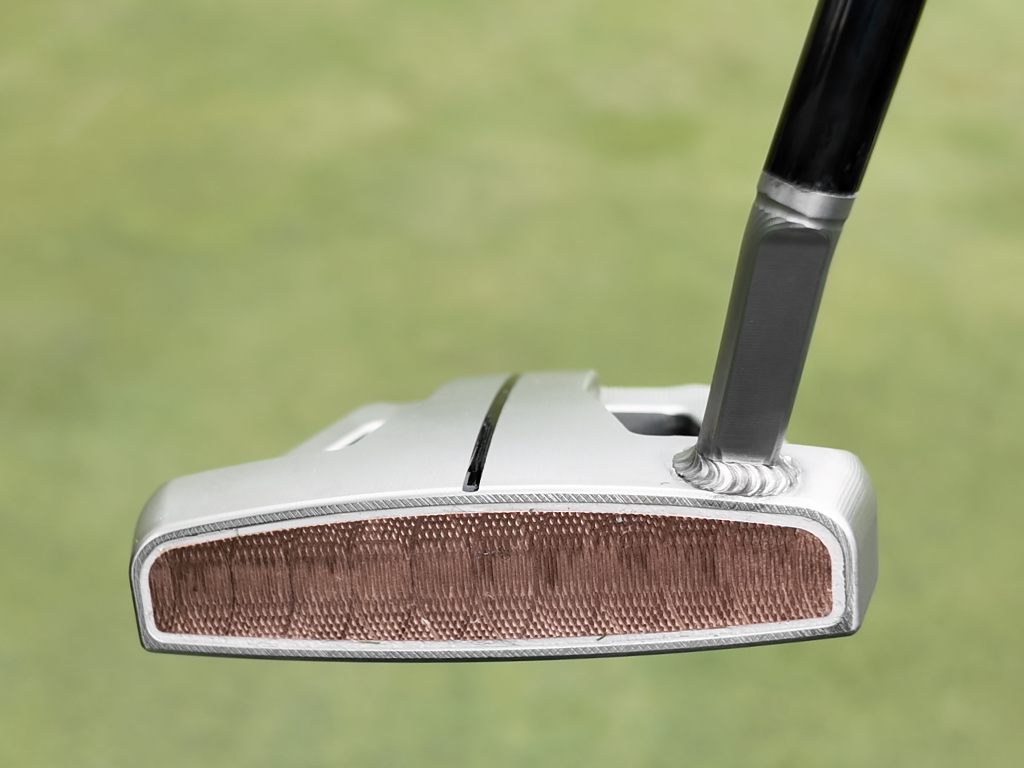
Arguably, the best perk of being a professional golfer on the PGA Tour is the ability to request or even just be handed pretty much any club you could think of. It happens more often than you think, usually with putters around the practice green from one event to the next. Come Wednesday, the Tour bags lining the edge of the putting surface become resting places for fallen flatsticks that never made the cut.
So let’s take a look at some of the best we’ve seen out on Tour this year that never made it to the competition. (You may notice none of Hideki Matsuyama’s custom Scotty Cameron putters made this list. There are too many.)
Let’s start with this custom Damascus Milled Odyssey Rossie made for Ryo Hisatsune. Featuring a single line and the short-slant hossel, we’ve seen plenty of Number 7 and jailbird heads featuring the Damascus Milled insert, but this is the first and only one we’ve spotted in a Rossie. Hisatsune primarily putts with an Odyssey Black Series iX #9, but we have seen him recently with a TaylorMade TP Collection SOTO, so there could be potential that the Damascus Milled Rossie could end up in the bag.

Everyone wants to be Cameron Young right now. We’ve had Justin Thomas and Tom Hoge both game the Scotty Cameron 9.5R prototype. Well, for the PGA Championship, Brooks Koepka nearly joined that list after requesting the same style of putter, with the full-length alignment line. But the Scotty Cameron reps took the request a step further and made one specially for Koepka with a Teryllium insert, similar to one in his previous Newport 2 gamers. The reason why this one didn’t go into play, though? Because it was too heavy.

Harry Hall was the third-best putter on Tour last year, so when Bettinardi made him a custom proto, you know it was going to be good. The custom BB28 blade features VDF face milling, a custom-welded single-bend shaft, and the owner’s initials – HH – on the sole of the putter. Hall, who usually games an Odyssey O-Works #7 W, has dabbled with a TaylorMade Spider Tour X already this year. Maybe there’s a chance this Bettinardi might make his bag.

Honestly, this one doesn’t need a description. It’s Kieth Mitchell’s custom Scotty Cameron Napa. One Scotty Cameron face stamp, two Scotty Dogs, two Scotty Cameron 7-Point Crowns and one Circle T. That is all. Oh, except for the Cashmere Cameron headcover.

Finally, and just for fun, how about we pour one out for this TaylorMade Spider Tour X made for Scottie Scheffler in its new torched finish. It’s unlikely we’ll see a putter change anytime soon from the best golfer in the world. In fact, he hit just two putts with it on the Harbour Town practice before going back to his trusty gamer.


Driver: Titleist GT3 (9 degrees) Buy here.
Shaft: Aldila Rogue Silver 130 M.S.I. 70 TX


3-wood: TaylorMade Qi35 (15 degrees)
Shaft: Fujikura Ventus Blue 7 X

7-wood: TaylorMade Qi35 (21 degrees)
Shaft: Fujikura Ventus Blue 8 X

Irons: Grindworks PR-202 (4), Grindworks PR-101A (5-PW)
Shafts: True Temper Dynamic Gold Tour Issue X100


Wedges: Cleveland RTX6 Tour Rack (52-10 Mid), Titleist Vokey Design SM10 (56-08M), SM11 (60-04T)
Shafts: True Temper Dynamic Gold Tour Issue S400


Putter: Scotty Cameron Tour Rat 1.5 Tour Prototype


Ball: Titleist Pro V1x
Grips: Golf Pride MCC


In our forums, our members have been discussing their favorite major winning irons used by Tiger Woods. WRXer ‘golferdude54’ kicks off the thread saying:
“Mizuno MP 14/29. Titleist 681T. Nike Forged Blades. TaylorMade P7TW.
Among these irons that helped Tiger win 15 majors, which is your favorite in terms of looks?”
And our members have been naming their favorites and why in response.
Here are a couple of posts from the thread, but make sure to check out the entire discussion and have your say at the link below.
- SwingBlade: “I prefer the early blades he played and the more recent TM TW’s especially because after Tiger had his major behavioral setbacks, part of Nikes support payback was making Tiger play a Nike putter and cease using his beloved uniquely customized Scotty putter.”
- ProjectX: “This (Nike Forged Blades) and there’s not even a close second.”
Entire Thread: “Which of Tiger’s major winning irons are your favorite? – GolfWRXers discuss”

Justin Rose WITB 2026 (April): Full WITB breakdown with new McLaren irons

RBC Heritage Tour Report: More minis, course-specific setups, Spider & GTS launches

What’s the story behind Webb Simpson’s custom-stamped irons?

Cadillac Championship Tour Report: Spieth’s sizable changes, McLaren Golf launches, and more

Kristoffer Reitan’s winning WITB: 2026 Truist Championship

Cameron Young’s winning WITB: 2026 Cadillac Championship

Aaron Rai’s winning WITB: 2026 PGA Championship

Nelly Korda WITB 2026 (April)

Justin Rose on the switch to McLaren Golf, learnings from previous equipment moves

Photos from the 2026 PGA Championship


Patrick Reed WITB 2026 (May)
Driver: Titleist GT3 (9 degrees) Buy here. Shaft: Aldila Rogue Silver 130 M.S.I. 70 TX 3-wood: TaylorMade Qi35 (15 degrees)...

Aaron Rai’s winning WITB: 2026 PGA Championship
Driver: TaylorMade M6 (9 degrees) Shaft: Aldilda Synergy Blue 70 TX 3-wood: TaylorMade Qi10 (15 degrees) Shaft: Fujikura Ventus Blue...


Michael Block WITB 2026 (May)
Driver: TaylorMade Qi4D (9 degrees) Shaft: Fujikura Ventus Black VeloCore+ 5 X 3-wood: TaylorMade Qi4D (15 degrees @14.25) Shaft: Mitsubishi...


Bryson DeChambeau WITB 2026 (May)
Driver: Krank Formula Fire Pro (6 degrees) Shaft: Project X Prototype 3-wood: Krank Formula Fire (10 degrees) Shaft: LA Golf BAD...
-
 Whats in the Bag3 weeks ago
Kristoffer Reitan’s winning WITB: 2026 Truist Championship
-
Whats in the Bag2 weeks ago
Aaron Rai’s winning WITB: 2026 PGA Championship
-
 Tour Photo Galleries3 weeks ago
Photos from the 2026 PGA Championship
-
 Equipment2 weeks ago
GolfWRX Launch Report: 2026 Titleist GTS drivers
-

 Equipment2 weeks ago
PGA Championship Tour Report: Fitzpatrick, Koepka among big-name putter switches for Aronimink
-

 News2 weeks ago
WITB Time Machine: Phil Mickelson’s winning WITB, 2021 PGA Championship
-

 Equipment2 weeks ago
Which of Tiger’s major winning irons are your favorite? – GolfWRXers discuss
-

 Equipment2 weeks ago
Lead Tape Report: Adjusting the swingweight of the Wanamaker Trophy


Joe
Aug 13, 2015 at 11:09 am
In stiff PING says the Nippon Modus 105 actually weighs 100g, cut. The CFS weighs 110g, cut.
Mat
Aug 3, 2015 at 10:35 am
I could imagine the 105’s in some S55s would be rather enjoyable…
Dave
Aug 2, 2015 at 8:40 am
Just got fitted for Ping new I release. It came down to the Modus 105 or the True Temper Project X 95. It was so close. I was within 0.5% on ball speed, swing speed, smash factor, launch angle and average carry was identical. TT had a bit higher average spin for me 5357 vs. 5296 and total carry with a 7i was 172 with TT versus 167. I went with the TT based purely off of comfort and feel since they were so close. But these were very consistent shafts and if I have any second thoughts, I will move to these.
Mark
Aug 2, 2015 at 5:34 am
Our assistant has these in his AP2s. Very smooth to the point of feeling “soggy”. No discernable
difference in performance considering the upcharge.
Mats B
Aug 1, 2015 at 3:47 pm
Nippon rules! Smoothest iron shaft in the current market, with tight dispersion and great trajectory and spin. I play Modus3 120 Stiff in my forged Mizuno 850s and in my 50 deg. Titleist SM5 Gap Wedge. Thinking of changing my 54 and 58 deg SM5 Wedges to Nippon Wedge shaft as well. It may well happen, before the grooves are worn out. 🙂
Joe
Aug 1, 2015 at 3:34 pm
Ping calls the 105 a high launch shaft in their media. Yet in this article it’s called mid. Which is true? How does it compare to the CFS which PING calls “mid”. Thank you.
Mats B
Aug 1, 2015 at 3:51 pm
CFS:s can’t compete, if you ask me, I’ve tried them both in I25:s and S55:s. Doesn’t provide the same smooth feel and dispersion is not keeping up. At least not with my swing speed and the way I load the shaft…..F.Y.I I’m a swinger not a hitter.
KK
Aug 1, 2015 at 7:52 pm
I’m guessing it’s mid in X, high in R and maybe S. I think steel shafts have fairly similar specs per weight class and is differentiated more on feel and individual swing/iron head. That’s compared with graphite which can vary wildly in the same weight class because of the increased engineering potential of composites. You may draw your own conclusions based on the raw weight of CFS but of course, in-person demo is the way to go.
Joe
Aug 2, 2015 at 12:36 am
They just seem so similar spec-wise. Within a few grams. CFS vs MODUS 105. Hmmm
Mats B
Aug 2, 2015 at 1:38 am
Ask your fitter to put one of each in a 6 or 7 iron and try it out, using Trackmann or Flightscope on an outdoor driving range. Compare your feel with the given data. Make sure both clubs has the exact same swing weight to start with. Otherwise you’re not comparing the shafts. If you like your current 6 or 7 iron, use the same swing weight, with the CFS and Modus 105 shaft. I agree with KK graphite has a wider range of engineering dispersion. But for steel shafts engineering possibilities has changed dramatically over the past 5 – 10 years. And steel shafts currently has an advantage over graphite in one area, it might change in the future, but that is the shaping of the profile of the shaft, which in my opinion hugely influence, what we feel as players. All options brings out both pros and cons for us amateurs, unless we decide to stick to TT Dynamic Gold. If you ask me a regular set of Nippon iron shafts are delivered with roughly the same tight tolerances as TT tour issue shafts. To me that’s a quality mark. Good Luck, for more info, check out: http://www.golfwrx.com/231525/iron-shaft-shootout-top-rated-steel-and-graphite-iron-shafts-get-put-to-the-test/
Joe
Aug 2, 2015 at 7:09 pm
I’ve played x100 for years. It was more just a curiosity question. Tnx
Mats "PUMP 2" Bergsten
Aug 4, 2015 at 4:13 am
Fair enough Joe. Coming from X100:s you’d be looking more towards Modus, 120, New 125 or 130, if you’re looking for something to compete with your X100:s. 🙂